
welcome to Jixiang E-commerce!
welcome to Jixiang E-commerce!
A glove procurement contract is more than a purchase order with a price and delivery date. In 2026, with Strait of Hormuz tensions disrupting shipping lanes, butadiene and acrylonitrile prices fluctuating, and regulatory deadlines tightening, the contract terms you negotiate determine whether your supply chain holds or breaks. This checklist identifies 12 critical terms every glove buyer should negotiate, with specific guidance for the current market environment.
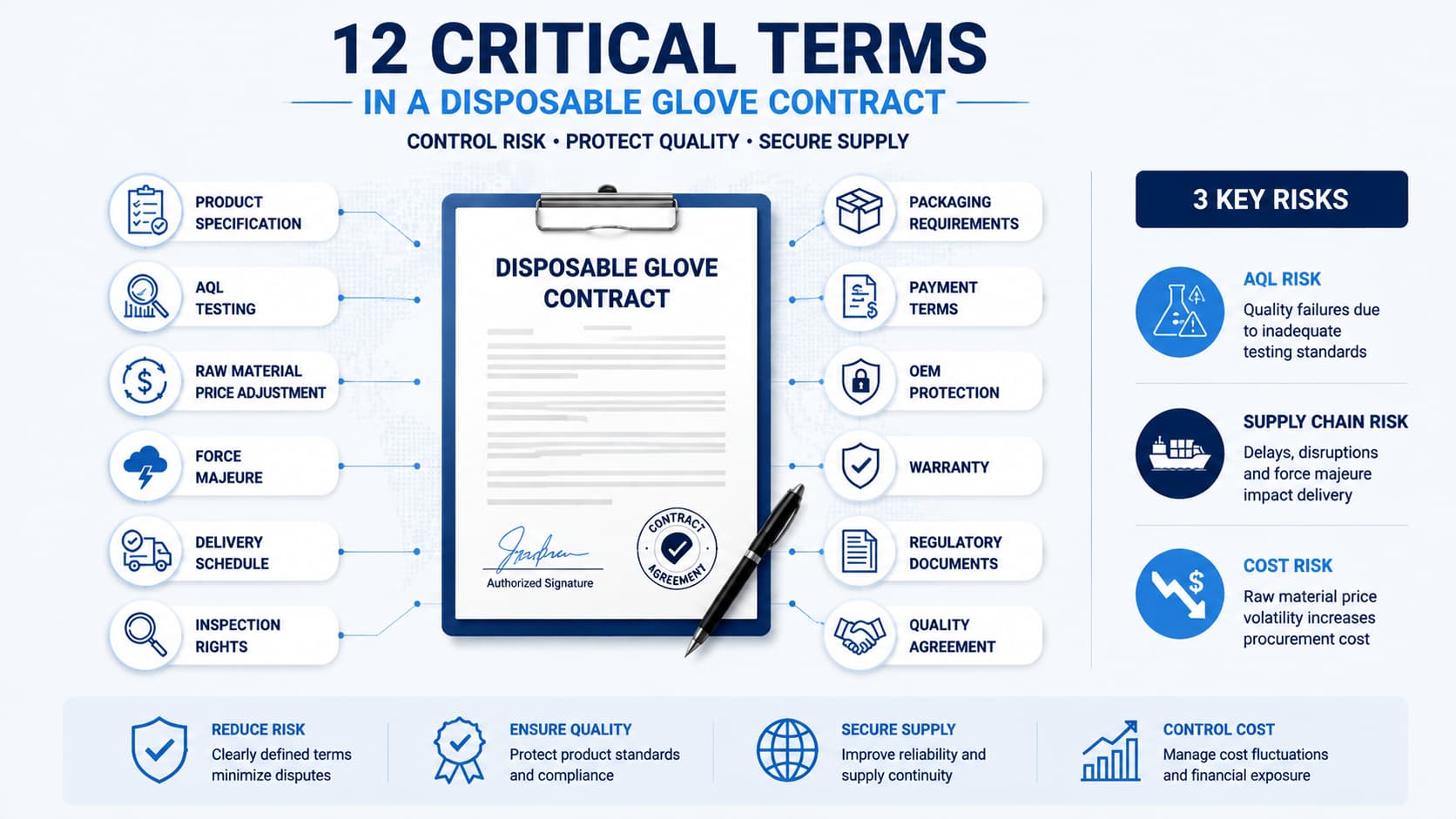
| # | Contract Term | What to Negotiate | Why It Matters in 2026 |
|---|---|---|---|
| 1 | Product specification | Material, thickness (mil/mm), AQL, size range, standards (EN 455 / EN 374) | Prevents substitution of lower-grade product; ensures regulatory compliance |
| 2 | AQL and batch testing | Require batch-level AQL test reports (not blanket CoC); specify AQL 1.5 for medical | Ensures quality consistency; protects against defective batches |
| 3 | Raw material price adjustment | Tie price to published feedstock index (ICIS butadiene/ACN); set +/- 10% threshold and 15% cap | Protects both buyer and supplier during butadiene/acrylonitrile volatility |
| 4 | Force majeure definition | List specific qualifying events (war, Hormuz closure, port strike, pandemic); define remedies | 2026 Hormuz tensions make vague force majeure clauses dangerous |
| 5 | Delivery schedule and penalties | Specify delivery windows, late-delivery penalties (e.g., 0.5% per week) | Holds supplier accountable; compensates for supply chain disruption |
| 6 | Pre-shipment inspection rights | Buyer or third-party inspection before loading; reject non-conforming batches | Prevents receiving defective goods; critical for medical-grade product |
| 7 | Packaging and labeling | Specify carton specs, inner pack count, language labeling, CE/FDA marks | Ensures compliance with destination market requirements |
| 8 | Payment terms | 30% advance / 70% against BL, or L/C at sight; tie final payment to inspection | Balances risk; protects against paying for non-conforming goods |
| 9 | Intellectual property and OEM | Define mold ownership, brand placement, non-competing clauses | Protects custom designs and brand identity |
| 10 | Warranty and defect return | Define defect rate threshold (e.g., > 2%), return process, replacement timeline | Ensures recourse for quality failures |
| 11 | Regulatory documentation | Require TDS, CoC, ISO 13485 certificate, test reports with each shipment | Essential for EU MDR, FDA, GSO compliance audits |
| 12 | Termination and exit | Define termination for cause, notice period, transition assistance | Allows orderly exit if supplier fails or market shifts |
In 2026, butadiene and acrylonitrile prices have been volatile due to crude oil market fluctuations and supply-side disruptions. A well-structured price adjustment clause protects both parties:
The Strait of Hormuz situation in 2026 has made force majeure clauses especially important. A vague clause that says "acts of God or government" is insufficient. Specify:
| Document | Purpose | Required For |
|---|---|---|
| Technical Data Sheet (TDS) | Material specs, thickness, standards, test results | All shipments |
| Certificate of Conformity (CoC) | Batch-level compliance confirmation | All shipments |
| ISO 13485 certificate | Quality management system verification | Medical gloves (annual) |
| AQL test report | Batch quality sampling results | Medical gloves (per batch) |
| EN 455 / ASTM D6319 test report | Standard-specific compliance | Medical gloves |
| EN 374 test report | Chemical permeation classification | Industrial/chemical gloves |
| Bill of lading | Shipping and title document | All international shipments |
Q: What is a force majeure clause and why does it matter for glove procurement?
A: A force majeure clause defines events (war, natural disasters, shipping lane closures) that excuse a supplier from fulfilling contractual obligations. In 2026, with Strait of Hormuz tensions affecting shipping, a well-drafted force majeure clause protects buyers by defining exactly which events qualify and what remedies (price hold, delayed delivery, cancellation) apply.
Q: Should I lock in a fixed price or use a price adjustment formula?
A: For nitrile rubber and PVC gloves, where butadiene and acrylonitrile feedstock prices are volatile, a price adjustment formula linked to a published feedstock index (e.g., ICIS butadiene CFR China) is often fairer than a rigid fixed price. For short-term contracts under 3 months, a fixed price may be acceptable if the supplier absorbs modest volatility.
Q: What AQL should I specify in the contract?
A: For medical examination gloves, specify AQL 1.5 (EN 455-1, ISO 2859-1). For surgical gloves, specify AQL 0.65. For industrial gloves, AQL 2.5 or 4.0 may be acceptable. The contract should require the supplier to provide batch-level AQL test reports, not just a blanket CoC claim.
Q: How do I protect against raw material price spikes during a long-term contract?
A: Include a raw material escalation clause that allows price adjustment only when feedstock (butadiene, acrylonitrile, PVC resin) moves beyond a defined band (e.g., +/- 10%). Require the supplier to provide third-party price references (ICIS, Platts, SunSirs). Cap the maximum adjustment at a reasonable percentage (e.g., 15%) to prevent runaway costs.
Q: What payment terms are standard for international glove procurement?
A: Common terms include 30% advance payment with 70% against bill of lading, or a letter of credit (L/C) at sight. For established relationships, net 30-60 days after delivery may be negotiated. Always tie final payment to satisfactory pre-shipment inspection results, not just shipping documents.
Please read on, stay posted, subscribe, and we welcome you to tell us what you think.


Copyright 2026@ Fujian Jixiang E-commerce Co., Ltd All Rights Reserved.
Sitemap |
Blog
|
Xml |
Privacy Policy
 Network Supported