
welcome to Jixiang E-commerce!
welcome to Jixiang E-commerce!
Medical and industrial nitrile gloves look similar but follow different standards. Learn the EN 455 vs EN 374 divide, thickness and dexterity trade-offs, and 2026 raw material cost implications.
Medical and industrial nitrile gloves may look nearly identical on a store shelf, but they are manufactured, tested, and certified under entirely different regulatory frameworks. Medical nitrile gloves must meet patient-safety standards (EN 455, ASTM D6319), while industrial nitrile gloves are governed by chemical-protection standards (EN ISO 21420, EN 374). Choosing the wrong category is not just a procurement error - it can be a regulatory violation. This guide breaks down the certification divide, thickness and dexterity trade-offs, raw material cost dynamics, and procurement decision criteria for 2026.
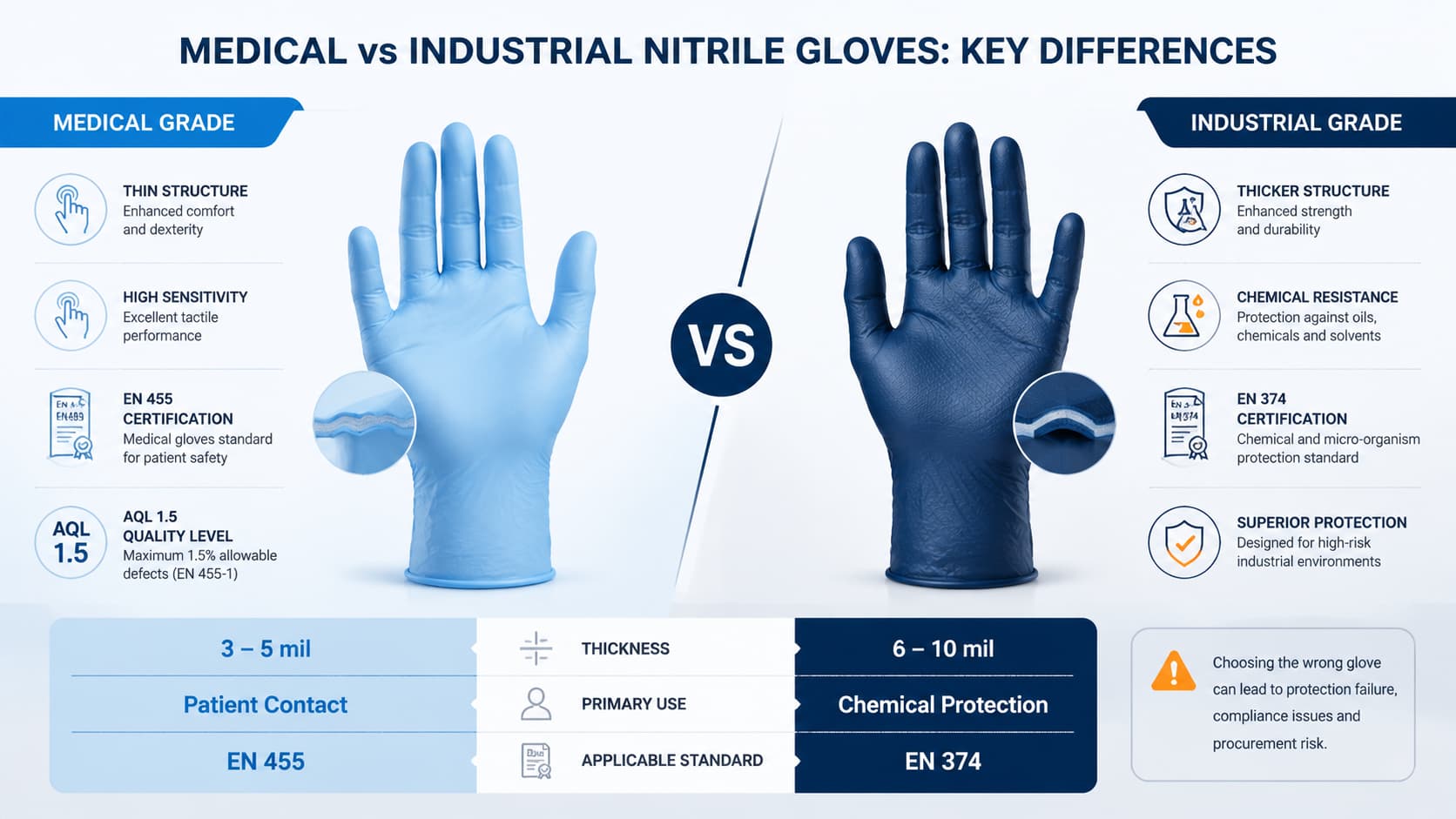
The fundamental distinction between medical and industrial nitrile gloves is the regulatory regime under which they are certified. Medical examination and surgical gloves are classified as medical devices. In the EU, they fall under the Medical Device Regulation (MDR 2017/745) and must comply with the EN 455 series. In the US, they require FDA 510(k) clearance and compliance with ASTM D6319 (nitrile examination gloves).
Industrial nitrile gloves, by contrast, are personal protective equipment (PPE). In the EU, they are regulated under the PPE Regulation (EU) 2016/425 and must comply with EN ISO 21420 (formerly EN 420) for general requirements and EN 374 for chemical protection. They are never tested for patient safety, biocompatibility, or sterility.
| Factor | Medical Nitrile Gloves | Industrial Nitrile Gloves |
|---|---|---|
| EU regulation | MDR 2017/745 (medical device) | PPE Regulation (EU) 2016/425 |
| Key standards | EN 455-1/2/3/4 | EN ISO 21420 + EN 374 |
| US standard | ASTM D6319, FDA 510(k) | ANSI/ISEA 105 (cut/chemical) |
| AQL requirement | 1.5 (exam) / 0.65 (surgical) | 2.5 or 4.0 typical |
| Biocompatibility | ISO 10993 required | Not required |
| Sterility option | Yes (gamma or EtO) | No |
| Intended user | Healthcare workers, patients | Industrial, laboratory, food workers |
Thickness is one of the most visible differences between the two categories. Medical examination gloves are typically 3-5 mil (0.076-0.127 mm) thick, prioritizing tactile sensitivity and dexterity. Surgical gloves may be even thinner. Industrial nitrile gloves commonly range from 6 to 10 mil (0.152-0.254 mm) or more, prioritizing puncture resistance and chemical breakthrough time over touch sensitivity.
The EN ISO 21420 dexterity scale rates performance from 1 to 5, where 5 is the highest dexterity (thinnest material). Medical exam gloves typically achieve level 4-5, while industrial gloves often rate level 1-3. This is a deliberate design trade-off, not a quality difference.
| Thickness (mil) | Typical Category | Dexterity Level (1-5) | Primary Use |
|---|---|---|---|
| 3-4 mil | Medical exam | 5 | Patient examination, nursing |
| 4-5 mil | Medical exam / light industrial | 4-5 | General medical, food handling |
| 5-6 mil | Medical / industrial crossover | 3-4 | Chemotherapy, dual-certified |
| 6-8 mil | Industrial | 2-3 | Mechanical, automotive, janitorial |
| 8-10+ mil | Industrial heavy-duty | 1-2 | Chemical handling, sharp hazards |
Both medical and industrial nitrile gloves are made from nitrile rubber, also known as NBR (nitrile butadiene rubber) or Buna-N. This synthetic rubber is produced by copolymerizing acrylonitrile (ACN) and butadiene. The ACN content typically ranges from 28% to 33% for glove-grade compounds, balancing oil resistance (higher ACN) with flexibility (lower ACN).
Medical-grade compounds use higher-purity nitrile rubber with stricter controls on residual monomers, extractables, and accelerators (for Type IV allergy management). Industrial compounds may use broader-specification nitrile rubber with more filler content, which reduces cost but may affect tensile consistency.
The two primary feedstocks for nitrile rubber are butadiene and acrylonitrile. In 2026, both have experienced significant price volatility driven by geopolitical factors:
Because industrial gloves use more material per unit (thicker construction), they carry a larger absolute raw-material cost per glove. However, medical-grade compounds command a price premium for purity and quality control. When feedstock prices spike, both categories face margin pressure, but the pass-through timing differs: industrial contracts often have faster price-adjustment clauses, while medical contracts may be locked longer due to tender cycles.
Q: Can industrial nitrile gloves be used for medical examinations?
A: No. Industrial nitrile gloves are not certified under EN 455 or ASTM D6319 and cannot be legally marketed or used as medical examination gloves. They lack the biological safety evaluation, AQL 1.5 water-leak testing, and regulatory clearance required for patient contact. Using industrial gloves in a medical setting is a regulatory violation.
Q: What is the main certification difference between medical and industrial nitrile gloves?
A: Medical nitrile gloves must comply with EN 455 series (EU MDR) or ASTM D6319 (US FDA 510(k)), including AQL 1.5 sampling, biocompatibility testing per ISO 10993, and sterility claims where applicable. Industrial nitrile gloves comply with EN ISO 21420 (formerly EN 420) and EN 374 for chemical protection under the PPE Regulation (EU) 2016/425, with no patient-safety requirements.
Q: Why are industrial nitrile gloves often thicker than medical ones?
A: Industrial applications involve sharper hazards, chemical exposure, and longer wear times, so industrial gloves are typically 6-10 mil thick for puncture and chemical resistance. Medical exam gloves are usually 3-5 mil to preserve dexterity (rated 1-5 on the EN ISO 21420 scale) and tactile sensitivity needed for clinical procedures.
Q: Does raw material cost affect medical and industrial gloves differently?
A: Yes. Medical-grade nitrile rubber requires higher-purity acrylonitrile butadiene rubber compounds and stricter quality control, which adds cost. However, industrial gloves use more material per unit (thicker). When butadiene prices rise (as in the 2026 Hormuz-driven cycle), both categories face cost pressure, but industrial gloves carry a larger raw-material weight per unit.
Q: Can a single glove carry both medical and industrial certification?
A: Yes. Some premium nitrile rubber gloves carry dual certification: EN 455 (medical) and EN 374 Type A/B/C (chemical). These are common in chemotherapy and emergency response settings. Buyers should verify both standards are listed on the Technical Data Sheet and Certificate of Conformity.
Please read on, stay posted, subscribe, and we welcome you to tell us what you think.


Copyright 2026@ Fujian Jixiang E-commerce Co., Ltd All Rights Reserved.
Sitemap |
Blog
|
Xml |
Privacy Policy
 Network Supported