welcome to Jixiang E-commerce!

Search

Home

PVC gloves

  • How to Choose the Right Disposable Gloves for Your Industry
    How to Choose the Right Disposable Gloves for Your Industry
    Mar 13, 2026
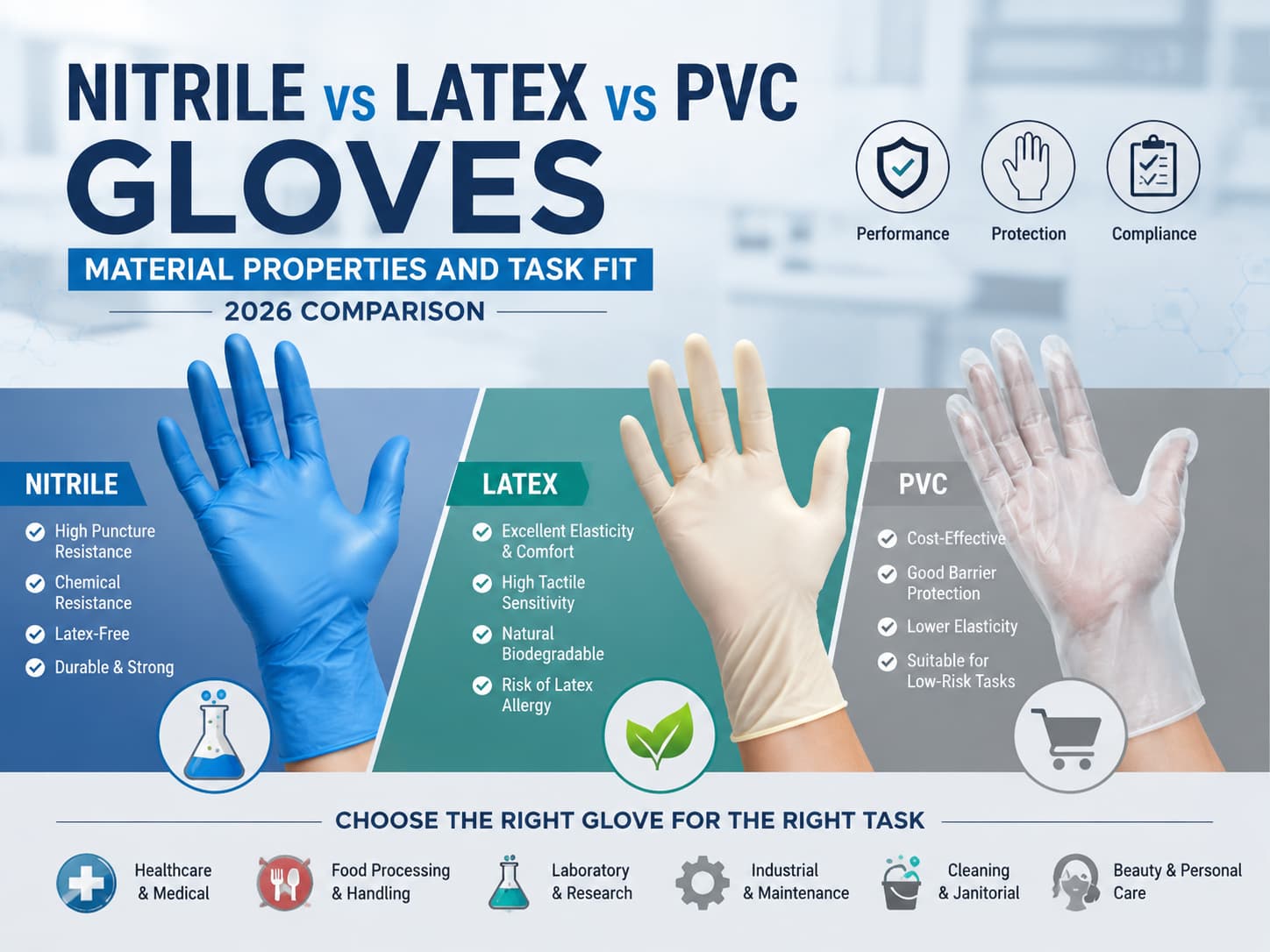
      How to Choose the Right Disposable Gloves for Your Industry Choosing the perfect disposable gloves can be challenging. This guide will help you select the right gloves for healthcare, food service, industrial, and laboratory applications. Introduction Disposable gloves are essential protective equipment across numerous industries, from healthcare facilities to manufacturing plants. However, not all gloves are created equal. Selecting the wrong type can lead to safety hazards, allergic reactions, or unnecessary costs.   With over 20 years of experience in the disposable glove industry, we've helped thousands of businesses find the perfect glove solutions. In this guide, we'll break down everything you need to know to make an informed decision. Understanding the Three Main Types of Disposable Gloves 1. Nitrile Gloves   Best for: Healthcare, automotive, chemical handling, laboratories Key Benefits: ✅ Superior chemical resistance ✅ Puncture-resistant (3x stronger than latex) ✅ Latex-free (no allergy concerns) ✅ Excellent grip in wet conditions ✅ Long shelf life Ideal Applications: Medical examinations Chemical handling Automotive repair Laboratory work Tattoo and piercing Why Choose Nitrile? Nitrile gloves are the gold standard for industries requiring durability and chemical protection. Made from synthetic rubber, they offer the best puncture resistance among disposable gloves. Pro Tip: For extended wear, choose thicker nitrile gloves (6-8 mil) for industrial applications, and thinner options (3-5 mil) for medical examinations. 2. Latex Gloves   Best for: Medical/surgical procedures, dental, laboratory Key Benefits: ✅ Superior fit and comfort ✅ Excellent tactile sensitivity ✅ Biodegradable (eco-friendly) ✅ Cost-effective ✅ Elastic and form-fitting Ideal Applications: Surgical procedures Dental examinations Laboratory work Cleaning and sanitation Important Note: Approximately 1-6% of the population has latex allergies. Always offer latex-free alternatives in healthcare settings. 3. PVC (Vinyl) Gloves   Best for: Food service, cleaning, light industrial work Key Benefits: ✅ Most affordable option ✅ Latex-free and powder-free ✅ Loose fit for easy on/off ✅ Good for short-term use ✅ Suitable for food handling Ideal Applications: Food preparation and handling Cleaning and janitorial work Hair salons Light industrial tasks Did You Know? The FDA requires food handlers to use gloves when preparing ready-to-eat foods to prevent bacterial contamination. Industry-Specific Recommendations Healthcare & Medical Recommended: Nitrile or Latex (powder-free) Why: Medical-grade protection required High puncture resistance essential Powder-free prevents contamination Thickness: 4-6 mil Standards: ASTM D6319 (nitrile), ASTM D3578 (latex) Food Service & Processing Recommended: PVC or Nitrile Why: FDA-approved for food contact Cost-effective for frequent changes Safe for all food types Thickness: 3-5 mil Standards: FDA 21 CFR 177.2600 Pro Tip: Blue nitrile gloves are preferred in food processing—they're easily visible if a piece falls into food. Automotive & Industrial Recommended: Heavy-duty Nitrile (6-8 mil) Why: Oil and chemical resistance Superior puncture protection Enhanced grip for tools Thickness: 6-8 mil Standards: EN 374 (chemical resistance) Laboratory & Research Recommended: Chemical-resistant Nitrile Why: Chemical splash protection Contamination prevention Powder-free essential Thickness: 5-8 mil Standards: ASTM D6319, EN 374, EN 455 5 Key Factors to Consider When Choosing Gloves 1. Material Allergies Always offer latex-free options Nitrile is safe for latex-sensitive individuals 2. Chemical Exposure Check chemical compatibility charts Nitrile: Excellent for oils, solvents, chemicals 3. Duration of Use Short tasks (<30 min): PVC or thin nitrile Extended wear (>1 hour): Thicker nitrile 4. Fit and Comfort Proper sizing prevents hand fatigue Latex offers best fit 5. Cost Considerations Material Cost per Pair Durability Best Value PVC $0.03-0.08 Low High volume, short use Latex $0.05-0.12 Medium Medical, surgical Nitrile $0.08-0.20 High Industrial, long use   Glove Sizing Guide   Size Palm Width (mm) Hand Length (mm) XS 60-75 150-160 S 70-85 160-170 M 80-95 170-180 L 90-105 180-190 XL 100-115 190-200 How to Measure: Measure around your dominant hand at the widest point Measure from the tip of your middle finger to your wrist Use the larger measurement to determine size Quality Standards to Look For Medical Gloves: FDA 510(k) Clearance (USA) CE Marking (Europe) ISO 13485 (Quality Management) ASTM D6319 (Nitrile) / ASTM D3578 (Latex) Industrial Gloves: EN 374 (Chemical Resistance) EN 388 (Mechanical Risks) Food Gloves: FDA 21 CFR 177.2600 (Food Contact) Common Mistakes to Avoid ❌ Using latex gloves with oil-based products ❌ Reusing disposable gloves ❌ Choosing wrong size ❌ Ignoring chemical compatibility ❌ Storing gloves in direct sunlight Conclusion Selecting the right disposable gloves is crucial for safety, comfort, and cost-efficiency. Quick Summary: Healthcare: Nitrile or Latex (medical-grade) Food Service: PVC or Nitrile (FDA-approved) Industrial: Heavy-duty Nitrile (6-8 mil) Laboratory: Chemical-resistant Nitrile "Request Free Quote" About Fujian Jixiang E-commerce Co., Ltd. With over 20 years of experience, we specialize in manufacturing high-quality disposable gloves. Why Choose Us? ✅ Factory-direct pricing ✅ ISO/CE/FDA certified products ✅ OEM/ODM customization ✅ Global shipping to 50+ countries Contact Us:info@jxgloves.com
  • SEO Blog: PVC (Vinyl) Gloves in 2026: Phthalate Restrictions, Cost Curves & Replacement Strategy
    SEO Blog: PVC (Vinyl) Gloves in 2026: Phthalate Restrictions, Cost Curves & Replacement Strategy
    Jul 20, 2026
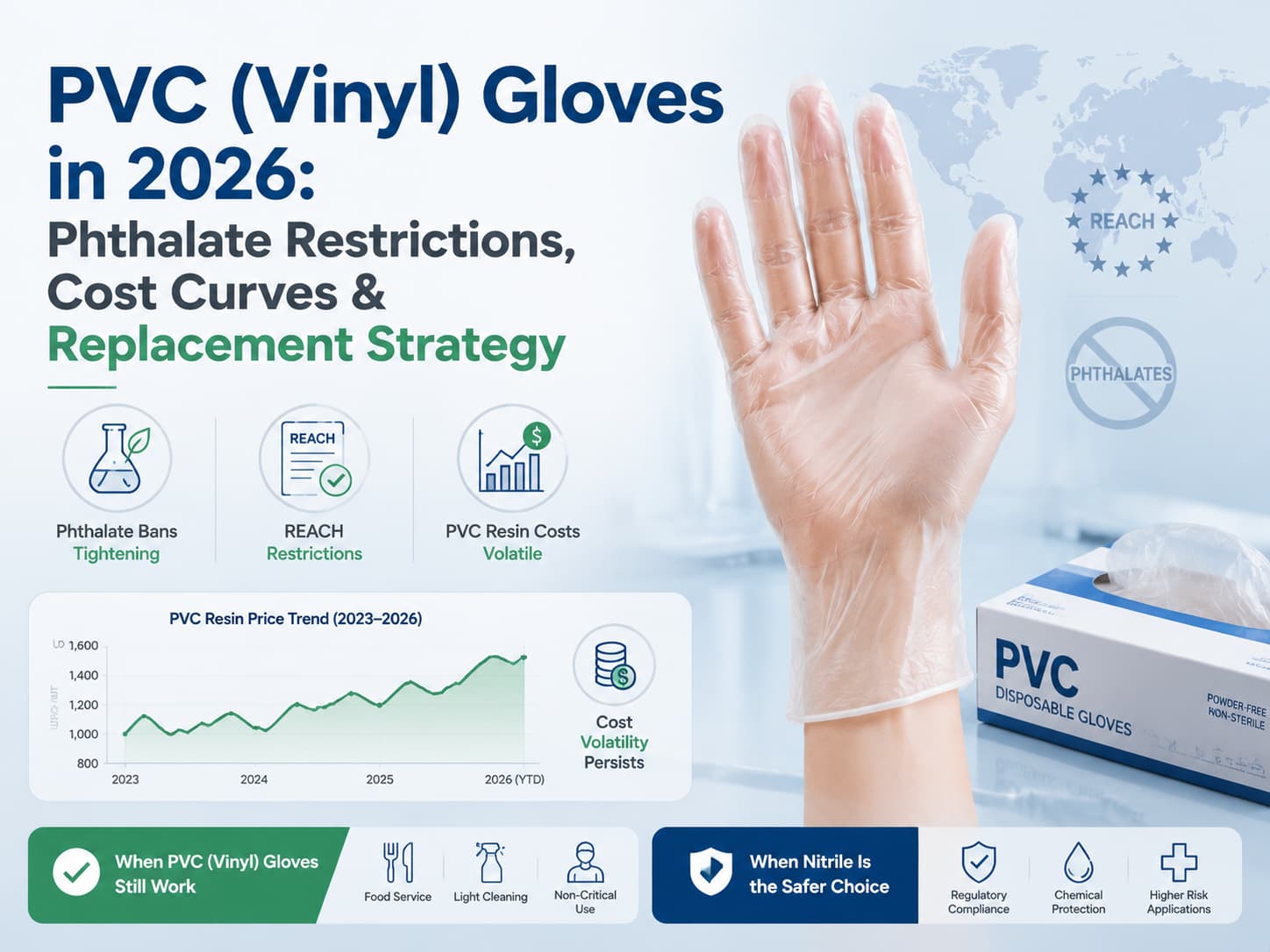
    PVC (vinyl) gloves still account for roughly 25-30% of the global disposable glove market by volume, but 2026 is turning into a difficult year for buyers who rely on vinyl as a low-cost option. New phthalate restrictions, REACH enforcement, and volatile PVC resin prices driven by crude oil are reshaping the total cost of ownership. This guide explains the current regulatory landscape, the raw-material economics, and when nitrile rubber is the better long-term choice. 1. What Are PVC (Vinyl) Gloves? PVC gloves are made from polyvinyl chloride, a thermoplastic polymer produced from vinyl chloride monomer. In disposable glove form, PVC is usually plasticized with phthalates or alternative plasticizers to make it flexible. They are popular in food service, light cleaning, and non-critical medical exams because they are generally cheaper than nitrile or latex and do not contain natural rubber latex proteins. 2. Why PVC Gloves Are Under Pressure in 2026 Three forces are squeezing the PVC glove market this year: Regulatory: The EU REACH Annex XVII restriction on DEHP, DBP, BBP, and DIBP in plasticized materials is already in force; many phthalate alternatives are now under scrutiny. Environmental: PVC is less recyclable than nitrile rubber in many waste streams, and ESG procurement policies are moving buyers toward alternatives. Economic: PVC resin is derived from chlorine and ethylene, which is linked to crude oil and natural gas feedstock prices. Brent crude above $95/bbl and the ongoing Strait of Hormuz uncertainty have kept PVC resin costs elevated. 3. Phthalate Restrictions by Market Region Applicable Regulation Key Restricted Substances Impact on PVC Gloves EU REACH Annex XVII + SVHC list DEHP, DBP, BBP, DIBP, DPHP under review Phthalate-plasticized vinyl gloves restricted in childcare, toys, and increasingly in medical/food contact USA FDA 21 CFR 177.2600 + state laws (e.g., California Prop 65) DEHP, DINP, DIDP depending on application Food-contact PVC gloves must use allowed plasticizers; migration limits apply GCC GSO 4872 / SASO technical regulations Phthalates limited in consumer products Medical and food-grade PVC gloves require CoC and plasticizer declaration China GB standards + food contact GB 4806 series Authorized plasticizer list with migration limits Domestic sale must comply with positive-list plasticizer requirements Sources: EU REACH Annex XVII, FDA 21 CFR 177.2600, GSO 4872, GB 4806.7-2016. Data current as of July 2026. 4. Raw Material Cost Curve: PVC Resin vs Nitrile Rubber Raw Material Q3 2026 Reference Range Cost Driver Glove Impact Brent crude $96-99 / bbl Strait of Hormuz supply-risk premium Pushes ethylene, acrylonitrile, and energy costs higher Butadiene (CFR China) $1,520-1,580 / MT C4 feedstock tightness + oil-linked naphtha Main driver of nitrile rubber cost Acrylonitrile (CFR China) $1,420-1,480 / MT Propylene-ammonia route Determines nitrile rubber barrier quality PVC resin (SG-5, China ex-works) $920-980 / MT Ethylene + chlorine + electricity Directly affects vinyl glove cost base DOP/DEHP plasticizers $1,050-1,150 / MT Phthalate raw material + regulation Phthalate-free alternatives often cost 10-20% more PVC resin and nitrile rubber are both linked to oil and gas derivatives, but their cost drivers differ. PVC depends on ethylene and chlorine; nitrile rubber depends on butadiene and acrylonitrile. In Q3 2026, the spreads are tightening because PVC resin is also being pushed up by higher chlorine and energy costs. Sources: ICIS, Platts, S&P Global Commodity Insights, July 2026 spot assessments. Ranges are indicative and subject to daily volatility. 5. When to Use PVC, When to Switch to Nitrile 6. 2026 Procurement Checklist for PVC Gloves Request plasticizer declaration: identify DEHP, DBP, BBP, DIBP, DINP, and any replacement plasticizers. Verify food-contact compliance: FDA 21 CFR 177.2600, EU 10/2011, or GB 4806 positive-list status. Check migration test reports for overall migration and specific phthalate migration. Confirm tensile strength and elongation meet ASTM D5250 (medical) or EN 455-2 (if medical claim). Ask for AQL level: 1.5 for general purpose, 0.65 for medical-grade claims. Compare total cost of ownership: include disposal, defect rate, and potential regulatory recall risk. 7. FAQ Q: Are PVC gloves banned in the EU? A: No, PVC gloves are not banned outright, but many phthalate plasticizers used in PVC are restricted under REACH Annex XVII. Food-contact and childcare applications face the strictest limits. Q: Can PVC gloves be used for food handling? A: Yes, if the plasticizer is on the positive list for food-contact materials and migration limits are met. In the EU, compliance with Regulation (EC) No 10/2011 is required. Q: Why are PVC glove prices rising in 2026? A: PVC resin prices are linked to ethylene and chlorine costs, both of which are influenced by oil and gas prices. The Strait of Hormuz uncertainty has added a risk premium to energy and freight. Q: Are nitrile gloves always better than PVC? A: Not always. Nitrile has better chemical and puncture resistance, but PVC can be cost-effective for short-duration, low-risk tasks with no chemical exposure. Q: What does "phthalate-free" PVC mean? A: It means the glove does not contain restricted phthalates such as DEHP, DBP, BBP, or DIBP. Buyers should still request a full plasticizer declaration because alternative plasticizers may have their own regulatory limits.

  • Q3 2026 Raw Material Cost Tracker for Disposable Gloves
    Q3 2026 Raw Material Cost Tracker for Disposable Gloves
    Jul 24, 2026
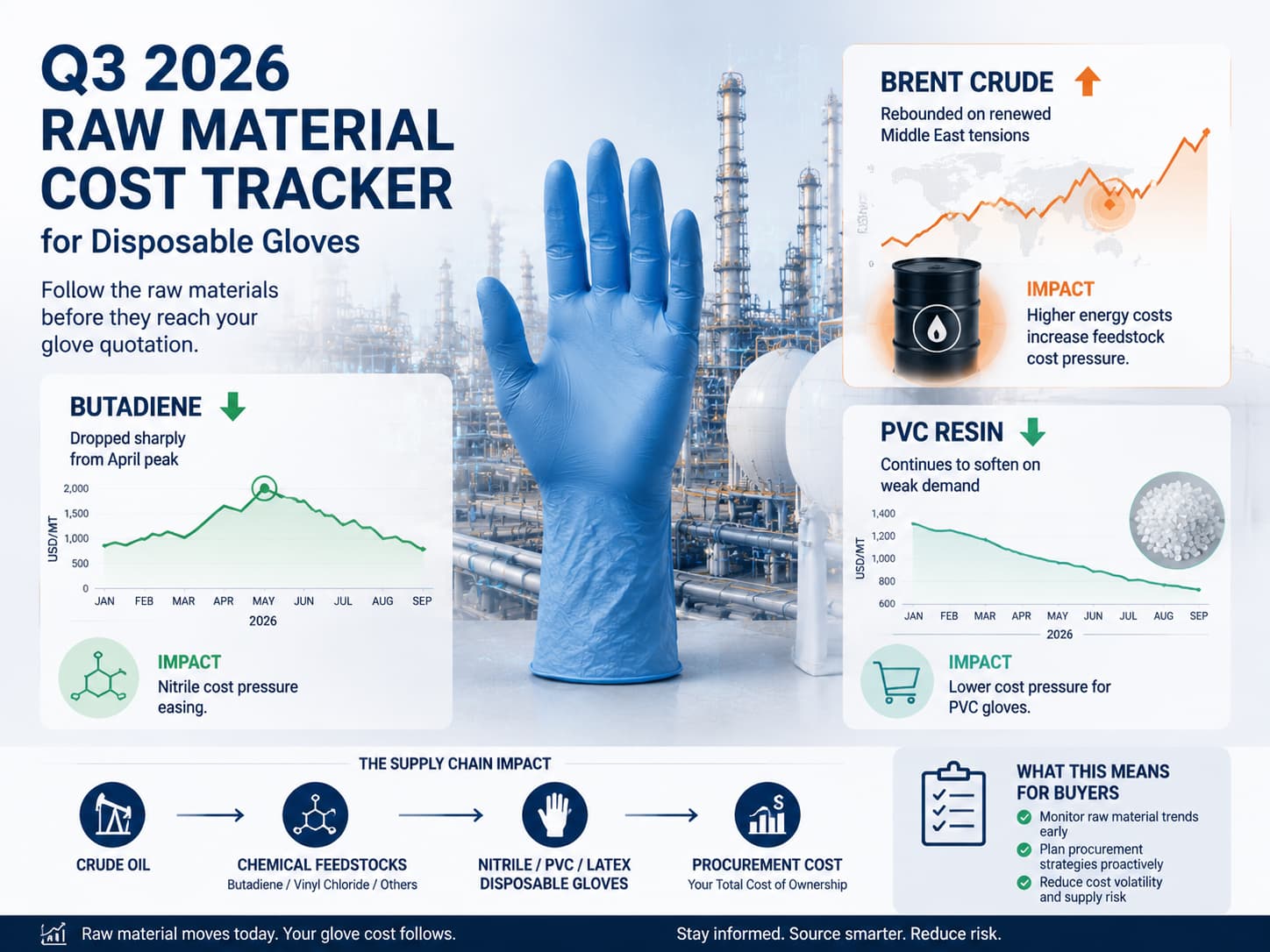
    In Q3 2026, the raw material basket for disposable gloves shows mixed trends: butadiene has dropped sharply from its April peak, Brent crude has rebounded on renewed Middle East tensions, and PVC resin continues to soften on weak demand. This tracker summarizes the key feedstock prices and their impact on nitrile, PVC, and latex gloves. 1. Cost Drivers This Quarter Brent crude is trading around $83-85/bbl (mid-July 2026, EIA), rebounding from early-July lows near $73/bbl as US-Iran tensions re-escalate and Strait of Hormuz disruptions persist. Butadiene has dropped approximately 30% from its April peak of ~$1,760/MT CFR China, but rebounded 18% within July on crude oil strength and cracker maintenance. Current CFR China: ~$1,230/MT (Echemi, Jul 15). Acrylonitrile prices are stable to slightly softer, with Chinese domestic prices around 9,400-10,500 RMB/MT (~$1,300-1,460/MT), as new capacity offsets feedstock cost increases. PVC resin continues to soften on weak downstream demand, with SG-5 prices around 4,100-5,000 RMB/MT (~$600-750/MT). The cost gap with nitrile rubber has widened, not narrowed. Ocean freight from Asia to Europe and the Middle East has stabilized but remains above pre-2024 levels. 2. Q3 2026 Raw Material Snapshot Material Price Range (Jul 2026) Change vs Q2 2026 Main Glove Application Brent crude $83-85 / bbl +5% to +10% (vs Jun avg) Feedstock for all petrochemical derivatives Butadiene (CFR China) $1,100-1,230 / MT -30% to -35% (vs Apr peak) Nitrile rubber Acrylonitrile (CFR China) $1,300-1,460 / MT -5% to -10% Nitrile rubber PVC resin (SG-5) $600-750 / MT -10% to -15% PVC / vinyl gloves Natural rubber latex (TSR20) $1,380-1,440 / MT -1% to +1% Latex gloves DOP/DEHP plasticizers $1,050-1,150 / MT -5% to -8% PVC glove plasticizers Sources: EIA (Brent weekly, Jul 17), Echemi (butadiene CFR China, Jul 15), SCI99 / 生意社 (domestic butadiene, Jul 21), 生意社 (PVC SG-5, acrylonitrile, Jul 20-22). Data collected Jul 20-22, 2026. Ranges are spot-market assessments and may vary by region. 3. Regional Impact on Glove Buyers Region Primary Cost Pressure Buyer Action Europe High energy and PVC costs; REACH compliance adds testing cost Lock Q3-Q4 prices early; request phthalate-free declarations Middle East / GCC Freight and import dependency; GSO testing requirements Consolidate shipments; verify GSO registration and CoC Southeast Asia Butadiene and acrylonitrile supply tightness Diversify supplier base; consider nitrile inventory coverage North America FDA compliance and freight; PVC phthalate scrutiny Audit plasticizer declarations; evaluate nitrile alternatives 4. Forward Outlook for Q4 2026 The forward outlook depends on three variables: the stability of oil flows through the Strait of Hormuz, the restart schedule of Asian butadiene crackers, and the pace of winter chlorine demand. If crude stays above $80/bbl and butadiene supply remains constrained by cracker maintenance, nitrile glove prices may see modest upward pressure despite the broader downward trend from Q2 peaks. PVC glove prices will be increasingly constrained by plasticizer regulation rather than raw material cost alone. 5. FAQ Q: Why do disposable glove prices follow oil prices? A: Nitrile, PVC, and latex gloves all depend on petrochemical or natural rubber feedstocks. Oil prices affect monomer costs, energy, and freight. Q: Which glove material is most affected by oil volatility? A: PVC and nitrile rubber are both highly oil-linked. Latex is less directly tied to crude but is affected by fertilizer and transportation costs. Q: What is the biggest cost in nitrile glove production? A: Raw nitrile rubber compound, driven by butadiene and acrylonitrile, typically accounts for 40-50% of finished glove cost. Q: Are PVC gloves becoming cheaper than nitrile? A: In Q3 2026, PVC resin has softened while butadiene has dropped ~30% from its April peak. The cost gap between PVC and nitrile gloves has widened slightly. The choice is increasingly driven by regulatory requirements (phthalate restrictions) rather than raw material cost alone. Q: How should buyers manage raw material risk? A: Use firm quarterly pricing, diversify suppliers, request transparent CoCs, and maintain 6-8 weeks of safety stock for critical SKUs.
Contact Us
Unit 1301-1, No. 3, Xixishan Wei Road, Software Park phase III, Torch High-tech Zone,Xiamen City, Fujian Province, China
+86-592-6511055
+86 -15750719843
Subscribe

Copyright 2026@ Fujian Jixiang E-commerce Co., Ltd All Rights Reserved. Sitemap | Blog | Xml | Privacy Policy Network Supported

leave a message

Leave A Message
If you are interested in our products and want to know more details,please leave a message here,we will reply you as soon as we can.
Submit

Home

Products

whatsApp

contact