
Laboratory Knowledge
Laboratory Solvent Compatibility for Nitrile Gloves: Acetone, IPA, DMSO, Xylene and Dilute Acids - A Selection Map
Jixiang (Xiamen) Medical Technology Co., Ltd.
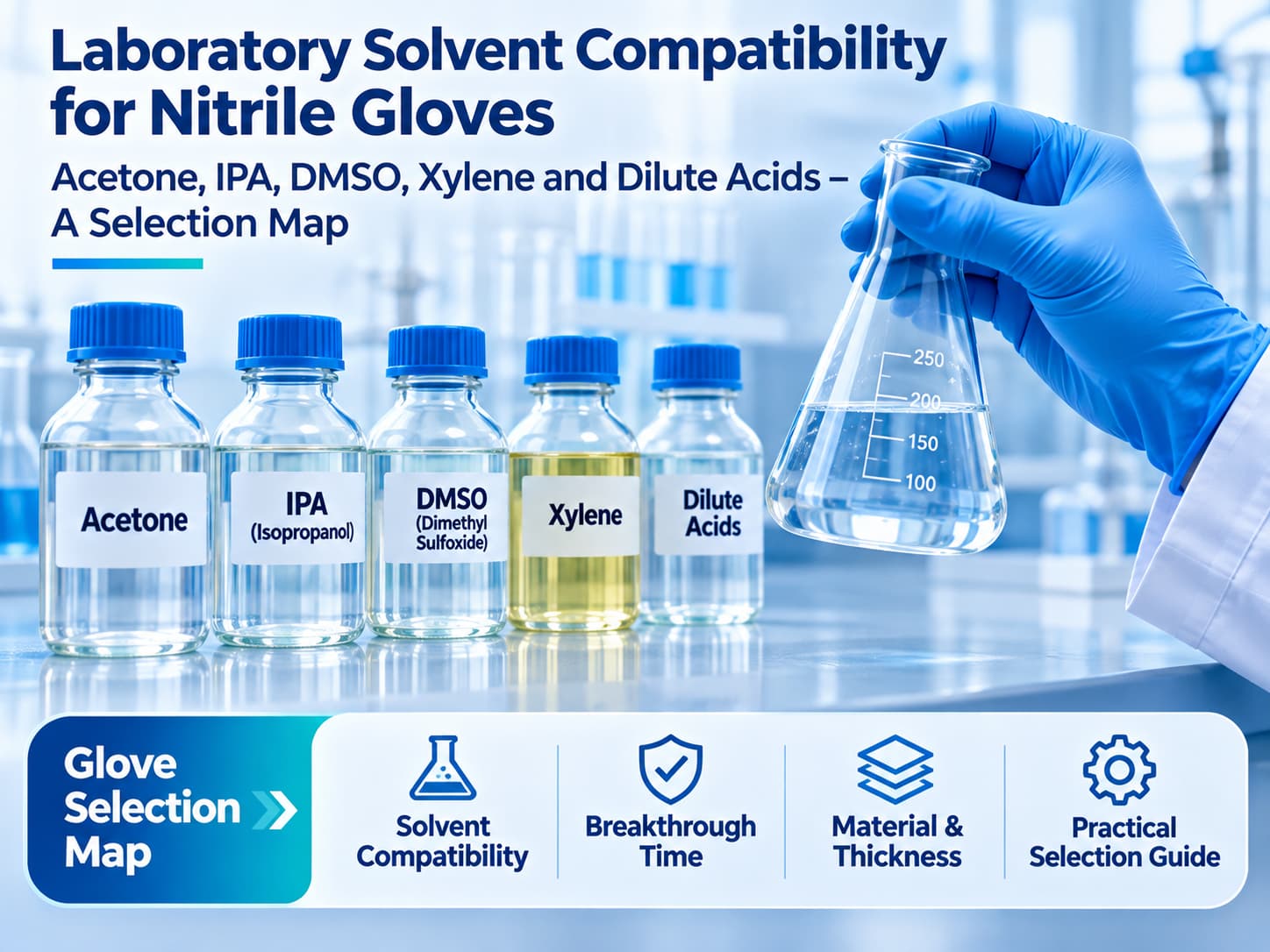
A disposable nitrile glove is a good short-term splash barrier for dilute aqueous acids, alkalis and alcohol-based disinfectants, but it is not a general-purpose solvent glove. Ketones such as acetone and aromatic hydrocarbons such as xylene can swell or degrade Nitrile Butadiene Rubber (NBR) film quickly, and DMSO is a known skin-penetration enhancer that makes any dissolved hazard more serious. Compatibility must be judged on the chemical, its concentration, contact time and the specific glove's EN ISO 374-1 data — never on the word "nitrile" alone.
Group by exposure, not by chemical name alone
Three exposure modes produce different decisions in the same laboratory:
- Incidental splash: a few drops, wiped off immediately, glove changed straight away. Many chemicals are tolerable in this mode.
- Short repeated contact: pipetting, wiping or handling a contaminated vessel over several minutes. Requires a permeation classification for that chemical.
- Immersion or prolonged wet work: a thin disposable examination glove is the wrong tool. Use a chemical protective glove selected under EN ISO 374-1 with a suitable performance level.
Breakthrough time measured in a laboratory test is not a wearable duration. It is the elapsed time until a chemical is detected permeating the film under controlled conditions; temperature, thickness, swelling and mixture effects shorten it in real use.
The selection map
Use this as a starting triage, then confirm against the exact glove's chemical resistance chart and lot-specific documentation.
- Isopropyl alcohol (IPA) and ethanol-based disinfectants: generally suitable for incidental splash and routine surface disinfection with a powder-free nitrile examination glove. Change after heavy wetting, and check the full disinfectant formulation, since additives and acids can behave differently from the pure alcohol.
- Dilute aqueous acids and alkalis (for example dilute hydrochloric acid or sodium hydroxide used in routine preparation): usually acceptable for brief splash contact. Concentration, temperature and contact time decide the limit; rinse off and change immediately after any spill.
- Acetone and other ketones: not suitable for more than momentary contact. Acetone can cause rapid swelling and loss of barrier integrity in Nitrile Butadiene Rubber (NBR) film. Where acetone wiping is routine, specify a glove with a documented permeation classification for the specific solvent or use a reusable chemical protective glove for that step.
- Xylene, toluene and other aromatic hydrocarbons: not suitable for thin disposable nitrile gloves in histology, clearing or staining workflows. These solvents attack the film and are often used in mixtures that permeate faster than any single component suggests.
- DMSO: treat as a double hazard. It is widely used to dissolve compounds and is also a skin-penetration enhancer. A standard examination glove should not be relied on for handling DMSO solutions containing toxic or pharmacologically active substances; seek a documented permeation rating and a defined change interval.
- Mixtures: the most common blind spot. A staining or extraction mixture can permeate faster than its individual components. Request mixture-specific guidance or run a conservative change rule.
Building a change rule your team will actually follow
Compatibility only works if the change routine is simple and observable:
- Post a short, chemical-specific list at the bench covering the solvents actually used in that room, not a generic chart.
- Set a default rule: any visible splash, any swelling, tackiness, discolouration or stiffening means change immediately, regardless of elapsed time.
- For short repeated contact with a rated chemical, set a conservative fixed interval well below the documented breakthrough time.
- Double-glove only where the outer glove is treated as a sacrificial, frequently changed layer — it is not a way to extend an unsuitable material's contact time.
- Record solvent, concentration, task duration and glove lot when an incident occurs, so the rule can be updated with evidence.
Keep the EN ISO 374-1 classification and EN 374-4 degradation data for the exact glove model in the lab's chemical file. A generic "chemical resistant" claim from a distributor is not a substitute.
FAQ
Q: Can I use nitrile gloves with acetone for a quick wipe?
A: Only for momentary incidental contact, with an immediate change. Acetone can rapidly swell Nitrile Butadiene Rubber (NBR) film, so routine acetone work needs a glove with documented permeation performance for that solvent.
Q: Is IPA safe with disposable nitrile gloves?
A: For routine disinfection splashes, generally yes, provided the full formulation is checked and heavily wetted gloves are changed. IPA is a very different case from acetone or xylene.
Q: Does a longer EN 374 breakthrough time mean I can wear the glove that long?
A: No. Breakthrough time is a controlled laboratory measurement of permeation onset. Real-world safe contact time is shorter and also depends on degradation, temperature, thickness and mixtures.
Source note: classification and terminology follow EN ISO 374-1, EN 374-2, EN 374-3 and EN 374-4 as published; laboratory practice described here is general guidance and does not replace a chemical-specific risk assessment or the glove manufacturer's resistance chart for the exact model and lot.