
Glove Technology
Nitrile Butadiene Rubber (NBR) Glove Compounds: How Acrylonitrile Content, Carboxylation and Crosslinking Define Barrier and Elasticity
Jixiang (Xiamen) Medical Technology Co., Ltd.
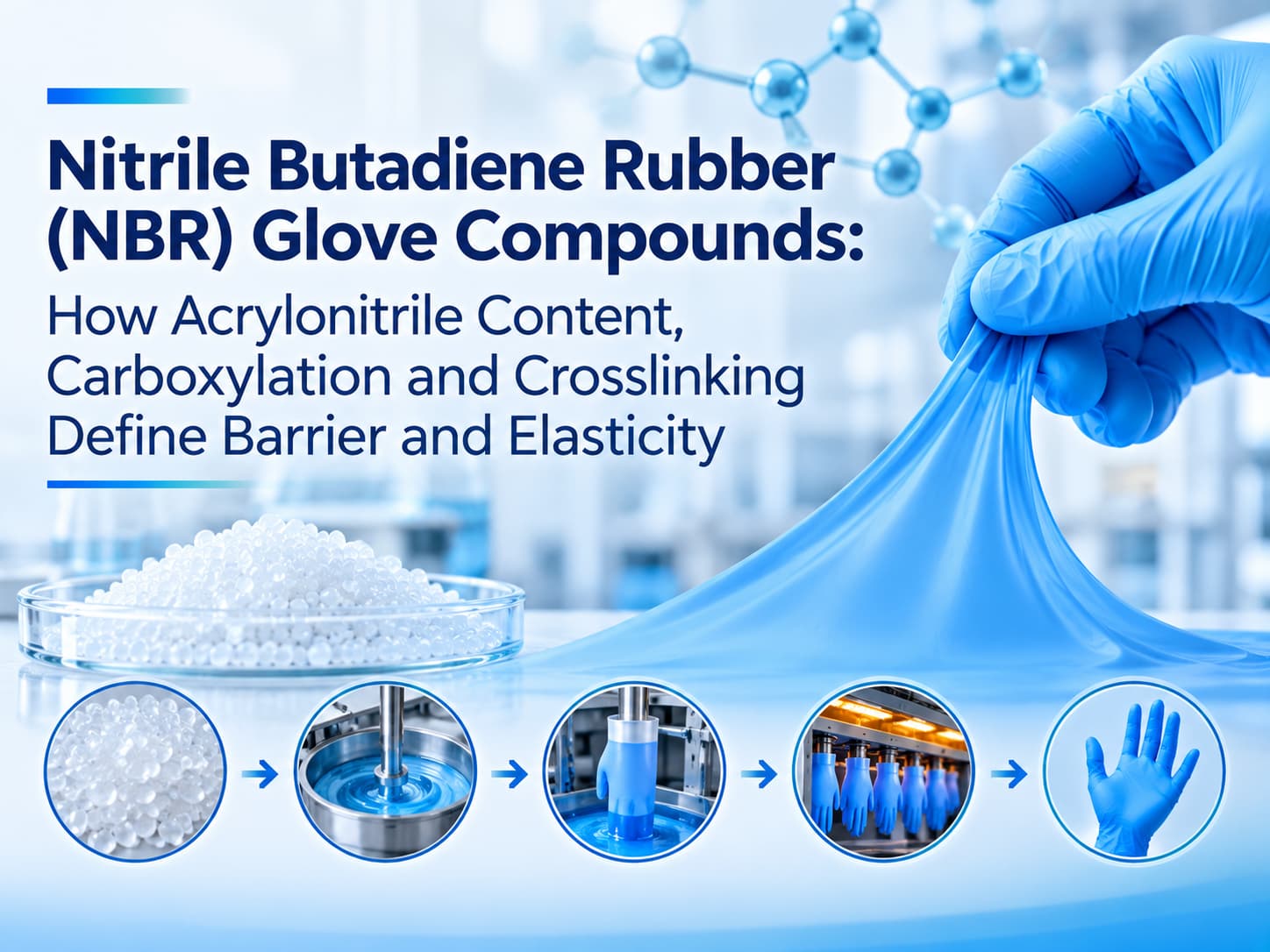
Nitrile Butadiene Rubber (NBR) is a copolymer of acrylonitrile and butadiene, and the balance between those two monomers is the single biggest lever on glove performance. More acrylonitrile improves resistance to oils, fuels and many solvents but raises the glass transition temperature, making the film stiffer and less comfortable in cold conditions. Carboxylated grades add a second, ionic crosslink network alongside the sulphur network, which is why a thin modern nitrile glove can be both strong and elastic. Understanding this chemistry turns a technical data sheet from a list of numbers into a set of predictable trade-offs.
The monomer ratio: chemical resistance versus flexibility
Acrylonitrile is polar. That polarity is what makes nitrile gloves resist hydrocarbon oils and many organic chemicals far better than natural rubber latex. Butadiene contributes the flexible, rubbery segments that let the film stretch and recover.
- Higher acrylonitrile content: better oil and fuel resistance, higher tensile strength, lower swelling in non-polar solvents, but higher stiffness and poorer low-temperature flexibility.
- Lower acrylonitrile content: softer, more elastic film with better dexterity and cold-chain comfort, but more swelling when exposed to oils and certain solvents.
- Practical consequence: a glove optimised for an automotive or oily-food task and one optimised for long clinical wear should not be specified by thickness alone. Two gloves of identical mil thickness can behave very differently in use.
Compound grades are usually proprietary, so buyers rarely see the exact ratio. What can be requested is a consistent grade across lots and a change-notification clause: a quiet switch in feedstock is one of the most common causes of a sudden "this batch feels different" complaint.
Carboxylation and the two crosslink networks
Most disposable nitrile gloves use carboxylated Nitrile Butadiene Rubber (XNBR), where carboxylic acid groups are grafted onto the polymer backbone. These groups allow two distinct crosslinking mechanisms to work together:
- Ionic crosslinks formed between carboxyl groups and metal oxides such as zinc oxide. These give high initial strength and modulus at low thickness.
- Covalent sulphur crosslinks formed during curing, often with accelerators. These contribute elasticity, recovery and heat-aging behaviour.
- Accelerator-free compounds remove the sulphur-accelerator chemistry associated with Type IV chemical allergy, relying on alternative crosslinking. They are a legitimate specification for sensitive-user environments, but the mechanical balance must be re-verified rather than assumed.
Compounding also includes pH control, surfactants, pigments, antifoam and fillers. Each addition is a potential source of extractables, which is why cleanroom and electronics buyers ask for ionic and particle data rather than relying on a generic "nitrile" description.
From compound dipped film: where the numbers come from
The aqueous compound is matured, then a ceramic or metal former is dipped in a calcium nitrate coagulant and into the compound. Leaching removes residual chemicals, curing develops the crosslink network, and a donning treatment is applied before stripping. What the buyer measures at the end is the downstream fingerprint of those steps:
- Tensile strength and elongation at break (EN 455-2, ASTM D6319, ISO 11193) reflect crosslink density and cure state. Over-curing raises strength but cuts elongation; under-curing leaves a tacky, weak film.
- Force at break after accelerated ageing reveals whether the network will survive the claimed shelf life.
- Pinhole AQL and water-leak test results reflect film uniformity, coagulant control and former cleanliness.
- Residual chemical and extractables data reflect leaching efficiency and post-treatment choice.
When two suppliers quote the same thickness and the same "blue nitrile" description, these four measurements are where the compound difference becomes visible.
What to put in a glove specification
Rather than asking a supplier to disclose a proprietary formula, specify the outcomes the formula must deliver:
- Material declared explicitly as Nitrile Butadiene Rubber (NBR), with the grade family fixed for the contract term and change notification in writing.
- Unaged and aged tensile and elongation values with test method, conditioning and report date.
- Whether the compound is accelerator-free, and evidence for the claim.
- Extractables, particle or ionic data where the glove enters a controlled environment.
- Consistency across three consecutive production lots before volume approval.
FAQ
Q: Is Nitrile Butadiene Rubber (NBR) the same as natural rubber latex?
A: No. NBR is a synthetic copolymer of acrylonitrile and butadiene and contains no natural rubber latex proteins. It is the standard material for powder-free disposable nitrile gloves and avoids Type I latex protein allergy risk.
Q: Does a higher acrylonitrile content always mean a better glove?
A: No. It improves oil and solvent resistance but reduces low-temperature flexibility and comfort. The right ratio depends on the task, not on a single maximum value.
Q: Why do two gloves with the same thickness tear differently?
A: Crosslink density, cure state, filler and compound grade all change tensile strength and elongation. Thickness measures geometry; it does not measure the polymer network.
Source note: polymer and compounding descriptions follow standard Nitrile Butadiene Rubber (NBR) and carboxylated NBR glove manufacturing literature; performance references follow EN 455-2, ASTM D6319 and ISO 11193 as published. Compound formulations are supplier-proprietary; buyers should verify claims against lot-specific test reports.