
Procurement Guides
Total Cost of Use for Disposable Gloves: A 2027 Budget Model for Distributors and Hospital Buyers
Jixiang (Xiamen) Medical Technology Co., Ltd.
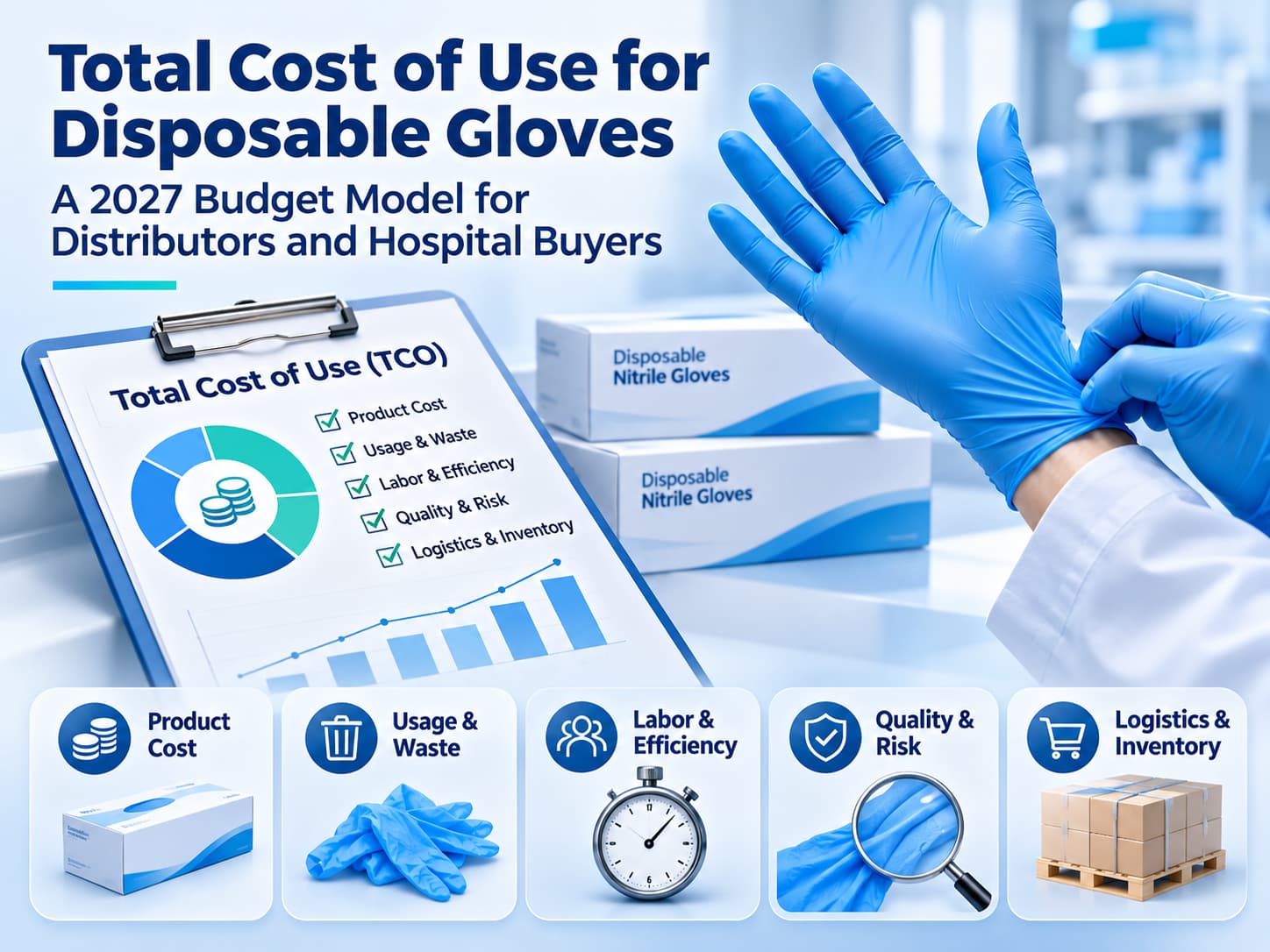
The price on a glove carton is not the cost of using that glove. Total cost of use divides every cost attached to a glove programme — landed purchase price, freight, duty, storage, expiry write-off, failure and the labour of changing gloves more often — by the number of tasks actually completed safely. A box that costs 8 percent less but fails twice as often is more expensive on almost every ward, production line and distribution ledger. A defensible 2027 budget starts with one formula and six measured inputs.
The formula
Use a single unit so comparisons stay honest: cost per protected task.
- Cost per protected task = total programme cost / number of tasks completed without a barrier failure.
- Total programme cost = purchase price + inbound freight and insurance + duty and clearance + warehousing and climate control + expiry write-off + failure cost + disposal.
- Failure cost = replacement gloves + re-work or repeated procedure + staff time + any incident documentation. In healthcare and food processing this term dominates, even when it is rarely booked against the glove budget.
The denominator is the part most tenders omit. If 4 percent of gloves tear or are changed early, only 96 out of 100 nominal uses were protected tasks.
The six inputs worth measuring for 30 days
Do not model from a supplier's data sheet alone. Collect these six numbers from your own sites:
- Landed cost per glove. Convert every quote to the same basis: per 1,000 gloves, delivered to your warehouse, including duty and the current freight rate. FOB and CIF quotes are not comparable until normalised.
- Freight cube efficiency. Cartons per 40-foot container and gross weight decide the freight cost per glove. A lighter box with fewer gloves per carton can quietly double the freight component on long GCC or EU lanes.
- Usable yield. Count gloves actually dispensed, minus those discarded on donning, damaged in opening, or rejected at receiving inspection. AQL 1.5 is a sampling acceptance criterion, not a forecast of your yield.
- Change frequency per task. If a thinner, harder-to-don film causes an extra change once per shift, the cost is glove volume plus staff time.
- Expiry write-off. FIFO rotation, remaining shelf life on arrival and storage conditions all decide how much stock never gets used. Boxes sitting in a hot warehouse age faster than the printed date suggests.
- Failure events. Log tears, pinhole discoveries and contamination events by lot number, not just in aggregate. Lot-level data is what turns a complaint into a supplier correction.
A worked comparison, described without a spreadsheet
Consider two quotes for the same volume, both at 100 gloves per box and the same nominal thickness.
- Supplier A is 8 percent cheaper per box, ships fewer cartons per container, and shows a 4 percent early-change rate in a 30-day ward trial.
- Supplier B costs more per box, packs more efficiently, and shows a 1.5 percent early-change rate.
- Once freight per glove, the 2.5 percentage-point difference in lost tasks, and the staff time for extra changes are added, B is usually cheaper per protected task. The exact crossover depends on your labour cost, which is why the model uses your numbers rather than an industry average.
Run the calculation separately for high-turnover clinical areas and low-turnover maintenance use. A single blended number hides where the waste actually sits.
How to put the model into a 2027 tender
Make the cost model contractual rather than analytical only:
- Require quotes on a delivered, per-1,000-glove basis with the Incoterm and destination port named.
- Ask for carton count, carton dimensions and gross weight per 1,000 gloves so freight is comparable.
- Set an acceptance window for early-change and tear rates during a defined trial, with lot-level reporting.
- Require a minimum remaining shelf life on arrival and a documented FIFO process at the warehouse.
- Fix the compound grade and thickness for the contract term, with written change notification before any substitution.
These clauses cost nothing to write and prevent most of the variance that makes annual glove budgets unreliable.
FAQ
Q: Is total cost of use the same as cost per box?
A: No. Cost per box covers purchase price only. Total cost of use adds freight, duty, storage, expiry write-off, disposal, failure and change frequency, then divides by tasks completed without a barrier failure.
Q: Which single input has the biggest effect?
A: Usually failure and change frequency, because each event adds a replacement glove, staff time and possible re-work. It is also the input most often missing from tender comparisons.
Q: Does a higher AQL always reduce total cost?
A: Not automatically. AQL is a sampling acceptance level for pinholes. Usable yield at your own sites depends on fit, donning, storage and handling too, which is why a 30-day trial is more predictive than a certificate alone.
Source note: costing structure follows standard landed-cost and activity-based procurement practice; quality references follow AQL 1.5 sampling as described in ISO 2859-1 and EN 455 / ASTM D6319 barrier testing; storage references follow EN 455-4 shelf-life determination. Figures in the worked comparison are illustrative, not measured data.