
welcome to Jixiang E-commerce!
welcome to Jixiang E-commerce!
Chlorinated nitrile gloves are surface-treated with chlorine to reduce tackiness and improve donning, while polymer-coated nitrile gloves use a thin polymer layer (usually polyurethane or silicone) for the same purpose; polymer-coated gloves keep the original surface chemistry intact and suit cleanroom and electronics work, whereas chlorinated gloves cost less but can yellow, carry chlorine odor, and shorten shelf life.
Why does the donning surface matter? During manufacturing, nitrile rubber gloves emerge sticky. Without a donning treatment, powdered gloves would be the historical fix, but powder-free regulation and sample-integrity requirements have made surface treatment the industry default. The two treatment routes define a real procurement choice that affects shelf life, cleanroom suitability and unit cost - a choice that matters more when raw-material prices are elevated (Brent above 103 USD/bbl as of 12 October 2026; Data sources:生意社 (SunSirs) Brent benchmark 104.72 USD/bbl, 2026-10-12; ICE Brent intraday ~103.3-103.8 USD/bbl, 2026-10-12.).
| Attribute | Chlorinated nitrile gloves | Polymer-coated nitrile gloves |
|---|---|---|
| Process | Chlorine gas or hypochlorite bath after curing | Polyurethane or silicone coating applied to inner surface |
| Donning feel | Slippery, slightly stiff surface | Smooth, low-friction, surface stays soft |
| Surface integrity | Oxidizes surface layer; possible yellowing | Original polymer surface preserved |
| Odor | May retain chlorine smell | Essentially odorless |
| Shelf life impact | Treatment can accelerate surface aging | No chemical aging of surface |
| Cleanroom / electronics fit | Not preferred (particle and ion residues) | Preferred for low-residue environments |
| Food contact | Generally acceptable; verify food-contact declaration | Verify coating is food-contact compliant |
| Relative cost | Lower | Slightly higher |
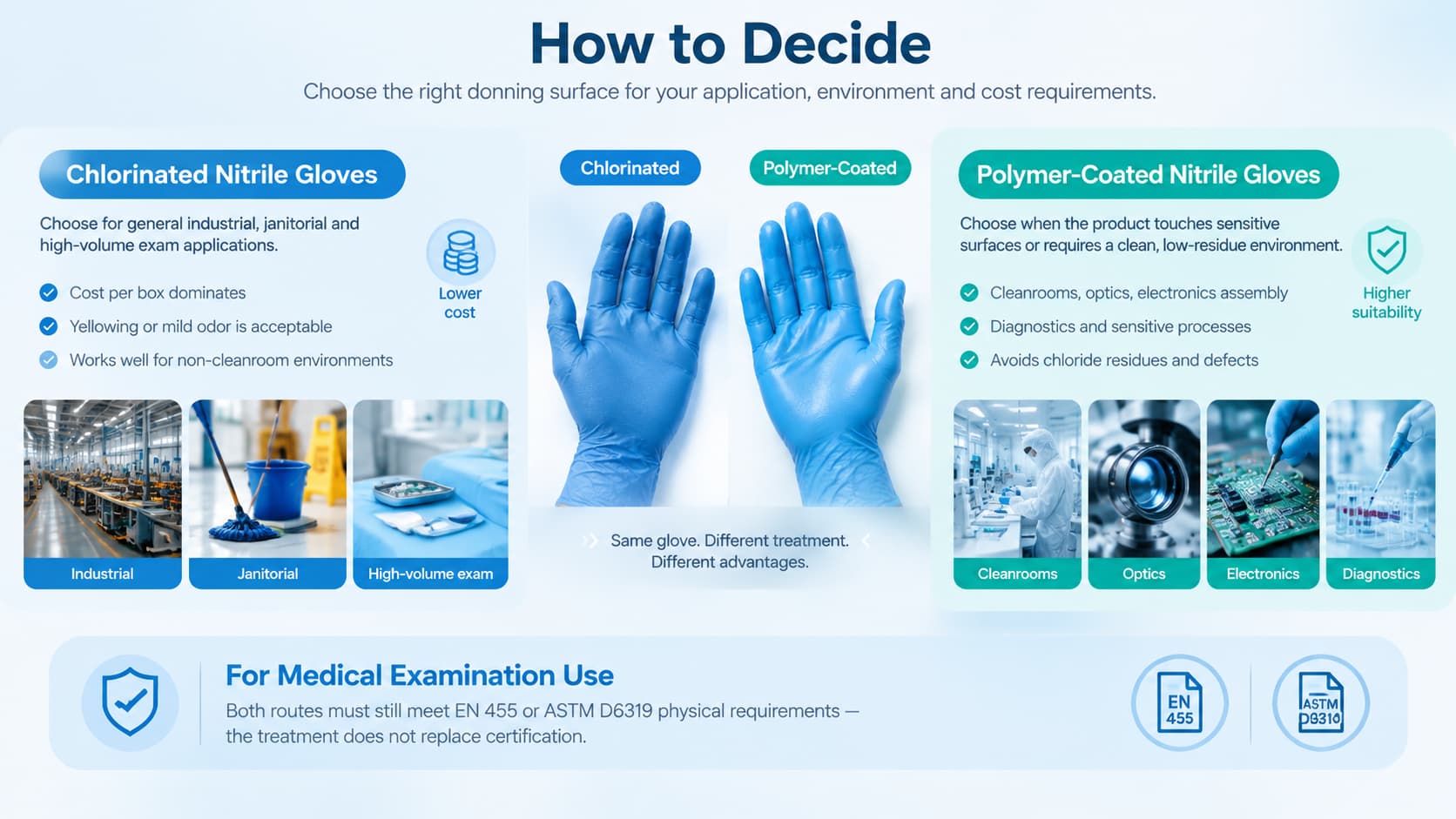
Choose chlorinated gloves for general industrial, janitorial and high-volume exam applications where cost per box dominates and yellowing or mild odor is acceptable. Choose polymer-coated gloves when the product touches sensitive surfaces: cleanrooms, optics, electronics assembly, diagnostics and any process where chloride residues would cause defects. For medical examination use, both routes must still meet EN 455 or ASTM D6319 physical requirements - the treatment does not replace certification.
Source note: process descriptions follow standard nitrile glove manufacturing literature (Intco, HANVO technical documentation); certification references follow EN 455 and ASTM D6319 as published.
Q: What is the difference between chlorinated and polymer-coated gloves?
A: Chlorinated gloves are treated with chlorine to lower surface tack, while polymer-coated gloves receive a polyurethane or silicone inner layer. Polymer-coated versions preserve the original surface and suit cleanrooms; chlorinated versions cost less but may yellow and shorten shelf life.
Q: Are chlorinated gloves worse for cleanrooms?
A: Yes, generally. Chlorination can leave oxidized surface residues and chloride ions, so polymer-coated nitrile is the preferred choice in cleanroom and electronics environments.
Q: Does chlorine treatment affect glove certification?
A: No. Both treatments must still meet EN 455 or ASTM D6319 physical requirements such as >= 14 MPa tensile strength before and after aging; the treatment only changes the surface, not the certification path.
Q: Why do chlorinated gloves sometimes smell?
A: Residual chlorine from the treatment bath can remain trapped in the film and cause a swimming-pool-like odor; strong odor in a fresh lot is a reason to reject it.
Q: Which type lasts longer in storage?
A: Polymer-coated gloves usually age better because chlorination oxidizes the surface layer and can accelerate surface degradation over the stated shelf life.
Please read on, stay posted, subscribe, and we welcome you to tell us what you think.


Copyright 2026@ Fujian Jixiang E-commerce Co., Ltd All Rights Reserved.
Sitemap |
Blog
|
Xml |
Privacy Policy
 Network Supported