
welcome to Jixiang E-commerce!
welcome to Jixiang E-commerce!
ASTM and EN are the two most important standards families for disposable nitrile gloves. This cheat sheet compares key standards, test methods, AQL requirements, and physical property specs side by side, so buyers can understand what dual certification requires.
ASTM International and the European Committee for Standardization (CEN) are the two primary standards bodies governing disposable medical gloves. ASTM D6319 is the US standard for nitrile examination gloves; EN 455 is the European standard for medical gloves for single use. Manufacturers selling to both the US and EU must understand the differences and achieve dual certification. This cheat sheet compares the two standards side by side.
| ASTM standard | Title | Material |
|---|---|---|
| ASTM D6319 | Nitrile Examination Gloves for Medical Application | Nitrile rubber |
| ASTM D3578 | Rubber Examination Gloves | Natural rubber latex |
| ASTM D5250 | Polyvinyl Chloride Examination Gloves | PVC |
| ASTM D3577 | Rubber Surgical Gloves | Natural rubber latex / nitrile |
| ASTM D6978 | Assessment of Resistance of Medical Gloves to Permeation by Chemotherapy Drugs | Any |
| EN standard | Title | Scope |
|---|---|---|
| EN 455-1 | Medical gloves for single use - Part 1: Freedom from holes | AQL and water leak test |
| EN 455-2 | Part 2: Physical properties | Force at break requirements |
| EN 455-3 | Part 3: Biological evaluation | Cytotoxicity, sensitization, irritation |
| EN 455-4 | Part 4: Shelf life determination | Accelerated and real-time aging |
| EN ISO 21420 | Protective gloves - General requirements (formerly EN 420) | pH, innocuousness, sizing, dexterity |
| EN 374-1 to -5 | Protective gloves against chemicals and micro-organisms | Permeation, penetration, degradation |
| Parameter | ASTM D6319 (US) | EN 455 series (EU) |
|---|---|---|
| Governing body | ASTM International | CEN (European Committee for Standardization) |
| Regulatory pathway | FDA 510(k) clearance | EU MDR (2017/745) via Notified Body |
| Hole freedom test | Water leak test, AQL 1.5 | EN 455-1: Water leak test, AQL 1.5 |
| Tensile strength (before aging) | >= 14 MPa | Not specified as MPa; EN 455-2 uses force at break |
| Tensile strength (after aging) | >= 14 MPa | Not specified as MPa; force at break applies |
| Elongation before aging | >= 500% | Not specified in EN 455-2 |
| Elongation after aging | >= 400% | Not specified in EN 455-2 |
| Force at break (exam gloves) | Not specified in force (uses tensile strength) | EN 455-2: >= 6.0 N (rubber); >= 3.6 N (thermoplastic) |
| Force at break (surgical) | Not specified (ASTM D3577 covers surgical) | EN 455-2: >= 9.0 N |
| Biological evaluation | ISO 10993 series (cytotoxicity, sensitization, irritation) | EN 455-3: ISO 10993 series (same test framework) |
| Shelf life | Manufacturer-defined with supporting data | EN 455-4: accelerated aging + real-time stability testing required |
| Sampling for AQL | ANSI/ASQ Z1.4 (equivalent to ISO 2859-1) | ISO 2859-1 |
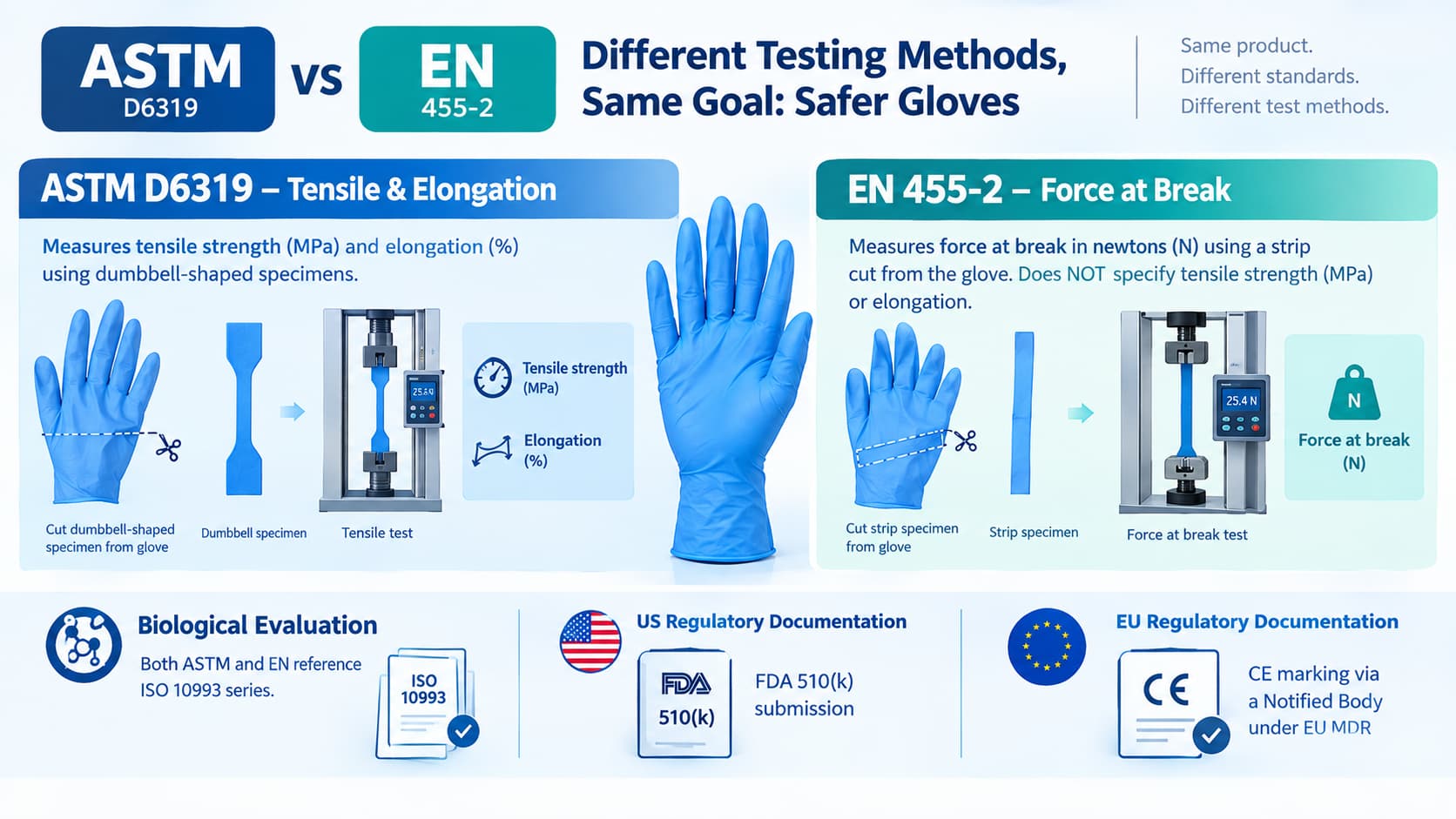
The most important difference between ASTM and EN is how they measure physical properties. ASTM D6319 specifies tensile strength in megapascals (MPa) and elongation percentage. EN 455-2 specifies force at break in newtons (N) but does NOT specify tensile strength in MPa or elongation. This means a glove could pass one standard but not the other depending on its material formulation:
For biological evaluation, both ASTM and EN reference the ISO 10993 series, so the testing framework is aligned. The difference is in regulatory documentation: the US requires FDA 510(k) submission, while the EU requires CE marking via a Notified Body under the EU MDR.
| Aspect | ASTM / FDA (US) | EN 455-1 (EU) |
|---|---|---|
| Acceptable Quality Level | AQL 1.5 for major defects (pinholes) | AQL 1.5 for pinholes |
| Premium grades | Some manufacturers offer AQL 0.65 | Some manufacturers offer AQL 0.65 |
| Sampling standard | ANSI/ASQ Z1.4 | ISO 2859-1 |
| Test method | Water leak test (1000 mL water, 2-5 sec) | Water leak test (1000 mL water, 2-5 sec) |
| Batch release | Per 21 CFR 800 + ASTM standards | Per EN 455-1 + ISO 2859-1 |
| Requirement | US (FDA 510(k)) | EU (EU MDR / CE marking) |
|---|---|---|
| Quality system | 21 CFR 820 (QSR) or ISO 13485 | ISO 13485 mandatory |
| Technical file | 510(k) premarket notification | Technical documentation per EU MDR Annex II/III |
| Biocompatibility | ISO 10993 test reports | EN 455-3 / ISO 10993 test reports |
| Performance testing | ASTM D6319 test report | EN 455-1 to -4 test reports |
| Risk management | ISO 14971 (recommended) | ISO 14971 (mandatory per EU MDR) |
| Labeling | English, per 21 CFR 801 | Language of member state + CE mark |
| UDI | Required per FDA UDI rule | Required per EU MDR UDI |
| Post-market | FDA MedWatch reporting | EUDAMED registration and vigilance |
Data sources: ASTM D6319-19; ASTM D3577; ASTM D3578; ASTM D5250; ASTM D6978; EN 455-1 to EN 455-4; EN ISO 21420:2020 (formerly EN 420); EN 374-1 to -5; EU MDR 2017/745; FDA 21 CFR 820; FDA 21 CFR 801; ISO 13485; ISO 14971; ISO 10993 series; ISO 2859-1; ANSI/ASQ Z1.4. Information current as of September 2026.
Q: What is the main difference between ASTM and EN glove standards?
A: The main difference is in how they measure physical properties. ASTM D6319 specifies tensile strength in megapascals (MPa) and elongation as a percentage. EN 455-2 specifies force at break in newtons (N) but does not set tensile strength or elongation requirements. Both use the same water leak test for AQL 1.5 and reference ISO 10993 for biocompatibility, but the regulatory pathways differ: FDA 510(k) for the US and CE marking via a Notified Body for the EU.
Q: Can one glove meet both ASTM and EN requirements?
A: Yes, many nitrile rubber gloves are dual-certified. A glove with tensile strength >= 14 MPa and elongation >= 500%/400% will typically also meet the EN 455-2 force at break requirement of >= 6.0 N for rubber examination gloves, because the two tests measure related properties through different methods. Manufacturers must conduct testing under both standards and maintain separate technical files for FDA 510(k) and EU MDR CE marking.
Q: Which ASTM standard applies to nitrile examination gloves?
A: ASTM D6319 is the US standard for nitrile examination gloves for medical application. It specifies tensile strength (>= 14 MPa before and after aging), elongation (>= 500% before aging, >= 400% after aging), dimensions, and AQL 1.5 for pinholes. For nitrile surgical gloves, ASTM D3577 applies. For chemotherapy drug permeation testing, ASTM D6978 applies.
Q: What does EN 455-2 test that ASTM D6319 does not?
A: EN 455-2 specifies force at break (measured in newtons) for different glove types: >= 6.0 N for rubber examination gloves, >= 3.6 N for thermoplastic (PVC/PE) examination gloves, and >= 9.0 N for surgical gloves. ASTM D6319 does not specify force at break in newtons; instead it uses tensile strength in MPa and elongation percentage. Conversely, ASTM D6319 specifies elongation, which EN 455-2 does not.
Q: Do I need both certifications to sell in the US and EU?
A: Yes, to sell medical gloves in both markets, you need both FDA 510(k) clearance (with ASTM D6319 compliance) for the US and CE marking (with EN 455 compliance) under the EU MDR for Europe. The two regulatory systems are independent. However, much of the underlying test data (ISO 10993 biocompatibility, AQL water leak testing, ISO 13485 quality system) can be shared between the two submissions.
Please read on, stay posted, subscribe, and we welcome you to tell us what you think.


Copyright 2026@ Fujian Jixiang E-commerce Co., Ltd All Rights Reserved.
Sitemap |
Blog
|
Xml |
Privacy Policy
 Network Supported