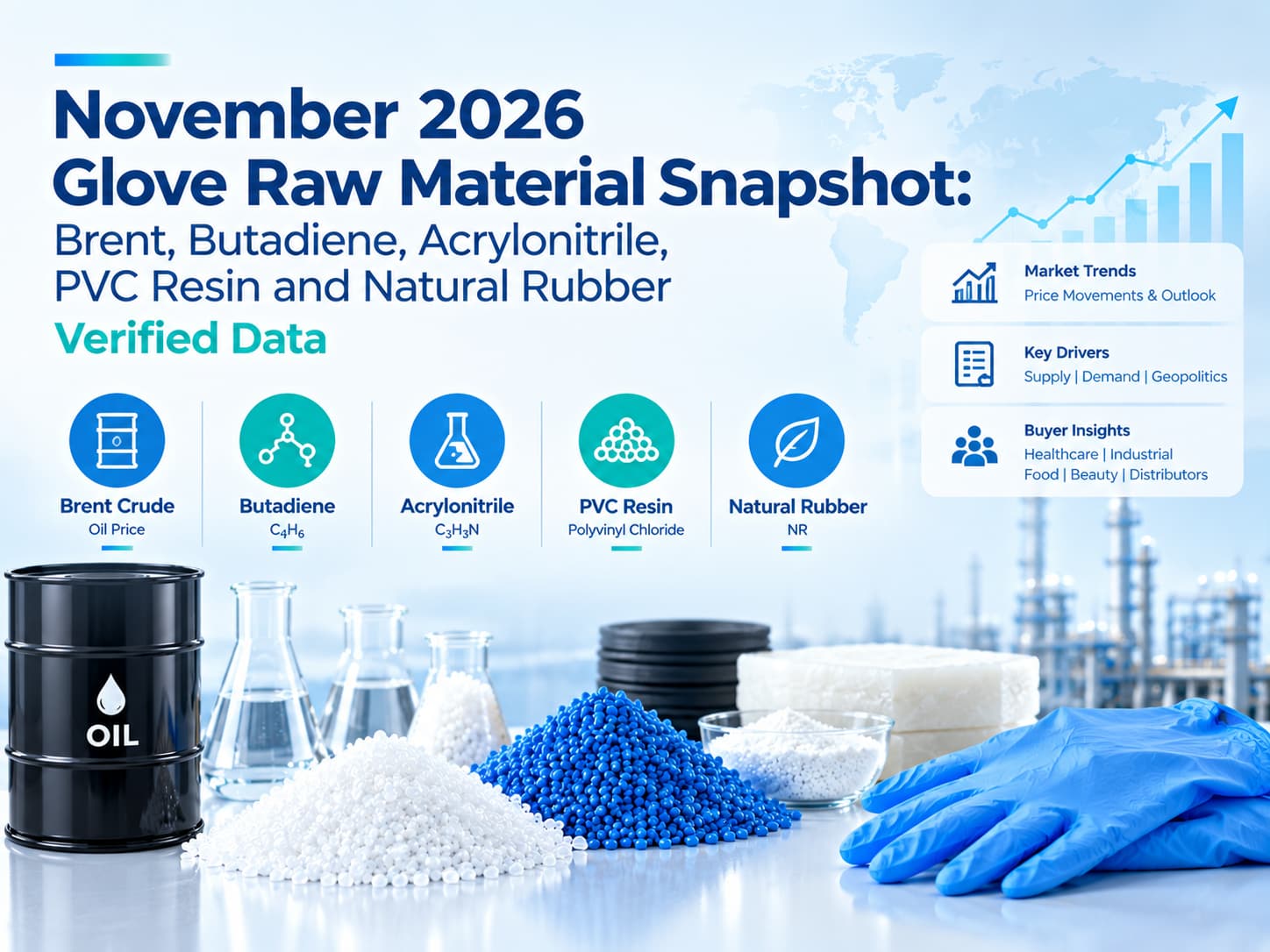
November 2026 Glove Raw Material Snapshot: Brent, Butadiene, Acrylonitrile, PVC Resin and Natural Rubber Verified Data
Oct 30, 2026
Verified glove raw material prices collected 27 October 2026: Brent at $115.81/bbl, butadiene CFR China $1,700/t, acrylonitrile 10,900 yuan/t, PVC SG-5 around 5,000 yuan/t and TSR20 correcting from its peak, with scenario actions for November contracting.
Heading into November 2026, glove raw material costs are splitting along a line that is no longer crude oil. Brent settled at 115.81 US dollars per barrel on 26 October, its highest sustained level of the year, yet butadiene has gone flat at 1,700 dollars per ton CFR China for two consecutive sessions and natural rubber has fallen about 5 percent from its 10 October peak. Crude is expensive, the nitrile chain is only partially following, and the practical risk for buyers has shifted from price level to freight and insurance.
Price Snapshot - Collected 27 October 2026
Commodity / Benchmark
Latest Price
Data Date
Direction
Source
Brent crude, ICE December contract
115.81 USD/bbl (settle), WTI 101.76
26 Oct 2026
Down 0.78 percent on the day, up 6 percent on the prior week
Reuters via Euronext; Xinhua
Butadiene, CFR China
1,700 USD/t
26 Oct 2026
Flat versus 23 Oct
ChemPriceHub
Butadiene, Shandong Luzhong delivered
14,200 yuan/t
26 Oct 2026
Up 3.09 percent
ChemPriceHub
Butadiene, 100ppi benchmark
13,433.33 yuan/t
26 Oct 2026
Firm, supported by crude and naphtha
SunSirs network (100ppi)
Acrylonitrile, 100ppi benchmark
10,900 yuan/t
26 Oct 2026
Up 1.55 percent day on day, up about 1 percent month to date
SunSirs network (100ppi)
Acrylonitrile, East China market
11,300 yuan/t
26 Oct 2026
Up 1.80 percent
Longzhong (oilchem)
PVC resin SG-5, East China carbide route
4,880 to 5,100 yuan/t
20 to 26 Oct 2026
Up 5.02 percent in seven days per 100ppi
Galaxy Futures; ECHEMI; 100ppi
Natural rubber TSR20, SICOM
2,559 USD/t
27 Oct 2026
Down 5.3 percent from the 2,703 peak on 10 Oct
SGX SICOM via commodity trackers; RTAS
Note on methodology: commodity quotations differ by region, specification and reporting agency, and the figures above are the published benchmarks available on the collection date. They are intended for procurement planning, not for trading.
What Drove October - and What Changes in November
Driver
What Happened in October
November Read-Across for Gloves
Hormuz and Gulf shipping
October became the worst month on record for attacks on commercial shipping around Hormuz, with 28 incidents reported and 11 tankers hit; war-risk cover reached 6 to 10 percent of hull value per transit against 0.15 to 0.25 percent before the conflict
Freight and insurance, not the chemical price, are the fastest-moving cost line for GCC and Europe deliveries
Crude feedstock
Brent rose 6 percent in the week to 23 October, then settled 0.78 percent lower at 115.81 USD/bbl on 26 October after peace talks in Tehran
Cost floor stays high; a single headline can move naphtha and butadiene within a week
Butadiene supply
Units at North Huajin and Hainan Refining restarted, easing the earlier resource shortage; October cargoes traded in a range
Supply is no longer the constraint, so butadiene is now priced off crude rather than off scarcity
Acrylonitrile
Supply stayed loose with producer inventory around 47,000 tonnes; one major Jiangsu producer cut its list price to 11,500 yuan/t on 21 October, then the benchmark rebounded into month end
Nitrile rubber's second feedstock is the looser leg, which caps nitrile cost inflation
PVC resin
Operating rate near 60 percent, the lowest of the year, with both carbide and ethylene routes loss-making; East China SG-5 rose about 5 percent in a week on cost support, not demand
Vinyl glove floor price rises with crude, upside limited by weak construction demand
Natural rubber
SICOM TSR20 peaked at 2,703 USD/t on 10 October, then corrected as weather improved in Thailand, Indonesia and Vietnam; ANRPC cut 2026 output growth to 0.6 percent
Latex glove input cost is correcting but stays structurally supported
Cost Pass-Through to a Nitrile Glove
Butadiene and acrylonitrile are the two feedstocks of nitrile rubber, and both are co-products of steam cracking alongside fuels. That is why crude oil sets the floor even when neither chemical moves. The table below translates the snapshot into directional pressure per glove family rather than into a price quote, because glove prices also carry conversion, energy, packaging and freight.
Glove Family
Key Inputs
Direction into November
What Buyers Should Do
Nitrile rubber examination gloves
Butadiene 1,700 USD/t CFR, acrylonitrile 10,900 yuan/t
Mild upward pressure: butadiene flat but firm, acrylonitrile rebounding off month-end lows
Negotiate index-linked pricing on butadiene plus acrylonitrile, with a quarterly reset rather than annual
Nitrile rubber industrial gloves
Same feedstocks plus higher compound loading
Same direction, larger absolute exposure per pair
Fix volume bands and price caps rather than a single flat price
PVC (vinyl) gloves
PVC SG-5 around 5,000 yuan/t, plasticiser, crude-linked ethylene
Upward pressure from cost side, capped by weak demand
Shorter price validity, 30 to 45 days, given the loss-making producer base
Latex examination and surgical gloves
Natural rubber TSR20 2,559 USD/t, correcting from peak
Correcting from a peak but still structurally high on tight ANRPC output
Wait on spot, but secure allocation - supply, not price, is the risk
Any glove landed in the Gulf or Europe
Freight, war-risk insurance, container availability
The largest single uncertainty this month
Add a freight and insurance review clause to existing contracts
Three Actions for November Contracts
Separate material from logistics in the price formula: with war-risk insurance at multiples of its pre-conflict level, a formula that only indexes the polymer will under-recover and invite renegotiation mid-quarter.
Set the reset trigger on published benchmarks: name the benchmark, the reference period and the trigger threshold, so a 3 percent move in butadiene CFR China is either passed through or not - without a debate.
Treat latex and nitrile differently: the nitrile chain is following crude upward, while natural rubber is correcting from a supply peak. A single "raw material" index applied to both will misprice one of them.
What Would Change This View
Three developments would move the November picture. A credible de-escalation that reopens Hormuz traffic would cut freight and insurance faster than it cuts crude, which is the largest single relief available to landed glove cost. A sustained break above 120 dollars on Brent would pull butadiene up with it and remove the current flatness. And a further ANRPC downgrade to natural rubber output would end the latex correction before it reaches the levels buyers are now expecting.
None of these can be forecast reliably from a single month of data, which is the argument for index-linked terms over fixed annual prices: the buyer and the supplier are both exposed to the same three variables, and a formula prices them honestly.
All price data collected 27 October 2026 from the sources cited in each row. Verify against live quotes before finalising November contracts; market conditions in the Gulf can change within days.
FAQ
Q: What is the butadiene price for gloves in late October 2026?
A: Butadiene was quoted at 1,700 US dollars per ton CFR China on 26 October 2026, unchanged from 23 October, with the domestic 100ppi benchmark at 13,433.33 yuan per ton and Shandong Luzhong delivered material at 14,200 yuan per ton, up 3.09 percent. Collected 27 October 2026.
Q: Why is Brent at 115.81 dollars but butadiene flat?
A: Because butadiene supply improved: units at North Huajin and Hainan Refining restarted, easing the earlier shortage. With supply no longer constrained, butadiene is priced off feedstock and downstream demand rather than scarcity, so it is not tracking every crude move.
Q: Are PVC glove prices rising in November 2026?
A: Directionally yes, but modestly. East China SG-5 rose from 4,800 to 4,900 yuan per ton to a 5,050 to 5,100 yuan range in the last week, about 5 percent, driven by cost support and a plant operating rate near 60 percent, while weak construction demand caps the upside.
Q: Is natural rubber still driving latex glove costs up?
A: It is correcting, not collapsing. SICOM TSR20 peaked at 2,703 US dollars per ton on 10 October and stood at 2,559 dollars per ton on 27 October, about 5.3 percent lower, while ANRPC cut its 2026 output growth forecast to 0.6 percent, which keeps the floor high.
Q: What is the biggest cost risk for glove buyers in November 2026?
A: Freight and war-risk insurance, not the polymer. With October the worst month on record for shipping attacks around Hormuz and war-risk cover at 6 to 10 percent of hull value per transit, a landed-cost formula that indexes only the raw material will under-recover quickly.



 Network Supported