How to Choose the Right Glove Thickness for Your Industry
Apr 23, 2026
"Mil" is a word that appears on every glove specification sheet, yet it's one of the most misunderstood terms in PPE procurement. Get the thickness wrong and you're either paying too much for over-spec'd gloves or exposing workers to risk with under-spec'd ones. This guide helps you get it right the first time.
1. What Is "Mil" and Why Does It Matter?
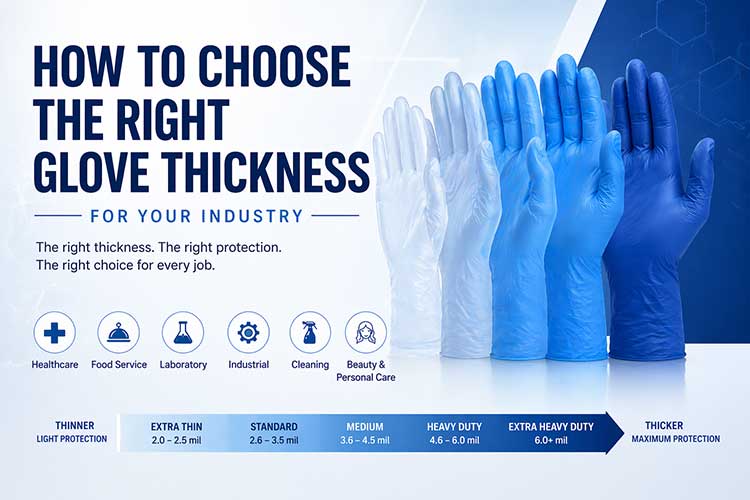
One mil equals one-thousandth of an inch (0.0254 mm). For disposable gloves, thickness is typically measured at the palm, finger, and cuff areas. The most important measurement is the fingertip thickness, as this is where gloves experience the highest stress.
Common nitrile glove thickness ranges:
Thickness
Category
Typical Weight
Common Description
2.5–3 mil
Ultra-light / Economy
2.5–3.5 g/pcs
Thin, food service, high-touch tasks
3.5–4 mil
Standard / Medical
4–5 g/pcs
Exam grade, general purpose
4.5–5 mil
Medium / Industrial
5–6 g/pcs
Enhanced durability, light chemical
6–7 mil
Heavy Duty
7–9 g/pcs
Industrial use, moderate chemical
8+ mil
Extra Heavy
10+ g/pcs
Extended chemical exposure, manufacturing
2. Industry-by-Industry Thickness Guide
Healthcare & Medical Examination
Recommended thickness: 3–4 mil (powder-free, medical-grade)
In medical examination settings, dexterity and tactile sensitivity are the primary requirements. A 3–4 mil glove provides adequate barrier protection for standard examination procedures while maintaining the fingertip sensitivity that clinicians rely on. Gloves must conform to EN 455 (Europe) or ASTM D6319 (Americas) standards.
Key spec: AQL 1.5 (acceptable quality level), confirming that no more than 1.5% of gloves in a batch have detectable defects.
Food Processing & Catering
Recommended thickness: 3–4 mil (food-safe, powder-free)
Food industry buyers often underestimate the importance of color coding. Regulatory bodies in the EU and GCC require food handlers to use detectable gloves — typically blue — so that any glove fragment can be visually identified in food products. A 3.5–4 mil nitrile glove balances cost, dexterity, and compliance for high-volume food environments.
Key spec: EC Regulation 1935/2004 (Europe) or FDA 21 CFR 170–180 (Americas) food contact compliance.
Industrial & Manufacturing
Recommended thickness: 5–7 mil
Workers in automotive, electronics, and general manufacturing facilities need gloves that resist abrasion, tears, and light chemical exposure — while still allowing enough dexterity to handle parts and tools. A 5–6 mil nitrile glove is the sweet spot for most light-to-medium industrial applications.
For heavier applications such as metal stamping, maintenance, or working with solvents, step up to 7–8 mil.
Petrochemical & Chemical Processing
Recommended thickness: 6–8 mil (or purpose-specific chemical gloves)
This is where thickness alone is not enough — chemical permeation data is critical. Always request EN 374-3 (Europe) or ASTM F739 permeation test data for the specific chemicals in your environment. A 6 mil nitrile glove provides good resistance to common petroleum products, oils, and mild solvents, but thick does not always mean better against aggressive chemicals.
Dental & Surgical
Recommended thickness: 2.5–3 mil (surgical: sterile, surgical-grade only)
Dental and surgical procedures require maximum tactile sensitivity. Surgical gloves are manufactured and tested to tighter tolerances than exam gloves (EN 455-2/-3 for sterile surgical use). Never substitute standard exam gloves for surgical procedures.
Automotive & Maintenance
Recommended thickness: 7–8 mil (black nitrile preferred)
Black nitrile gloves in 7–8 mil are the standard for automotive workshops and maintenance environments. The dark color helps hide grease and oils (reducing the urge to remove gloves during tasks), and the heavier gauge provides better puncture resistance against sharp metal components.
3. Thickness vs. Touch Sensitivity Trade-Off
A common question from buyers: "If thicker means better protection, why not always buy the heaviest glove?"
The answer is ergonomics. Thicker gloves increase hand fatigue over time, reduce tactile sensitivity, and can lead workers to remove gloves during tasks — which defeats the purpose of PPE. In clinical or food environments where workers change gloves dozens of times per day, a lighter-weight glove that workers will actually keep on is safer than a heavy one they'll remove.
The right specification balances protection level with user compliance.
4. Questions to Ask Your Supplier
Before placing any glove order, ask your supplier for:
① Thickness test report (EN 455-1 or ASTM D3578) — measured at palm, finger, and cuff
② AQL certification (1.5 for medical, 2.5–4 for industrial)
③ Chemical permeation data (if applicable, EN 374-3 or ASTM F739)
④ Physical property testing: tensile strength, elongation at break
⑤ Weight per pair (a useful cross-check for consistent quality across batches)
Conclusion
Choosing the right glove thickness is about matching protection to task, not defaulting to the thickest (most expensive) option. For most medical and food applications, 3.5–4 mil delivers the optimal balance. For industrial use, 5–6 mil is the sweet spot. When in doubt, request samples in 2–3 thickness variants and test them in your actual work environment.
Jixiang (LYEEANG brand) manufactures nitrile gloves from 2.5 mil to 8 mil. Contact us at www.jxgloves.com to request thickness-specific samples with full test documentation.
[Request a Factory Audit Report]
About Fujian Jixiang E-commerce Co., Ltd.
With over 20 years of experience, we specialize in manufacturing high-quality disposable gloves.
Why Choose Us?
· ✅ Factory-direct pricing
· ✅ ISO/CE/FDA certified products
· ✅ OEM/ODM customization
· ✅ Global shipping to 50+ countries
Contact Us: info@jxgloves.com



 Network Supported