Nitrile Exam Glove FAQ: 15 Most-Asked Questions About Disposable Nitrile Gloves (2026)
Oct 21, 2026
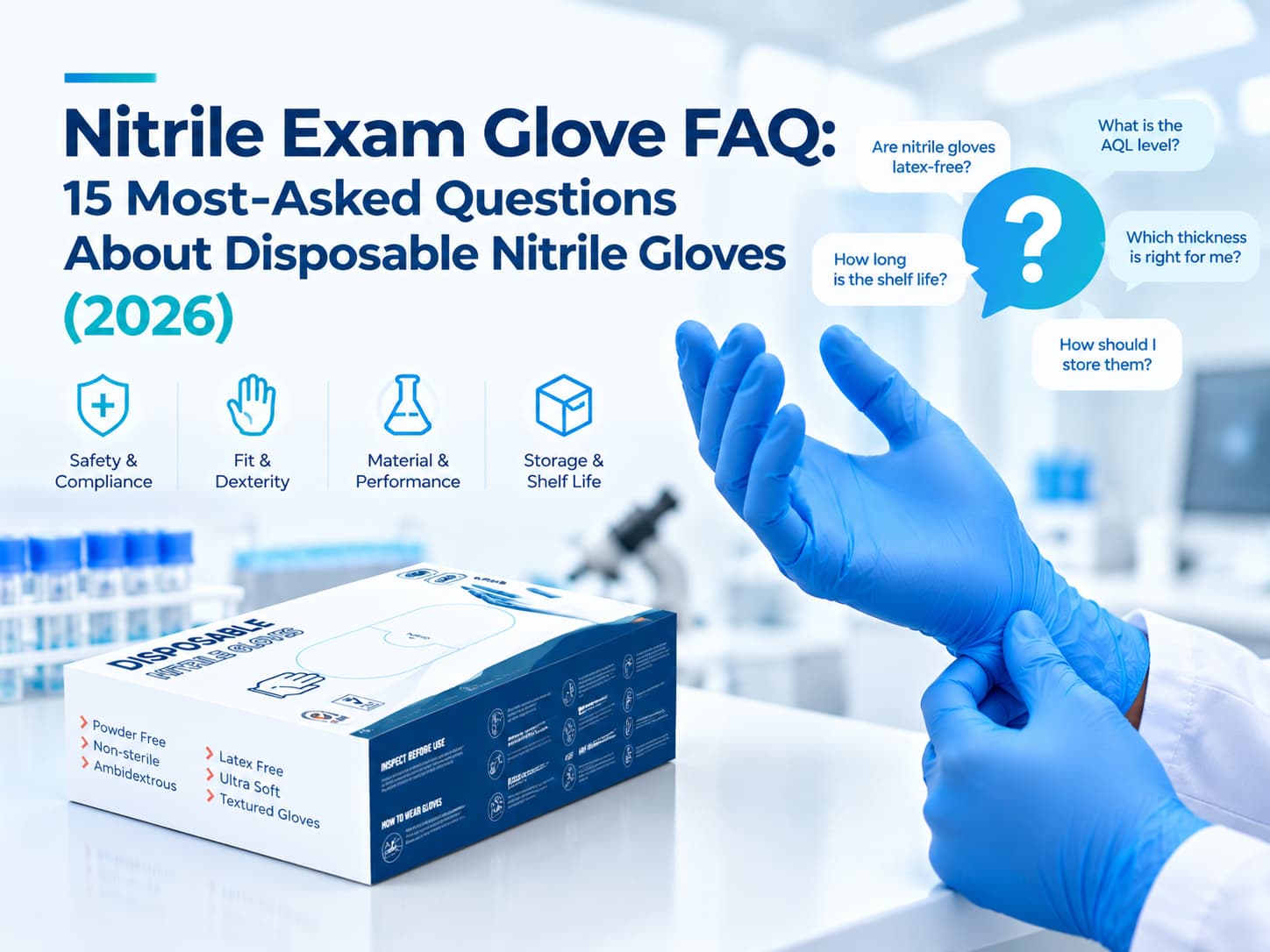
A nitrile exam glove is a powder-free, single-use barrier made from nitrile rubber (acrylonitrile butadiene rubber), certified to EN 455 or ASTM D6319 for medical use. The 15 questions below are the ones buyers and end users raise most often - answered directly, without sales language.
Product Basics
Q: Are nitrile gloves ambidextrous? Most disposable nitrile gloves are ambidextrous (one shape fits both hands). Surgical-grade sterile gloves are anatomically shaped. If hand fatigue matters on long shifts, some suppliers offer hand-specific exam shapes - check the datasheet.
Q: Why do exam gloves come in different colors? Color is a management tool, not a performance feature: blue for food processing (visual detection), purple for chemotherapy per common practice, and departmental color-coding in hospitals to prevent cross-use.
Q: What does cuff length mean? Standard exam cuffs are about 240 mm long. Extended-cuff versions (280-300 mm) protect the wrist area during liquid tasks; they do not by themselves change the certification class.
Sizing and Fit
Q: How do I choose the right size? Measure hand circumference at the knuckles and match it to the size chart. EN ISO 21420 (formerly EN 420) defines sizing codes 6 to 11. A correct size should feel snug without pressure marks; an oversized glove slips and tears, an undersized one fails at the thumb webbing.
Q: Does size affect protection? Yes. Barrier performance is tested on correctly sized hands in both EN 455 and ASTM D6319 methods. Wearing the wrong size invalidates the assumptions behind the test data in real use.
Q: Are textured fingertips always better? Texture improves grip on wet and oily surfaces but slightly reduces tactile sensitivity. Dry, clean tasks often feel better in smooth finish gloves; wet assembly and food wash-down benefit from full texture.
Use and Handling
Q: Can nitrile gloves be used with food? Yes, if the glove carries a food-contact declaration (EU 1935/2004 or FDA 21 CFR 177.2600). Blue color and metal-detectable variants are common HACCP additions in food plants.
Q: Can they handle chemicals? Only within tested limits. Disposable nitrile resists splashes of many detergents and dilute chemicals, but permeation data (EN 374 for the EU) decides actual chemical suitability. For extended chemical contact, use reusable chemical gloves instead.
Q: Can I wash and reuse disposable gloves? No. Washing creates micro-tears and removed gloves cannot be reliably re-donned. Disposable means single use - that is what the certification covers.
Q: What is the difference between exam and industrial grades? Exam grade meets medical standards (EN 455 or ASTM D6319) with stricter leak testing; industrial grade prioritizes physical durability. Many product lines meet both - the datasheet and certificate decide, not the box color.
Quality and Documentation
Q: What is AQL and does it matter for my order? AQL is the accepted quality limit for the pinhole leak test (EN 455-1 / ISO 2859-1 sampling). Medical exam gloves commonly target AQL 1.5 or better. Ask for the batch test report with your shipment, not just a brochure.
Q: What tests are behind the strength numbers? EN 455-2 requires break force of at least 6.0 N for rubber exam gloves (3.6 N for thermoplastic film, 9.0 N for surgical); it does not set an elongation limit. ASTM D6319 requires tensile strength of at least 14 MPa before and after aging, with elongation of at least 500% (unaged) and 400% (aged).
Q: How long is the shelf life? Typical nitrile exam gloves carry a 3-5 year shelf life from the date of manufacture when stored at 10-30 C away from direct sunlight. Verify the manufacture date printed on the box and rotate stock FIFO.
Q: What documents should a buyer receive? Minimum set: Declaration of Conformity, technical data sheet, food-contact or medical certificate as applicable, and a batch-specific test report. For the EU, ISO 13485 certification of the manufacturer is standard practice.
Q: Are accelerator-free nitrile gloves worth specifying? For users with Type IV contact dermatitis linked to accelerators (thiurams, carbamates, MBT), yes - accelerator-free formulations reduce that risk. They cost slightly more, so target them where skin reactions have actually been observed.
Question Category
Key Point
Document to Request
Sizing
Match hand circumference to size code 6-11 (EN ISO 21420)
Size chart on datasheet
Food contact
Declaration required; blue and detectable variants common
Food-contact certificate
Chemicals
Only within tested permeation limits
EN 374 chemical list
Quality
AQL 1.5 or better typical for exam grade
Batch test report
Strength
EN 455-2 break force >= 6.0 N; ASTM D6319 tensile >= 14 MPa
TDS with test method
Shelf life
3-5 years stored at 10-30 C; rotate FIFO
Manufacture date on box



 Network Supported