welcome to Jixiang E-commerce!

Search

Home

nitrile gloves

  • How to Choose the Right Disposable Gloves for Your Industry
    How to Choose the Right Disposable Gloves for Your Industry
    Mar 13, 2026
      How to Choose the Right Disposable Gloves for Your Industry Choosing the perfect disposable gloves can be challenging. This guide will help you select the right gloves for healthcare, food service, industrial, and laboratory applications. Introduction Disposable gloves are essential protective equipment across numerous industries, from healthcare facilities to manufacturing plants. However, not all gloves are created equal. Selecting the wrong type can lead to safety hazards, allergic reactions, or unnecessary costs.   With over 20 years of experience in the disposable glove industry, we've helped thousands of businesses find the perfect glove solutions. In this guide, we'll break down everything you need to know to make an informed decision. Understanding the Three Main Types of Disposable Gloves 1. Nitrile Gloves   Best for: Healthcare, automotive, chemical handling, laboratories Key Benefits: ✅ Superior chemical resistance ✅ Puncture-resistant (3x stronger than latex) ✅ Latex-free (no allergy concerns) ✅ Excellent grip in wet conditions ✅ Long shelf life Ideal Applications: Medical examinations Chemical handling Automotive repair Laboratory work Tattoo and piercing Why Choose Nitrile? Nitrile gloves are the gold standard for industries requiring durability and chemical protection. Made from synthetic rubber, they offer the best puncture resistance among disposable gloves. Pro Tip: For extended wear, choose thicker nitrile gloves (6-8 mil) for industrial applications, and thinner options (3-5 mil) for medical examinations. 2. Latex Gloves   Best for: Medical/surgical procedures, dental, laboratory Key Benefits: ✅ Superior fit and comfort ✅ Excellent tactile sensitivity ✅ Biodegradable (eco-friendly) ✅ Cost-effective ✅ Elastic and form-fitting Ideal Applications: Surgical procedures Dental examinations Laboratory work Cleaning and sanitation Important Note: Approximately 1-6% of the population has latex allergies. Always offer latex-free alternatives in healthcare settings. 3. PVC (Vinyl) Gloves   Best for: Food service, cleaning, light industrial work Key Benefits: ✅ Most affordable option ✅ Latex-free and powder-free ✅ Loose fit for easy on/off ✅ Good for short-term use ✅ Suitable for food handling Ideal Applications: Food preparation and handling Cleaning and janitorial work Hair salons Light industrial tasks Did You Know? The FDA requires food handlers to use gloves when preparing ready-to-eat foods to prevent bacterial contamination. Industry-Specific Recommendations Healthcare & Medical Recommended: Nitrile or Latex (powder-free) Why: Medical-grade protection required High puncture resistance essential Powder-free prevents contamination Thickness: 4-6 mil Standards: ASTM D6319 (nitrile), ASTM D3578 (latex) Food Service & Processing Recommended: PVC or Nitrile Why: FDA-approved for food contact Cost-effective for frequent changes Safe for all food types Thickness: 3-5 mil Standards: FDA 21 CFR 177.2600 Pro Tip: Blue nitrile gloves are preferred in food processing—they're easily visible if a piece falls into food. Automotive & Industrial Recommended: Heavy-duty Nitrile (6-8 mil) Why: Oil and chemical resistance Superior puncture protection Enhanced grip for tools Thickness: 6-8 mil Standards: EN 374 (chemical resistance) Laboratory & Research Recommended: Chemical-resistant Nitrile Why: Chemical splash protection Contamination prevention Powder-free essential Thickness: 5-8 mil Standards: ASTM D6319, EN 374, EN 455 5 Key Factors to Consider When Choosing Gloves 1. Material Allergies Always offer latex-free options Nitrile is safe for latex-sensitive individuals 2. Chemical Exposure Check chemical compatibility charts Nitrile: Excellent for oils, solvents, chemicals 3. Duration of Use Short tasks (<30 min): PVC or thin nitrile Extended wear (>1 hour): Thicker nitrile 4. Fit and Comfort Proper sizing prevents hand fatigue Latex offers best fit 5. Cost Considerations Material Cost per Pair Durability Best Value PVC $0.03-0.08 Low High volume, short use Latex $0.05-0.12 Medium Medical, surgical Nitrile $0.08-0.20 High Industrial, long use   Glove Sizing Guide   Size Palm Width (mm) Hand Length (mm) XS 60-75 150-160 S 70-85 160-170 M 80-95 170-180 L 90-105 180-190 XL 100-115 190-200 How to Measure: Measure around your dominant hand at the widest point Measure from the tip of your middle finger to your wrist Use the larger measurement to determine size Quality Standards to Look For Medical Gloves: FDA 510(k) Clearance (USA) CE Marking (Europe) ISO 13485 (Quality Management) ASTM D6319 (Nitrile) / ASTM D3578 (Latex) Industrial Gloves: EN 374 (Chemical Resistance) EN 388 (Mechanical Risks) Food Gloves: FDA 21 CFR 177.2600 (Food Contact) Common Mistakes to Avoid ❌ Using latex gloves with oil-based products ❌ Reusing disposable gloves ❌ Choosing wrong size ❌ Ignoring chemical compatibility ❌ Storing gloves in direct sunlight Conclusion Selecting the right disposable gloves is crucial for safety, comfort, and cost-efficiency. Quick Summary: Healthcare: Nitrile or Latex (medical-grade) Food Service: PVC or Nitrile (FDA-approved) Industrial: Heavy-duty Nitrile (6-8 mil) Laboratory: Chemical-resistant Nitrile "Request Free Quote" About Fujian Jixiang E-commerce Co., Ltd. With over 20 years of experience, we specialize in manufacturing high-quality disposable gloves. Why Choose Us? ✅ Factory-direct pricing ✅ ISO/CE/FDA certified products ✅ OEM/ODM customization ✅ Global shipping to 50+ countries Contact Us:info@jxgloves.com
  • US Distributor Case Study: How We Grew Their Glove Revenue by 40% in 18 Months
    US Distributor Case Study: How We Grew Their Glove Revenue by 40% in 18 Months
    Apr 07, 2026
      Introduction As the foreign trade team at Jixiang, we've worked with distributors across dozens of countries, but some partnerships stand out because of the measurable impact they create. This is the story of how we helped a mid-sized US medical supply distributor transform their glove business. By providing consistent product quality, complete regulatory documentation, and responsive support, we helped them grow glove-related revenue by 40% in just eighteen months. Here's exactly how we did it. Understanding the Problem A Distributor Struggling with Supply Chain Chaos Our partner, a regional distributor based in the southeastern United States, came to us after years of frustration with their existing glove suppliers. They served hospitals, dental clinics, and long-term care facilities across six states, and their procurement team was dealing with three recurring nightmares. First, quality was all over the place. Batches from their previous suppliers varied significantly, with some shipments failing ASTM D6319 tensile testing right out of the box. When your customers are hospitals, that kind of inconsistency is unacceptable. Second, lead times were a guessing game. Orders took anywhere from 60 to 90 days to arrive, making it nearly impossible to plan inventory or respond to sudden demand spikes. During flu season or public health events, they were constantly scrambling. Third, regulatory compliance was falling on their shoulders. Their suppliers didn't provide FDA 510(k) documentation or help with the paperwork, so the distributor's team was spending hundreds of hours per year handling it themselves. The result? About 12% of their annual glove inventory was being returned or discounted due to quality issues, eating directly into their margins. How We Approached the Partnership Starting with Trust, Not Orders We didn't start by pushing products. We started by listening. During our first series of calls, we focused on understanding their exact pain points, their customer requirements, and their growth targets. Only then did we propose a structured evaluation process. We arranged for sample shipments to be tested at an independent US laboratory, provided complete access to our ISO 13485 quality management documentation, and walked their procurement team through our FDA 510(k) registrations and technical files. Transparency from day one was our priority. What Made Our Approach Different Three things set us apart during the evaluation. Our Fujian Jixiang Medical Technology factory operates under ISO 13485 and ISO 9001 certified quality management systems, with 15 automated production lines capable of producing over 7 billion gloves annually. This scale means consistent quality across every batch, period. Our dedicated compliance team maintains current FDA, CE, and other international certifications and provides complete documentation packages so distributors don't have to chase paperwork. And because we control the entire process from raw material compounding to final packaging at our own factory, we can offer shorter lead times and better cost control than trading companies or multi-layered supply chains. The Pilot Order We started with a pilot order of 200,000 nitrile exam gloves across three sizes. We assigned a dedicated account manager who coordinated production scheduling, provided real-time order tracking, and prepared all US customs clearance documentation in advance. The shipment arrived within 35 days and passed all quality inspections at their warehouse. That pilot built the confidence to move forward. The Results: Numbers That Matter Revenue Growth Within the first year, our partner consolidated approximately 70% of their glove procurement with us. The simplified supply chain and competitive pricing enabled them to offer better terms to their end customers. Total glove revenue grew by 40% year-over-year. Quality They Could Count On Defect rates dropped from 3.2% with their previous suppliers to below 0.5% with our products. Customer complaints about glove quality decreased by 85%. Over the entire evaluation period, they had zero returned shipments from our factory. Operational Improvements With lead times consistently between 35 and 45 days and full order visibility throughout the process, our partner reduced safety stock levels by 25%, freeing up warehouse space and working capital. The pre-prepared FDA documentation package saved an estimated 200 hours of annual compliance work. Customer Satisfaction Our partner's Net Promoter Score among healthcare facility clients improved by 18 points. Several hospital procurement managers specifically cited the improved product consistency as a reason for renewing their contracts. What We Learned from This Partnership Communication Is Everything The most impactful thing we did wasn't about the gloves themselves. It was about communication. Monthly forecast sharing, proactive updates on production status, and fast response times when issues arose. That trust is what turned a trial order into a long-term partnership. Documentation Should Be Easy Distributors shouldn't need a compliance team just to import gloves. We invested in building a comprehensive documentation system so that our partners can focus on selling and serving their customers, not chasing certificates and test reports. Quality Consistency Wins Repeat Business One good batch doesn't build a relationship. Delivering the same quality standard across every single order, month after month, is what earns trust and drives growth. That's the standard we hold ourselves to at Jixiang. Looking Forward This partnership reinforced our belief that the best way to grow internationally is to make our distributors successful. When we take care of quality, compliance, and delivery reliability, our partners can focus on what they do best: building relationships with their customers and growing their business. If you're a distributor looking for a glove manufacturing partner who treats your success as their own, we'd love to start that conversation.   [Request a Factory Audit Report] About Fujian Jixiang E-commerce Co., Ltd. With over 20 years of experience, we specialize in manufacturing high-quality disposable gloves. Why Choose Us? ✅ Factory-direct pricing ✅ ISO/CE/FDA certified products ✅ OEM/ODM customization ✅ Global shipping to 50+ countries Contact Us: info@jxgloves.com
  • SEO Blog: PVC (Vinyl) Gloves in 2026: Phthalate Restrictions, Cost Curves & Replacement Strategy
    SEO Blog: PVC (Vinyl) Gloves in 2026: Phthalate Restrictions, Cost Curves & Replacement Strategy
    Jul 20, 2026
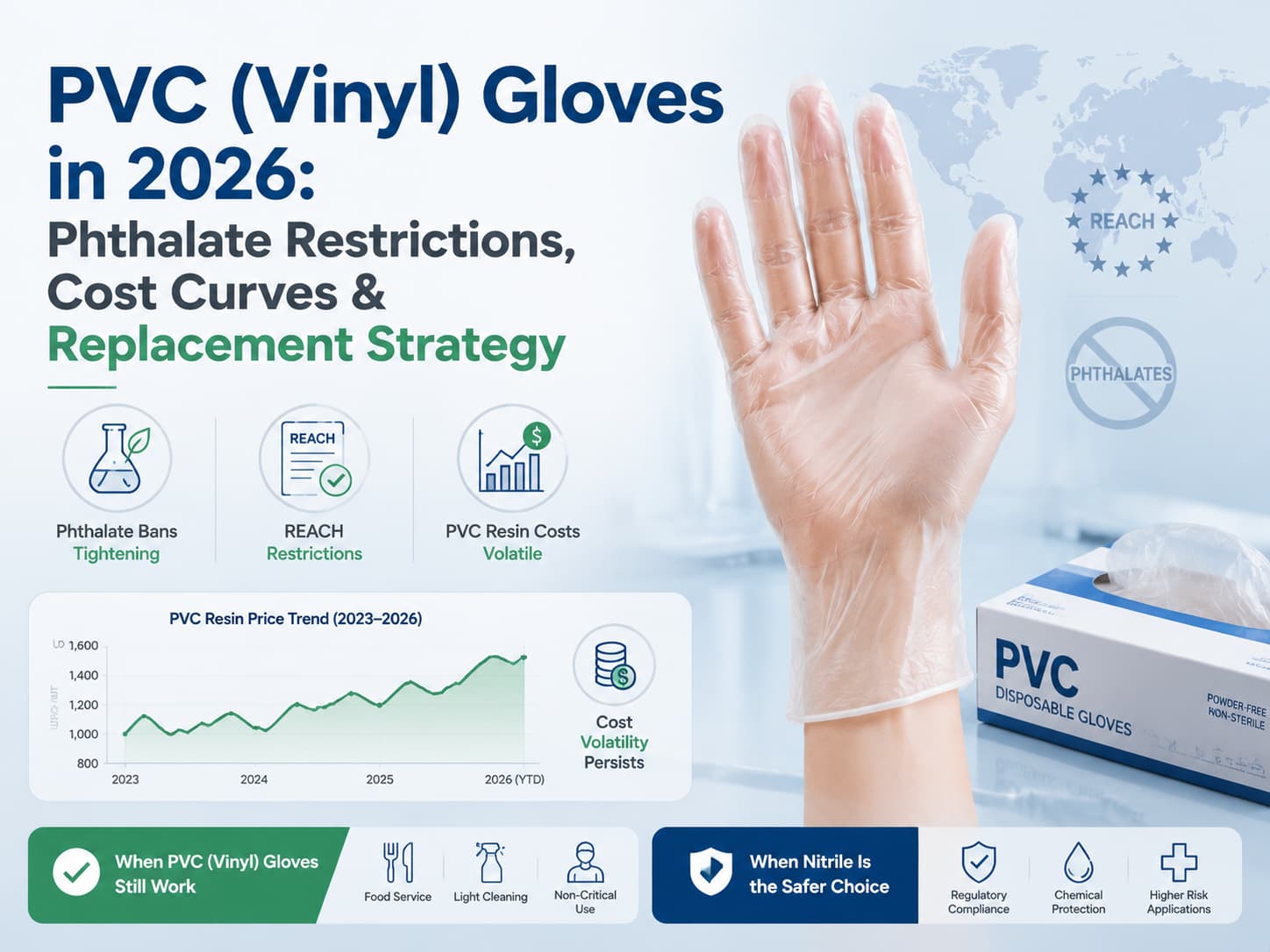
    PVC (vinyl) gloves still account for roughly 25-30% of the global disposable glove market by volume, but 2026 is turning into a difficult year for buyers who rely on vinyl as a low-cost option. New phthalate restrictions, REACH enforcement, and volatile PVC resin prices driven by crude oil are reshaping the total cost of ownership. This guide explains the current regulatory landscape, the raw-material economics, and when nitrile rubber is the better long-term choice. 1. What Are PVC (Vinyl) Gloves? PVC gloves are made from polyvinyl chloride, a thermoplastic polymer produced from vinyl chloride monomer. In disposable glove form, PVC is usually plasticized with phthalates or alternative plasticizers to make it flexible. They are popular in food service, light cleaning, and non-critical medical exams because they are generally cheaper than nitrile or latex and do not contain natural rubber latex proteins. 2. Why PVC Gloves Are Under Pressure in 2026 Three forces are squeezing the PVC glove market this year: Regulatory: The EU REACH Annex XVII restriction on DEHP, DBP, BBP, and DIBP in plasticized materials is already in force; many phthalate alternatives are now under scrutiny. Environmental: PVC is less recyclable than nitrile rubber in many waste streams, and ESG procurement policies are moving buyers toward alternatives. Economic: PVC resin is derived from chlorine and ethylene, which is linked to crude oil and natural gas feedstock prices. Brent crude above $95/bbl and the ongoing Strait of Hormuz uncertainty have kept PVC resin costs elevated. 3. Phthalate Restrictions by Market Region Applicable Regulation Key Restricted Substances Impact on PVC Gloves EU REACH Annex XVII + SVHC list DEHP, DBP, BBP, DIBP, DPHP under review Phthalate-plasticized vinyl gloves restricted in childcare, toys, and increasingly in medical/food contact USA FDA 21 CFR 177.2600 + state laws (e.g., California Prop 65) DEHP, DINP, DIDP depending on application Food-contact PVC gloves must use allowed plasticizers; migration limits apply GCC GSO 4872 / SASO technical regulations Phthalates limited in consumer products Medical and food-grade PVC gloves require CoC and plasticizer declaration China GB standards + food contact GB 4806 series Authorized plasticizer list with migration limits Domestic sale must comply with positive-list plasticizer requirements Sources: EU REACH Annex XVII, FDA 21 CFR 177.2600, GSO 4872, GB 4806.7-2016. Data current as of July 2026. 4. Raw Material Cost Curve: PVC Resin vs Nitrile Rubber Raw Material Q3 2026 Reference Range Cost Driver Glove Impact Brent crude $96-99 / bbl Strait of Hormuz supply-risk premium Pushes ethylene, acrylonitrile, and energy costs higher Butadiene (CFR China) $1,520-1,580 / MT C4 feedstock tightness + oil-linked naphtha Main driver of nitrile rubber cost Acrylonitrile (CFR China) $1,420-1,480 / MT Propylene-ammonia route Determines nitrile rubber barrier quality PVC resin (SG-5, China ex-works) $920-980 / MT Ethylene + chlorine + electricity Directly affects vinyl glove cost base DOP/DEHP plasticizers $1,050-1,150 / MT Phthalate raw material + regulation Phthalate-free alternatives often cost 10-20% more PVC resin and nitrile rubber are both linked to oil and gas derivatives, but their cost drivers differ. PVC depends on ethylene and chlorine; nitrile rubber depends on butadiene and acrylonitrile. In Q3 2026, the spreads are tightening because PVC resin is also being pushed up by higher chlorine and energy costs. Sources: ICIS, Platts, S&P Global Commodity Insights, July 2026 spot assessments. Ranges are indicative and subject to daily volatility. 5. When to Use PVC, When to Switch to Nitrile 6. 2026 Procurement Checklist for PVC Gloves Request plasticizer declaration: identify DEHP, DBP, BBP, DIBP, DINP, and any replacement plasticizers. Verify food-contact compliance: FDA 21 CFR 177.2600, EU 10/2011, or GB 4806 positive-list status. Check migration test reports for overall migration and specific phthalate migration. Confirm tensile strength and elongation meet ASTM D5250 (medical) or EN 455-2 (if medical claim). Ask for AQL level: 1.5 for general purpose, 0.65 for medical-grade claims. Compare total cost of ownership: include disposal, defect rate, and potential regulatory recall risk. 7. FAQ Q: Are PVC gloves banned in the EU? A: No, PVC gloves are not banned outright, but many phthalate plasticizers used in PVC are restricted under REACH Annex XVII. Food-contact and childcare applications face the strictest limits. Q: Can PVC gloves be used for food handling? A: Yes, if the plasticizer is on the positive list for food-contact materials and migration limits are met. In the EU, compliance with Regulation (EC) No 10/2011 is required. Q: Why are PVC glove prices rising in 2026? A: PVC resin prices are linked to ethylene and chlorine costs, both of which are influenced by oil and gas prices. The Strait of Hormuz uncertainty has added a risk premium to energy and freight. Q: Are nitrile gloves always better than PVC? A: Not always. Nitrile has better chemical and puncture resistance, but PVC can be cost-effective for short-duration, low-risk tasks with no chemical exposure. Q: What does "phthalate-free" PVC mean? A: It means the glove does not contain restricted phthalates such as DEHP, DBP, BBP, or DIBP. Buyers should still request a full plasticizer declaration because alternative plasticizers may have their own regulatory limits.
  • Q3 2026 Raw Material Cost Tracker for Disposable Gloves
    Q3 2026 Raw Material Cost Tracker for Disposable Gloves
    Jul 24, 2026
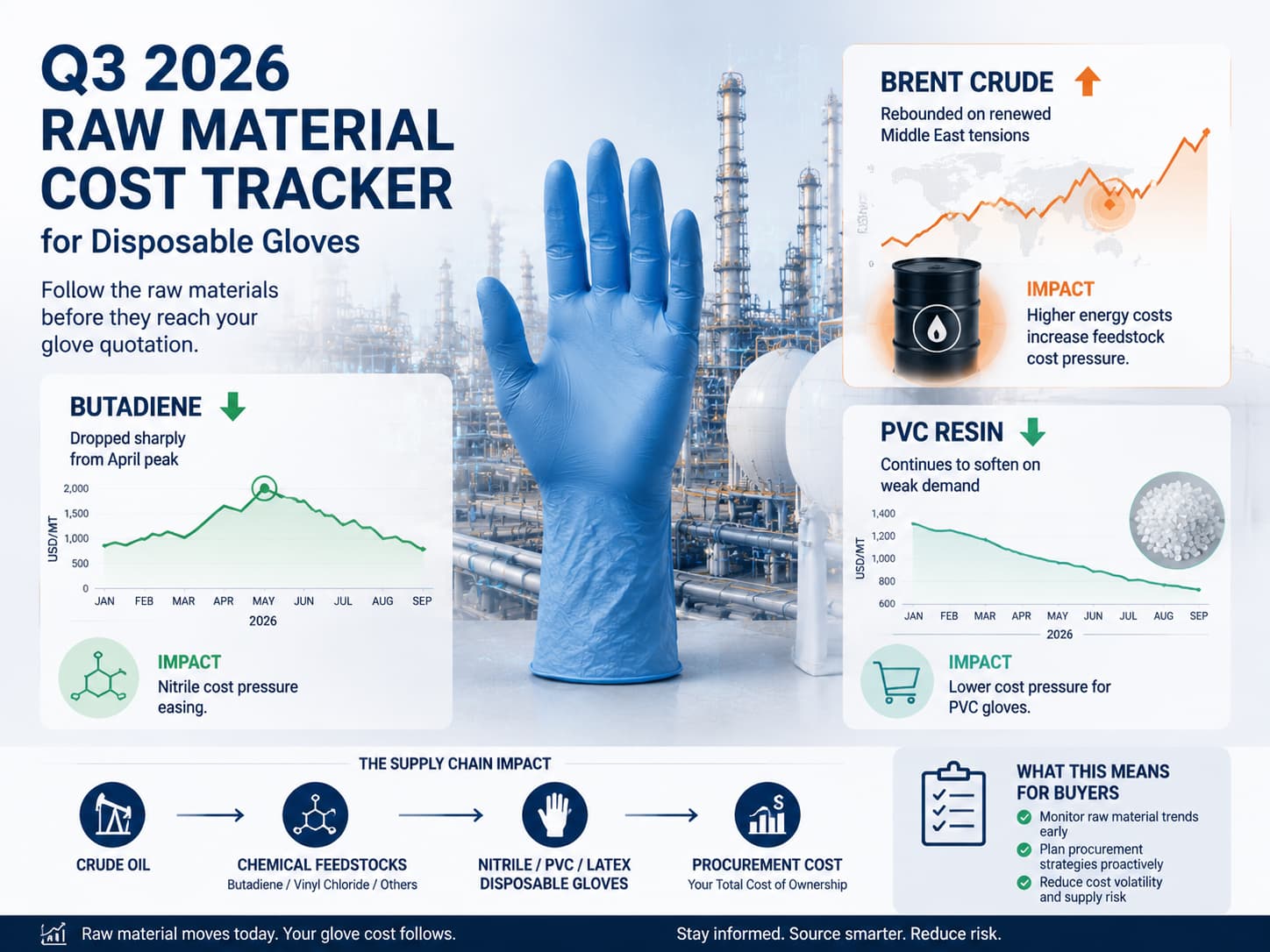
    In Q3 2026, the raw material basket for disposable gloves shows mixed trends: butadiene has dropped sharply from its April peak, Brent crude has rebounded on renewed Middle East tensions, and PVC resin continues to soften on weak demand. This tracker summarizes the key feedstock prices and their impact on nitrile, PVC, and latex gloves. 1. Cost Drivers This Quarter Brent crude is trading around $83-85/bbl (mid-July 2026, EIA), rebounding from early-July lows near $73/bbl as US-Iran tensions re-escalate and Strait of Hormuz disruptions persist. Butadiene has dropped approximately 30% from its April peak of ~$1,760/MT CFR China, but rebounded 18% within July on crude oil strength and cracker maintenance. Current CFR China: ~$1,230/MT (Echemi, Jul 15). Acrylonitrile prices are stable to slightly softer, with Chinese domestic prices around 9,400-10,500 RMB/MT (~$1,300-1,460/MT), as new capacity offsets feedstock cost increases. PVC resin continues to soften on weak downstream demand, with SG-5 prices around 4,100-5,000 RMB/MT (~$600-750/MT). The cost gap with nitrile rubber has widened, not narrowed. Ocean freight from Asia to Europe and the Middle East has stabilized but remains above pre-2024 levels. 2. Q3 2026 Raw Material Snapshot Material Price Range (Jul 2026) Change vs Q2 2026 Main Glove Application Brent crude $83-85 / bbl +5% to +10% (vs Jun avg) Feedstock for all petrochemical derivatives Butadiene (CFR China) $1,100-1,230 / MT -30% to -35% (vs Apr peak) Nitrile rubber Acrylonitrile (CFR China) $1,300-1,460 / MT -5% to -10% Nitrile rubber PVC resin (SG-5) $600-750 / MT -10% to -15% PVC / vinyl gloves Natural rubber latex (TSR20) $1,380-1,440 / MT -1% to +1% Latex gloves DOP/DEHP plasticizers $1,050-1,150 / MT -5% to -8% PVC glove plasticizers Sources: EIA (Brent weekly, Jul 17), Echemi (butadiene CFR China, Jul 15), SCI99 / 生意社 (domestic butadiene, Jul 21), 生意社 (PVC SG-5, acrylonitrile, Jul 20-22). Data collected Jul 20-22, 2026. Ranges are spot-market assessments and may vary by region. 3. Regional Impact on Glove Buyers Region Primary Cost Pressure Buyer Action Europe High energy and PVC costs; REACH compliance adds testing cost Lock Q3-Q4 prices early; request phthalate-free declarations Middle East / GCC Freight and import dependency; GSO testing requirements Consolidate shipments; verify GSO registration and CoC Southeast Asia Butadiene and acrylonitrile supply tightness Diversify supplier base; consider nitrile inventory coverage North America FDA compliance and freight; PVC phthalate scrutiny Audit plasticizer declarations; evaluate nitrile alternatives 4. Forward Outlook for Q4 2026 The forward outlook depends on three variables: the stability of oil flows through the Strait of Hormuz, the restart schedule of Asian butadiene crackers, and the pace of winter chlorine demand. If crude stays above $80/bbl and butadiene supply remains constrained by cracker maintenance, nitrile glove prices may see modest upward pressure despite the broader downward trend from Q2 peaks. PVC glove prices will be increasingly constrained by plasticizer regulation rather than raw material cost alone. 5. FAQ Q: Why do disposable glove prices follow oil prices? A: Nitrile, PVC, and latex gloves all depend on petrochemical or natural rubber feedstocks. Oil prices affect monomer costs, energy, and freight. Q: Which glove material is most affected by oil volatility? A: PVC and nitrile rubber are both highly oil-linked. Latex is less directly tied to crude but is affected by fertilizer and transportation costs. Q: What is the biggest cost in nitrile glove production? A: Raw nitrile rubber compound, driven by butadiene and acrylonitrile, typically accounts for 40-50% of finished glove cost. Q: Are PVC gloves becoming cheaper than nitrile? A: In Q3 2026, PVC resin has softened while butadiene has dropped ~30% from its April peak. The cost gap between PVC and nitrile gloves has widened slightly. The choice is increasingly driven by regulatory requirements (phthalate restrictions) rather than raw material cost alone. Q: How should buyers manage raw material risk? A: Use firm quarterly pricing, diversify suppliers, request transparent CoCs, and maintain 6-8 weeks of safety stock for critical SKUs.
  • Disposable Glove Receiving Inspection: Incoming Quality Assurance Checklist (2026)
    Disposable Glove Receiving Inspection: Incoming Quality Assurance Checklist (2026)
    Aug 21, 2026
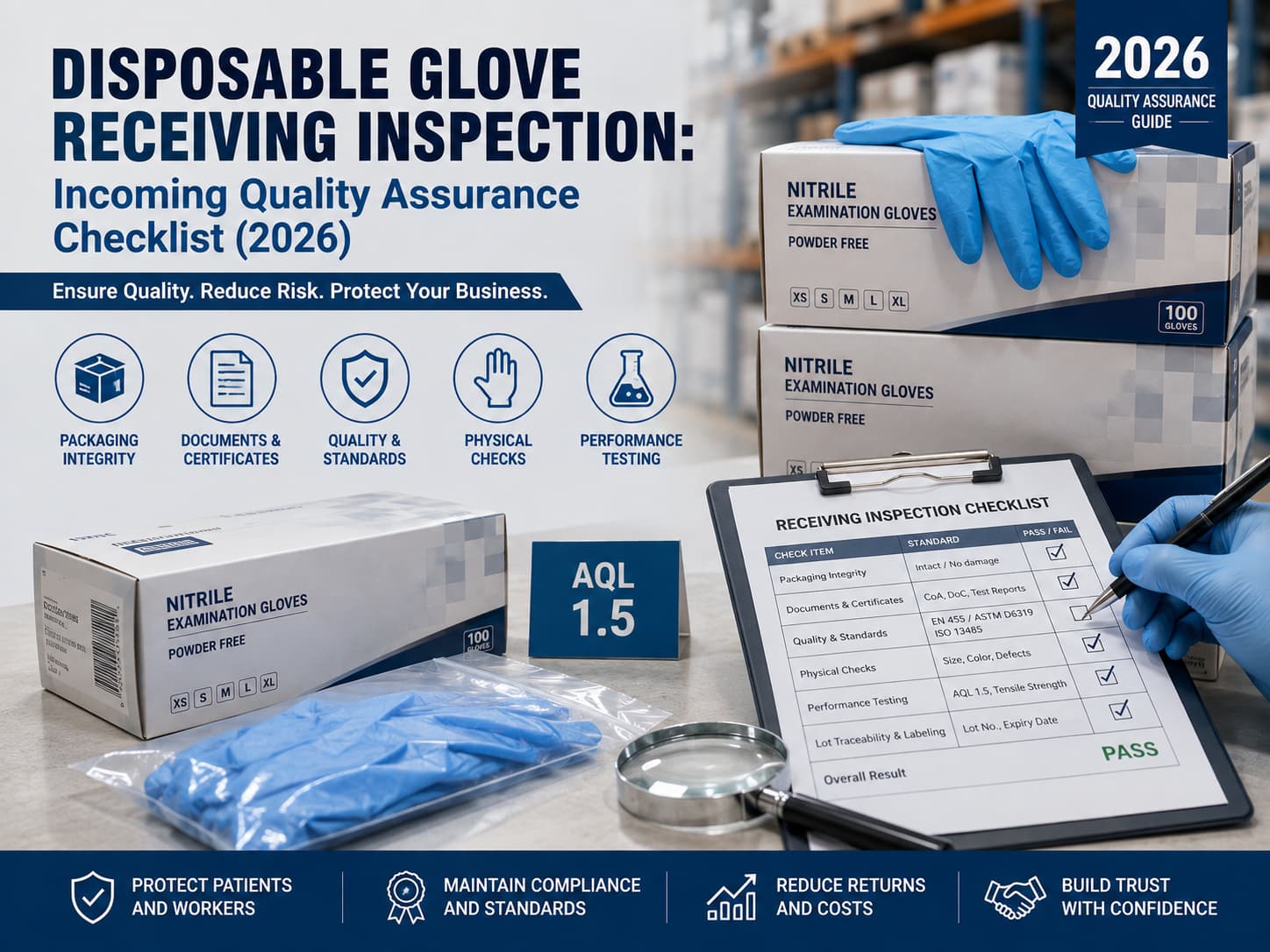
    Receiving inspection is the structured process of verifying that a delivered glove shipment matches the purchase order, the supplier's test claims, and the applicable standards - before the goods are accepted and paid for. It is the buyer's last independent checkpoint before quality problems become expensive problems. This guide covers the documents to verify, the visual checks, the statistical sampling plan, on-site tests, and the accept-hold-reject decision framework. 1. Direct Answer: What Receiving Inspection Is and Why It Matters Receiving inspection (incoming quality assurance, or AQA) is performed at the warehouse when goods arrive. Its purpose is to protect the buyer from three risks: (1) wrong or short product (incorrect size mix, count, or model), (2) non-conforming quality (failed AQL, damaged packaging, missing certifications), and (3) unverifiable claims (a supplier that says "compliant" but provides no batch evidence). In volatile markets, batch-level documentation and spot checks are the difference between catching a problem in 48 hours and discovering it after the gloves are already distributed to users. 2. Documents to Verify Before Opening Cartons Check the documents first - they determine what the shipment claims to be. Verify that lot numbers, quantities, and descriptions match the purchase order. Document What to check Why it matters Packing list Carton count, quantity, lot numbers, model/size mix Confirms shipment matches the PO Certificate of Conformity (CoC) / Analysis (CoA) Batch-level test results: AQL water leak, tensile strength, elongation, dimensions Proves the batch passed manufacturing QC Standards certificates EN 455, ASTM D6319, EN ISO 374, ISO 13485 (as applicable) Confirms the product is certified to the required standard EU Declaration of Conformity Product ID, standards cited, manufacturer signature Required for legal EU placement Labels / carton marking Size, quantity, lot number, expiry date, manufacturer ID, barcode/UDI Enables traceability and stock rotation Regulatory registration references FDA 510(k) K-number, EUDAMED UDI-DI for medical gloves Confirms legal market access 3. Visual Inspection of Cartons and Labels Carton condition: Check for crushing, water damage, or torn outer boxes. If outer cartons are damaged, inspect inner boxes before accepting. Label accuracy: Verify size, quantity, lot number, and expiry date printed on cartons match the packing list. Expired or near-expiry stock should be flagged. Lot consistency: Multiple lot numbers in one shipment are normal - but every lot must have its own CoC/CoA and test report. Single-lot shipments are easier to trace. Pallet and wrapping: Check for moisture, pests, or foreign objects. Document any anomalies with photos. 4. Statistical Sampling per ISO 2859-1 Sample size follows ISO 2859-1 (ANSI/ASQ Z1.4), using the lot size, the inspection level (typically General Level II), and the AQL from your contract (AQL 1.5 for medical exam gloves, AQL 2.5/4.0 for industrial). Examples for AQL 1.5, General Level II: Lot size (pieces) Sample size (pieces) Accept (Ac) Reject (Re) 2,801 - 8,000 125 5 6 8,001 - 22,000 200 7 8 22,001 - 110,000 315 10 11 110,001 - 500,000 500 14 15 500,001+ 800 21 22 Sample randomly from multiple cartons and multiple layers of the pallet - not from the first box you open. Record which cartons were sampled for traceability. Never reduce the sample size below the standard; the acceptance numbers lose their statistical meaning. 5. On-Site Physical Tests Several checks can be performed at the warehouse without laboratory equipment: Water leak (AQL) test: Fill a sampled glove with about 1,000 mL of water, hold 1-2 minutes, and check for droplets or wet spots. Any leak = barrier failure. Perform on a statistically valid sample. Visual defect check: Inspect sampled gloves for holes, tears, discoloration, embedded particles, or powder anomalies. Thickness spot check: If you have a micrometer, measure palm and finger thickness and compare to the TDS/specification (in mil or mm). Elasticity check: Gently stretch a sampled glove - it should return to shape without tearing or whitening (stress whitening indicates degraded polymer). Powder check (powder-free products): Shake a glove over dark fabric; visible powder residue indicates non-conformance. Laboratory tensile and elongation testing (ASTM D412 / EN 455-2) requires a tensile testing machine - for full verification, send samples to an ISO 17025 accredited laboratory. 6. Accept - Hold - Reject Decision Framework Decision Trigger Action ACCEPT All document, visual, and sampling checks pass Document results, release to stock, file the inspection report with the CoC/CoA HOLD Minor non-conformity: label misprints, damaged outer cartons with intact inner boxes, missing copies of certificates (verifiable) Quarantine the lot, notify the supplier, set a resolution deadline (e.g., 7 days) for replacement documents or re-labeling REJECT Failed AQL, wrong product/size mix, missing or non-matching certificates, expired or near-expiry stock Quarantine the lot, issue a written rejection with photos and test evidence, negotiate return/credit per contract, keep retain samples 7. Records and Traceability Every inspection produces a record. Keep at least: inspection date, PO number, supplier, lot numbers, sample size and acceptance/rejection result, on-site test results, photos of anomalies, and the disposition (accept/hold/reject). Retain samples from each inspected lot for 6-12 months for medical products. A complete inspection file is the evidence base for claims, audits, and regulatory inquiries - and it feeds directly into supplier scorecards for the next sourcing decision. Data sources: ISO 2859-1 (sampling procedures for inspection by attributes); EN 455 series; ASTM D6319 / D412; ISO 17025 (laboratory accreditation); EU MDR 2017/745 (UDI requirements). Sampling table values are from ISO 2859-1 General Inspection Level II, AQL 1.5. Information current as of August 2026. FAQ Q: What is a receiving inspection for disposable gloves and why is it important? A: Receiving inspection (incoming quality assurance) is the process of verifying that a delivered glove shipment matches the purchase order, the supplier's test claims, and the applicable standards BEFORE the goods are accepted and paid for. It matters because in volatile markets a meaningful share of shipments shows issues - wrong size mix, damaged cartons, missing batch reports, or in rare cases failed AQL. Accepting defective goods without evidence makes claims and returns much harder. A structured receiving inspection protects the buyer's quality, safety, and budget. Q: What documents must accompany a compliant glove shipment? A: A compliant shipment should include: (1) packing list with quantities, carton counts, and lot numbers; (2) Certificate of Conformity / Certificate of Analysis with batch-level test results (AQL water leak, tensile strength, elongation, dimensions); (3) applicable standards certificates (EN 455, ASTM D6319, ISO 13485, or EN ISO 374 for chemical gloves); (4) EU Declaration of Conformity if selling in the EU; (5) labels with size, lot number, expiry date, and manufacturer ID; and (6) for medical gloves, regulatory registration references such as FDA 510(k) K-number or EUDAMED UDI-DI. Verify that lot numbers on documents match lot numbers on cartons. Q: How many gloves should be sampled for an AQL inspection? A: Sampling follows ISO 2859-1 (ANSI/ASQ Z1.4). For a medical glove shipment with AQL 1.5 at General Inspection Level II, a lot of 35,001-150,000 gloves requires a sample of 315 gloves with acceptance number 10 and rejection number 11. For a smaller lot of 8,001-22,000 gloves, the sample is 200 gloves with acceptance 7 and rejection 8. Use the lot size and AQL from your contract to look up the correct sample size - never sample fewer than the standard requires, or the inspection loses statistical meaning. Q: Can we test the water leak (AQL) on-site at our warehouse? A: Yes, a basic on-site water leak test is feasible: fill a sampled glove with about 1,000 mL of water and inspect for droplets or wet spots after 1-2 minutes. Any leak means the glove fails barrier integrity. This catches gross defects such as holes and tears, but does not substitute for laboratory tensile and elongation testing, which requires a tensile testing machine. For full verification, send samples to an accredited laboratory (ISO 17025) and request the batch test report from the manufacturer. Q: What should we do if a shipment fails inspection? A: Follow a three-tier decision: (1) ACCEPT - all checks pass; document and release to stock. (2) HOLD - minor non-conformities such as label misprints or damaged outer cartons with intact inner boxes; quarantine, notify the supplier, and decide on rework or re-labeling with a time limit. (3) REJECT - failed AQL, wrong product, missing certificates, or non-conforming labeling; quarantine the lot, formally reject in writing, and negotiate return or credit per contract terms. Always photograph non-conformities, keep retain samples, and issue a written inspection report within 48 hours.  

  • Latex Protein Allergy and Glove Selection: Type I Reactions, Protein Testing, and Nitrile Alternatives (2026 Guide)
    Latex Protein Allergy and Glove Selection: Type I Reactions, Protein Testing, and Nitrile Alternatives (2026 Guide)
    Aug 25, 2026
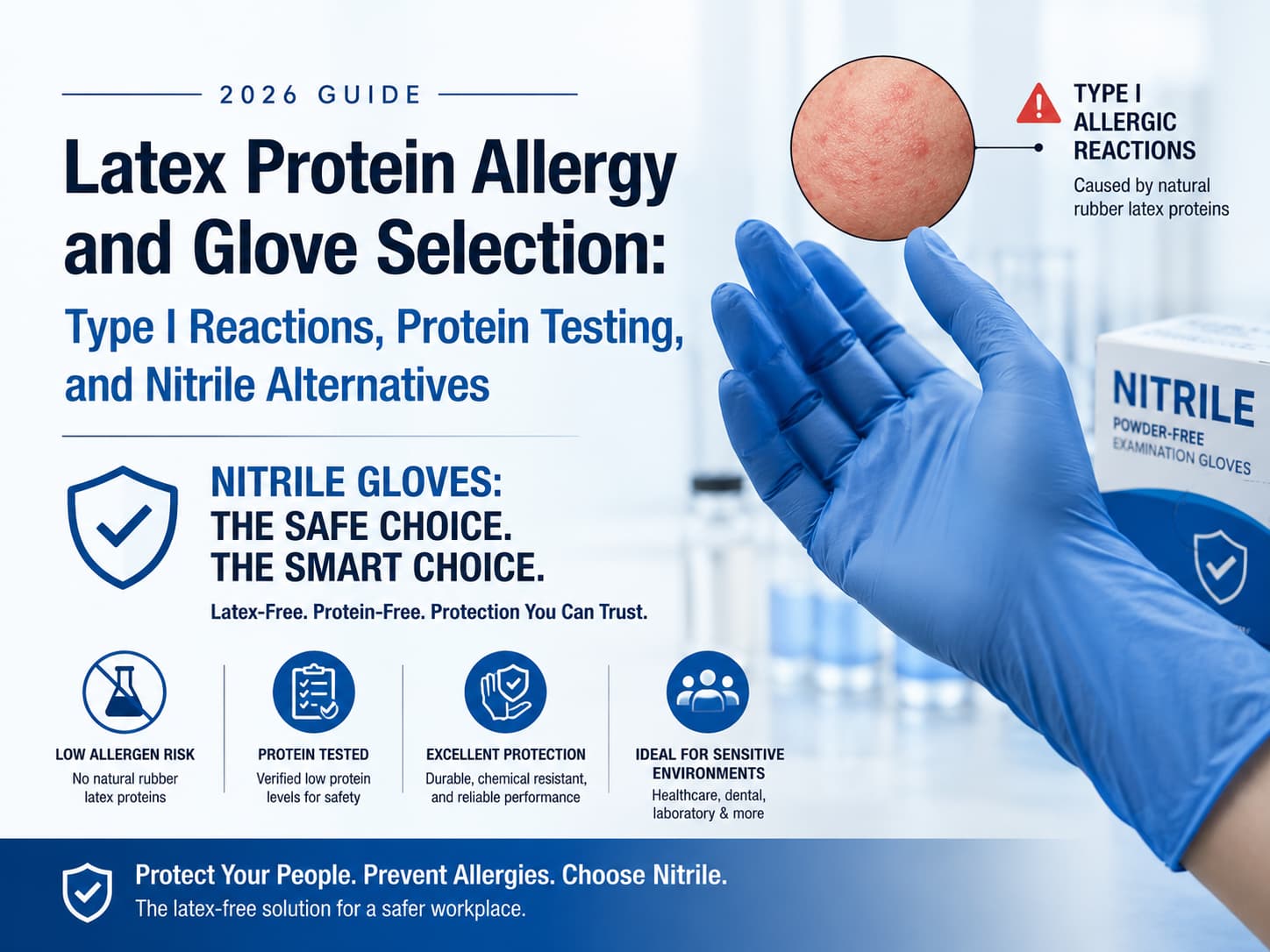
    Latex protein allergy is a Type I IgE-mediated reaction that can escalate from skin irritation to anaphylaxis. This guide explains how latex proteins trigger allergy, how protein testing works (ASTM D5712, ISO 12243), and why nitrile gloves are the safer, cost-effective choice for healthcare and industry in 2026. Latex protein allergy (Type I) is one of the most serious occupational health issues associated with medical gloves. Unlike contact dermatitis, which is a skin reaction, Type I latex allergy is an immediate hypersensitivity reaction mediated by immunoglobulin E (IgE). It can progress from hives to life-threatening anaphylaxis in minutes. This guide explains the science behind latex protein allergy, the testing used to quantify it, and why switching to nitrile rubber gloves has become standard practice in healthcare and industry. 1. What Is Type I Latex Protein Allergy? Latex gloves are made from natural rubber latex, a milky fluid harvested from the Hevea brasiliensis tree. This fluid naturally contains proteins, and some of these proteins are antigens: when they contact skin, mucous membranes, or the bloodstream, the immune system of sensitive individuals produces IgE antibodies. On re-exposure, the antibodies trigger the release of histamine and other chemicals, producing symptoms within minutes. Because Type I reactions are systemic and potentially fatal, they are distinct from Type IV contact dermatitis (a delayed T-cell-mediated reaction caused by chemicals such as accelerators). The table below summarizes the differences. Feature Type I (Immediate) Type IV (Delayed) Mechanism IgE-mediated T-cell mediated Trigger Latex proteins Accelerators, vulcanization chemicals Onset Minutes 6-48 hours Symptoms Hives, rhinitis, asthma, anaphylaxis Itchy rash, blisters, cracking Glove material involved Natural rubber latex Latex and nitrile (accelerator chemicals) Severity Can be life-threatening Usually local, rarely systemic Prevention Latex-free gloves (nitrile, PVC, TPE) Accelerator-free formulations 2. Who Is at Risk? Prevalence studies from the 1990s-2000s, when powdered latex gloves were widely used, reported latex protein sensitization in roughly 8-17% of healthcare workers with heavy exposure. Rates have fallen sharply in markets that moved to powder-free and low-protein gloves, but risk groups remain: Healthcare and dental workers with years of glove exposure Patients with spina bifida or repeated surgeries (frequent latex exposure via catheters and gloves) Workers in laboratories, food processing, and cleaning who wear latex gloves daily Atopic individuals (those with existing allergies, eczema, or asthma) Workers in glove manufacturing itself 3. Symptoms and Diagnosis Type I reactions present across three severity levels: Skin: contact urticaria (hives) within minutes at the contact site Respiratory: sneezing, runny nose, itchy eyes, asthma-like wheezing Systemic: angioedema, hypotension, anaphylaxis (medical emergency) Diagnosis is confirmed by an allergist using skin-prick tests with latex extract, specific IgE blood tests, or a supervised glove-use test. Anyone with suspected latex allergy should be evaluated before anaphylaxis occurs, and should carry an epinephrine auto-injector if confirmed. 4. Protein Testing Standards Because proteins are the trigger, quantifying them is the core of latex glove safety. Three methods dominate: ASTM D5712: modified Lowry method for analysis of protein in natural rubber and its products; the most commonly cited test for water-extractable protein on glove surfaces ISO 12243: determination of water-extractable protein in medical gloves made from natural rubber latex using the modified Lowry method; a harmonized approach for international markets EN 455-3: the EU biological evaluation standard, which requires protein testing (extractable latex proteins play a central role in latex allergy) plus powder and endotoxin limits Buyers should request the protein test report (usually expressed in micrograms per gram, mg/g, or micrograms per square decimeter) with every latex glove batch. Powder-free latex gloves typically have far lower protein content than powdered ones, because powder binds and carries proteins into the air, where they are inhaled. 5. Regulatory Actions Against Latex Exposure FDA ban on powdered surgeon and powdered patient examination gloves (effective January 2017) because powder increases protein exposure and aerosolization EU medical device rules (currently Regulation (EU) 2017/745) require biocompatibility evaluation of gloves, including sensitization testing under ISO 10993-10 WHO and CDC guidance has long recommended latex-free protocols where Type I allergy risk exists Many hospitals and food facilities have adopted 100% latex-free policies for this reason 6. Why Nitrile Rubber Gloves Are the Safer Choice Nitrile rubber (acrylonitrile butadiene rubber, ACN + butadiene) is a synthetic polymer that contains no latex proteins at all. It delivers the barrier performance that latex is famous for, without the allergy risk. Property Natural rubber latex Nitrile rubber Latex proteins Present - Type I allergy risk None Barrier vs pathogens Excellent (EN 455 certified) Excellent (EN 455 / ASTM D6319 certified) Chemical resistance Moderate Better (oils, solvents, many chemicals) Puncture resistance Good Better Tensile strength Very high (18+ MPa typical) High (14+ MPa per ASTM D6319) Elongation Very high (650-700%+) 400-600% Cost (2026) Moderate Competitive; premium in acute shortages Type IV risk Low-moderate Low-moderate (accelerator chemicals; accelerator-free options exist) The practical result: nitrile gloves now dominate medical examination, dental, laboratory, food service, and industrial applications in most markets. 7. Building a Latex-Free Procurement Policy Audit current usage: identify every latex glove and latex-containing product (catheters, tourniquets, bandages) in the facility Choose alternatives: nitrile rubber for exam and general tasks; PVC or TPE for low-risk food handling; specialized gloves for chemo and cleaning Verify certification: EN 455 (EU) or ASTM D6319 with FDA 510(k) (US) for medical use; keep batch test reports on file Train staff: communicate the difference between Type I and Type IV, and how to recognize symptoms Label high-risk areas: maintain clearly marked latex-free zones in ORs, dental suites, and allergy clinics Review TDS data: request protein test reports from any supplier that still supplies latex gloves Data sources: prevalence literature on latex protein sensitization (8-17% in high-exposure healthcare workers, pre-powder-free transition); FDA final rule banning powdered gloves (2016, effective 2017); ASTM D5712; ISO 12243; EN 455-3; EN ISO 21420 (formerly EN 420) for general glove requirements; ISO 10993-10. Information current as of August 2026; verify regulatory status before procurement decisions. FAQ Q: What is the difference between Type I and Type IV glove allergies? A: Type I is an immediate IgE-mediated reaction to latex proteins, with symptoms appearing within minutes (hives, rhinitis, asthma, and in severe cases anaphylaxis). Type IV is a delayed T-cell-mediated contact dermatitis caused by chemicals such as accelerators, appearing 6-48 hours after exposure, and it can affect both latex and nitrile glove wearers. Nitrile gloves eliminate Type I risk (no latex proteins) but some users may still develop Type IV reactions to accelerator chemicals, which is why accelerator-free nitrile gloves exist. Q: How do I know if I am allergic to latex? A: A doctor (allergist) can confirm latex allergy with a skin-prick test using latex extract, a specific IgE blood test, or a supervised glove-use test. Common signs include hives where the glove touched the skin, sneezing, itchy eyes, or wheezing within minutes of putting on a latex glove. Anyone with suspected Type I latex allergy should be formally evaluated, because repeated exposure can escalate from mild symptoms to anaphylaxis. Q: Can nitrile gloves cause latex allergy? A: No. Nitrile rubber (acrylonitrile butadiene rubber, ACN + butadiene) is fully synthetic and contains no latex proteins, so it cannot trigger Type I latex allergy. Nitrile gloves are the standard replacement for latex in healthcare, dental, laboratory, and food settings. Note that a small number of users may develop Type IV contact dermatitis from accelerator chemicals in nitrile gloves; accelerator-free formulations are available for these cases. Q: Do powder-free latex gloves still carry allergy risk? A: Yes, a reduced but real risk. Powder-free latex gloves have much lower protein content and produce far less airborne protein than powdered gloves, which is why sensitization rates fell after the FDA powdered-glove ban (effective January 2017). But even low-protein latex can trigger symptoms in already-sensitized individuals. For facilities with any Type I allergy concern, latex-free nitrile gloves remain the safer choice. Q: What protein tests should a buyer request from a latex glove supplier? A: Request batch-level reports for ASTM D5712 (modified Lowry, water-extractable protein) and, for EU shipments, evidence of EN 455-3 compliance which covers protein, powder, and endotoxin testing. ISO 12243 is the international method for the same modified Lowry analysis. Check that the protein value is expressed in a clear unit (e.g., micrograms per gram or per square decimeter) and that the report covers the specific batch being shipped, not a historical sample.  
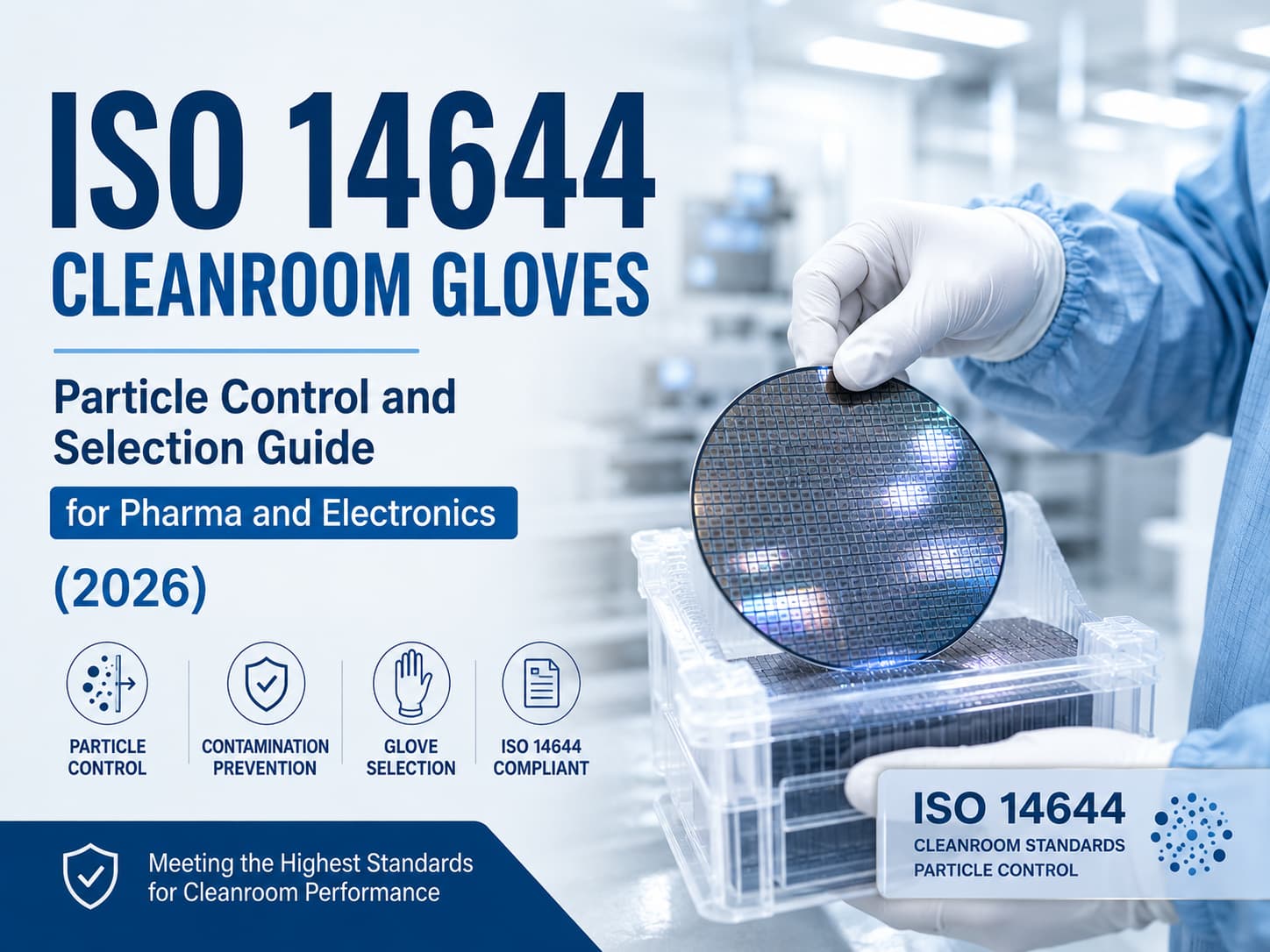
  • ISO 14644 Cleanroom Gloves: Particle Control and Selection Guide for Pharma and Electronics (2026)
    ISO 14644 Cleanroom Gloves: Particle Control and Selection Guide for Pharma and Electronics (2026)
    Aug 31, 2026
    ISO 14644 cleanroom gloves are disposable gloves engineered for controlled environments where airborne particles must be minimized. This guide explains cleanroom classifications, particle limits, material selection, and testing standards for pharmaceutical and electronics manufacturing. ISO 14644 cleanroom gloves are disposable gloves designed and manufactured for controlled environments where airborne particles, ionic contamination, and extractable residues must be kept within strict limits. Unlike general medical or industrial gloves, cleanroom gloves are washed, packaged, and tested specifically to reduce particle shedding and outgassing. They are used in pharmaceutical compounding, semiconductor fabrication, aerospace assembly, biotechnology, and medical device manufacturing. This guide explains the ISO 14644 classification system, how to match a glove to a cleanroom class, and what testing data buyers should request. 1. What Is ISO 14644? ISO 14644 is the international family of standards for cleanrooms and associated controlled environments. Part 1 (ISO 14644-1:2015) defines cleanroom classes by the maximum concentration of airborne particles per cubic meter. The lower the class number, the cleaner the environment. Gloves used in these rooms must themselves not become a particle source. ISO 14644-1 class Max particles >= 0.5 micrometres / m3 Max particles >= 5.0 micrometres / m3 Typical glove requirement ISO Class 3 35 0 (not defined) Specialized gloves; very low particle shedding ISO Class 4 352 3 Low-shedding nitrile or latex ISO Class 5 3,520 29 High-quality nitrile, double-bagged ISO Class 6 35,200 293 Nitrile or latex, cleaned and packaged ISO Class 7 352,000 2,930 Standard cleanroom-grade gloves ISO Class 8 3,520,000 29,300 Cleanroom-compatible gloves 2. Why Gloves Matter in a Cleanroom A human hand is a major source of particles, skin flakes, oils, and microorganisms. A glove is the barrier between the operator and the product. But if the glove itself sheds particles, releases plasticizers, or holds ionic residues, it becomes a contamination source. Cleanroom gloves are therefore subjected to additional controls beyond standard medical glove testing: Particle shedding: measured by methods such as IEST-RP-CC005 to count particles released during wear or flexing Ionic contamination: tested for chloride, sodium, potassium, and other ions that can corrode electronics Non-volatile residue (NVR): measures extractable organic and inorganic residues left after solvent extraction Silicone and amide content: critical for electronics and aerospace where residue causes defects Bioburden: especially important for aseptic pharmaceutical operations 3. Material Selection: Nitrile, Latex, and PVC Most cleanroom gloves are made from nitrile rubber or natural rubber latex. PVC is rarely used in high-grade cleanrooms because of plasticizer migration and higher particle counts. The table below compares the three materials for cleanroom use. Material Particle shedding Chemical resistance Allergy risk Common cleanroom use Nitrile rubber Low (especially chlorinated, powder-free) Good (oils, solvents) Type I latex-free; low Type IV with accelerator-free grades Semiconductor, pharma, biotech Natural rubber latex Very low in high-grade cleanroom grades Moderate Type I protein allergy risk Pharma, laboratory (declining due to allergy policy) PVC / vinyl Higher than nitrile/latex Limited Low protein risk; plasticizer concerns Low-grade controlled areas only 4. Thickness and Dexterity Cleanroom work often involves handling small components, vials, or wafers. Glove thickness is therefore a trade-off between tactile sensitivity and chemical or tear resistance. Cleanroom gloves are typically 3.5-6.0 mil (0.09-0.15 mm) in thickness. Dexterity ratings under EN ISO 21420 (formerly EN 420) range from 1 to 5, with 5 being the most dexterous; cleanroom tasks usually require dexterity level 4 or 5. 5. Standards and Test Methods to Request Buyers should ask suppliers for cleanroom-specific test reports in addition to standard medical glove certificates: ISO 14644-1: confirms the target cleanroom class the glove is suitable for IEST-RP-CC005: recommended practice for glove and finger cot testing in cleanrooms, covering particles, extractables, and ions ASTM D6319 or EN 455: baseline medical/examination glove physical properties ISO 10993-5 / ISO 10993-10: cytotoxicity and sensitization testing EN ISO 21420 (formerly EN 420): general glove requirements including pH, innocuousness, and dexterity 6. Packaging and Handling Rules Even a clean glove becomes contaminated if it is not packaged correctly. Cleanroom gloves are typically: Cleaned with deionized water to remove surface particles and ions Packaged in double bags so the outer bag can be removed before entering the cleaner zone Labeled with lot number, manufacturing date, expiry date, and cleanroom class claim Stored away from direct light, heat, and humidity to prevent material degradation 7. Buyer Checklist for Cleanroom Glove Procurement Define the cleanroom class: match the glove to the ISO 14644-1 class of your operation Request particle and ionic test data: do not rely only on medical glove certificates Choose nitrile for high-grade rooms: nitrile rubber gloves offer the best balance of low shedding, chemical resistance, and latex-free safety Verify accelerator-free options: if operators show Type IV sensitivity, specify accelerator-free nitrile Check double-bagging and labeling: ensure the packaging supports your entry protocol Audit the supplier's cleanroom washing line: not every glove factory has dedicated cleanroom finishing equipment Data sources: ISO 14644-1:2015; IEST-RP-CC005; EN ISO 21420:2020 (formerly EN 420); ASTM D6319; EN 455 series; ISO 10993 series. Information current as of August 2026; verify specific cleanroom requirements with your facility qualification. FAQ Q: What is the difference between ISO 14644-1 Class 5 and Class 7 cleanroom gloves? A: The difference is the maximum allowable particle concentration. ISO Class 5 permits no more than 3,520 particles of 0.5 micrometres or larger per cubic metre, while ISO Class 7 permits up to 352,000 such particles. Gloves for Class 5 must release far fewer particles during flexing and wear, so they are usually higher-grade nitrile or latex that has been washed and double-bagged. Class 7 gloves can be standard cleanroom-compatible gloves with less stringent particle limits. Q: Are latex gloves allowed in cleanrooms? A: Yes, but their use is declining. Natural rubber latex gloves can be manufactured to very low particle-shedding levels and are still used in some pharmaceutical and laboratory cleanrooms. However, they carry a Type I latex protein allergy risk, so many facilities have moved to latex-free nitrile gloves to protect operators and avoid protein contamination. Q: What tests prove a glove is suitable for a cleanroom? A: The most common cleanroom-specific tests are IEST-RP-CC005 (particle shedding, extractables, and ionic contamination), non-volatile residue (NVR) testing, and silicone/amide analysis for electronics. Buyers should also request baseline medical glove data such as ASTM D6319 or EN 455 physical properties, plus ISO 10993 biocompatibility reports. Q: Can I use standard medical nitrile gloves in a cleanroom? A: Not without verification. Standard medical nitrile gloves may meet ASTM D6319 or EN 455 for barrier and strength, but they are not necessarily washed or packaged to reduce particle shedding. For cleanroom use, you need gloves that have been specifically processed, tested for particles and ions, and double-bagged for cleanroom entry. Q: Why is double-bagging important for cleanroom gloves? A: Double-bagging creates a buffer between the outer shipping carton - which has been exposed to warehouse and transport environments - and the clean interior. The outer bag is removed before the gloves enter the cleaner zone, reducing the risk that cardboard dust, fibres, or other contaminants are carried into the controlled environment.  
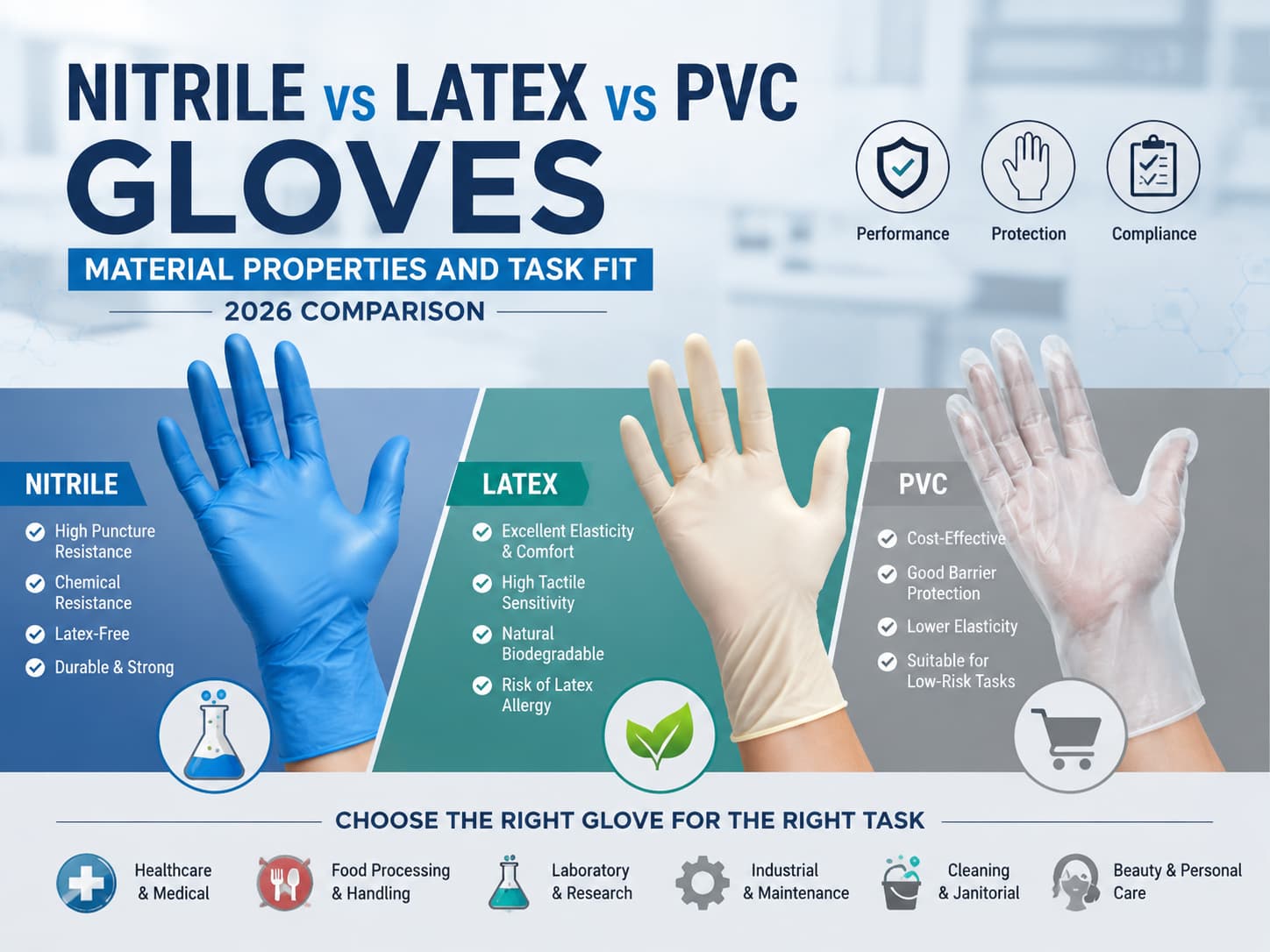
  • Nitrile vs Latex vs PVC Gloves - Material Properties and Task Fit (2026 Comparison)
    Nitrile vs Latex vs PVC Gloves - Material Properties and Task Fit (2026 Comparison)
    Sep 03, 2026
    Nitrile, latex, and PVC gloves each have different strengths. This comparison explains the chemistry, barrier performance, allergy risks, and best-use tasks for each material so buyers can match the glove to the job. The three most common disposable glove materials - nitrile rubber, natural rubber latex, and polyvinyl chloride (PVC) - are not interchangeable. Each has a different polymer structure, barrier profile, elasticity, allergy risk, and cost base. The right choice depends on the task, the regulatory environment, and the user population. This guide compares the materials side by side and provides a task-based selection framework. 1. The Chemistry in One Sentence Nitrile rubber is acrylonitrile butadiene rubber (ACN + butadiene), a synthetic polymer with no latex proteins Natural rubber latex is a plant-derived polymer harvested from Hevea brasiliensis trees; it contains proteins that can trigger Type I allergy PVC is a thermoplastic polymer made from vinyl chloride monomer, softened with plasticizers such as phthalates or DINCH for glove use 2. Side-by-Side Material Comparison Property Nitrile rubber Natural rubber latex PVC / vinyl Source Synthetic (ACN + butadiene) Natural (Hevea tree latex) Synthetic (vinyl chloride) Latex proteins None Present None Tensile strength High (>= 14 MPa per ASTM D6319) Very high (18-24 MPa typical) Moderate (8-13 MPa typical) Elongation at break 400-600% 650-750% 250-350% Puncture resistance Excellent Good Lower Chemical resistance Best (oils, solvents, many chemicals) Moderate Limited (better with acids/bases) Tactile sensitivity Very good, especially thin grades Excellent Fair Allergy risk Type I: none; Type IV: possible (accelerator chemicals) Type I: yes; Type IV: possible Type I: none; plasticizer/Type IV: possible Cost position (2026) Mid-to-premium Moderate Lowest Common thickness 3-8 mil (0.08-0.20 mm) 3-7 mil (0.08-0.18 mm) 3-5 mil (0.08-0.13 mm) 3. Barrier Performance Against Pathogens and Chemicals For medical and food safety, the most important question is whether the glove blocks pathogens and the chemicals it will contact. Nitrile rubber generally outperforms latex and PVC for oils, solvents, and many hospital chemicals. Latex has excellent barrier properties for biological fluids but is degraded by oils. PVC is acceptable for low-risk tasks and short-duration contact but has lower puncture resistance and can soften or leak under stress. 4. Allergy Considerations Type I latex allergy is the headline risk for natural rubber latex gloves. It can cause hives, respiratory symptoms, and anaphylaxis. Nitrile and PVC gloves eliminate this risk. However, nitrile gloves can still trigger Type IV contact dermatitis in some users because of accelerator chemicals such as thiurams, carbamates, and mercaptobenzothiazole (MBT). Accelerator-free nitrile gloves are available for sensitive users. 5. Cost and Supply Factors in 2026 Raw material costs influence glove pricing. Nitrile rubber depends on acrylonitrile and butadiene, both petrochemical derivatives; prices can rise with crude oil and cracker economics. Natural rubber latex depends on plantation supply, weather, and the TSR20 price. PVC is tied to PVC resin and plasticizer costs, which are generally the lowest of the three. As of late August 2026, Brent crude has risen above $89/barrel on Middle East tensions, putting upward pressure on nitrile feedstock costs, while PVC resin remains relatively soft. 6. Task-Based Selection Guide Task / Industry Recommended material Why Medical examination Nitrile rubber Latex-free, strong barrier, puncture-resistant, meets ASTM D6319 / EN 455 Surgery Natural rubber latex or synthetic polyisoprene Best tactile sensitivity and elasticity; low-protein powder-free grades required Chemotherapy handling Thick nitrile (ASTM D6978 tested) Resists permeation by oncology drugs Food handling Nitrile or PVC Cost-effective, complies with FDA 21 CFR 177.2600 / EU 1935/2004 Industrial / automotive Nitrile Oil and solvent resistance Cleanroom / electronics Powder-free nitrile or latex Low particle shedding; chemical compatibility Short low-risk cleaning PVC Lowest cost; adequate for brief contact Tattoo / beauty Nitrile Barrier to inks and blood; latex-free for client safety 7. Procurement Checklist Assess the hazard: biological, chemical, mechanical, or combination Screen users for latex allergy: if any risk exists, default to nitrile or PVC Match thickness to task: 3-4 mil for dexterity; 6-8 mil for durability Request certifications: EN 455 or ASTM D6319 for medical; FDA 21 CFR 177.2600 or EU 1935/2004 for food Consider accelerator-free nitrile: for users with Type IV dermatitis Check raw material trends: lock in pricing when butadiene/ACN costs are rising Data sources: ASTM D6319; EN 455 series; EN ISO 21420:2020 (formerly EN 420); FDA 21 CFR 177.2600; EU 1935/2004; ASTM D6978; material property data from major glove manufacturers. Information current as of August 2026. FAQ Q: Which glove material is best for chemical resistance? A: Nitrile rubber generally offers the best chemical resistance among the three common disposable glove materials, especially against oils, greases, solvents, and many hospital chemicals. Latex performs well against biological fluids but is degraded by oils and hydrocarbons. PVC has limited chemical resistance and is best for short-duration, low-risk contact. Q: Are nitrile gloves completely allergy-free? A: Nitrile gloves eliminate Type I latex allergy because they contain no latex proteins. However, some users may develop Type IV contact dermatitis from accelerator chemicals used in the vulcanization process, such as thiurams, carbamates, and mercaptobenzothiazole (MBT). Accelerator-free nitrile gloves are available for these users. Q: Why are PVC gloves cheaper than nitrile and latex? A: PVC gloves are cheaper because PVC resin and plasticizer raw materials are generally lower-cost than nitrile rubber monomers (acrylonitrile and butadiene) or natural rubber latex. They are also simpler to manufacture. The trade-off is lower puncture resistance, lower elasticity, and more limited chemical resistance. Q: Can latex gloves be used for food handling? A: Yes, powder-free latex gloves can be used for food handling where permitted, but many food businesses avoid them because of Type I latex allergy risk among workers and customers. Nitrile and PVC are more common choices in food service because they are latex-free. Q: Which material has the best tactile sensitivity? A: Natural rubber latex has the best tactile sensitivity and elasticity, which is why it remains preferred for surgical applications. Modern thin nitrile gloves (3-4 mil) can approach latex-like sensitivity for most examination tasks, while PVC is generally less tactile.  
Contact Us
Unit 1301-1, No. 3, Xixishan Wei Road, Software Park phase III, Torch High-tech Zone,Xiamen City, Fujian Province, China
+86-592-6511055
+86 -15750719843
Subscribe

Copyright 2026@ Fujian Jixiang E-commerce Co., Ltd All Rights Reserved. Sitemap | Blog | Xml | Privacy Policy Network Supported

leave a message

Leave A Message
If you are interested in our products and want to know more details,please leave a message here,we will reply you as soon as we can.
Submit

Home

Products

whatsApp

contact