
welcome to Jixiang E-commerce!
welcome to Jixiang E-commerce!
Proper donning and doffing of disposable gloves is the single most effective way to prevent cross-contamination. This step-by-step guide covers correct technique, common mistakes, and special scenarios for healthcare, food processing, and industrial use.
Proper donning and doffing of disposable gloves is the single most effective — and most frequently overlooked — step in preventing cross-contamination. Studies show that up to 60% of glove users make at least one critical error during glove removal, turning the glove itself into a vehicle for pathogen transmission rather than a barrier against it.
1. Why Donning and Doffing Technique Matters
Gloves are not a substitute for hand hygiene — they are a supplement to it. The World Health Organization (WHO) and CDC both emphasize that gloves must be changed between tasks, and hands must be cleaned immediately after glove removal. The glove is only as effective as the technique used to put it on and take it off.
The most common failure mode is not glove perforation during use — it is contamination of the user's own hands during removal. When gloves are pulled off incorrectly, pathogens on the glove exterior can transfer directly to skin, completely defeating the purpose of wearing gloves.
2. Before You Start: Hand Hygiene
Always wash hands with soap and water (or use alcohol-based hand rub with at least 60% ethanol) before donning gloves. This prevents trapping bacteria against the skin if the glove develops a micro-perforation during use. Dry hands thoroughly — moisture significantly reduces glove donning ease and can cause the glove to tear.
3. Step-by-Step: Correct Donning Procedure
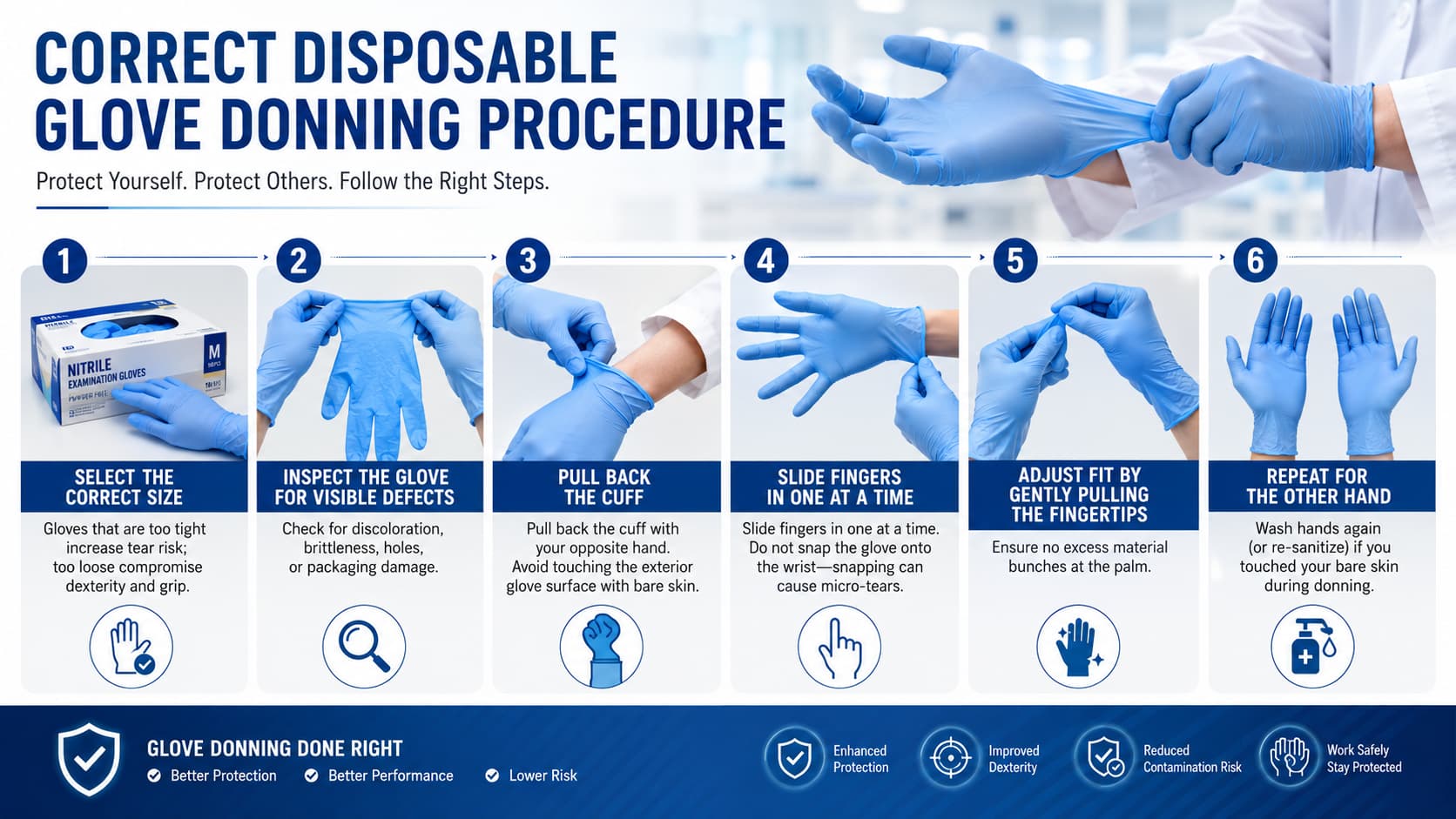
Step 1: Select the correct size. Gloves that are too tight increase tear risk; too loose compromise dexterity and grip.
Step 2: Inspect the glove for visible defects — discoloration, brittleness, or packaging damage.
Step 3: Pull back the cuff with your opposite hand. Avoid touching the exterior glove surface with bare skin.
Step 4: Slide fingers in one at a time. Do not snap the glove onto the wrist — snapping can cause micro-tears.
Step 5: Adjust fit by gently pulling the fingertips. Ensure no excess material bunches at the palm.
Step 6: Repeat for the other hand. Wash hands again (or re-sanitize) if you touched your bare skin during donning.
4. Step-by-Step: Correct Doffing Procedure (CDC Method)
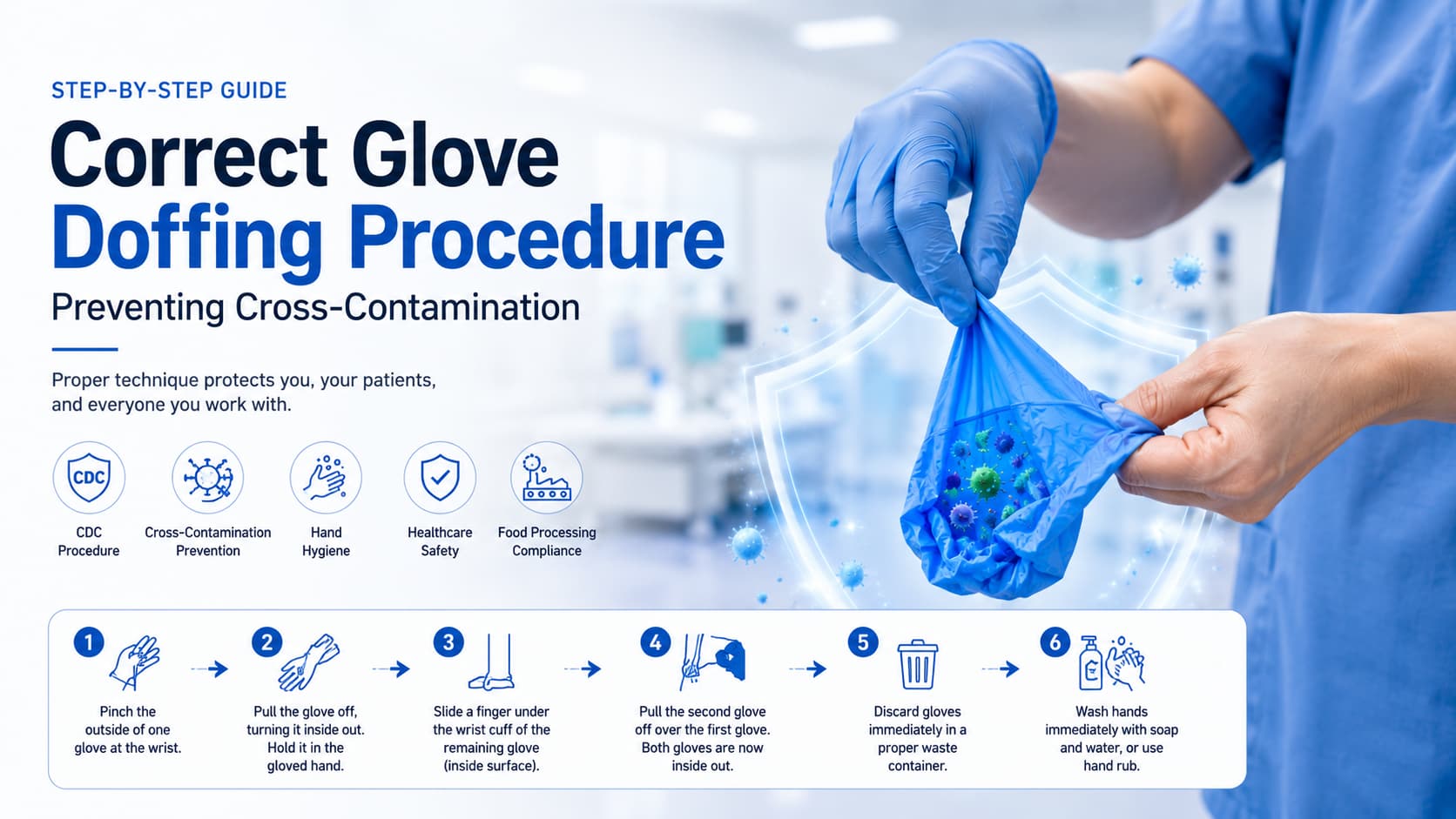
The doffing step is where most contamination occurs. Follow this sequence exactly:
Step 1: Pinch the outside of one glove at the wrist — use the opposite gloved hand.
Step 2: Pull the glove off, turning it inside out as you remove it. Hold the removed glove in the still-gloved hand.
Step 3: Slide a finger under the wrist cuff of the remaining glove — from the inside surface (the skin-contact side, which is clean).
Step 4: Pull the second glove off over the first glove, so both gloves are now contained inside out in one bundle.
Step 5: Discard gloves immediately in a proper waste container. Do not reuse.
Step 6: Wash hands immediately with soap and water, or use alcohol-based hand rub.
5. Common Mistakes That Cause Contamination
|
Mistake |
Why It Matters |
Correct Approach |
|
Touching glove exterior with bare skin during donning |
Transfers pathogens before use begins |
Use glove dispenser; touch only cuff |
|
Snapping gloves onto wrists |
Causes micro-tears invisible to naked eye |
Roll on gently; never snap |
|
Pulling fingers first when removing |
Exterior surface touches bare skin |
Always pinch at wrist/cuff area |
|
Reusing "clean-looking" gloves |
Micro-perforations increase with use |
Single-use only; discard after task |
|
Not washing hands after removal |
Residual contamination on hands |
Hand hygiene is mandatory after doffing |
|
Wearing gloves for >4 hours continuously |
Moisture buildup increases perforation risk |
Change gloves every 2–4 hours |
6. Special Scenarios
Rings and jewelry: Remove rings before donning gloves. Rings can puncture gloves and harbor bacteria under the band. If removal is not possible (e.g., wedding band), choose a glove size that accommodates the jewelry without overstretching.
Long nails: Nails longer than 2mm increase glove perforation risk by ~30% (source: Journal of Hospital Infection, 2024). Keep nails short and smooth. Artificial nails are not recommended in healthcare or food handling settings.
Wet hands: Never don gloves on wet hands. Moisture weakens the glove material and creates a breeding ground for bacteria inside the glove. Dry hands completely before donning.
7. Double-Gloving: When and How
Double-gloving (wearing two pairs of gloves) is recommended for high-risk procedures in healthcare and certain chemical handling scenarios. The inner glove catches any perforation in the outer glove, providing a visible alert (if colored gloves are used) or at minimum a secondary barrier.
Proper double-gloving technique: Don the first (inner) glove normally. Don the second (outer) glove, ensuring the cuff of the outer glove overlaps the inner glove cuff by at least 2cm. When doffing, remove the outer glove first using the standard method, then remove the inner glove.
8. Glove Dispenser Design and Cross-Contamination
The glove dispenser itself is an overlooked source of contamination. Touch-free dispensers (where users pull gloves without contacting the dispenser exterior) reduce cross-contamination risk by ~45% compared to standard box dispensers (source: Infection Control Journal, 2025).
Best practices for dispenser placement:
• Place dispensers at all hand-washing stations
• Use wall-mounted dispensers to avoid countertop contamination
• Restock before the box is completely empty (to avoid aggressive handling)
• Clean dispenser exterior daily with approved disinfectant
Summary: The 4 Rules of Proper Glove Use
1. Clean hands before donning.
2. Don gloves correctly — no snapping, no touching the exterior.
3. Remove gloves using the cuff-pinch method — exterior never touches bare skin.
4. Clean hands immediately after removal. Discard gloves after single use.
FAQ
Q1: How long can I wear disposable gloves continuously?
A: For most applications, change gloves every 2–4 hours. In healthcare settings, gloves must be changed between every patient. In food handling, change gloves every time you switch tasks or after any contamination event.
Q2: Can I wash disposable gloves with soap and water?
A: No. Disposable gloves (nitrile, latex, vinyl) are designed for single use. Washing can degrade the material and does not eliminate contamination.
Q3: What is the correct way to remove gloves without touching the contaminated surface?
A: Pinch the glove at the wrist (exterior surface), pull off inside-out, then use the still-gloved hand to pull the second glove from the inside cuff. Both gloves end up inside-out in one bundle.
Q4: Are nitrile gloves easier to don than latex?
A: Nitrile gloves are naturally less elastic than latex, which can make donning slightly more difficult. Powder-free nitrile gloves may benefit from a polymer coating (chlorination or polymer finish) to improve donning ease.
Q5: Should I use glove liners underneath disposable gloves?
A: Liners can improve comfort for extended wear and reduce allergic contact dermatitis. However, they add cost and may reduce dexterity. For most standard applications, liners are not necessary.
Related reading: EN 455-1 covers freedom-from-holes testing (AQL); proper donning technique helps maintain that integrity in real-world use.
Please read on, stay posted, subscribe, and we welcome you to tell us what you think.


Copyright 2026@ Fujian Jixiang E-commerce Co., Ltd All Rights Reserved.
Sitemap |
Blog
|
Xml |
Privacy Policy
 Network Supported