
welcome to Jixiang E-commerce!
welcome to Jixiang E-commerce!
ISO 14644 cleanroom gloves are disposable gloves engineered for controlled environments where airborne particles must be minimized. This guide explains cleanroom classifications, particle limits, material selection, and testing standards for pharmaceutical and electronics manufacturing.
ISO 14644 cleanroom gloves are disposable gloves designed and manufactured for controlled environments where airborne particles, ionic contamination, and extractable residues must be kept within strict limits. Unlike general medical or industrial gloves, cleanroom gloves are washed, packaged, and tested specifically to reduce particle shedding and outgassing. They are used in pharmaceutical compounding, semiconductor fabrication, aerospace assembly, biotechnology, and medical device manufacturing. This guide explains the ISO 14644 classification system, how to match a glove to a cleanroom class, and what testing data buyers should request.
ISO 14644 is the international family of standards for cleanrooms and associated controlled environments. Part 1 (ISO 14644-1:2015) defines cleanroom classes by the maximum concentration of airborne particles per cubic meter. The lower the class number, the cleaner the environment. Gloves used in these rooms must themselves not become a particle source.
| ISO 14644-1 class | Max particles >= 0.5 micrometres / m3 | Max particles >= 5.0 micrometres / m3 | Typical glove requirement |
|---|---|---|---|
| ISO Class 3 | 35 | 0 (not defined) | Specialized gloves; very low particle shedding |
| ISO Class 4 | 352 | 3 | Low-shedding nitrile or latex |
| ISO Class 5 | 3,520 | 29 | High-quality nitrile, double-bagged |
| ISO Class 6 | 35,200 | 293 | Nitrile or latex, cleaned and packaged |
| ISO Class 7 | 352,000 | 2,930 | Standard cleanroom-grade gloves |
| ISO Class 8 | 3,520,000 | 29,300 | Cleanroom-compatible gloves |
A human hand is a major source of particles, skin flakes, oils, and microorganisms. A glove is the barrier between the operator and the product. But if the glove itself sheds particles, releases plasticizers, or holds ionic residues, it becomes a contamination source. Cleanroom gloves are therefore subjected to additional controls beyond standard medical glove testing:
Most cleanroom gloves are made from nitrile rubber or natural rubber latex. PVC is rarely used in high-grade cleanrooms because of plasticizer migration and higher particle counts. The table below compares the three materials for cleanroom use.
| Material | Particle shedding | Chemical resistance | Allergy risk | Common cleanroom use |
|---|---|---|---|---|
| Nitrile rubber | Low (especially chlorinated, powder-free) | Good (oils, solvents) | Type I latex-free; low Type IV with accelerator-free grades | Semiconductor, pharma, biotech |
| Natural rubber latex | Very low in high-grade cleanroom grades | Moderate | Type I protein allergy risk | Pharma, laboratory (declining due to allergy policy) |
| PVC / vinyl | Higher than nitrile/latex | Limited | Low protein risk; plasticizer concerns | Low-grade controlled areas only |
Cleanroom work often involves handling small components, vials, or wafers. Glove thickness is therefore a trade-off between tactile sensitivity and chemical or tear resistance. Cleanroom gloves are typically 3.5-6.0 mil (0.09-0.15 mm) in thickness. Dexterity ratings under EN ISO 21420 (formerly EN 420) range from 1 to 5, with 5 being the most dexterous; cleanroom tasks usually require dexterity level 4 or 5.
Buyers should ask suppliers for cleanroom-specific test reports in addition to standard medical glove certificates:
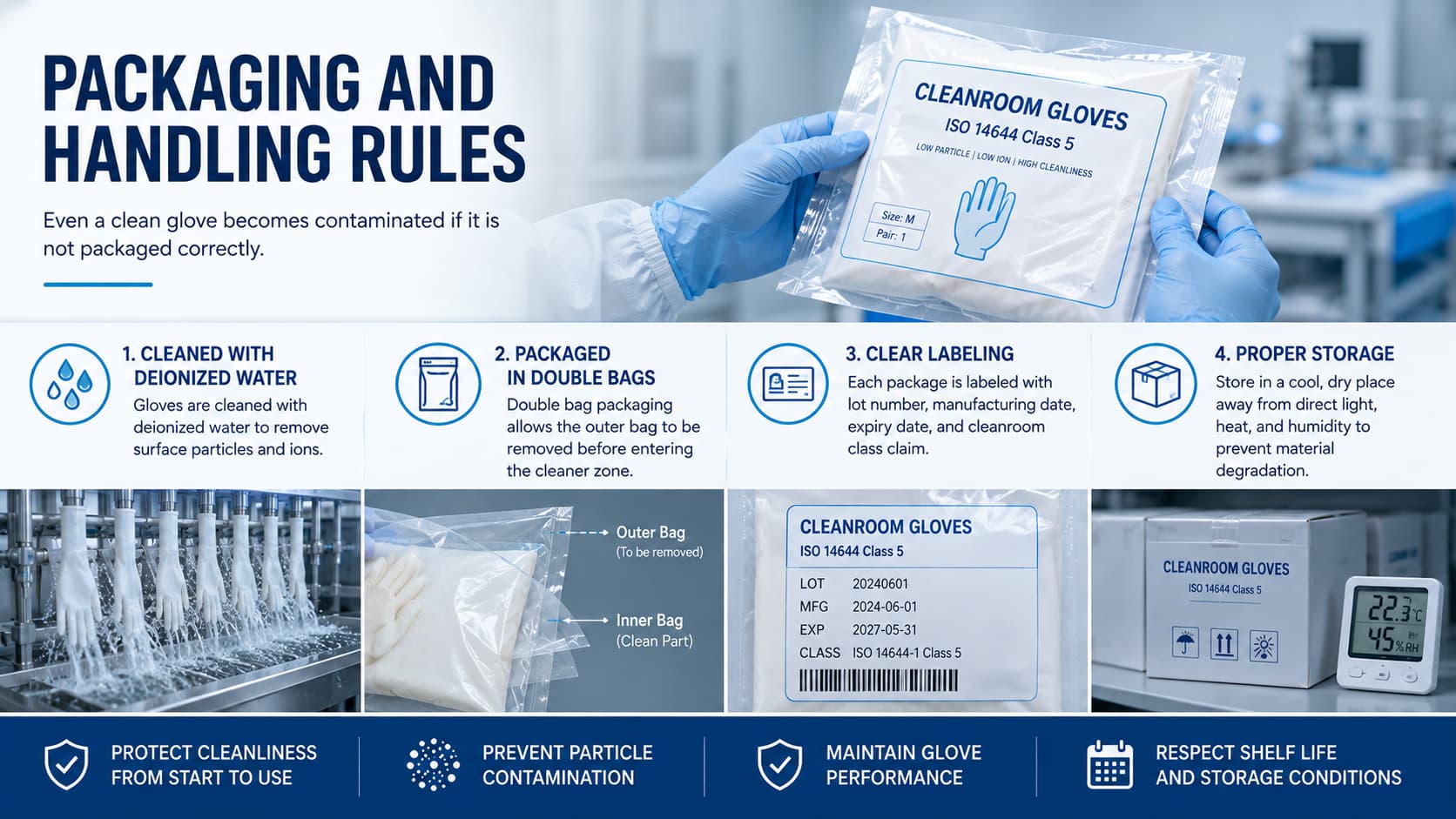
Even a clean glove becomes contaminated if it is not packaged correctly. Cleanroom gloves are typically:
Data sources: ISO 14644-1:2015; IEST-RP-CC005; EN ISO 21420:2020 (formerly EN 420); ASTM D6319; EN 455 series; ISO 10993 series. Information current as of August 2026; verify specific cleanroom requirements with your facility qualification.
Q: What is the difference between ISO 14644-1 Class 5 and Class 7 cleanroom gloves?
A: The difference is the maximum allowable particle concentration. ISO Class 5 permits no more than 3,520 particles of 0.5 micrometres or larger per cubic metre, while ISO Class 7 permits up to 352,000 such particles. Gloves for Class 5 must release far fewer particles during flexing and wear, so they are usually higher-grade nitrile or latex that has been washed and double-bagged. Class 7 gloves can be standard cleanroom-compatible gloves with less stringent particle limits.
Q: Are latex gloves allowed in cleanrooms?
A: Yes, but their use is declining. Natural rubber latex gloves can be manufactured to very low particle-shedding levels and are still used in some pharmaceutical and laboratory cleanrooms. However, they carry a Type I latex protein allergy risk, so many facilities have moved to latex-free nitrile gloves to protect operators and avoid protein contamination.
Q: What tests prove a glove is suitable for a cleanroom?
A: The most common cleanroom-specific tests are IEST-RP-CC005 (particle shedding, extractables, and ionic contamination), non-volatile residue (NVR) testing, and silicone/amide analysis for electronics. Buyers should also request baseline medical glove data such as ASTM D6319 or EN 455 physical properties, plus ISO 10993 biocompatibility reports.
Q: Can I use standard medical nitrile gloves in a cleanroom?
A: Not without verification. Standard medical nitrile gloves may meet ASTM D6319 or EN 455 for barrier and strength, but they are not necessarily washed or packaged to reduce particle shedding. For cleanroom use, you need gloves that have been specifically processed, tested for particles and ions, and double-bagged for cleanroom entry.
Q: Why is double-bagging important for cleanroom gloves?
A: Double-bagging creates a buffer between the outer shipping carton - which has been exposed to warehouse and transport environments - and the clean interior. The outer bag is removed before the gloves enter the cleaner zone, reducing the risk that cardboard dust, fibres, or other contaminants are carried into the controlled environment.
Please read on, stay posted, subscribe, and we welcome you to tell us what you think.


Copyright 2026@ Fujian Jixiang E-commerce Co., Ltd All Rights Reserved.
Sitemap |
Blog
|
Xml |
Privacy Policy
 Network Supported