Glove Tensile Strength and Elongation - How Physical Property Tests Define Nitrile Glove Quality
Aug 27, 2026
Tensile strength and elongation at break are the two numbers that tell you whether a nitrile glove will tear in use. This guide explains how the tests work, the requirements in ISO 11193, EN 455-2, and ASTM D6319, and how buyers should read a test report.
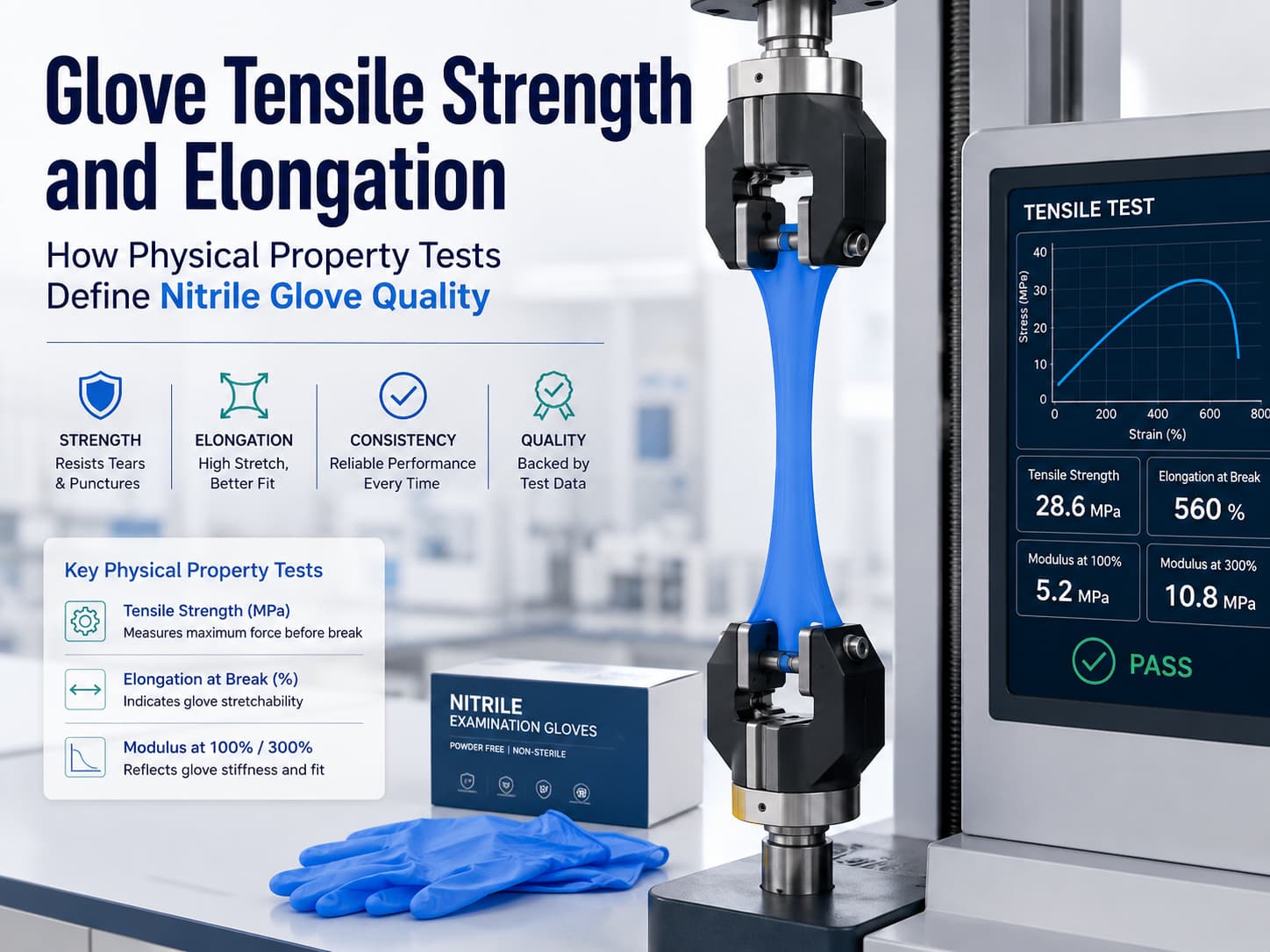
Tensile strength is the maximum force a glove material can withstand before it breaks, expressed in megapascals (MPa); elongation at break is how far the material stretches before tearing, expressed as a percentage of original length. Together they determine whether a glove tears when you pull it on, when you flex your fingers, or when it snags on a sharp edge. A glove that fails either test fails its barrier function - a torn glove is no longer protection. This guide explains how these tests are performed, what the major standards require, and how to read the numbers on a datasheet.
1. Why Physical Properties Matter
A disposable glove is a barrier. Tensile strength and elongation are the two properties that decide how well that barrier survives real use:
Donning: the glove is stretched over the hand; low elongation means it tears during donning
Movement: repeated finger flexing stresses the material; weak material develops holes or tears
Snagging: contact with instruments, rings, or rough surfaces concentrates force at a point
Aging: materials degrade over time; the after-aging values tell you if the glove will still perform at the end of its shelf life
2. How the Tests Work
The test procedure is standardized across ISO 11193, EN 455-2, and ASTM D6319:
Thirteen gloves are sampled from one lot
Dumbbell-shaped (dog-bone) test pieces are cut from the palm, back of hand, or cuff, avoiding textured areas, along the longitudinal axis
Test pieces are conditioned for at least 16 hours at 23 +/- 2 degrees C and 50 +/- 10% relative humidity
Each piece is pulled at a crosshead speed of 500 mm/min until it breaks
The median value of the 13 results is reported
For the after-aging value, a second set is aged 7 days at 70 degrees C (per ISO 188) before testing
The median (not the average) is used, which makes the result robust to a single outlier piece.
3. Requirements by Standard
Each standard expresses the requirement differently - Newtons (force at break) or MPa (tensile strength):
Standard
Strength metric
Requirement (median)
Elongation at break
Aging
ISO 11193-1
Force at break
>= 7 N before aging; >= 6 N after aging
>= 500% before; >= 400% after
7 days at 70 degrees C (ISO 188)
EN 455-2
Force at break
>= 6.0 N (examination); >= 3.6 N (PVC/thermoplastic); >= 9.0 N (surgical)
Not specified in EN 455-2
7 days at 70 degrees C (ISO 188)
ASTM D6319
Tensile strength
>= 14 MPa before and after aging
>= 500% before; >= 400% after
7 days at 70 degrees C
Two practical takeaways:
EN 455-2 deliberately does not specify elongation - elongation figures on a datasheet come from the ASTM or ISO specification
Newtons and MPa are not interchangeable: MPa normalizes force by the cross-section of the test piece, so comparing them directly across standards is not valid
4. What the Numbers Mean for Buyers
Higher force at break / tensile strength generally means a more durable glove that resists punctures and tears. Higher elongation means the glove stretches further before breaking - important for donning and dexterity. But the balance matters:
Too weak (low force at break): gloves tear during donning or use
Too stiff (low elongation): gloves feel tight, restrict movement, and crack
Too elastic (very high elongation with low strength): gloves feel baggy and snag easily
Typical material behavior (indicative ranges, not requirements):
Material
Tensile strength (typical)
Elongation at break (typical)
Feel
Natural rubber latex
18-24 MPa
650-750%
Very elastic, high strength
Nitrile rubber
14-25 MPa
400-600%
Strong, good elasticity
Vinyl (PVC)
8-13 MPa
250-350%
Stiffer, lower strength
5. Common Mistakes When Reading a Datasheet
Comparing MPa and N directly: not valid - they measure different quantities
Ignoring after-aging values: the glove will degrade; after-aging is the true shelf-life performance
Quoting a single batch: physical properties vary by batch; request reports for the actual lot shipped
Missing the median note: standards report the median of 13 pieces; a strong outlier should not be presented as the result
Assuming higher is always better: very high strength can mean a stiffer glove; match the property profile to the task
6. Buyer Checklist
Request force at break (ISO 11193 / EN 455-2) or tensile strength (ASTM D6319) before AND after aging
Check elongation at break before and after aging (where specified)
Verify the report covers the exact batch code being shipped
Confirm the test lab is accredited (ISO/IEC 17025)
Match the property profile to the application: thin high-tactility gloves for precision, thicker higher-strength gloves for industrial use
Keep reports on file for audits and customer requests
Data sources: ISO 11193-1:2020; EN 455-2:2015; ASTM D6319-19; ISO 37; ISO 188; ISO 2859-1; ISO/IEC 17025. Requirements verified against official standard summaries and published manufacturer conformance data (including FDA 510(k) summaries). Typical material ranges are indicative and vary by formulation. Information current as of August 2026.
FAQ
Q: What is a good tensile strength for nitrile gloves?
A: Under ASTM D6319, nitrile medical examination gloves must have a tensile strength of at least 14 MPa before and after accelerated aging. Most commercial nitrile gloves test well above this, typically in the 18-25 MPa range. For non-medical industrial gloves, requirements vary by standard and use case, but higher tensile strength generally means better puncture and tear resistance.
Q: Why do gloves need to pass tests after accelerated aging?
A: Gloves degrade over time due to oxidation, heat, and humidity. The accelerated aging test (7 days at 70 degrees C, per ISO 188) simulates years of shelf life in about a week. Passing after aging proves the glove will still meet its strength and elongation requirements at the end of its declared shelf life. A glove that only passes before aging may become brittle or weak before you use it.
Q: What is the difference between force at break (N) and tensile strength (MPa)?
A: Force at break (Newtons) is the absolute force needed to break the test piece. Tensile strength (MPa) divides that force by the cross-sectional area of the test piece, normalizing for thickness. EN 455-2 and ISO 11193 use force at break; ASTM D6319 uses tensile strength. They are not directly comparable, which is why you cannot convert one to the other without knowing the test piece geometry.
Q: Which standard should my supplier test report reference?
A: It should reference the standard required by your market: EN 455-2 for EU medical use, ASTM D6319 for US medical use (with FDA 510(k)), and ISO 11193-1 for international and GCC tenders. Many suppliers report multiple standards on one datasheet. Whatever the standard, the report must show before- and after-aging values, the batch code, and an accredited test laboratory.
Q: Does higher tensile strength always mean a better glove?
A: Not necessarily. Higher strength improves tear and puncture resistance, but it often comes with lower elongation and a stiffer feel. A very strong, stiff glove may be uncomfortable and restrict dexterity. The best glove matches its physical property profile to the task: high tactility and moderate strength for precision work, high strength and durability for industrial use. Always look at strength AND elongation together.



 Network Supported