
welcome to Jixiang E-commerce!
welcome to Jixiang E-commerce!
Understand nitrile glove thickness in mil and millimeters. Our 2026 guide covers ASTM D6319 standards, thickness by application (medical, industrial, lab, food), performance trade-offs between durability and dexterity, and a data-driven selection framework for procurement professionals.
When sourcing disposable nitrile gloves, thickness is one of the most consequential yet frequently misunderstood specifications. A common and persistent misconception in procurement is that “gauge” applies to disposable gloves. Let us be clear from the outset: gauge is a measurement unit for knitted work glove liners (number of stitches per inch), not for disposable nitrile, latex, or PVC gloves. The correct units for disposable glove thickness are mil (one-thousandth of an inch) and millimeter (mm). This guide explains what glove thickness really means, how to read mil and mm specifications, the performance trade-offs involved, and how to choose the right thickness for your application in 2026 — all grounded in verifiable data from ASTM D6319, EN 455-2, and industry sources.
Understanding the Correct Units: Mil and Millimeter
Mil: One mil equals one-thousandth of an inch (0.001 inch), equivalent to 0.0254 mm. When a nitrile glove is labeled “4 mil,” the material is approximately 0.10 mm thick at the standardized measurement point (typically the palm). Mil is a direct linear measurement — the larger the number, the thicker the glove. This unit is the industry standard in North America, the Middle East, and most international procurement specifications for disposable gloves.
Millimeter (mm): The metric equivalent, used predominantly in European and Asian technical documentation. Conversion: 1 mil = 0.0254 mm; 1 mm ≈ 39.37 mil. EN 455-2 and most EU MDR documentation express thickness requirements in millimeters. For procurement professionals working across markets, fluency in both units is essential.
A critical clarification: Gauge (sometimes seen as “needle count” or “针数”) refers to the number of stitches per inch in a knitted fabric liner. It is the standard measurement for cut-resistant, thermal, and general work gloves with textile liners (e.g., 7-gauge, 10-gauge, 13-gauge, 18-gauge). A higher gauge number means a finer, thinner knit liner. Gauge has no application whatsoever to disposable nitrile, latex, PVC, or vinyl examination and surgical gloves. If a supplier uses “gauge” to describe disposable glove thickness, this is either a misunderstanding or an imprecise industry colloquialism — always request mil or mm specifications instead.
|
Thickness Grade |
Palm Thickness |
Typical Weight |
Key Applications |
|
Ultra-thin |
2.0 – 3.0 mil (0.051 – 0.076 mm) |
2.5 – 3.0 g/pc |
Dental, high-frequency food handling, light cleaning, beauty/hotel |
|
Standard examination |
3.0 – 4.0 mil (0.076 – 0.102 mm) |
3.5 – 4.0 g/pc |
Medical examination, general lab, food processing (20–60 min wear) |
|
Heavy-duty daily |
4.5 – 6.5 mil (0.114 – 0.165 mm) |
5.0 – 6.0 g/pc |
Automotive repair, general labor PPE, livestock/fishery, strong cleaners |
|
Industrial / chemical |
6.0 – 8.0+ mil (0.152 – 0.203+ mm) |
6.5 – 8.0 g/pc |
Lab/pharma, paint/printing, chemical splash, high-abrasion environments |
Critical Distinction: Finger, Palm, and Cuff Thickness Are Not the Same
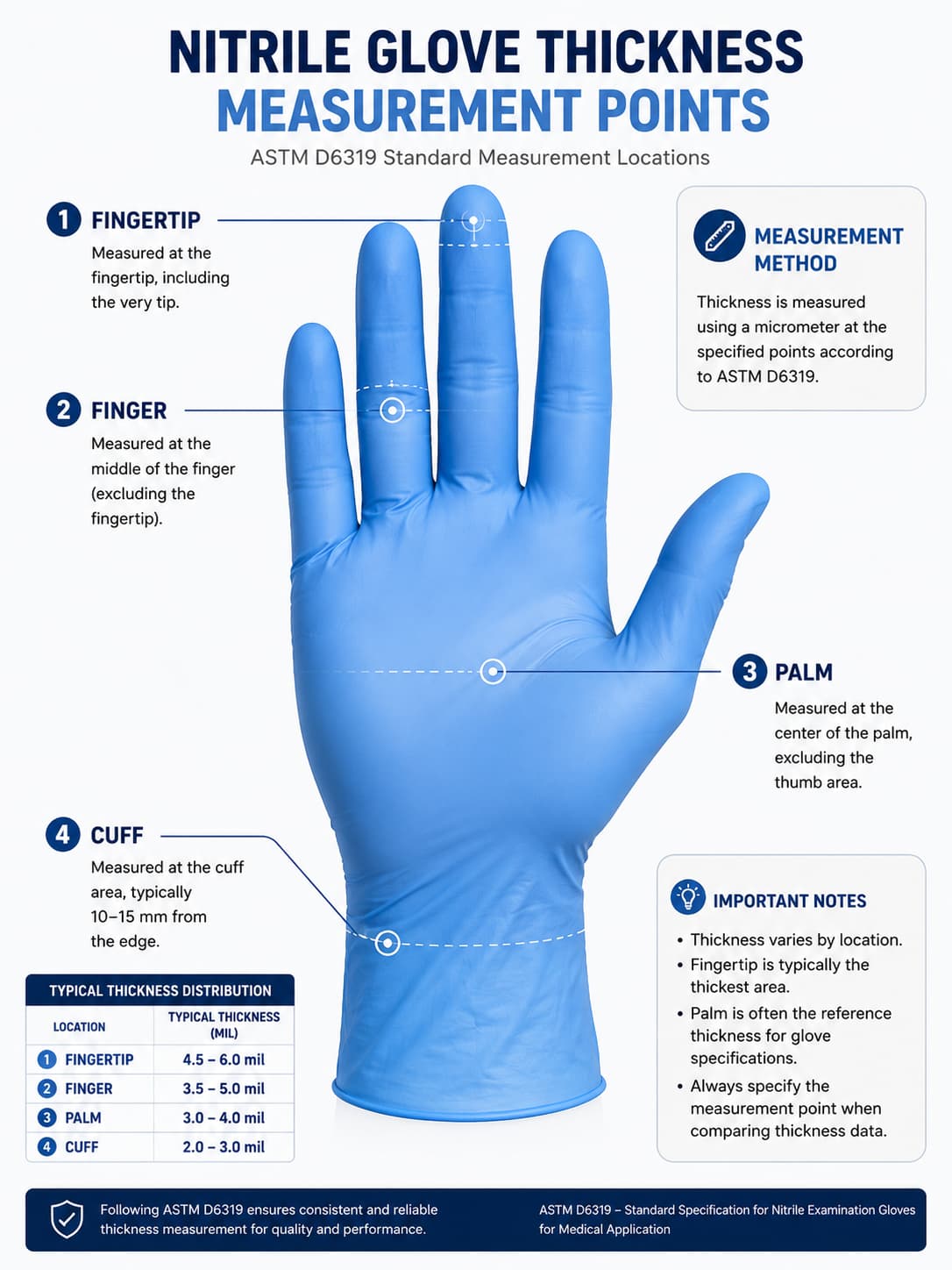
Nitrile gloves are not uniformly thick across their surface. Three measurement points matter and they produce systematically different values:
Fingertip thickness: The thickest measurement point, as fingers sustain the greatest contact and wear. In a standard 4-mil rated glove, fingertip thickness typically reaches 4.5–6.0 mil. This is the most critical measurement for puncture resistance.
Palm thickness: The most commonly quoted value on packaging and specification sheets. This is the mid-range measurement and represents the primary working contact area. A glove labeled as “4 mil” generally refers to palm thickness.
Cuff thickness: The thinnest measurement point, as the cuff does not need to resist puncture or chemical exposure. Cuff thickness may be 20–30% thinner than palm thickness.
ASTM D6319 and EN 455-2 require that thickness meets minimum values at all measurement points, not just the palm. A supplier claiming “4 mil” but with 2.8-mil fingertips is marketing a glove that effectively performs as sub-3-mil where protection matters most. Always request thickness data broken down by measurement point. (Source: ASTM D6319-19; EN 455-2:2024)
The Performance Trade-off: Thickness vs Dexterity vs Durability
Nitrile glove thickness presents an engineering trade-off between three competing priorities, each supported by measurable data:
1. Durability and barrier protection: Puncture resistance scales significantly with thickness. At equivalent formulation, a 6-mil glove provides approximately 2× the puncture resistance of a 4-mil glove. Chemical permeation breakthrough time is extended by approximately 30–50% when moving from 4-mil to 6-mil thickness. For applications involving cytotoxic drugs, strong solvents, or mechanical hazards, thicker gloves (6+ mil) are essential.
2. Tactile sensitivity and dexterity: Thinner gloves transmit more tactile feedback. A 2025 study in the Journal of Occupational Health found that task error rates increased by 22% when workers switched from 3-mil to 6-mil gloves for precision assembly tasks. Surgeons, dentists, and electronics assemblers require the fine motor control that only thin gloves (2–3 mil) can provide. (Source: Journal of Occupational Health, Vol. 67, 2025)
3. Cost per unit: Raw material is the dominant cost driver in nitrile rubber glove manufacturing — acrylonitrile and butadiene account for approximately 55–65% of total production cost. Thicker gloves consume more nitrile rubber per unit. With butadiene CFR China spot prices at approximately $1,450–1,480/MT and acrylonitrile at $1,380–1,420/MT as of late June 2026, the raw material cost differential between a 3-mil and 6-mil glove can reach 40–60%. The per-unit procurement cost for 6-mil gloves is typically 15–30% higher than for 4-mil gloves of equivalent quality. (Sources: ICIS Petrochemical Index, July 2026; Intco cost analysis, 2026)
How to Read a Disposable Glove Thickness Specification Sheet
Professional buyers should look beyond the headline number and evaluate specifications systematically:
Measurement points: Require finger, palm, and cuff values reported separately. A single “average” number that does not specify measurement locations is insufficient for procurement decisions.
Single wall vs double wall: Some specifications quote single-wall thickness while others quote double-wall (folded) thickness. Double-wall readings are approximately twice single-wall readings. Always confirm which convention applies before comparing across suppliers. This is a common source of apparent specification discrepancies.
Measurement standard: ASTM D3767 (Procedure A) and EN 455-2 specify standardized measurement points and methods. For international procurement in 2026, require EN 455-2 compliance as the baseline, since it is harmonized with EU MDR requirements. Gloves tested under different standards may yield different numerical results for the same physical product.
Tolerance and batch consistency: A specification of “4.0 mil ± 0.4 mil” (±10%) is standard. Wider tolerances (±20%+) indicate poor process control. Request statistical process control (SPC) data with Cpk ≥ 1.33 as evidence of consistent manufacturing.
|
Specification Element |
What to Look For |
Red Flag |
|
Thickness unit |
Clearly stated as mil or mm |
States gauge without mil/mm equivalent |
|
Measurement points |
Finger + palm values reported separately |
Single average number with no location specified |
|
Wall convention |
States single wall or double wall explicitly |
Ambiguous; no wall convention disclosed |
|
Test standard |
ASTM D3767 or EN 455-2 cited |
No test standard referenced |
|
Tolerance range |
±10% or tighter specified |
No tolerance or ±20%+ range |
|
Batch consistency |
SPC chart or Cpk ≥ 1.33 available |
Refuses to share thickness SQC data |
Selection Framework: Matching Thickness to Application
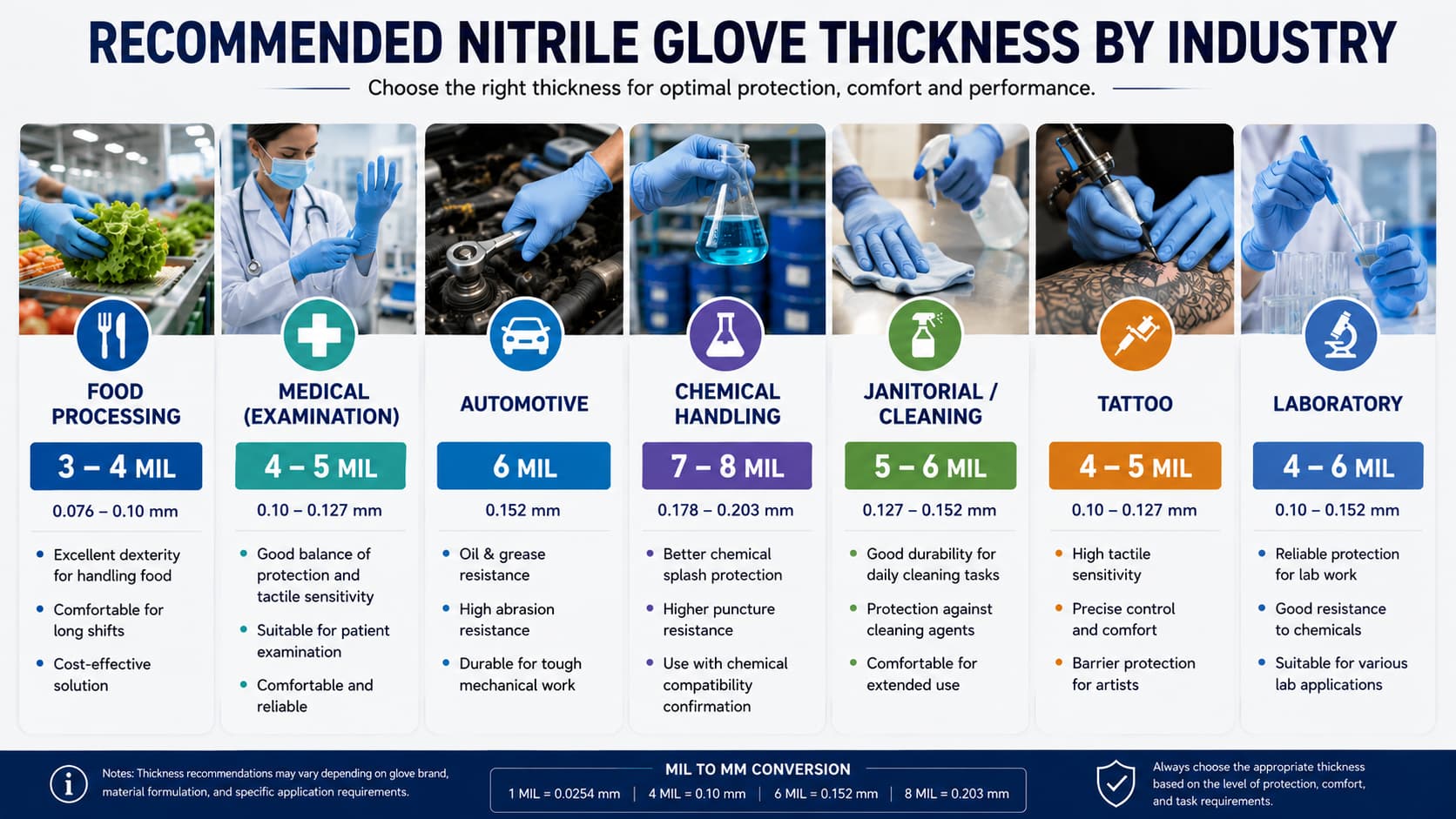
Use the following decision framework, based on ASTM D6319 requirements and real-world performance data, to select the appropriate nitrile rubber glove thickness:
Medical examination: 3.0–4.0 mil palm, 4.5–6.0 mil fingertip (EN 455-2 / ASTM D6319 compliant). Standard examinations require barrier protection against bloodborne pathogens while maintaining tactile sensitivity for palpation. AQL ≤ 1.5 for pinhole defects is required. For chemotherapy drug handling, ASTM D6978-rated gloves at 5.0+ mil are mandatory.
Laboratory and research: 3.0–5.0 mil palm. Routine lab work with aqueous solutions can use 3–4 mil. Work involving organic solvents, acids, or alkalis requires 4.5–5.5 mil with specific EN 374 chemical permeation ratings. Note: no disposable glove provides indefinite chemical protection — permeation breakthrough time data must be consulted for each chemical.
Industrial and manufacturing: 5.0–8.0 mil palm. Mechanical hazards, abrasive surfaces, and prolonged chemical contact demand thicker nitrile rubber gloves. Automotive and heavy manufacturing: 6-mil minimum recommended. Chemical manufacturing or hazardous waste: 8-mil or thicker with full EN 374 Type A certification.
Food processing: 3.0–5.0 mil (FDA 21 CFR 177 compliant). The balance of food safety barrier protection and handling dexterity makes 3.5–4.5 mil the most common specification. Blue-colored nitrile rubber gloves provide visual contrast for fragment detection in food products.
Electronics and cleanroom: 2.5–4.0 mil (ISO Class 5–7 compatible). Thinner gloves preserve tactile feedback for precision assembly but must meet cleanroom particulate and extractable standards. Double-gloving with a thin inner layer (2.5–3.0 mil) and a slightly thicker outer layer (3.5–4.0 mil) is common in semiconductor environments.
The Double-Gloving Standard
Double-gloving — wearing two pairs of gloves simultaneously — is standard practice in many surgical and high-risk settings. A 2024 systematic review in The Lancet Infectious Diseases found that double-gloving reduced the risk of inner-glove perforation by 71% compared to single-gloving, without clinically significant loss of dexterity when appropriately sized gloves were used. (Source: The Lancet Infectious Diseases, Vol. 24, 2024)
The evidence-based standard configuration: 3-mil inner glove for dexterity + 4–5 mil outer glove for enhanced protection. Color-indicator systems — where the inner glove is a contrasting color (e.g., green or blue) — allow wearers to immediately detect outer-glove perforation, a critical safety feature in surgical settings.
Cost-Benefit Analysis: Thicker Is Not Always Better
Over-specifying thickness generates unnecessary costs without proportional safety gains. A facility using 6-mil gloves where 4-mil would be adequate incurs approximately 15–30% higher per-glove procurement costs. For an organization consuming 500,000 gloves per month, this translates to roughly $15,000–25,000 in avoidable annual material expenditure at current nitrile rubber pricing. (Source: Author estimate based on ICIS raw material data, Q2 2026)
The key is application-matched specification: use the minimum thickness that meets regulatory standards and provides adequate barrier protection for the specific task, then validate through in-use testing rather than defaulting to the thickest available option.
2026 Trends Affecting Glove Thickness Decisions
Several converging trends are reshaping thickness decisions in the nitrile rubber glove market:
Raw material cost pressure: As of early July 2026, Brent crude oil has risen above $95/bbl amid renewed tensions in the Strait of Hormuz, directly impacting feedstock costs for both butadiene and acrylonitrile — the two key monomers in nitrile rubber production. Each $10/bbl increase in crude translates to approximately $80–120/MT in combined monomer cost increases with a 4–6 week lag. This cost pressure is driving some buyers toward thinner specifications to manage budgets. (Source: Platts Petrochemical Index, Q2 2026)
EU MDR compliance tightening: Notified bodies are increasingly scrutinizing thickness uniformity as part of EN 455-2 compliance evidence packages. Manufacturers with robust statistical process control (Cpk ≥ 1.33) are favored in EU tender evaluations.
GSO certification expansion: The GCC Standardization Organization has expanded GCTS requirements for medical gloves imported into GCC member states. Thickness specifications must now be explicitly declared in GSO certificate schedules. Non-compliant product shipments have been detained at Saudi and UAE ports as recently as May 2026. (Source: GSO Technical Notice 2026-03)
Key Takeaways
Disposable nitrile, latex, and PVC gloves are measured in mil (0.001 inch) and millimeter (mm) only. Gauge is a unit for knitted work glove liners and does not apply to disposable examination or surgical gloves. Any supplier using “gauge” for disposables should be asked to provide mil or mm specifications.
Nitrile glove thickness is not uniform — fingertip, palm, and cuff values differ substantially. Always request measurement-point breakdowns. The palm value is the standard label reference; the fingertip value is critical for puncture risk.
The optimal thickness balances barrier protection, tactile sensitivity, and cost. There is no universal “best” thickness — only the right thickness for each application, validated by standards (ASTM D6319, EN 455-2) and in-use testing.
6-mil gloves offer approximately 2× the puncture resistance and 30–50% longer chemical breakthrough time vs 4-mil gloves, at 15–30% higher unit cost. Match the specification to the hazard, not the budget alone.
2026 raw material cost pressure from crude oil volatility makes application-matched thickness more financially critical than ever. Over-specifying by even 1–2 mil can add tens of thousands of dollars in annual costs for mid-volume users.
Please read on, stay posted, subscribe, and we welcome you to tell us what you think.


Copyright 2026@ Fujian Jixiang E-commerce Co., Ltd All Rights Reserved.
Sitemap |
Blog
|
Xml |
Privacy Policy
 Network Supported