
welcome to Jixiang E-commerce!
welcome to Jixiang E-commerce!
Disposable or reusable? The answer depends on the task, the contamination risk, and the cost per use. Compare barrier integrity, standards, and true economics with this task-based glove selection guide.
The core difference is simple: disposable gloves are designed for one use or one procedure, then discarded; reusable gloves are designed for multiple uses with cleaning in between. The deciding factor is never just price per box - it is barrier integrity, contamination risk, and true cost per use for the specific task. This guide gives procurement teams and safety officers a task-based framework to choose correctly.
Disposable gloves (nitrile rubber, latex, vinyl, polyethylene) are manufactured to be worn once and thrown away. Their barrier is guaranteed until first use. Reusable gloves (heavy-duty nitrile, neoprene, natural rubber, PVC) are worn repeatedly for months or years and cleaned between uses. The fundamental trade-off: disposable gloves guarantee a fresh barrier but create waste; reusable gloves save material but their barrier degrades with every flex, chemical contact, and cleaning cycle - and they can carry contamination from one task to the next.
| Attribute | Disposable gloves | Reusable gloves |
|---|---|---|
| Typical materials | Nitrile rubber, latex, vinyl (PVC), polyethylene | Heavy-duty nitrile, neoprene, natural rubber, PVC |
| Intended lifespan | Single use / single procedure | Months to years with cleaning |
| Barrier integrity | Guaranteed until first use | Degrades with use, flexing, and cleaning |
| Cross-contamination risk | None if changed correctly | High unless rigorously cleaned and segregated |
| Typical thickness | 3-8 mil (0.08-0.20 mm) | 10-60 mil (0.25-1.50 mm) for chemical gloves |
| Key standards | EN 455, ASTM D6319, EN ISO 374, EN 388 | EN ISO 374, EN 388, EN ISO 21420 (formerly EN 420) |
| Cleaning required | None - discard | Wash, dry, inspect after every use |
| Cost per use | Higher at high frequency | Lower at high frequency, if maintained |
Use the table below as a first-pass decision tool. When in doubt, choose the option that protects against the worst-case contamination or injury scenario.
| Task category | Contamination / injury risk | Recommended choice |
|---|---|---|
| Healthcare - patient contact, exams | Blood, body fluids, pathogens | Disposable medical gloves (EN 455 / ASTM D6319, AQL 1.5) |
| Healthcare - chemotherapy handling | Hazardous drug permeation | Disposable chemo-tested nitrile (ASTM D6978 where applicable) |
| Food handling - ready-to-eat | Foodborne pathogens, cross-contamination | Disposable food-grade gloves |
| Cleanroom / electronics | Particles, electrostatic discharge | Disposable cleanroom gloves (ISO 14644 classification) |
| Heavy chemical handling (industry) | Concentrated acids, solvents, oils | Reusable chemical-resistant gloves (EN ISO 374) |
| Abrasion / puncture-heavy work | Mechanical injury | Reusable heavy-duty gloves (EN 388) |
| Household cleaning, gardening | Mild chemicals, dirt | Reusable household gloves |
| Short, changing tasks (assembly, inspection) | Varies by step | Disposable nitrile rubber |
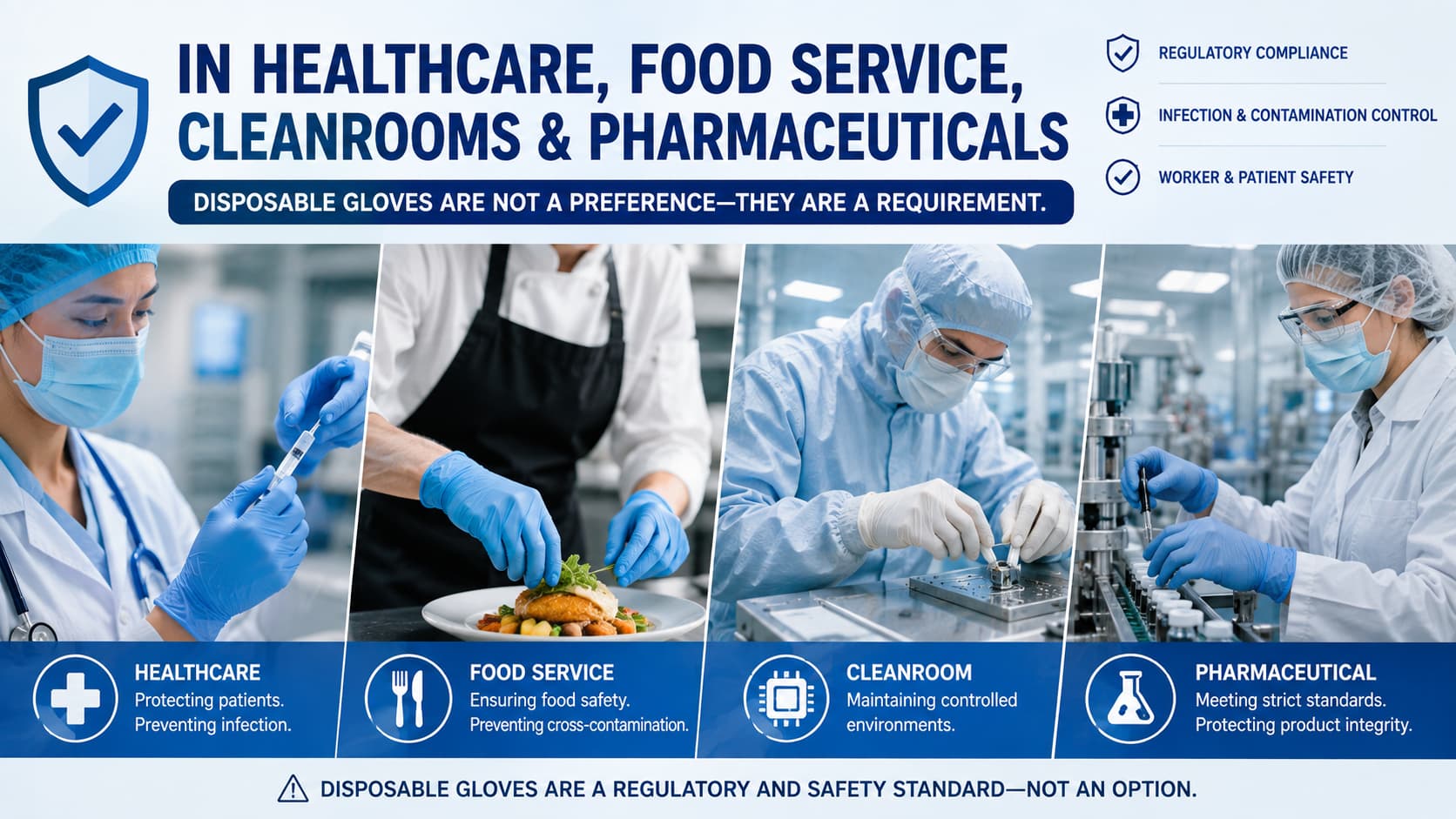
In three settings, single-use disposable gloves are not a preference - they are a regulatory and safety requirement:
Reusable gloves are the correct choice when the glove is the tool for a repeated task, the contamination is limited to the glove material itself, and the exposure justifies the higher initial investment:
Comparing only box prices is misleading. The correct metric is cost per protected task. The example below shows a stylized comparison for an industrial facility.
| Scenario | Purchase price | Uses per glove | Cost per task (approx.) |
|---|---|---|---|
| Disposable nitrile rubber, 100-box (100 pcs) | $8-15 per box | 1 | $0.08-0.15 per task |
| Disposable nitrile rubber, case of 10 boxes | $70-130 per case | 1 | $0.07-0.13 per task |
| Reusable chemical glove, pair | $12-25 per pair | 100-200 uses (18-24 months) | $0.06-0.25 per task (incl. cleaning) |
| Reusable household glove, pair | $3-8 per pair | 50-150 uses (6-12 months) | $0.02-0.16 per task (incl. cleaning) |
Reusable gloves win on cost only when they are actually reused many times, cleaned correctly, and never used for contamination-prone tasks. If a reusable glove is discarded early because of damage or contamination, its cost per use quickly exceeds that of disposables.
Data sources: EN 455 series (EU medical gloves); ASTM D6319 / D3578 (US medical gloves); EN ISO 374 (chemical protection); EN 388 (mechanical risk); EN ISO 21420 (formerly EN 420, general requirements); US FDA Food Code; EU Regulation 1935/2004. Cost figures are illustrative ranges for comparison, current as of August 2026 - obtain current quotes for budgeting.
Q: What is the main difference between reusable and disposable gloves?
A: Disposable gloves are designed for a single use or single procedure, then discarded. Reusable gloves are designed for multiple uses over months or years, with cleaning between uses. The critical difference is barrier integrity management: a disposable glove is guaranteed intact until first use, while a reusable glove's barrier degrades with each flex, chemical exposure, and cleaning cycle. In healthcare, food handling, and cleanroom work, single-use disposable gloves are mandatory because cross-contamination between users or tasks cannot be safely eliminated.
Q: Can disposable gloves be washed and reused to save money?
A: No. Washing and reusing disposable nitrile or vinyl gloves is explicitly prohibited by infection control guidelines (CDC, WHO) because washing degrades the polymer barrier, creates micro-tears, and cannot remove all contaminants. Studies show that washing gloves increases the risk of cross-contamination rather than reducing it. The cost savings are illusory when a single healthcare-associated infection costs far more than a box of gloves. If a task requires repeated protection, choose correct single-use discipline, or a properly maintained reusable glove for non-medical tasks.
Q: When does a reusable glove make economic sense?
A: Reusable gloves make economic sense for repeated, high-frequency tasks where the glove is not exposed to contamination that requires disposal - for example, household cleaning, gardening, dishwashing, light assembly, or handling consistent chemicals. The cost per use of a good reusable nitrile or PVC glove (kept 0.5-2 years with proper cleaning) can be 5-20x lower than using disposable gloves for the same number of tasks. However, if the glove contacts blood or food, or becomes contaminated, or if the task changes between uses, disposable is the correct choice.
Q: What standards apply to reusable vs disposable gloves?
A: Disposable medical gloves follow the EN 455 series (EU) or ASTM D6319/D3578 (US), with AQL 1.5 water-leak testing. Disposable industrial gloves may follow EN ISO 374 for chemical protection and EN 388 for mechanical risk. Reusable chemical gloves follow EN ISO 374 (permeation testing), EN 388 (mechanical), and EN ISO 21420 (formerly EN 420) for general requirements. The key point: a glove's standard tells you the intended use - always match the certified standard to the actual task, not the brand or color.
Q: Are reusable gloves ever acceptable in food service?
A: In food service, single-use disposable gloves are the standard for direct food contact (US FDA Food Code, EU Regulation 1935/2004 and HACCP practices). Reusable gloves are generally not acceptable for direct handling of ready-to-eat food because they cannot be reliably cleaned between uses and create cross-contamination risk. Reusable gloves can be used for non-food tasks such as washing dishes and cleaning equipment, but they must be color-segregated and never used for direct food contact.
Please read on, stay posted, subscribe, and we welcome you to tell us what you think.


Copyright 2026@ Fujian Jixiang E-commerce Co., Ltd All Rights Reserved.
Sitemap |
Blog
|
Xml |
Privacy Policy
 Network Supported