
welcome to Jixiang E-commerce!
welcome to Jixiang E-commerce!
Surgical gloves are sterile, anatomically shaped single-use gloves designed for operating room procedures. This guide covers ASTM D3577, EN 455 series, sterilization methods, material selection, double gloving, and procurement criteria for OR teams and hospital buyers.
Surgical gloves are sterile, single-use gloves designed specifically for use in the operating room. Unlike examination gloves, surgical gloves are anatomically shaped (with separate left and right gloves), have longer cuffs (typically 28-30 cm), and must meet more stringent quality and sterility requirements. This guide covers the standards, materials, sizing, donning technique, and procurement criteria that OR teams and hospital buyers need to know.
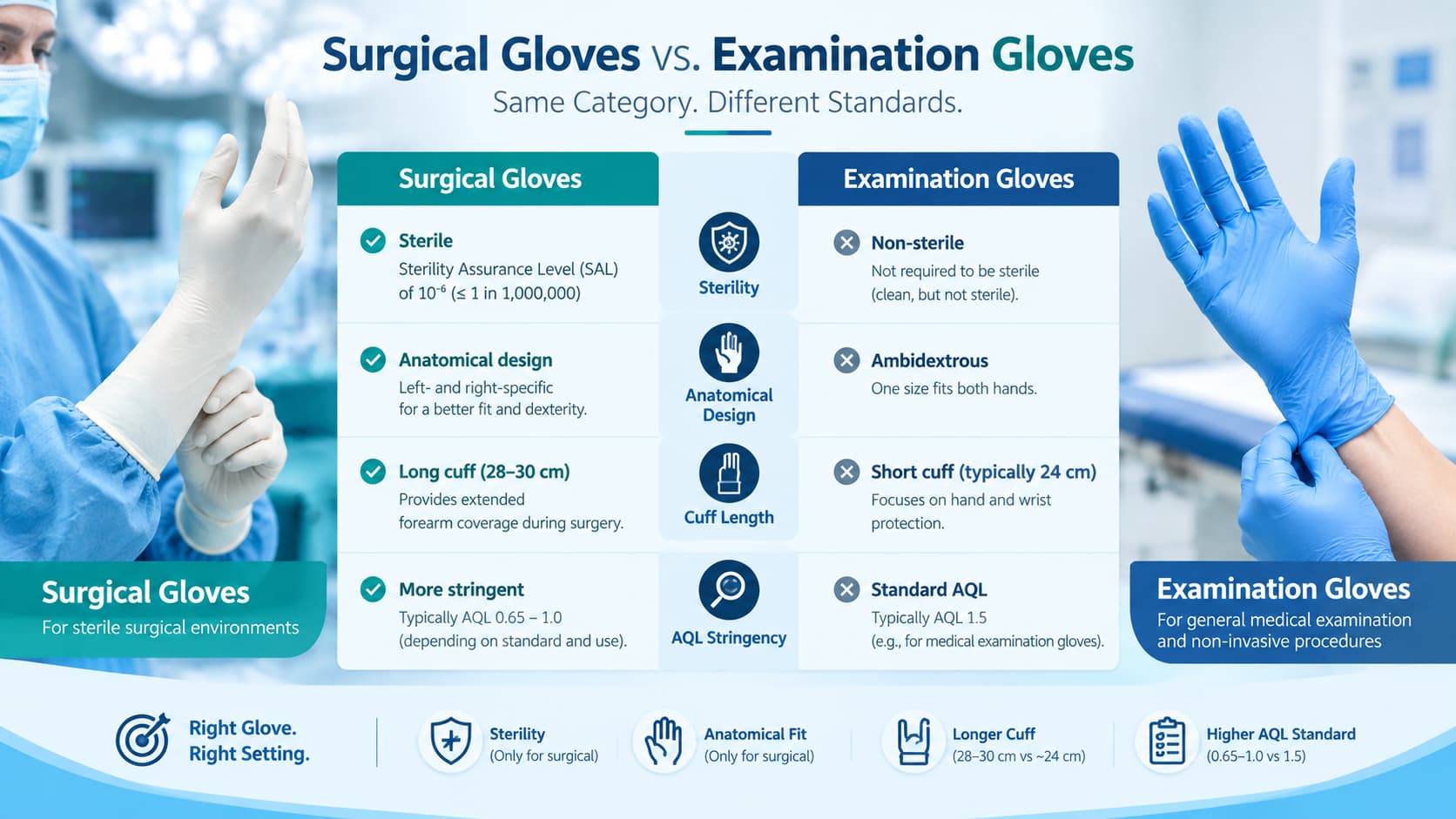
The key differences between surgical gloves and examination gloves are sterility, anatomical design, cuff length, and AQL stringency. Surgical gloves must be sterile with a Sterility Assurance Level (SAL) of 10^-6, meaning the probability of a viable microorganism on the glove is less than or equal to one in a million. They are left- and right-specific to match hand anatomy, and they typically have a cuff length of 28-30 cm to provide extended forearm coverage during surgery.
| Standard | Scope | Key requirements | Region |
|---|---|---|---|
| ASTM D3577 | Rubber surgical gloves | Tensile strength, elongation, dimensions, AQL 1.5 for major defects | US |
| EN 455-1 | Freedom from holes | Water leak test; AQL 1.5 for surgical (premium brands achieve AQL 0.65) | EU |
| EN 455-2 | Physical properties | Force at break: surgical gloves >= 9.0 N; no elongation requirement specified | EU |
| EN 455-3 | Biological evaluation | Cytotoxicity, sensitization, irritation testing per ISO 10993 | EU |
| EN 455-4 | Shelf life determination | Accelerated aging and real-time stability testing | EU |
| EN ISO 21420 (formerly EN 420) | General requirements | pH, innocuousness, sizing, dexterity (levels 1-5) | EU |
Surgical gloves must be sterilized to SAL 10^-6. Two methods dominate the industry:
| Method | Dose / conditions | Advantages | Limitations |
|---|---|---|---|
| Gamma radiation | 25-40 kGy (typically 25 kGy) | Fast, no chemical residuals, penetrates sealed packaging, well-established | Can cause polymer chain scission; material-specific dose limits apply |
| Ethylene oxide (EtO) | Gas concentration, humidity, temperature, aeration time | Compatible with radiation-sensitive materials; gentler on some polymers | Requires aeration to remove residuals; longer cycle; environmental concerns |
Gamma radiation is the more common method for nitrile rubber and latex surgical gloves. EtO is used when the polymer formulation is sensitive to radiation or when specific packaging materials require it.
| Material | Elasticity | Tactile sensitivity | Allergy risk | Common surgical use |
|---|---|---|---|---|
| Natural rubber latex | Excellent | Excellent | Type I protein allergy risk | Traditional standard; declining in latex-free hospitals |
| Synthetic polyisoprene | Very good (close to latex) | Very good | Latex-free; low Type IV risk | Preferred latex-free surgical material |
| Nitrile rubber | Good | Good | Latex-free; possible Type IV from accelerators | Increasing in cost-sensitive and allergy-aware programs |
| Neoprene (polychloroprene) | Moderate | Moderate | Latex-free | Niche use; chemical-resistant surgical applications |
For hospitals transitioning away from latex, synthetic polyisoprene offers the closest feel to natural rubber. Nitrile rubber gloves are increasingly used in cost-sensitive programs and for users with confirmed latex allergy. Accelerator-free nitrile surgical gloves are available for users with Type IV sensitivity.
Surgical gloves use the sizing system defined in EN ISO 21420 (formerly EN 420). Sizes range from 6.0 to 9.0, with half sizes available. Size is determined by hand circumference measured at the metacarpophalangeal joints. Surgical gloves are anatomical (left and right specific), unlike examination gloves which are ambidextrous.
| Size code | Hand circumference (mm) | Hand length (mm, minimum) | Typical fit |
|---|---|---|---|
| 6.0 | 150-170 | 150 | Small |
| 6.5 | 170-185 | 160 | Small-medium |
| 7.0 | 185-200 | 170 | Medium |
| 7.5 | 200-215 | 180 | Medium-large |
| 8.0 | 215-230 | 190 | Large |
| 8.5 | 230-245 | 200 | Large-extra large |
| 9.0 | 245+ | 210 | Extra large |
Dexterity levels under EN ISO 21420 range from 1 to 5, with 5 being the most dexterous. Surgical procedures typically require dexterity level 4 or 5 because of the fine motor control needed for suturing, instrument handling, and tissue manipulation.
The preferred method for donning sterile surgical gloves in the OR is closed gloving, where the hands remain inside the gown cuffs throughout the process. This technique minimizes the risk of contamination because the bare hand never contacts the exterior of the glove. The steps are:
Open gloving - where bare hands contact the glove interior - is used when closed gloving is not possible, but carries a higher contamination risk.
Double gloving involves wearing two pairs of gloves during surgery. The inner glove is typically colored (green, blue, or orange) and the outer glove is translucent. When the outer glove is punctured or torn, the colored inner glove becomes visible, alerting the surgical team to change gloves immediately. Clinical studies show that double gloving significantly reduces inner glove perforation rates and blood exposure incidents. The CDC and AORN recommend double gloving for procedures with high perforation risk, such as orthopedic surgery, trauma surgery, and vascular surgery.
EN 455-4 defines the requirements for determining the shelf life of medical gloves for single use. Manufacturers must conduct both accelerated aging and real-time stability testing to assign an expiry date. Typical shelf life is 3-5 years for nitrile rubber gloves and 3 years for natural rubber latex gloves. Storage conditions directly affect shelf life:
Data sources: ASTM D3577; EN 455-1 to EN 455-4; EN ISO 21420:2020 (formerly EN 420); ISO 11137 (radiation sterilization); ISO 11135 (EtO sterilization); AORN Guidelines; CDC infection control guidance. Information current as of September 2026.
Q: What is the difference between surgical gloves and examination gloves?
A: Surgical gloves are sterile (SAL 10^-6), anatomically shaped (left and right specific), have longer cuffs (28-30 cm), and meet more stringent AQL requirements (typically AQL 1.5, with premium brands achieving AQL 0.65). Examination gloves are ambidextrous, may be non-sterile, have shorter cuffs, and typically meet AQL 1.5 or 2.5.
Q: Why must surgical gloves be sterile?
A: Surgical gloves contact sterile tissue, open wounds, and the surgical field. Any microbial contamination on the glove can directly enter the patient body. Sterility at SAL 10^-6 means the probability of a viable microorganism on the glove is less than or equal to one in a million, which is the minimum assurance level for surgical procedures.
Q: What is double gloving and when is it recommended?
A: Double gloving means wearing two pairs of gloves during surgery, with a colored inner glove under a translucent outer glove. When the outer glove is punctured, the colored inner glove becomes visible. The CDC and AORN recommend double gloving for procedures with high perforation risk, such as orthopedic, trauma, and vascular surgery, because it significantly reduces blood exposure incidents.
Q: How should surgical gloves be stored?
A: Surgical gloves should be stored at 10-30 degrees C, below 65% relative humidity, away from direct sunlight and UV sources, at least 15 cm from walls and floor. FIFO (first in, first out) rotation is essential. Typical shelf life is 3-5 years for nitrile rubber and 3 years for natural rubber latex, as determined by EN 455-4 accelerated and real-time aging tests.
Q: Can nitrile gloves be used for surgery?
A: Yes, nitrile rubber surgical gloves are increasingly used, especially in latex-free programs and for users with latex allergy. They provide good chemical resistance and puncture resistance. However, they are less elastic than natural rubber latex or synthetic polyisoprene. Accelerator-free nitrile options are available for users with Type IV sensitivity. Nitrile surgical gloves must still meet ASTM D3577 or EN 455 requirements.
Please read on, stay posted, subscribe, and we welcome you to tell us what you think.


Copyright 2026@ Fujian Jixiang E-commerce Co., Ltd All Rights Reserved.
Sitemap |
Blog
|
Xml |
Privacy Policy
 Network Supported