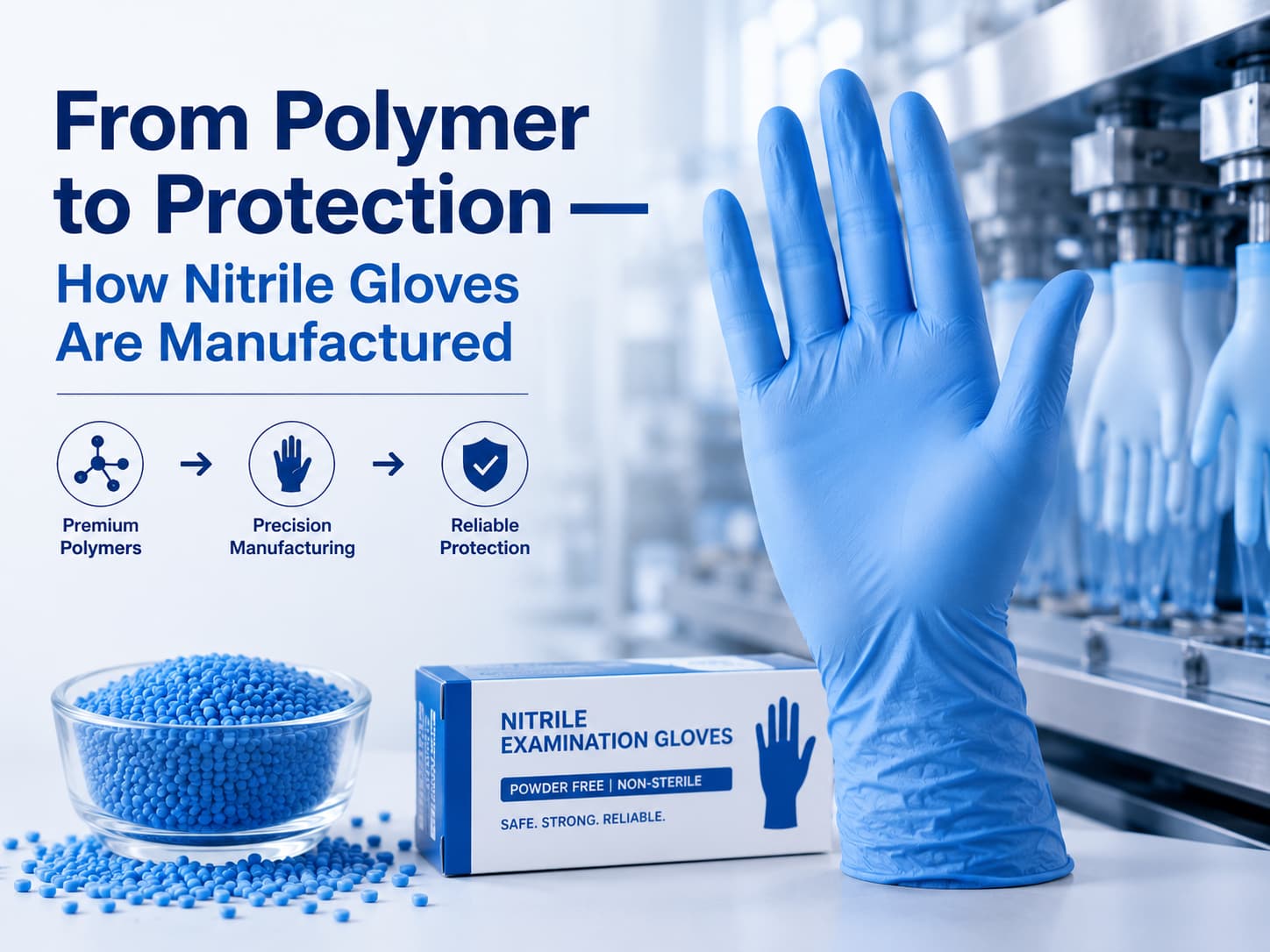
From Polymer to Protection — How Nitrile Gloves Are Manufactured
Jul 03, 2026
Every nitrile glove that reaches a healthcare worker has traveled through a sophisticated manufacturing pipeline. Understanding this process empowers buyers to evaluate supplier capability, trace quality failures, and make informed sourcing decisions.
Step 1 — Raw Material Preparation
The foundation of every nitrile glove is NBR synthetic latex — a colloidal dispersion of nitrile-butadiene rubber particles in water. NBR is produced by emulsion polymerization of acrylonitrile (chemical resistance) and butadiene (elasticity). The acrylonitrile content typically ranges from 28-35% by weight.
Before dipping, the NBR synthetic latex undergoes compounding: sulfur vulcanizing agents, zinc oxide activators, accelerators (or alternative cross-linkers in accelerator-free formulations), antioxidants, and pigments are added. The compound must age 24-48 hours to stabilize viscosity.
Step 2 — Former Preparation and Coagulant Dipping
Ceramic or aluminum hand-shaped formers are cleaned, heated to 50-70C, and dipped into a coagulant bath containing calcium nitrate and calcium carbonate. The coagulant creates a thin chemical film that causes NBR rubber particles to deposit and coagulate instantly upon contact.
Step 3 — NBR rubber Dipping
The coagulant-coated formers enter the NBR rubber dip tank at controlled speed and dwell time (8-15 seconds). The coagulant film triggers immediate particle deposition, forming a wet gel layer of 0.08-0.20mm thickness. The formers rotate to ensure even coating on fingertips and cuffs.
Step 4 — Leaching and Vulcanization
After dipping, the wet gel gloves undergo water leaching — a warm-water rinse lasting 10-30 minutes that removes residual coagulant salts, soluble proteins, and excess accelerators. Leaching is critical for biocompatibility and allergy reduction.
The formers then pass through a multi-zone curing oven at 100-130C for 20-40 minutes. Vulcanization cross-links the acrylonitrile-butadiene polymer chains, converting the wet gel into a stable, elastic rubber film.
Step 5 — Post-Processing and Surface Treatment
After curing, gloves undergo chlorination or polymer coating to create a smooth, non-sticking inner surface for easy donning. Polymer coating (typically polyurethane or acrylic) is preferred for accelerator-free formulations to avoid additional chemical residues.
Step 6 — Quality Control and AQL Testing
Test
Standard
Threshold
Water-leak pinhole test
EN 455-2
AQL <= 1.5
Tensile strength (before/after aging)
EN 455-3
>=14 MPa / >=10 MPa
Elongation at break
EN 455-3
>=500% / >=400%
Visual defect inspection
ISO 2859-1
Zero critical defects per batch
Accelerator residue (GC-MS)
ISO 10993-7
<1 ppm for accelerator-free
Q: NBR synthetic latex vs natural rubber latex?
A: NBR synthetic latex is from acrylonitrile and butadiene polymerization; contains no natural proteins, eliminating Type I latex allergy risk entirely.
Q: Why is leaching important?
A: Leaching removes residual coagulant salts, proteins, and accelerator traces from the surface. Without it, these residues cause skin irritation.
Q: How does acrylonitrile content affect performance?
A: Higher content (30-35%) increases oil/solvent resistance but reduces flexibility. JIXIANG balances both properties.
Q: What does AQL 1.5 mean practically?
A: No more than 1.5% of sampled gloves may have pinholes. For 35,000 gloves, 200 tested; <=7 defects accepted.
Q: Can nitrile gloves be sterilized for surgical use?
A: Standard exam gloves cannot. Surgical-grade requires EN 455-4 sterile validation and gamma irradiation. JIXIANG offers both exam and surgical ranges.
{
"@context": "https://schema.org",
"@type": "FAQPage",
"mainEntity": [
{
"@type": "Question",
"name": "NBR vs natural rubber latex?",
"acceptedAnswer": {
"@type": "Answer",
"text": "NBR from acrylonitrile/butadiene; no natural proteins; eliminates Type I allergy."
}
},
{
"@type": "Question",
"name": "Why leaching matters?",
"acceptedAnswer": {
"@type": "Answer",
"text": "Removes residual salts, proteins, accelerators from surface."
}
},
{
"@type": "Question",
"name": "Acrylonitrile content effect?",
"acceptedAnswer": {
"@type": "Answer",
"text": "Higher = more chemical resistance, less flexibility. JIXIANG balances."
}
},
{
"@type": "Question",
"name": "AQL 1.5 meaning?",
"acceptedAnswer": {
"@type": "Answer",
"text": "



 Network Supported