How to Read and Verify a Glove Technical Data Sheet (TDS): A Procurement Guide for Buyers
Sep 14, 2026
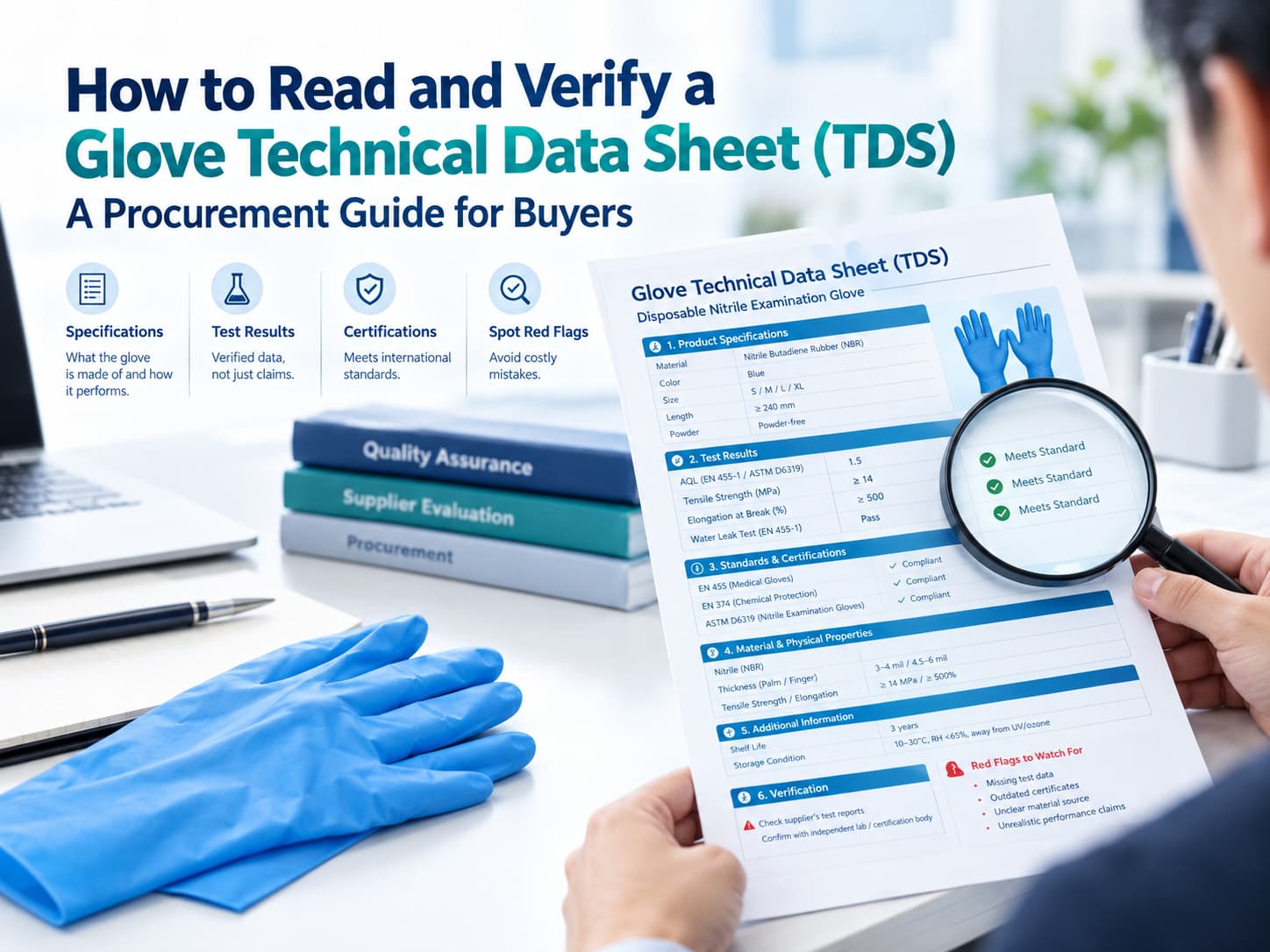
A Technical Data Sheet (TDS) is one of the most important documents a glove buyer receives from a supplier. It contains specifications, test results, certifications, and material information that determines whether a glove meets your requirements. This guide explains how to read each section of a glove TDS, what red flags to watch for, and how to verify claims against independent standards.
A Technical Data Sheet (TDS) is the primary document that communicates a glove product's specifications, performance characteristics, and compliance status. Unlike a Certificate of Conformity (CoC) which certifies that a specific batch meets requirements, a TDS describes the product design and typical performance. For procurement teams, the ability to read and verify a TDS is essential for qualifying suppliers, comparing products, and ensuring regulatory compliance. This guide breaks down each section of a typical glove TDS.
1. What Is a TDS and How Does It Differ from a CoC?
Document
Purpose
Scope
Updated
Technical Data Sheet (TDS)
Describes product design, materials, specifications, and typical performance
Product family / SKU
When design or material changes
Certificate of Conformity (CoC)
Certifies that a specific batch meets stated requirements
Specific production batch / lot
Per batch
Test Report
Provides detailed test method, results, and lab accreditation for a specific sample
Specific sample / batch
Per test
A TDS tells you what the glove is designed to do. A CoC tells you that a specific batch actually meets those design requirements. Both are necessary for thorough supplier qualification.
2. Section-by-Section TDS Breakdown
2.1 Product Identification
This section includes the product name, SKU, brand, and intended use. Verify that:
The product name matches your procurement specification
The intended use statement aligns with your application (medical examination, food handling, industrial, etc.)
The SKU is current and not obsolete
2.2 Material Composition
The TDS should state the primary polymer and any additives:
Material
What to verify
Red flag
Nitrile rubber (NBR / acrylonitrile butadiene rubber)
ACN content affects chemical resistance; typical range 18-34%
Vague description like "synthetic rubber" without specifying NBR
Natural rubber latex
Protein content if Type I allergy is a concern
No protein level data for healthcare applications
PVC (polyvinyl chloride)
Plasticizer type (DEHP-free for medical use in EU)
DEHP plasticizer for EU medical market
Accelerators
Type of crosslinking agents (thiurams, carbamates, MBT)
No accelerator information for accelerator-free claims
2.3 Physical Properties
This is the most critical section for performance verification. Compare against the relevant standard:
Property
ASTM D6319 (nitrile exam)
EN 455-2 (medical gloves)
What to check
Tensile strength (before aging)
>= 14 MPa
Not specified as MPa
Value meets or exceeds standard
Tensile strength (after aging)
>= 14 MPa
Not specified as MPa
Value meets or exceeds standard
Elongation (before aging)
>= 500%
Not specified
Value meets or exceeds standard
Elongation (after aging)
>= 400%
Not specified
Value meets or exceeds standard
Force at break
Not specified
>= 6.0 N (rubber exam); >= 3.6 N (thermoplastic)
Value meets or exceeds standard
Thickness (palm / finger)
Manufacturer spec
Manufacturer spec
Consistent with intended protection level
2.4 Dimensions and Sizing
Verify that the sizing chart matches your user population. Key dimensions include:
Palm width: Measured at the metacarpals; determines fit
Length: Minimum length from cuff to fingertip (typically >= 240 mm for exam gloves)
Cuff thickness: Important for durability during donning
Finger thickness: Affects tactile sensitivity and puncture resistance
2.5 Quality Level (AQL)
The TDS should state the Acceptable Quality Level for pinholes:
AQL 1.5: Standard for medical examination gloves (ASTM D6319, EN 455-1)
AQL 0.65: Premium grade; lower defect rate
AQL 2.5: Industrial grade; higher defect tolerance
Verify that the stated AQL matches your procurement requirements and the intended use.
2.6 Certifications and Standards Compliance
This section lists the standards and regulations the product is designed to meet. Verify each claim:
Claim
What to verify
How to verify
FDA 510(k) cleared
510(k) number and device listing
Search FDA 510(k) database
CE marked (EU MDR)
Notified Body certificate and CE mark validity
Request NB certificate; check EUDAMED
EN 455-1 to -4
Test reports for each part
Request test reports from ISO 17025 lab
ASTM D6319
Test report with MPa and elongation data
Request test report
ISO 13485
Certificate for the manufacturing facility
Request current certificate
Food contact compliance
Migration testing per EU 1935/2004 or FDA 21 CFR 177
Request migration test report
2.7 Shelf Life and Storage Conditions
Verify:
Shelf life: Typical range 3-5 years for nitrile; 3 years for latex
Storage temperature: Usually 10-30 degrees C
Relative humidity: Typically below 65%
Light protection: Away from direct sunlight and UV
3. Red Flags in a Glove TDS
Red flag
Why it matters
Action
Missing test values
Cannot verify compliance
Request full test report
"Typical values" without range
No understanding of batch-to-batch variation
Request min/max or standard deviation
Standards listed without test data
Claim may not be substantiated
Request test reports for each standard
Outdated standards referenced
Product may not meet current requirements
Verify current edition of standard
No lab accreditation stated
Test data may not be reliable
Request ISO 17025 lab accreditation
Inconsistent units
Suggests copy-paste errors or non-technical authorship
Request clarification
Vague material descriptions
Cannot assess biocompatibility or chemical resistance
Request full material composition
4. How to Verify TDS Claims
Cross-check against standards: Compare each test value against the relevant ASTM, EN, or ISO requirement
Request independent test reports: Do not rely solely on supplier-generated TDS values; ask for third-party ISO 17025 lab reports
Verify certifications: Check FDA 510(k) numbers in the FDA database; verify CE certificates with the Notified Body
Request samples for internal testing: Water leak test, visual inspection, and fit evaluation on your own staff
Audit the manufacturing facility: ISO 13485 certification and on-site quality systems
Check lot traceability: Ensure the supplier can link any CoC back to the TDS and manufacturing batch
5. TDS vs Real-World Performance
A TDS describes the product under ideal test conditions. Real-world performance depends on:
Storage conditions: Heat and humidity can degrade gloves before use
Donning technique: Rough handling can cause micro-tears not detected by AQL testing
Chemical exposure: The TDS does not test against all possible chemicals; verify specific chemical compatibility for industrial use
Fit: A glove that meets all specs but fits poorly will fail in practice due to tearing or compromised dexterity
Data sources: ASTM D6319-19; EN 455-1 to EN 455-4; EN ISO 21420:2020; ISO 13485; ISO 17025; FDA 21 CFR 820; EU MDR 2017/745; ISO 10993 series. Information current as of September 2026.
FAQ
Q: What is the difference between a TDS and a CoC?
A: A Technical Data Sheet (TDS) describes the product design, materials, specifications, and typical performance for a product family or SKU. A Certificate of Conformity (CoC) certifies that a specific production batch meets the stated requirements. The TDS tells you what the glove is designed to do; the CoC tells you that a specific batch actually meets those requirements.
Q: What physical properties should I verify on a nitrile glove TDS?
A: For nitrile examination gloves, verify tensile strength >= 14 MPa (before and after aging), elongation >= 500% before aging and >= 400% after aging (per ASTM D6319), and AQL 1.5 for pinholes. If the glove claims EN 455 compliance, verify force at break >= 6.0 N for rubber examination gloves.
Q: How can I verify FDA 510(k) claims on a TDS?
A: Search the FDA 510(k) Premarket Notification database using the 510(k) number provided on the TDS. Verify that the device name and manufacturer match the TDS. The FDA database is publicly accessible at accessdata.fda.gov.
Q: What are red flags in a glove TDS?
A: Red flags include: missing test values, "typical values" without ranges, standards listed without supporting test data, outdated standard editions, no ISO 17025 lab accreditation, inconsistent units, and vague material descriptions like "synthetic rubber" without specifying the polymer type.
Q: Should I rely solely on the TDS for supplier qualification?
A: No. A TDS is a starting point, not proof of compliance. Always request independent third-party test reports from ISO 17025 accredited laboratories, verify certifications through official databases, request samples for internal evaluation, and conduct facility audits for critical suppliers.



 Network Supported