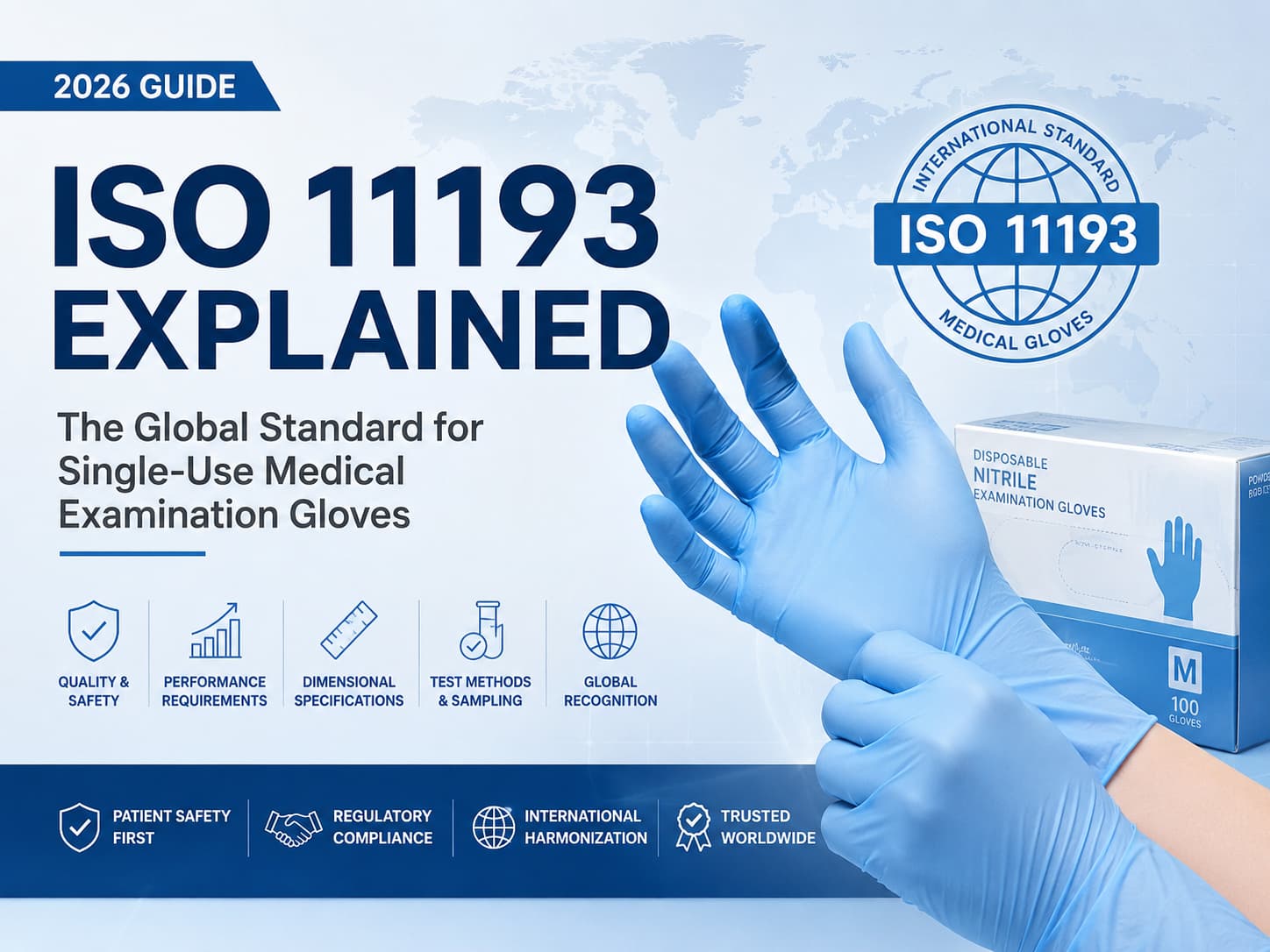
ISO 11193 Explained: The Global Standard for Single-Use Medical Examination Gloves (2026 Guide)
Aug 28, 2026
ISO 11193 is the international standard specification for single-use medical examination gloves. It has two parts: ISO 11193-1 covers gloves made from rubber latex or rubber solution (natural rubber latex, nitrile rubber, polychloroprene, styrene-butadiene rubber, and thermoplastic elastomers), and ISO 11193-2 covers gloves made from poly(vinyl chloride), PVC. The current edition of Part 1 is ISO 11193-1:2020. When a glove carries ISO 11193 compliance, it means the lot has been tested for freedom from holes, dimensions, physical properties (force at break and elongation), and biocompatibility.
1. Scope and Structure
ISO 11193-1:2020 (third edition, published August 2020) specifies requirements for packaged sterile or bulk non-sterile rubber gloves used in medical examinations and diagnostic or therapeutic procedures, and for handling contaminated medical materials. Gloves are classified by type and finish:
Type 1: gloves made primarily from natural rubber latex
Type 2: gloves made primarily from nitrile rubber latex, polychloroprene rubber latex, styrene-butadiene rubber solution or emulsion, or thermoplastic elastomer solution
Finishes: textured, smooth, powdered, or powder-free surface
Part
Material
Typical glove
Current edition in wide use
ISO 11193-1
Rubber latex / rubber solution (natural rubber, nitrile, polychloroprene, SBR, TPE)
Medical examination gloves
ISO 11193-1:2020
ISO 11193-2
Poly(vinyl chloride), PVC
Vinyl examination gloves
ISO 11193-2
2. Key Test Requirements
ISO 11193-1 sets requirements across five areas, with test methods drawn from other standards:
Attribute
Requirement (typical)
Test method
Length
Min 220-230 mm depending on size
ISO 11193-1 dimensional requirements
Thickness
Min 0.05-0.08 mm at palm/finger (varies by finish)
ISO 4648
Freedom from holes
AQL 1.5 (water leak test, ISO 2859-1 sampling)
Water leak test
Force at break
>= 7 N before aging; >= 6 N after aging (median)
ISO 37
Elongation at break
>= 500% before aging; >= 400% after aging
ISO 37
Aging
7 days at 70 degrees C
ISO 188
Powder residue (powder-free)
Maximum powder per glove, if labeled powder-free
Defined in standard
Biocompatibility
Cytotoxicity, sensitization, irritation
ISO 10993 series
Note: values above reflect typical published conformance data from major manufacturers; always verify the exact figures in the supplier batch test report. AQL stands for Acceptable Quality Limit - for medical examination gloves the hole tolerance is AQL 1.5 (maximum 1.5% of a sampled lot may leak).
3. How ISO 11193 Compares with EN 455 and ASTM D6319
Buyers often see ISO 11193, EN 455, and ASTM D6319 on the same datasheet. They test similar properties but express them differently:
Property
ISO 11193-1
EN 455-2
ASTM D6319
Market focus
International / GCC (GSO ISO 11193-1)
EU
US (FDA 510(k))
Freedom from holes
AQL 1.5
AQL 1.5 (EN 455-1)
AQL 1.5
Force at break (exam gloves)
>= 7 N (before aging), >= 6 N (after)
>= 6.0 N
Not used (uses MPa)
Tensile strength
Not specified as MPa
Not specified as MPa
>= 14 MPa (before and after aging)
Elongation
>= 500% / >= 400%
Not specified
>= 500% / >= 400%
Aging protocol
7 days at 70 degrees C
7 days at 70 degrees C
7 days at 70 degrees C (per ASTM D7160)
Biological evaluation
ISO 10993 series
EN 455-3
ISO 10993 series
The key insight: EN 455-2 and ISO 11193 express strength as force at break in Newtons, while ASTM D6319 expresses it as tensile strength in MPa. Both are valid; they measure different quantities (absolute force vs force per unit cross-section).
4. Where ISO 11193 Is Used
GCC / Middle East: GSO has adopted ISO 11193-1 as GSO ISO 11193-1:2020, making it a common acceptance standard in Saudi Arabia, the UAE, and other Gulf states
Southeast Asia, Latin America, and Africa: widely referenced in public hospital procurement
Global manufacturers: most export factories certify to ISO 11193-1 plus EN 455 and/or ASTM D6319 for dual-market coverage
China: the national standard GB 10213 is technically identical to ISO 11193-1
5. Buyer Checklist for ISO 11193 Compliance
Confirm the edition: request the exact standard and edition (e.g., ISO 11193-1:2020) named on the certificate and test report
Check the AQL: verify the water-leak AQL is 1.5 for medical examination use
Request full physical property data: force at break and elongation before AND after aging
Verify biocompatibility: ISO 10993 test reports (cytotoxicity, sensitization, irritation)
Review labeling: packaging symbols per ISO 15223, date of manufacture, batch code
Confirm finish: powder-free vs powdered and the powder residue test, if applicable
Cross-check with market rules: GSO ISO 11193-1 for GCC, EN 455 for EU, ASTM D6319 + FDA 510(k) for US
Data sources: ISO 11193-1:2020 (ISO.org); ISO 11193-2; GSO ISO 11193-1:2020; EN 455-1/2 series; ASTM D6319-19; ISO 2859-1; ISO 37; ISO 188; ISO 10993 series. Values cross-checked against published manufacturer conformance data. Information current as of August 2026.
FAQ
Q: Is ISO 11193 the same as EN 455 or ASTM D6319?
A: No, but they cover similar ground. ISO 11193 is the international standard for single-use examination gloves; EN 455 is the EU harmonized standard (Part 1 holes, Part 2 physical properties, Part 3 biological evaluation, Part 4 shelf life); ASTM D6319 is the US standard for nitrile examination gloves linked to FDA 510(k) clearance. Many export gloves are certified to two or three of these. Key differences: EN 455-2 and ISO 11193-1 report strength as force at break in Newtons, while ASTM D6319 reports tensile strength in MPa.
Q: Does ISO 11193 apply to PVC (vinyl) gloves?
A: Yes. ISO 11193-2 is the part that specifies requirements for single-use examination gloves made from poly(vinyl chloride). Part 1 covers rubber materials (natural rubber latex, nitrile rubber, polychloroprene, SBR, TPE). When a datasheet simply says ISO 11193, check which part is referenced - Part 1 for rubber, Part 2 for PVC.
Q: What AQL does ISO 11193 require for pinholes?
A: ISO 11193-1 requires an Acceptable Quality Limit of 1.5 for freedom from holes when tested with the water leak test and sampled per ISO 2859-1. This means no more than 1.5% of the sampled lot may leak. AQL 1.5 is the same threshold used by EN 455-1 and ASTM D6319 for medical examination gloves.
Q: How should a buyer verify ISO 11193 compliance?
A: Ask the supplier for the certificate and, more importantly, the batch test report showing the standard and edition, the batch code, the water-leak AQL result, force at break and elongation before and after aging, powder residue (if powder-free), and ISO 10993 biocompatibility data. The report must cover the specific batch being shipped, not a historical sample. You can also verify that the test laboratory is accredited (e.g., ISO/IEC 17025).
Q: Can a glove be certified to ISO 11193 and EN 455 at the same time?
A: Yes, this is common practice. Export factories typically certify a single product to ISO 11193-1 (international/GCC), EN 455 (EU), and ASTM D6319 (US) so the same glove can be sold across markets. Because the test methods for holes and aging are harmonized, dual certification usually requires little extra testing beyond the physical property differences (force at break vs tensile strength).



 Network Supported