
welcome to Jixiang E-commerce!
welcome to Jixiang E-commerce!
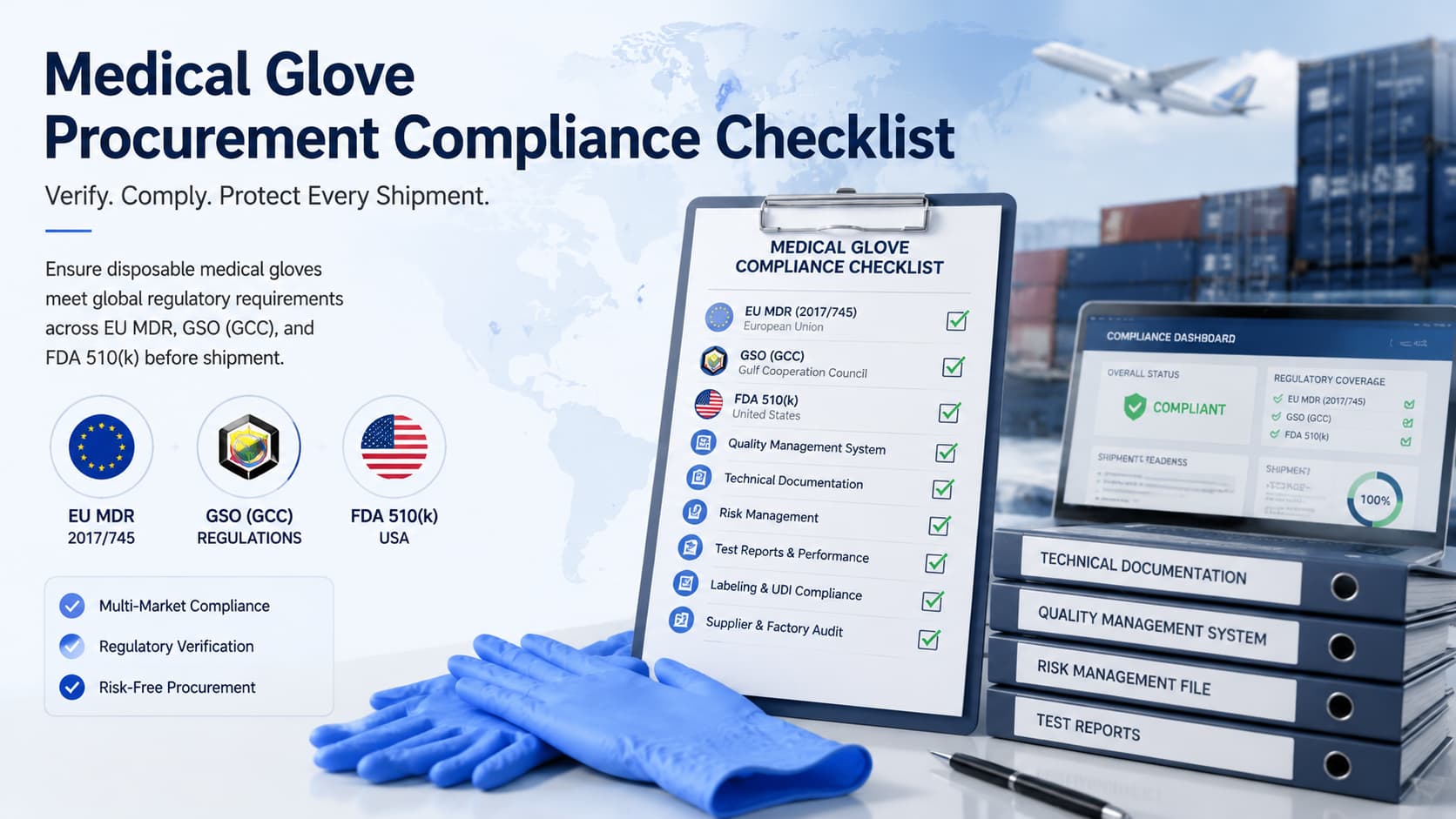
A medical glove procurement compliance checklist is a structured framework that importers, distributors, and healthcare procurement managers use to verify that disposable medical gloves meet all applicable regulatory requirements before shipment. In 2026, this checklist must cover at least three major regulatory regimes — EU MDR (2017/745), GSO (GCC), and FDA 510(k) (USA) — because a single shipment may be destined for multiple markets or held to the most stringent standard as organizational policy. This article provides a detailed, regulation-by-regulation compliance checklist, supporting tables, and an FAQ section for procurement professionals sourcing nitrile rubber medical gloves.
Regulatory enforcement of medical glove standards has intensified across all major markets in 2025–2026. The European Commission has accelerated MDR transition timelines, GSO market surveillance has resulted in port-level shipment detentions in Saudi Arabia and the UAE, and the FDA has increased its foreign supplier verification inspection cadence. The cost of non-compliance extends beyond financial penalties: detained shipments, contract cancellations, and reputational damage to the importer are common consequences. A proactive, checklist-driven procurement process reduces these risks and provides auditable due diligence records.
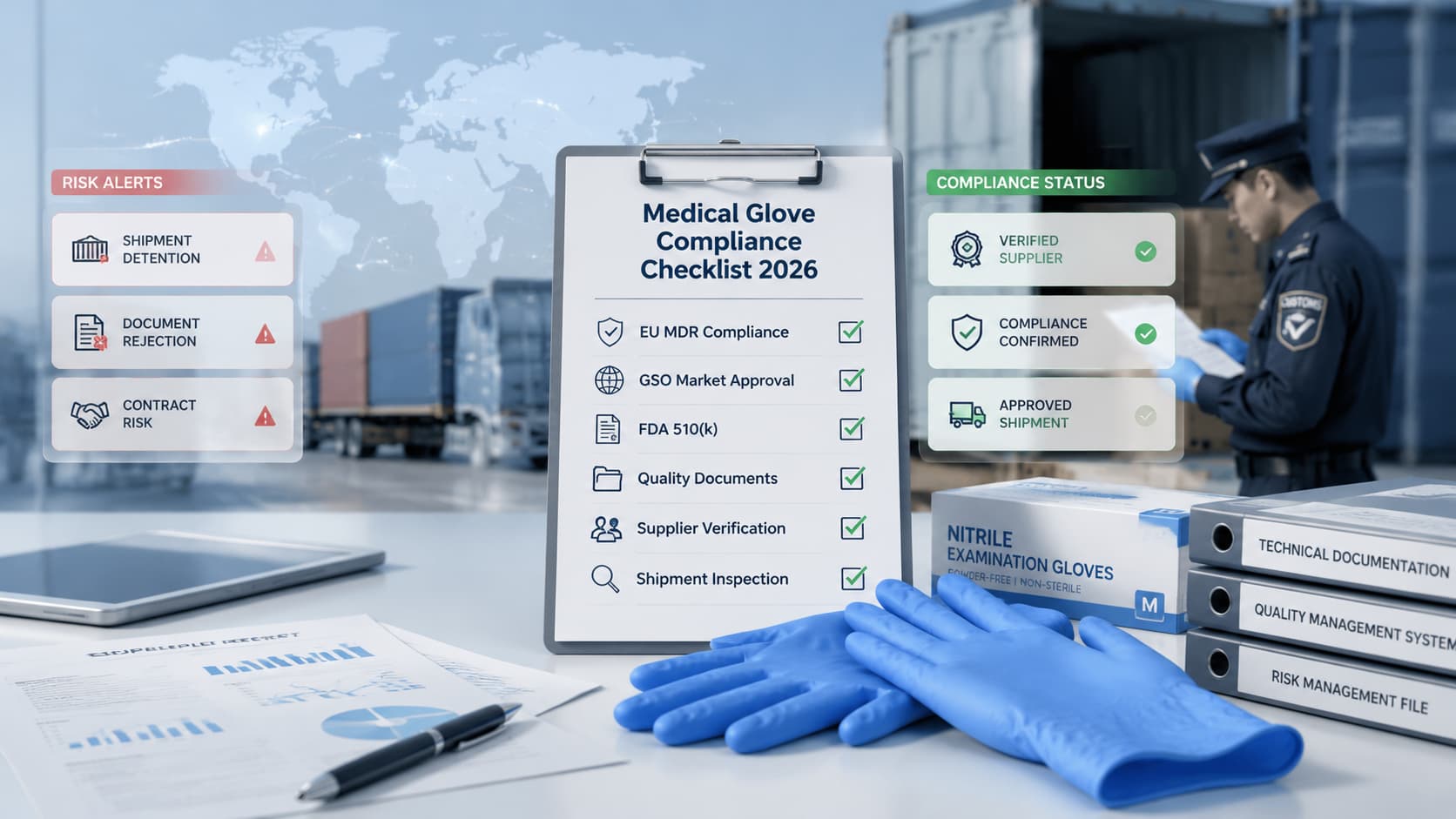
The EU Medical Device Regulation (2017/745), fully applicable since May 2021, replaced the Medical Device Directive (93/42/EEC). Medical gloves are classified as Class I (non-sterile examination gloves), Class Is (sterile examination gloves), or Class IIa (surgical gloves). As of 2026, all medical gloves placed on the EU market must be MDR-compliant; MDD certificates are no longer valid.
| Checklist Item | Requirement | Verification Method | Priority |
|---|---|---|---|
| CE Marking with NB number | Four-digit NB number adjacent to CE mark (Class Is & IIa) | Visual inspection; cross-check on EU NANDO database | Critical |
| EU Declaration of Conformity | Manufacturer-signed DoC referencing MDR 2017/745, all standards listed | Request PDF; verify signature date within validity (max 5 years) | Critical |
| EN 455-1:2020 — Freedom from holes | AQL ≤ 1.5 (exam); AQL ≤ 0.65 (surgical) | Request latest EN 455-1 report from ISO 17025-accredited lab | Critical |
| EN 455-2:2015 — Physical properties | Min thickness and tensile strength before/after aging | Request EN 455-2 report; verify finger AND palm thickness | Critical |
| EN 455-3:2023 — Biological evaluation | Endotoxin limits, latex protein, chemical residue | Request EN 455-3 test report from accredited lab | High |
| EN 455-4:2009 — Shelf-life | Real-time aging study demonstrating shelf-life claim | Request aging study summary; verify matches packaging | High |
| EN 374 series — Chemical protection | Permeation resistance for claimed chemicals | Request EN 374 test reports per claimed chemical | High (if claimed) |
| ISO 13485:2016 QMS Certificate | QMS certificate covering medical glove production | Request valid ISO 13485; verify scope includes medical gloves | High |
| EU MDR PRRC (Article 15) | Named Person Responsible for Regulatory Compliance | Request PRRC name/qualifications; verify in DoC | Medium |
| UDI (Unique Device Identification) | UDI-DI and UDI-PI assigned, registered in EUDAMED | Request UDI-DI; verify in EUDAMED | Medium |
| Clinical Evaluation Report | CER per MDR Annex XIV for Class IIa surgical gloves | Request CER summary (Class IIa only) | Medium (IIa) / Low (I) |
| Post-Market Surveillance Plan | Documented PMS per MDR Articles 83-86 | Request PMS plan summary | Low-Medium |
The Gulf Cooperation Council Standardization Organization (GSO) regulates medical gloves under GSO Technical Regulation for Medical Devices. All medical gloves imported into GCC member states (Saudi Arabia, UAE, Qatar, Kuwait, Oman, Bahrain) must carry the GSO Conformity Tracking Symbol (GCTS) with a valid GSO Certificate of Conformity.
| Checklist Item | Requirement | Verification Method | Priority |
|---|---|---|---|
| GSO Certificate of Conformity | Valid GSO CoC from GSO-notified body | Request CoC; verify dates; cross-check on GSO portal | Critical |
| GCTS on product labeling | GCTS with NB ID + certificate number on packaging | Visual inspection of outer + primary packaging | Critical |
| GSO 2297:2020 — Medical Gloves | Compliance with GSO 2297 (= EN 455 series) | Request GSO 2297 test report from accredited lab | Critical |
| GSO 2298:2020 — Chemical (if claimed) | Compliance with GSO 2298 for chemical-resistant gloves | Request GSO 2298 report (if applicable) | High |
| Arabic-language labeling | Arabic on outer packaging (mandatory for Saudi) | Verify Arabic text, font size, accuracy | Critical |
| SFDA Registration (Saudi) | Separate SFDA medical device registration | Request SFDA reg number; verify on SFDA MDNR portal | Critical (Saudi) |
| UAE MoHAP Registration | MoHAP registration for UAE market | Request MoHAP registration/notification number | High (UAE) |
| Halal certification (optional) | Halal certificate for government/religious procurement | Request Halal cert if marketed as Halal-compliant | Medium |
| Pre-shipment inspection | PSI certificate for certain GCC countries | Request PSI reference number | Medium |
The U.S. FDA regulates medical gloves as Class I medical devices under 21 CFR 880.6250 (examination) and 21 CFR 878.4460 (surgical). A 510(k) premarket notification is required for most medical glove products.
| Checklist Item | Requirement | Verification Method | Priority |
|---|---|---|---|
| FDA 510(k) Clearance | 510(k) number for specific glove product | Search 510(k) on FDA database | Critical |
| FDA Establishment Registration | Manufacturer registered; renewed annually (Oct-Dec) | Verify on FDA Establishment Registration database | Critical |
| FDA Device Listing | Specific glove product listed under registration | Verify device listing is active | Critical |
| 21 CFR 820 (QSR) | QMS compliant with FDA QSR / ISO 13485 | Request QSR/ISO 13485 certificate | High |
| ASTM D3578 or D3577 | Compliance with applicable ASTM standard | Request ASTM test report from accredited lab | High |
| ASTM D6319 (nitrile rubber) | Nitrile-specific ASTM with physical property requirements | Request ASTM D6319 test report | High (nitrile rubber) |
| ASTM D6978 (chemotherapy) | Chemotherapy drug permeation resistance | Request ASTM D6978 if marketed for chemo use | High (if claimed) |
| 21 CFR 177.2600 (food contact) | Indirect food additive compliance | Request compliance statement from manufacturer | Medium |
| Labeling — 21 CFR 801 | Proper labeling: intended use, warnings, contraindications | Review against 21 CFR 801 | Medium |
| Requirement Area | EU MDR | GSO (GCC) | FDA (USA) |
|---|---|---|---|
| Product standard | EN 455 series | GSO 2297 (=EN 455) | ASTM D3578 / D6319 |
| Quality system | ISO 13485 | ISO 13485 | 21 CFR 820 / ISO 13485 |
| AQL (examination) | ≤ 1.5 (EN 455-1) | ≤ 1.5 (GSO 2297) | ≤ 1.5 (ASTM D3578) |
| AQL (surgical) | ≤ 0.65 (EN 455-1) | ≤ 0.65 (GSO 2297) | ≤ 0.65 (ASTM D3577) |
| Registration | Notified Body (NANDO) | GSO NB + National Regulator | FDA CDRH |
| Labeling language | Official EU language(s) | Arabic + English | English |
| UDI required? | Yes (EUDAMED) | Under development | Yes (GUDID) |
| Clinical evidence | CER (Class IIa) | Not required (Class I) | Not routinely required |
1. Expired certificates: MDD certs are no longer valid. Verify certificates reference MDR 2017/745, not MDD 93/42/EEC. GSO certificates max 3-year validity. Expired certs are the #1 cause of GCC port detention.
2. Thickness non-conformity: EN 455-2 and GSO 2297 specify minimum thickness at defined points. Gloves passing AQL 1.5 pinhole test may still fail thickness. Always request finger AND palm data; verify minimums (not just averages) meet the standard.
3. Labeling errors: Arabic labeling issues (missing text, wrong translations, illegible fonts) frequently cause GCC market rejection. Have labeling reviewed by a native Arabic speaker before shipment.
4. Incomplete DoC: EU DoC must list ALL applicable standards. A DoC referencing only EN 455 without EN 374 (when chemical claims exist) is technically incomplete.
5. Single-market assumptions: Products cleared for EU may need separate GSO and FDA registrations. Each is independent. Do not assume EU MDR compliance covers other regimes.
For each supplier and product, maintain a compliance dossier (updated at least annually) containing:
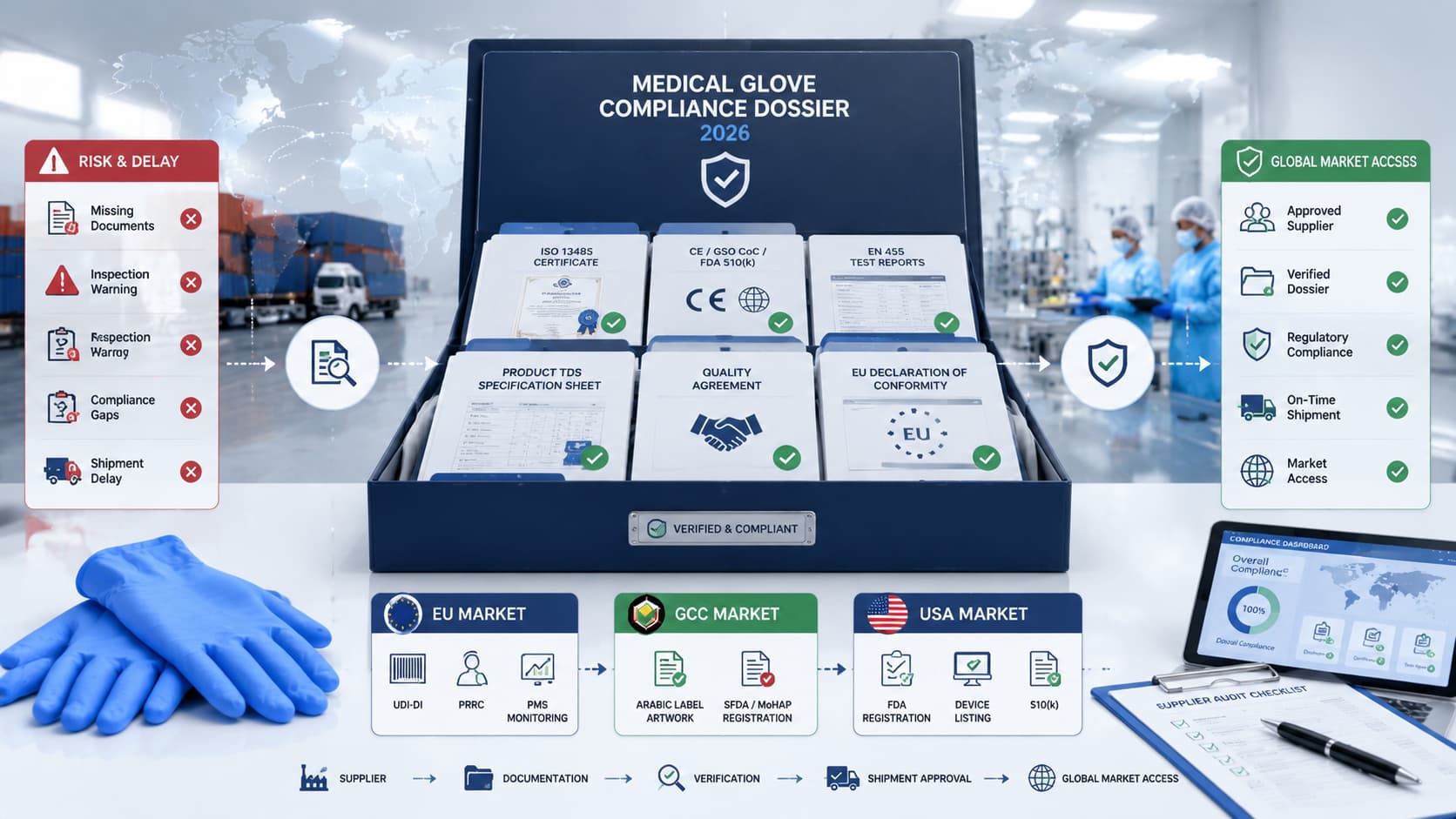
Core (all products): (1) Valid ISO 13485 certificate; (2) Valid CE/GSO CoC/510(k); (3) Latest EN 455-1/-2/-3 reports; (4) EU DoC (for EU-bound); (5) Product TDS with finger + palm thickness; (6) Quality agreement with batch release criteria.
Market-specific: EU: UDI-DI, PRRC details, PMS summary. GCC: Arabic label artwork, SFDA/MoHAP numbers. USA: FDA establishment reg, device listing, 510(k) summary.
A well-maintained dossier serves as both procurement gate-check and inspection defense. The ability to produce 12–18 months of organized compliance records distinguishes professional importers from enforcement-risk operators.
Q: Does a single CE certificate under EU MDR cover all GCC and FDA requirements?
A: No. EU MDR, GSO, and FDA are independent regulatory frameworks. CE marking does not replace GSO certification or FDA 510(k) clearance. A medical glove sold into all three markets requires separate conformity assessments. Underlying test data (EN 455, ISO 13485) can support multiple applications, reducing duplicate testing costs.
Q: How often should we re-verify our supplier's compliance documents?
A: ISO 13485 certificates: 3-year validity with annual surveillance. CE certs (MDR): max 5 years. GSO CoC: 1–3 years. FDA registration: renewed annually (Oct–Dec). Best practice: maintain a compliance calendar and request updated certificates 30 days before expiry.
Q: What is the most common compliance failure at GCC ports?
A: Expired or missing GSO certificates, followed by Arabic labeling deficiencies. As of mid-2026, Saudi customs have tightened verification and conduct random physical testing. Factor an additional 7–14 days for customs clearance into Saudi Arabia.
Q: Can I self-declare conformity for Class I medical gloves under EU MDR?
A: Yes — for non-sterile Class I exam gloves where manufacturer holds valid ISO 13485 and has a PRRC. However, most EU importers and public tenders require notified body involvement even for Class I as risk mitigation. Self-declaration is technically legal but commercially limited.
Please read on, stay posted, subscribe, and we welcome you to tell us what you think.


Copyright 2026@ Fujian Jixiang E-commerce Co., Ltd All Rights Reserved.
Sitemap |
Blog
|
Xml |
Privacy Policy
 Network Supported