Biodegradable Nitrile Gloves vs Traditional Nitrile Gloves: An ESG-Focused Procurement Comparison (2026)
Jul 17, 2026
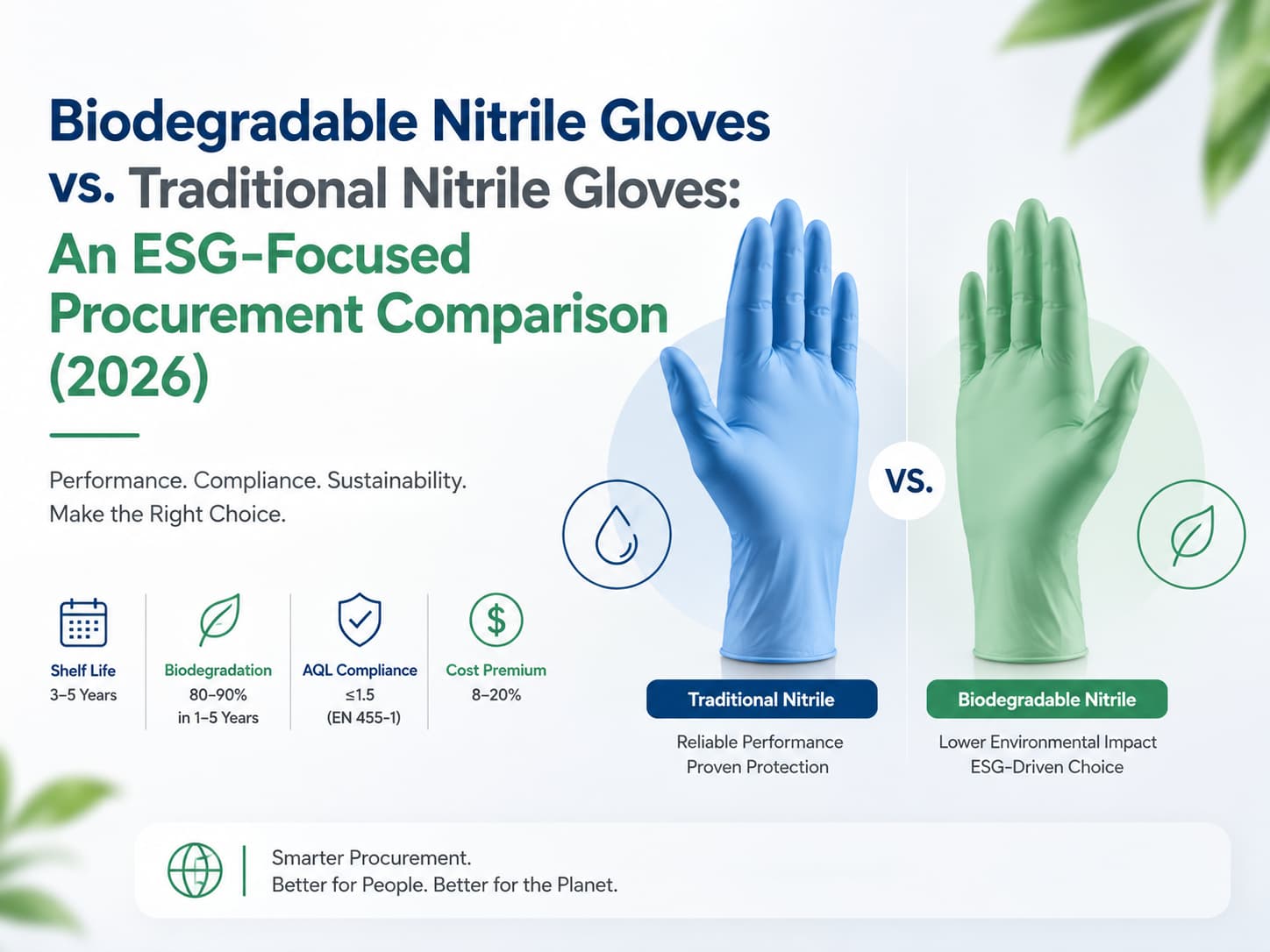
Biodegradable nitrile gloves are designed to break down in landfill or industrial composting conditions significantly faster than traditional nitrile rubber gloves. They use organic or bio-based additive packages that accelerate microbial degradation. The performance trade-offs vs traditional nitrile gloves include higher unit cost (typically 8-20%), shorter shelf life (12-18 months vs 3-5 years), and a more limited chemical permeation database. This comparison guide helps 2026 procurement teams understand when biodegradable nitrile makes sense for ESG reporting, when traditional nitrile remains the better choice, and how to verify biodegradation claims responsibly.
What "Biodegradable Nitrile" Actually Means in 2026
Biodegradable nitrile gloves are not a new polymer. They are conventional nitrile rubber (acrylonitrile butadiene rubber) with an additive package that accelerates microbial breakdown under specific conditions. The two most common additive technologies in 2026 are:
1. Organic nutrient additives: These provide a food source for microorganisms in landfill or compost environments. The additive itself is consumed, and the polymer matrix is broken down into smaller fragments. Typical claim: 80-90% biodegradation within 1-5 years under ASTM D5511 conditions (anaerobic landfill simulation).
2. Bio-based or partially bio-based nitrile: Some manufacturers use a portion of bio-based feedstock (e.g., butadiene from sugarcane or corn-derived ethanol) to reduce the carbon footprint of the base polymer. These are not necessarily biodegradable but have a lower cradle-to-gate carbon footprint.
Important clarification: Biodegradable nitrile does NOT mean the glove will decompose in a normal waste pile in a few weeks. Industrial composting or specific landfill conditions are required. The ASTM D5511 and D5526 standard test methods simulate accelerated landfill conditions, not ambient disposal.
Side-by-Side Comparison: Biodegradable vs Traditional Nitrile
When Biodegradable Nitrile Makes Sense
Based on 2026 ESG procurement trends and supplier feedback, biodegradable nitrile is a reasonable choice in the following scenarios:
1. ESG reporting requirements: Companies with published Scope 3 emissions targets or zero-waste-to-landfill commitments can include biodegradable nitrile in their reporting. The 80-90% biodegradation claim within 1-5 years is meaningful for waste-stream reporting.
2. High-volume low-hazard applications: Food service, hospitality, dental, and general-purpose use cases where shelf life (12-18 months) is acceptable and chemical permeation data is not the primary selection criterion.
3. Customer or end-user pressure: When end consumers or downstream customers (e.g., hospital systems, restaurant chains) are explicitly requesting biodegradable or compostable glove options.
4. Government and public sector tenders: Some EU and UK public sector tenders now include biodegradation or recycled content scoring criteria. Biodegradable nitrile can earn additional tender points.
When Traditional Nitrile Remains the Better Choice
Biodegradable nitrile is not a universal upgrade. The following scenarios strongly favor traditional nitrile:
1. Long shelf-life inventory requirements: Healthcare systems, government stockpiles, and disaster response agencies typically need 3-5 year shelf life. Biodegradable nitrile's 12-18 month shelf life is disqualifying.
2. Chemical or cytotoxic drug handling: ASTM D6978 chemotherapy drug handling and EN 374 chemical permeation applications require extensive test data. Biodegradable nitrile has a more limited chemical permeation database. Verify each chemical of interest is tested before switching.
3. High-temperature storage: Biodegradable nitrile is more sensitive to heat. Storage above 30 degrees C can accelerate degradation of the additive package and shorten functional shelf life.
4. Cost-sensitive high-volume applications: For applications where every fractional cent per glove matters (e.g., 1M+ gloves per month), the 8-20% premium is a significant cost driver without proportional functional benefit.
How to Verify Biodegradation Claims
Not all "biodegradable" claims are equal. Procurement teams should require the following documentation:
1. ASTM D5511 or D5526 test report: These are the standard test methods for high-solids anaerobic biodegradation. Request the actual test report, not just a summary. The report should specify the test duration, conditions, and percentage of biodegradation achieved.
2. Independent third-party validation: Test reports should be from accredited third-party labs (ISO 17025). In-house manufacturer claims are not sufficient.
3. Specific test conditions: The 80-90% biodegradation claim is achieved under specific conditions. Request the temperature, humidity, and microbial environment used in testing. A claim of "biodegradable" without test condition disclosure is marketing language.
4. Time-to-biodegradation: A 5-year claim is significantly different from a 1-year claim. Request the time to 80% biodegradation.
5. Shelf life vs biodegradation trade-off: Confirm that the biodegradation does not begin during storage. Additive packages should be designed to remain dormant during normal storage and activate only in landfill or compost conditions.
2026 Cost and Market Context
Biodegradable nitrile currently trades at an 8-20% premium to traditional nitrile, depending on volume and supplier. The premium is driven primarily by the additive package cost (typically $0.003-0.008/pc) and the dedicated production runs required to avoid cross-contamination with non-biodegradable lines. As of July 2026, with Brent crude at $95-98/bbl and butadiene at $1,450-1,520/MT, the absolute price difference for a 4-mil examination glove is approximately $0.004-0.008/pc. For an organization consuming 1M gloves per month, this is $4,000-8,000/month in additional cost. (Source: ICIS Petrochemical Index, July 2026)
Production capacity for biodegradable nitrile has expanded significantly in 2024-2026, with major Malaysian and Thai manufacturers adding dedicated lines. Expect the premium to narrow to 5-15% by 2027 as scale increases.
Common Procurement Mistakes
"Biodegradable means it disappears in my trash." No. Biodegradable nitrile requires specific landfill or industrial composting conditions. It will not degrade quickly in a typical waste pile or recycling stream.
"I can substitute it for traditional nitrile in any application." No. Shelf life and chemical permeation data are the two main constraints. Verify each application before switching.
"All biodegradable nitrile is the same." No. Additive technology, test method used, and time-to-biodegradation vary significantly. Always require the test report.
"Bio-based means biodegradable." Not necessarily. Bio-based refers to feedstock origin; biodegradable refers to end-of-life behavior. They are different attributes.
Key Takeaways
Biodegradable nitrile is conventional NBR with an additive package that accelerates microbial breakdown under specific landfill or composting conditions. It is not a new polymer.
The typical biodegradation claim is 80-90% within 1-5 years under ASTM D5511 conditions, which simulate accelerated landfill. Real-world ambient disposal will be slower.
Biodegradable nitrile carries an 8-20% cost premium and a 12-18 month shelf life, both of which limit its applicability in long-inventory and chemical-handling scenarios.
Biodegradation claims should be verified with ASTM D5511 or D5526 test reports from accredited third-party labs, with specific test conditions and time-to-biodegradation disclosed.
For ESG reporting, government tenders, and customer-driven applications, biodegradable nitrile is a viable 2026 procurement option. For high-hazard, long-shelf-life, or cost-sensitive applications, traditional nitrile remains the better choice.
FAQ
Q: Are biodegradable nitrile gloves a different polymer?
A: No. Biodegradable nitrile gloves are conventional nitrile rubber (acrylonitrile butadiene rubber, NBR) with an organic additive package that accelerates microbial breakdown. The base polymer is the same as traditional nitrile. The additive provides a food source for microorganisms in landfill or composting environments.
Q: Do biodegradable nitrile gloves decompose in normal trash?
A: No. Biodegradable nitrile requires specific landfill or industrial composting conditions to biodegrade. The 80-90% biodegradation claim is achieved under ASTM D5511 or D5526 test conditions, which simulate accelerated high-solids anaerobic landfill. Normal ambient disposal will be significantly slower.
Q: What is the cost premium for biodegradable nitrile in 2026?
A: As of mid-2026, biodegradable nitrile trades at an 8-20% premium to traditional nitrile, depending on volume and supplier. For a 4-mil examination glove at $0.045/pc base, the additional cost is approximately $0.004-0.008/pc, or $4,000-8,000 per month for an organization consuming 1 million gloves monthly. The premium is expected to narrow to 5-15% by 2027 as production capacity scales.
Q: What is the shelf life of biodegradable nitrile gloves?
A: Biodegradable nitrile gloves typically have a 12-18 month shelf life, compared to 3-5 years for traditional nitrile. This is because the additive package is designed to remain dormant during normal storage but becomes active in landfill conditions. For applications requiring long shelf life (healthcare stockpiles, disaster response), traditional nitrile is the better choice.
Q: Is bio-based the same as biodegradable?
A: No. Bio-based refers to feedstock origin (e.g., butadiene from sugarcane or corn-derived ethanol). Biodegradable refers to end-of-life behavior (breakdown in landfill or compost). They are independent attributes. A glove can be bio-based but not biodegradable, or biodegradable but not bio-based. Verify each claim with its specific test report.



 Network Supported