ASTM D6319 Explained: US Standard for Nitrile Examination Gloves (2026 Guide)
Aug 12, 2026
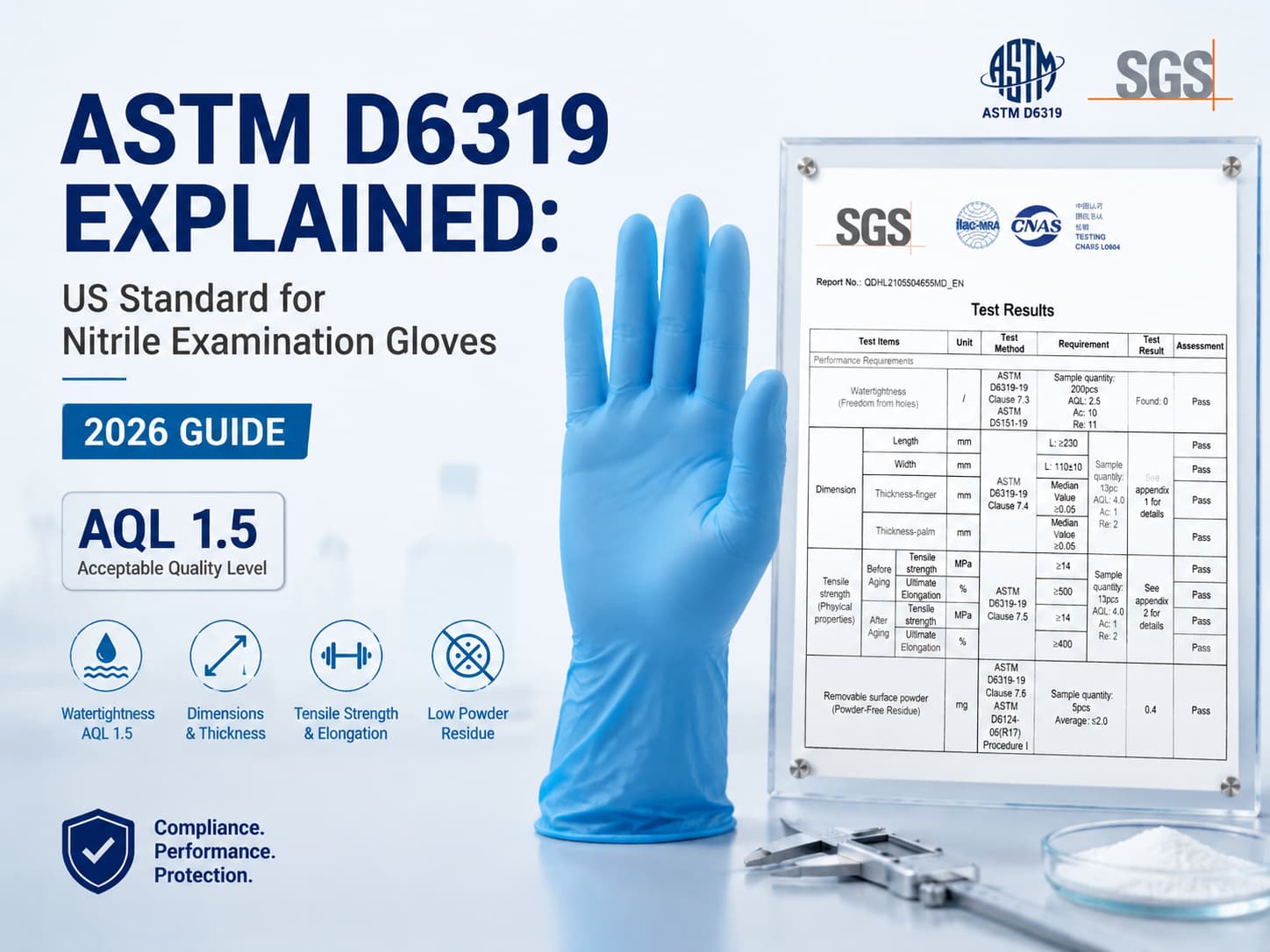
ASTM D6319 is the US standard specification for nitrile examination gloves intended for medical application. This certification interpretation guide explains the scope of ASTM D6319, its key test requirements, the FDA 510(k) clearance linkage, and how it compares to the European EN 455 series. Essential reading for procurement professionals sourcing gloves for the US healthcare market or dual-certifying products for both the US and EU.
1. What Is ASTM D6319?
ASTM D6319, titled "Standard Specification for Nitrile Examination Gloves for Medical Application," is maintained by ASTM International (formerly American Society for Testing and Materials). First published in 1999, it is regularly revised to reflect current manufacturing practice and biocompatibility science. The standard establishes requirements for nitrile rubber gloves used in medical examinations, diagnostic procedures, and patient contact in healthcare settings.
ASTM D6319 is recognized by the US FDA and is referenced as a consensus standard for 510(k) premarket notification submissions for medical examination gloves. Gloves that demonstrate compliance with ASTM D6319, along with biocompatibility testing per ISO 10993, are eligible for 510(k) clearance.
2. Scope and Application
ASTM D6319 applies to nitrile rubber examination gloves used in medical examinations, diagnostic procedures, and patient contact. The standard covers five key attribute groups:
Attribute Group
What It Covers
Test Reference
Physical dimensions
Length, width, palm thickness, finger thickness
ASTM D6319 section 6
Physical properties
Tensile strength, elongation at break before and after accelerated aging
ASTM D6319 section 7
Freedom from holes
Water leak test (AQL 1.5)
ASTM D6319 section 8, ISO 2859-1
Powder residue
Maximum powder amount (if labeled powder-free)
ASTM D6319 section 9
Biocompatibility
Cytotoxicity, sensitization, irritation (referenced to ISO 10993)
ISO 10993 series
3. Key Test Requirements
Physical Properties (Before and After Accelerated Aging)
ASTM D6319 specifies tensile strength and elongation at break both before and after accelerated aging. The aging protocol is per ASTM D7160 or equivalent. Minimum values depend on the thickness category, but typical requirements are:
Property
Before Aging
After Aging (7 days @ 70 degrees C)
Test Reference
Tensile strength
>= 14 MPa
>= 14 MPa
ASTM D412
Elongation at break
>= 500%
>= 400%
ASTM D412
Tensile strength (finger)
>= 18 MPa
>= 18 MPa
ASTM D412
Freedom from Holes (Water Leak Test)
The water leak test is the critical barrier integrity check. Gloves are filled with a defined volume of water and visually inspected for leaks. The Acceptable Quality Level (AQL) is 1.5, meaning the sample can have at most 1.5% defective units when sampled per ISO 2859-1 (equivalent to ANSI/ASQ Z1.4). Sampling plans typically reference General Inspection Level I or II with single sampling.
The water leak test is harmonized with EN 455-1, meaning gloves that pass one test generally pass both. Dual-certified gloves typically use the same leak test method.
Powder Residue Limit
ASTM D6319 limits the powder residue on powder-free gloves to 2 mg per glove maximum. The test method fills the glove with water and rinses, then evaporates the rinsate and weighs the residue. Powdered gloves have no residue limit under ASTM D6319, but FDA regulations and purchaser requirements increasingly favor powder-free products.
4. Biocompatibility Requirements (ISO 10993)
ASTM D6319 does not specify biocompatibility test methods itself but requires that the glove pass cytotoxicity, sensitization, and irritation tests per the ISO 10993 series. Typically, the following tests are required:
Test
Purpose
Method Reference
Cytotoxicity (MEM elution)
Detect cell-killing substances
ISO 10993-5
Sensitization (LLNA or GPMT)
Detect allergic contact dermatitis potential
ISO 10993-10
Irritation (intracutaneous reactivity)
Detect skin irritation potential
ISO 10993-10
Acute systemic toxicity (optional)
Detect systemic toxic effects
ISO 10993-11
Testing must be performed on the finished glove, not just the raw nitrile rubber. A change in formulation (different accelerator, plasticizer, pigment) typically requires re-testing per ISO 10993.
5. ASTM D6319 vs EN 455 Comparison
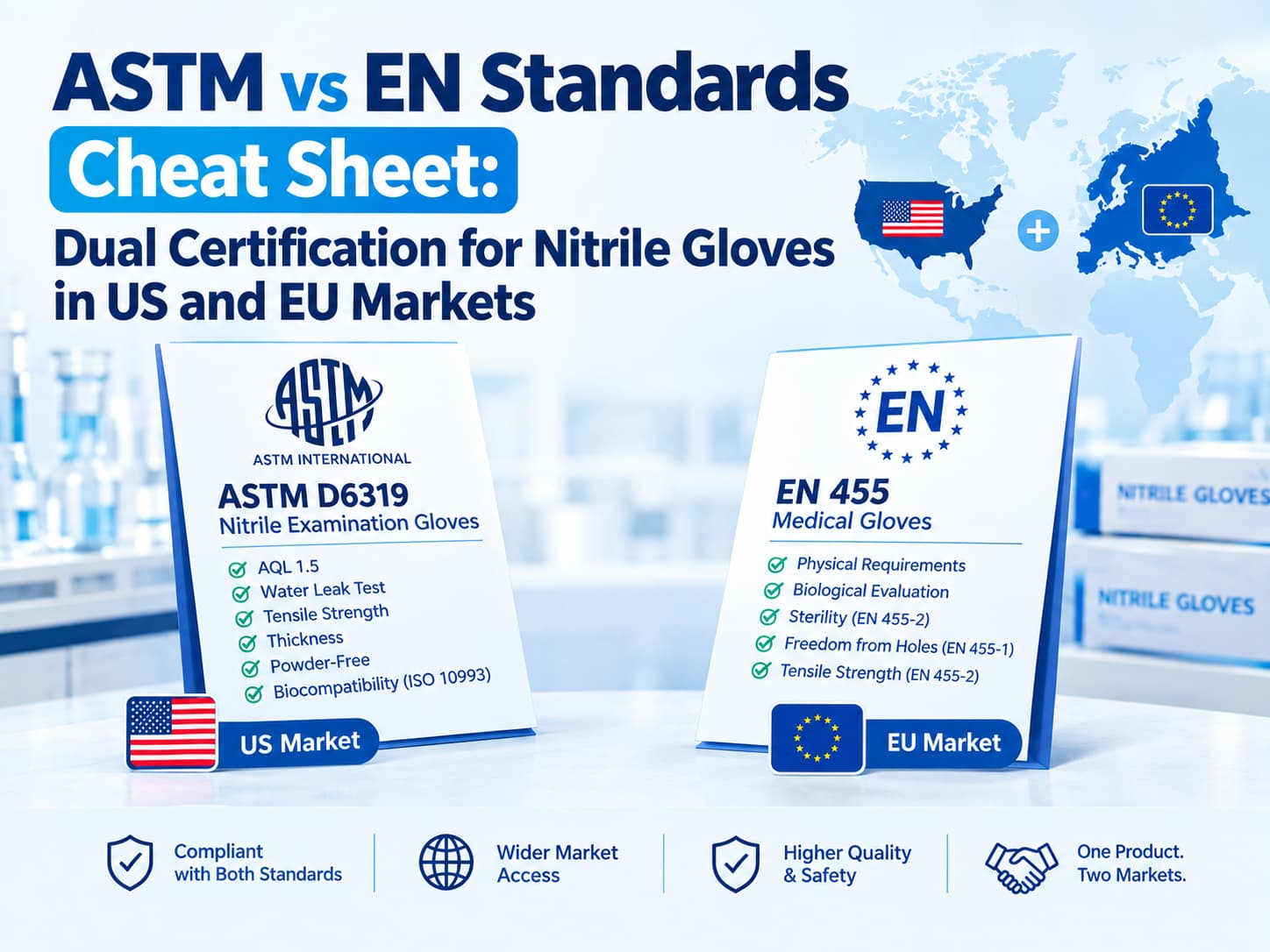
ASTM D6319 and EN 455 (series 1-4) both certify nitrile examination gloves for medical use. For dual-certified products, the differences are minor but worth understanding.
Requirement
ASTM D6319
EN 455 Series
Region of recognition
US (FDA 510(k))
EU (MDR 2017/745)
Freedom from holes AQL
1.5
1.5 (EN 455-1)
Tensile strength (before aging)
>= 14 MPa
>= 7 MPa (EN 455-2)
Elongation (before aging)
>= 500%
>= 500% (EN 455-2)
Powder residue limit
<= 2 mg/glove (powder-free)
<= 2 mg/glove (EN 455-3 powder-free)
Protein content limit
Not applicable (nitrile)
<= 50 microg/g for latex; not applicable to nitrile
Biocompatibility
ISO 10993 required
ISO 10993 required (EN 455-3)
Shelf life determination
ASTM D7160
EN 455-4
The most notable difference is tensile strength: ASTM D6319 requires a minimum of 14 MPa before aging (and same after aging), while EN 455-2 requires only 7 MPa before aging. ASTM D6319 is more stringent on tensile strength, which is one reason many manufacturers dual-certify to ASTM D6319 first and then add EN 455.
6. FDA 510(k) Clearance Process
To market nitrile examination gloves in the US, manufacturers must obtain FDA 510(k) clearance. The 510(k) pathway requires:
Predicate device identification: Demonstrate substantial equivalence to a legally marketed predicate device.
Performance testing: Compliance with ASTM D6319 (plus biocompatibility per ISO 10993).
Labeling review: Compliance with 21 CFR 801 (medical device labeling).
Quality system: Manufacturing under FDA Quality System Regulation (21 CFR 820, transitioning to QSR harmonized with ISO 13485).
User fee: Standard FDA user fee (currently approximately $24,000 for a 510(k) submission, with small-business discounts available).
After clearance, the glove is listed in the FDA 510(k) database with the K-number. Importers and distributors should verify the K-number on each shipment's documentation.
7. Procurement Checklist for ASTM D6319 Gloves
Verify FDA 510(k) clearance - Check the FDA 510(k) database for an active K-number for the glove model.
Request the ASTM D6319 test report - Confirm compliance with physical properties, water leak, and powder residue limits.
Request the ISO 10993 biocompatibility report - Confirm cytotoxicity, sensitization, and irritation test results on the finished glove.
Verify shelf life data - Request ASTM D7160 or EN 455-4 accelerated aging test results. Typical nitrile rubber glove shelf life is 3-5 years under proper storage.
Confirm AQL 1.5 sampling - Request batch-level AQL test reports with each shipment.
Verify labeling compliance - Check 21 CFR 801 labeling: size, intended use, manufacturer, expiration date, lot number, storage conditions.
Confirm US agent representation - Foreign manufacturers must designate a US Agent for FDA correspondence.
Audit the manufacturer - For high-volume procurement, conduct an on-site or remote audit covering ISO 13485 quality system and ASTM D6319 production controls.
FAQ
Q: What is ASTM D6319 and what products does it cover?
A: ASTM D6319 is the US standard specification for nitrile examination gloves for medical application. It establishes requirements for nitrile rubber gloves used in medical examinations, diagnostic procedures, and patient contact. The standard covers physical properties, dimensions, freedom from holes (water leak test), powder residue, and protein content. ASTM D6319 is referenced by the US FDA for 510(k) premarket notification clearance of medical examination gloves.
Q: How does ASTM D6319 differ from EN 455 for nitrile examination gloves?
A: ASTM D6319 and EN 455 series (EN 455-1, 455-2, 455-3, 455-4) both certify nitrile examination gloves for medical use, but they are regional standards. ASTM D6319 is recognized in the US (with FDA 510(k) clearance) while EN 455 is required in the EU under the Medical Device Regulation (MDR 2017/745). Many manufacturers dual-certify to access both markets. Key test differences include slightly different AQL sampling plans and protein-content limits (EN 455 limits latex protein; ASTM D6319 focuses on nitrile-specific biocompatibility per ISO 10993).
Q: What AQL does ASTM D6319 require?
A: ASTM D6319 sets the maximum Acceptable Quality Level (AQL) for freedom from holes (water leak test) at 1.5, in line with EN 455-1 and the general medical examination glove standard. The standard requires sampling per ISO 2859-1 (equivalent to ANSI/ASQ Z1.4). Some manufacturers voluntarily meet AQL 0.65 for surgical-grade applications. Batch-level AQL test reports are the standard requirement for procurement verification.
Q: Does ASTM D6319 require biocompatibility testing?
A: Yes. ASTM D6319 defers biocompatibility testing to ISO 10993 (Biological evaluation of medical devices). For nitrile examination gloves, the typical panel includes cytotoxicity, sensitization, and irritation tests. Test reports must reference the specific material formulation. A change in formulation (different accelerator, plasticizer, or pigment) may require re-testing under ISO 10993.
Q: What packaging and labeling requirements does ASTM D6319 specify?
A: ASTM D6319 requires that each glove be properly labeled with size, intended use (medical examination), and the manufacturer's identification. The packaging must include the expiration date (determined per ASTM D7160 or equivalent accelerated aging protocol), storage conditions, and any applicable warnings. For US sale, the label must also comply with FDA 21 CFR 801 (medical device labeling). Cartons must include the lot number for traceability.



 Network Supported