Medical Gloves for Hospitals and Clinics: A Complete Procurement Guide for Healthcare Facilities
Mar 31, 2026
The selection of appropriate medical gloves stands as one of the most critical procurement decisions for hospitals, clinics, and healthcare systems worldwide. As the first line of defense against cross-contamination and occupational exposure, medical gloves play an indispensable role in safeguarding both healthcare professionals and patients. With the global medical gloves market projected to surpass $18 billion by 2028, understanding the nuances of glove selection, regulatory compliance, and supply chain reliability has never been more important for procurement managers and healthcare administrators.
Understanding Medical Glove Categories
Medical gloves are broadly classified into two primary categories: surgical gloves and examination gloves. While both serve as essential healthcare PPE, they differ significantly in design, manufacturing standards, and intended applications. Surgical gloves are designed for use in operating rooms and invasive procedures, where precision, tactile sensitivity, and sterile conditions are paramount. These gloves are typically sterilized, individually packaged, and manufactured to stricter dimensional tolerances to ensure a snug, anatomical fit that supports delicate surgical maneuvers.
Examination gloves, on the other hand, are intended for general clinical use including patient examinations, diagnostic procedures, and routine care tasks. They are available in both sterile and non-sterile variants, with non-sterile exam gloves being the most commonly used across healthcare facilities. Understanding this distinction is fundamental for procurement teams tasked with outfitting diverse departments within a hospital or clinic setting.
Beyond these primary categories, specialized medical gloves have emerged to address specific clinical needs. Orthodontic gloves with extended cuffs, chemotherapy-tested gloves for oncology departments, and antimicrobial-coated gloves for high-risk environments represent the evolving landscape of clinical gloves designed to meet increasingly sophisticated healthcare requirements.
Material Considerations: Nitrile, Latex, and Vinyl
The choice of glove material directly impacts performance, safety, and user satisfaction. Nitrile medical gloves have rapidly become the preferred choice across most healthcare settings, and for good reason. Nitrile offers superior puncture resistance compared to latex and vinyl, excellent chemical resistance against a wide range of substances including many chemotherapy drugs, and eliminates the risk of latex allergy reactions that affect an estimated 4.3% of the general population and up to 17% of healthcare workers.
Modern nitrile formulations have evolved significantly, addressing early concerns about stiffness and comfort. Today's premium nitrile medical gloves offer remarkable elasticity and tactile sensitivity that rivals natural rubber latex. Advanced polymer blends and manufacturing techniques such as chlorination and polymer coating have transformed the wearing experience, making nitrile gloves comfortable enough for extended clinical shifts while maintaining the barrier integrity that healthcare environments demand.
Latex gloves, while declining in market share due to allergy concerns, continue to offer unmatched elasticity and comfort. For procedures requiring the highest degree of tactile feedback, some surgeons still prefer latex surgical gloves. However, most healthcare facilities have adopted latex-free policies to protect both staff and patients, making nitrile the default choice for the majority of clinical applications.
Vinyl gloves, manufactured from polyvinyl chloride (PVC), represent the most economical option but come with significant limitations. Their lower puncture resistance and barrier integrity make them unsuitable for high-risk procedures. Vinyl gloves are best reserved for low-risk tasks such as basic patient care, housekeeping duties, and administrative tasks in clinical settings where fluid exposure is minimal.
Regulatory Standards and Compliance
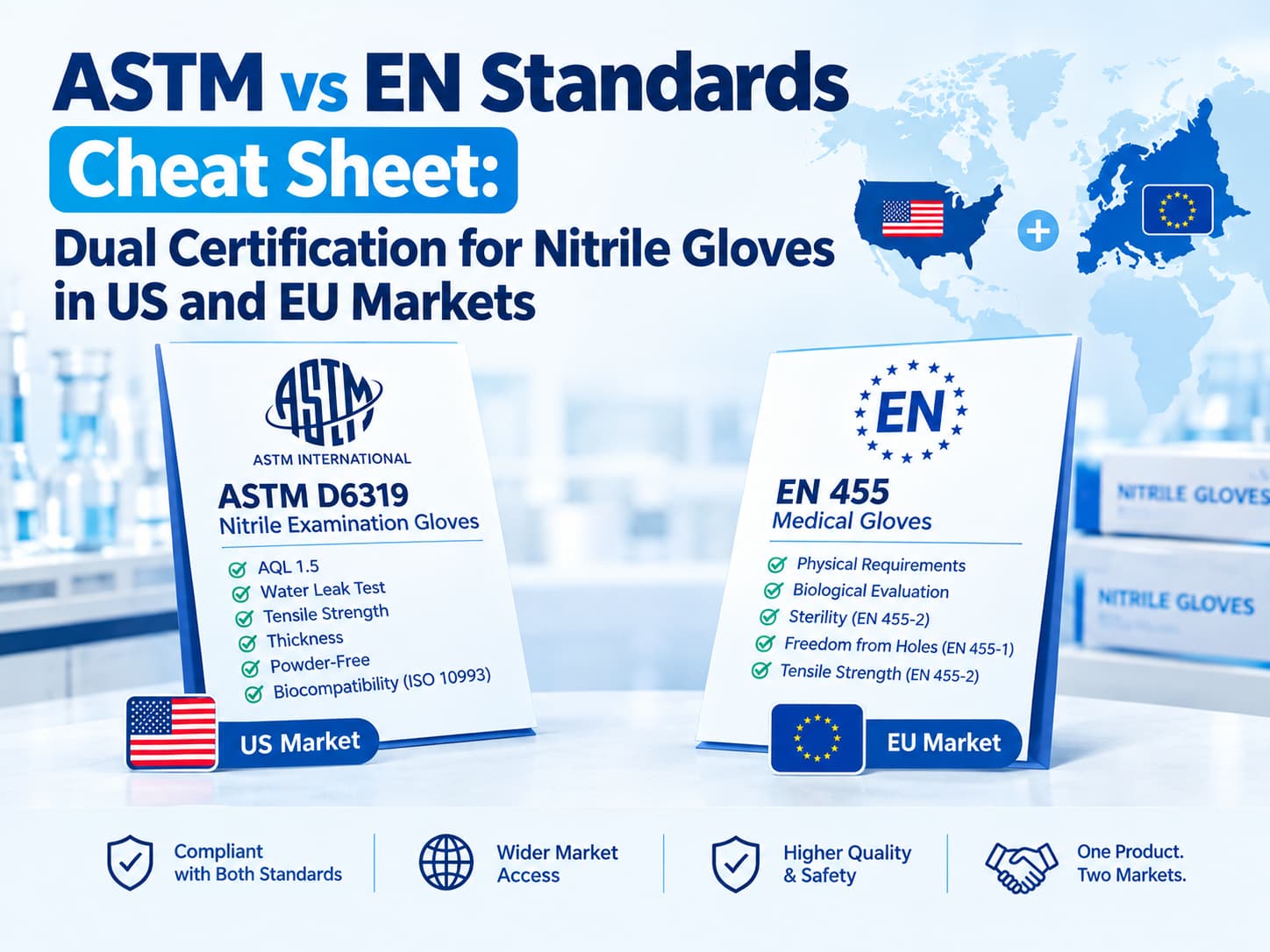
Healthcare facilities must ensure that all medical gloves meet stringent regulatory requirements. In the United States, the Food and Drug Administration (FDA) regulates medical gloves as Class I medical devices, requiring manufacturers to comply with 21 CFR Part 800 regulations. Key compliance markers include the FDA 510(k) clearance for surgical gloves, adherence to ASTM D3578 standards for rubber examination gloves, ASTM D6319 for nitrile examination gloves, and ASTM D5151 for pinhole leak testing.
For international procurement, particularly for healthcare systems in the Middle East and other regions, CE marking under the European Medical Device Regulation (MDR) and compliance with ISO 13485 quality management systems are essential considerations. Procurement managers should verify that their glove suppliers maintain current certifications and can provide documentation of ongoing quality assurance testing.
The current Good Manufacturing Practice (cGMP) requirements for medical gloves include rigorous quality control processes throughout production. Batch testing for water tightness, visual inspection for defects, dimensional checks, and tensile strength testing are mandatory. Facilities should request and review their suppliers' quality control documentation, including Certificate of Analysis (CoA) for each shipment, to ensure consistent product quality.
Selection Criteria for Healthcare Facilities
Choosing the right medical gloves requires careful evaluation of several factors that extend beyond basic material preferences. Glove thickness, measured in mils or micrometers, directly influences both protection levels and dexterity. Surgical gloves typically range from 4 to 6 mils in thickness, prioritizing tactile sensitivity, while heavy-duty exam gloves may reach 8 to 10 mils for enhanced barrier protection during high-risk procedures.
Powder-free gloves have become the industry standard following the FDA's 2017 ban on powdered surgeon's and patient examination gloves. The ban addressed concerns about powder-related complications including post-surgical adhesions, allergic reactions, and wound contamination. All modern medical gloves should be powder-free, utilizing chlorination or polymer coating processes to facilitate easy donning.
Glove sizing and fit are critical for both safety and comfort. Ill-fitting gloves compromise barrier integrity, increase fatigue during prolonged use, and can lead to hand injuries. Procurement teams should ensure that their suppliers offer a comprehensive range of sizes from XS to XXL, with consistent sizing across production batches. Many leading manufacturers provide sizing guides and sample programs to help facilities establish proper fitting protocols.
Color coding has emerged as a valuable feature in healthcare environments, helping staff quickly identify glove types and detect tears or contamination. Blue and purple nitrile gloves are particularly popular in clinical settings, as the color provides high contrast against skin tones, making breaches more visible. Some facilities implement color-coded systems where different colors correspond to different departments or risk levels.
Infection Control and Cross-Contamination Prevention
Medical gloves serve as a cornerstone of infection control protocols in healthcare settings. The World Health Organization's Standard Precautions mandate glove use during any procedure with potential exposure to blood, body fluids, mucous membranes, or non-intact skin. Proper glove usage, including timely changes between patients and between clean and contaminated body sites during a single procedure, is essential for effective infection prevention.
The COVID-19 pandemic dramatically highlighted the importance of reliable glove supply chains and the consequences of inadequate PPE stockpiles. Healthcare facilities worldwide experienced severe shortages that compromised care delivery and put frontline workers at risk. This experience has reshaped procurement strategies, with many facilities now maintaining larger safety stock levels and diversifying their supplier base to ensure supply continuity.
Antimicrobial and antibacterial glove technologies represent an emerging frontier in infection control gloves. These specialized products incorporate active antimicrobial agents into the glove material, providing an additional layer of protection against pathogen transmission. While not yet standard in most facilities, these innovations are gaining attention as healthcare-associated infections (HAIs) remain a significant concern, affecting approximately 1 in 31 hospital patients on any given day in the United States.
Supply Chain Considerations for Procurement Managers
Establishing a reliable supply chain for medical gloves requires strategic planning and supplier evaluation. Key considerations include manufacturing capacity and scalability to meet surge demand, lead times and logistics capabilities, quality consistency across production runs, pricing stability and contract flexibility, and regulatory compliance documentation support.
For procurement teams serving healthcare facilities in the United States and Middle East, partnering with manufacturers who maintain established distribution networks and local warehousing capabilities can significantly reduce lead times and improve supply reliability. Manufacturers with production facilities in multiple countries offer additional supply chain resilience against regional disruptions.
Volume purchasing agreements and long-term contracts remain the most effective strategy for securing favorable pricing while ensuring supply stability. However, these agreements should include quality guarantees, the option to adjust order volumes based on actual consumption, and clear performance metrics for the supplier.
Cost Optimization Without Compromising Quality
Balancing cost efficiency with quality requirements is a perennial challenge for healthcare procurement teams. While per-unit cost is an important metric, total cost of ownership should be the primary consideration. Factors influencing total cost include failure rates and associated waste, staff preferences and compliance rates, storage and shelf-life considerations, and the potential costs of healthcare-associated infections linked to inadequate PPE.
Bulk purchasing of nitrile medical gloves in case quantities, combined with vendor-managed inventory programs, can reduce per-unit costs by 15-25% compared to ad hoc purchasing. Many manufacturers offer tiered pricing structures that reward consistent volume commitments, making strategic sourcing partnerships particularly valuable for multi-facility healthcare systems.
The Future of Medical Gloves
The medical glove industry continues to evolve in response to changing healthcare needs and technological capabilities. Biodegradable nitrile gloves address growing environmental concerns, with several manufacturers now offering products that break down significantly faster in landfill conditions compared to conventional nitrile. Smart gloves incorporating sensors for monitoring hand hygiene compliance represent another emerging innovation.
Sustainable manufacturing practices are becoming increasingly important in supplier evaluation. Healthcare facilities, particularly those with sustainability commitments, should consider manufacturers who implement energy-efficient production processes, water recycling systems, and responsible waste management practices.
Conclusion
Selecting the right medical gloves for hospitals and clinics requires a comprehensive understanding of material properties, regulatory requirements, clinical applications, and supply chain dynamics. By prioritizing quality, compliance, and supplier reliability, healthcare procurement teams can ensure that their facilities remain well-equipped to protect both healthcare workers and patients. As the industry continues to innovate, staying informed about emerging technologies and evolving standards will be essential for making procurement decisions that balance performance, protection, and value.
For healthcare facilities seeking a dependable partner in medical glove procurement, it is essential to work with manufacturers who combine rigorous quality standards with the production capacity and distribution capabilities to meet your facility's needs consistently. The right glove supplier is not just a vendor but a strategic partner in your facility's infection control and occupational safety mission.
[Request a Factory Audit Report]
About Fujian Jixiang E-commerce Co., Ltd.
With over 20 years of experience, we specialize in manufacturing high-quality disposable gloves.
Why Choose Us?
✅ Factory-direct pricing
✅ ISO/CE/FDA certified products
✅ OEM/ODM customization
✅ Global shipping to 50+ countries
Contact Us: info@jxgloves.com




 Network Supported