welcome to Jixiang E-commerce!

Search

Home

nitrile examination gloves

  • ASTM vs EN Standards Cheat Sheet: Dual Certification for Nitrile Gloves in US and EU Markets
    ASTM vs EN Standards Cheat Sheet: Dual Certification for Nitrile Gloves in US and EU Markets
    Sep 11, 2026
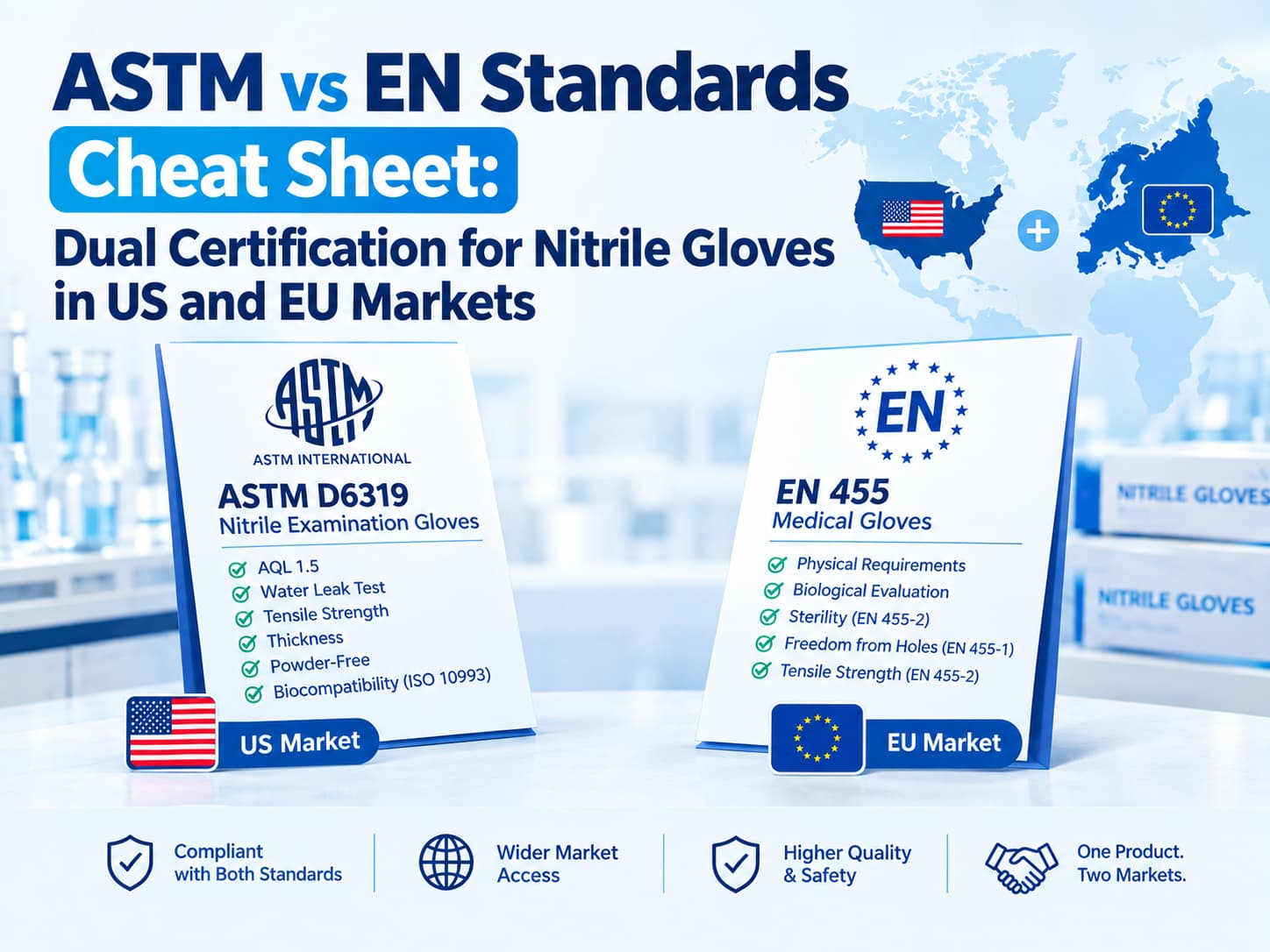
    ASTM and EN are the two most important standards families for disposable nitrile gloves. This cheat sheet compares key standards, test methods, AQL requirements, and physical property specs side by side, so buyers can understand what dual certification requires. ASTM International and the European Committee for Standardization (CEN) are the two primary standards bodies governing disposable medical gloves. ASTM D6319 is the US standard for nitrile examination gloves; EN 455 is the European standard for medical gloves for single use. Manufacturers selling to both the US and EU must understand the differences and achieve dual certification. This cheat sheet compares the two standards side by side. 1. Key ASTM Standards for Disposable Gloves ASTM standard Title Material ASTM D6319 Nitrile Examination Gloves for Medical Application Nitrile rubber ASTM D3578 Rubber Examination Gloves Natural rubber latex ASTM D5250 Polyvinyl Chloride Examination Gloves PVC ASTM D3577 Rubber Surgical Gloves Natural rubber latex / nitrile ASTM D6978 Assessment of Resistance of Medical Gloves to Permeation by Chemotherapy Drugs Any 2. Key EN Standards for Disposable Gloves EN standard Title Scope EN 455-1 Medical gloves for single use - Part 1: Freedom from holes AQL and water leak test EN 455-2 Part 2: Physical properties Force at break requirements EN 455-3 Part 3: Biological evaluation Cytotoxicity, sensitization, irritation EN 455-4 Part 4: Shelf life determination Accelerated and real-time aging EN ISO 21420 Protective gloves - General requirements (formerly EN 420) pH, innocuousness, sizing, dexterity EN 374-1 to -5 Protective gloves against chemicals and micro-organisms Permeation, penetration, degradation 3. Side-by-Side: ASTM D6319 vs EN 455 for Nitrile Gloves Parameter ASTM D6319 (US) EN 455 series (EU) Governing body ASTM International CEN (European Committee for Standardization) Regulatory pathway FDA 510(k) clearance EU MDR (2017/745) via Notified Body Hole freedom test Water leak test, AQL 1.5 EN 455-1: Water leak test, AQL 1.5 Tensile strength (before aging) >= 14 MPa Not specified as MPa; EN 455-2 uses force at break Tensile strength (after aging) >= 14 MPa Not specified as MPa; force at break applies Elongation before aging >= 500% Not specified in EN 455-2 Elongation after aging >= 400% Not specified in EN 455-2 Force at break (exam gloves) Not specified in force (uses tensile strength) EN 455-2: >= 6.0 N (rubber); >= 3.6 N (thermoplastic) Force at break (surgical) Not specified (ASTM D3577 covers surgical) EN 455-2: >= 9.0 N Biological evaluation ISO 10993 series (cytotoxicity, sensitization, irritation) EN 455-3: ISO 10993 series (same test framework) Shelf life Manufacturer-defined with supporting data EN 455-4: accelerated aging + real-time stability testing required Sampling for AQL ANSI/ASQ Z1.4 (equivalent to ISO 2859-1) ISO 2859-1 4. Key Differences in Testing Approach The most important difference between ASTM and EN is how they measure physical properties. ASTM D6319 specifies tensile strength in megapascals (MPa) and elongation percentage. EN 455-2 specifies force at break in newtons (N) but does NOT specify tensile strength in MPa or elongation. This means a glove could pass one standard but not the other depending on its material formulation: ASTM approach: tensile strength and elongation on dumbbell-shaped specimens cut from the glove EN approach: force at break on a strip cut from the glove, measured in newtons Result: a nitrile glove with tensile strength of 16 MPa may have a force at break that varies with specimen width and thickness For biological evaluation, both ASTM and EN reference the ISO 10993 series, so the testing framework is aligned. The difference is in regulatory documentation: the US requires FDA 510(k) submission, while the EU requires CE marking via a Notified Body under the EU MDR. 5. AQL and Sampling Comparison Aspect ASTM / FDA (US) EN 455-1 (EU) Acceptable Quality Level AQL 1.5 for major defects (pinholes) AQL 1.5 for pinholes Premium grades Some manufacturers offer AQL 0.65 Some manufacturers offer AQL 0.65 Sampling standard ANSI/ASQ Z1.4 ISO 2859-1 Test method Water leak test (1000 mL water, 2-5 sec) Water leak test (1000 mL water, 2-5 sec) Batch release Per 21 CFR 800 + ASTM standards Per EN 455-1 + ISO 2859-1 6. Documentation Requirements for Dual Certification Requirement US (FDA 510(k)) EU (EU MDR / CE marking) Quality system 21 CFR 820 (QSR) or ISO 13485 ISO 13485 mandatory Technical file 510(k) premarket notification Technical documentation per EU MDR Annex II/III Biocompatibility ISO 10993 test reports EN 455-3 / ISO 10993 test reports Performance testing ASTM D6319 test report EN 455-1 to -4 test reports Risk management ISO 14971 (recommended) ISO 14971 (mandatory per EU MDR) Labeling English, per 21 CFR 801 Language of member state + CE mark UDI Required per FDA UDI rule Required per EU MDR UDI Post-market FDA MedWatch reporting EUDAMED registration and vigilance 7. Dual Certification Roadmap Design for both: specify nitrile rubber formulation that meets both ASTM D6319 (tensile >= 14 MPa, elongation >= 500%/400%) and EN 455-2 (force at break >= 6.0 N) Implement ISO 13485: this satisfies both FDA QSR expectations and EU MDR requirements Conduct ISO 10993 testing: biocompatibility data is accepted by both FDA and EU Notified Bodies Perform AQL testing: use ISO 2859-1 sampling (accepted by both ASTM and EN) Compile US technical file: 510(k) with ASTM D6319 performance data Compile EU technical file: EU MDR Annex II/III with EN 455-1 to -4 data Assign regulatory representatives: US Agent for FDA, Authorized Representative for EU Submit and maintain: register with FDA and obtain CE marking; update both files for any design or material changes Data sources: ASTM D6319-19; ASTM D3577; ASTM D3578; ASTM D5250; ASTM D6978; EN 455-1 to EN 455-4; EN ISO 21420:2020 (formerly EN 420); EN 374-1 to -5; EU MDR 2017/745; FDA 21 CFR 820; FDA 21 CFR 801; ISO 13485; ISO 14971; ISO 10993 series; ISO 2859-1; ANSI/ASQ Z1.4. Information current as of September 2026. FAQ Q: What is the main difference between ASTM and EN glove standards? A: The main difference is in how they measure physical properties. ASTM D6319 specifies tensile strength in megapascals (MPa) and elongation as a percentage. EN 455-2 specifies force at break in newtons (N) but does not set tensile strength or elongation requirements. Both use the same water leak test for AQL 1.5 and reference ISO 10993 for biocompatibility, but the regulatory pathways differ: FDA 510(k) for the US and CE marking via a Notified Body for the EU. Q: Can one glove meet both ASTM and EN requirements? A: Yes, many nitrile rubber gloves are dual-certified. A glove with tensile strength >= 14 MPa and elongation >= 500%/400% will typically also meet the EN 455-2 force at break requirement of >= 6.0 N for rubber examination gloves, because the two tests measure related properties through different methods. Manufacturers must conduct testing under both standards and maintain separate technical files for FDA 510(k) and EU MDR CE marking. Q: Which ASTM standard applies to nitrile examination gloves? A: ASTM D6319 is the US standard for nitrile examination gloves for medical application. It specifies tensile strength (>= 14 MPa before and after aging), elongation (>= 500% before aging, >= 400% after aging), dimensions, and AQL 1.5 for pinholes. For nitrile surgical gloves, ASTM D3577 applies. For chemotherapy drug permeation testing, ASTM D6978 applies. Q: What does EN 455-2 test that ASTM D6319 does not? A: EN 455-2 specifies force at break (measured in newtons) for different glove types: >= 6.0 N for rubber examination gloves, >= 3.6 N for thermoplastic (PVC/PE) examination gloves, and >= 9.0 N for surgical gloves. ASTM D6319 does not specify force at break in newtons; instead it uses tensile strength in MPa and elongation percentage. Conversely, ASTM D6319 specifies elongation, which EN 455-2 does not. Q: Do I need both certifications to sell in the US and EU? A: Yes, to sell medical gloves in both markets, you need both FDA 510(k) clearance (with ASTM D6319 compliance) for the US and CE marking (with EN 455 compliance) under the EU MDR for Europe. The two regulatory systems are independent. However, much of the underlying test data (ISO 10993 biocompatibility, AQL water leak testing, ISO 13485 quality system) can be shared between the two submissions.
  • Hand Hygiene and Glove Use in Healthcare: Integrating WHO Five Moments with Glove Protocols
    Hand Hygiene and Glove Use in Healthcare: Integrating WHO Five Moments with Glove Protocols
    Sep 15, 2026
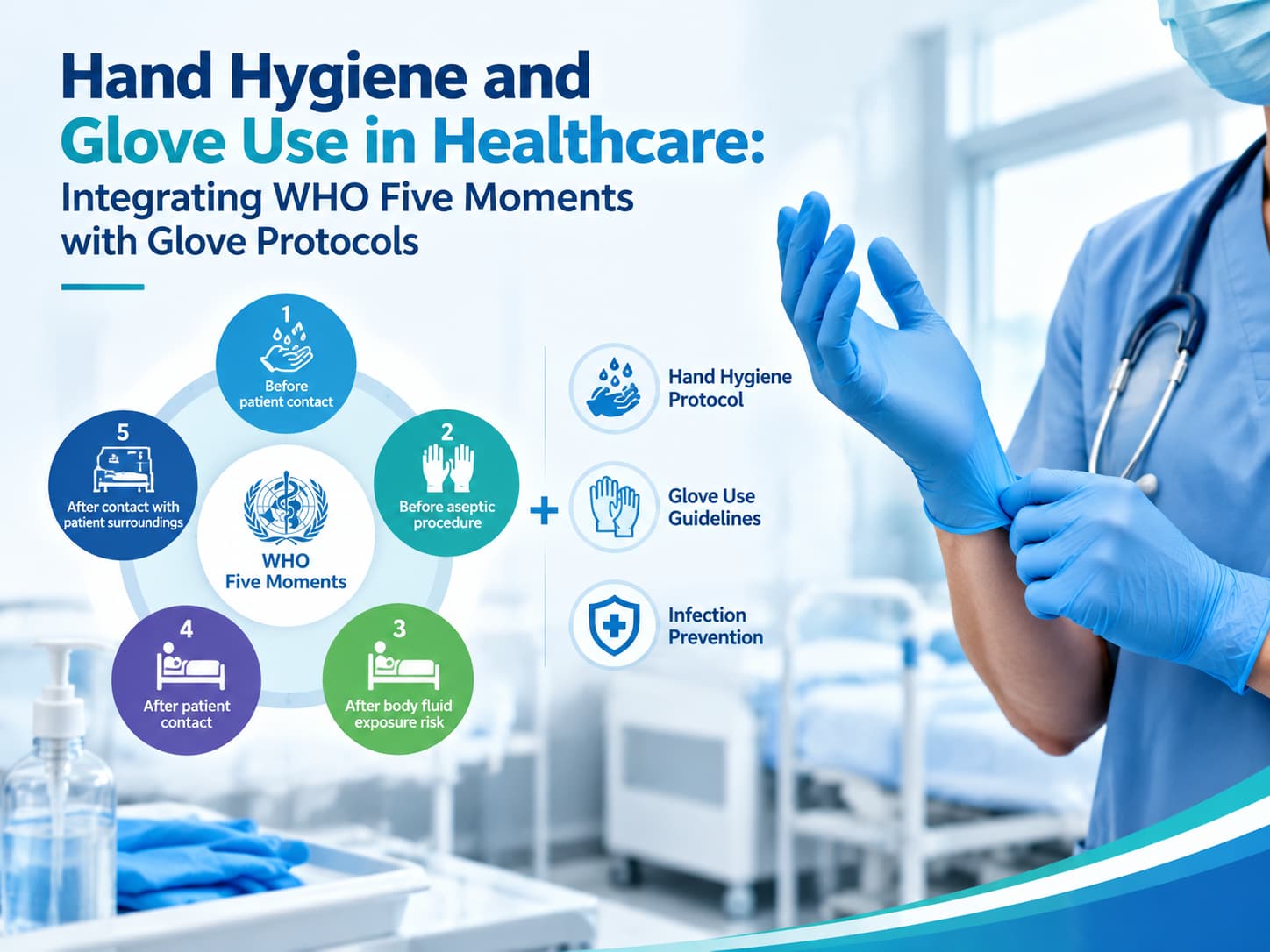
    Healthcare-associated infections affect millions of patients annually. This guide integrates the WHO Five Moments for Hand Hygiene with evidence-based glove use protocols to reduce cross-transmission and improve patient safety. Healthcare-associated infections (HAIs) remain one of the most significant threats to patient safety worldwide. The World Health Organization (WHO) estimates that hundreds of millions of patients are affected by HAIs each year, leading to increased mortality, prolonged hospital stays, and higher healthcare costs. Hand hygiene is the single most effective measure to prevent HAIs, yet compliance remains suboptimal in many settings. Gloves serve as a critical adjunct to hand hygiene, but improper use can paradoxically increase infection risk. This article integrates the WHO Five Moments for Hand Hygiene with evidence-based glove protocols to provide a practical framework for healthcare workers. 1. The WHO Five Moments for Hand Hygiene The WHO Five Moments define when hand hygiene must be performed during patient care: Moment Description Glove relevance 1. Before touching a patient Clean hands before patient contact to protect the patient from germs carried on your hands Don gloves if contact with blood, body fluids, mucous membranes, or non-intact skin is anticipated 2. Before clean/aseptic procedure Clean hands immediately before any aseptic task to protect the patient from harmful germs Sterile gloves required for invasive aseptic procedures 3. After body fluid exposure risk Clean hands immediately after exposure risk to protect yourself and the healthcare environment Remove gloves and perform hand hygiene immediately 4. After touching a patient Clean hands after touching the patient or their immediate surroundings to protect yourself and the environment Remove gloves and perform hand hygiene; do not wear the same gloves between patients 5. After touching patient surroundings Clean hands after touching any object or furniture in the patient's immediate surroundings Gloves should already be removed; perform hand hygiene 2. When to Use Gloves vs Hand Hygiene Alone Gloves are not a substitute for hand hygiene. The decision to wear gloves depends on the anticipated exposure: Clinical situation Hand hygiene Gloves required? Glove type Routine patient examination (intact skin) Yes (Moments 1, 4) No - Contact with blood or body fluids Yes (Moments 2, 3) Yes Examination gloves (nitrile or latex) Invasive aseptic procedure Yes (Moment 2) Yes Sterile surgical gloves Contact with contaminated surfaces Yes (Moment 5) Yes, if heavy contamination expected Examination gloves Handling sterile equipment Yes (Moment 2) Yes Sterile gloves 3. Common Errors in Glove-Hand Hygiene Sequence Errors in the sequence of glove use and hand hygiene can negate the protective benefits of both: Error Why it is harmful Correct action Wearing gloves without hand hygiene before donning Contaminants on hands are trapped against skin, promoting microbial growth Perform hand hygiene before donning gloves Wearing the same gloves between patients Cross-transmission of pathogens between patients Remove gloves and perform hand hygiene between every patient contact Reusing single-use gloves Compromised barrier integrity; AQL testing assumes single use Dispose of gloves after each use Skipping hand hygiene after glove removal Glove juice and micro-tears allow hand contamination Always perform hand hygiene immediately after glove removal Using gloves as a substitute for hand hygiene Gloves have micro-perforations; hands become contaminated during use Hand hygiene is always required, regardless of glove use 4. Glove Selection by Clinical Task Task Recommended glove Key specification General patient examination Nitrile examination glove, 3.5-4.5 mil AQL 1.5, powder-free Surgical procedures Sterile surgical glove, latex or synthetic SAL 10^-6, AQL 0.65-1.5, anatomical fit Chemotherapy handling Chemotherapy-rated nitrile, 7-9 mil ASTM D6978 compliant, tested against specific drugs High-risk infection isolation Nitrile examination glove, extended cuff AQL 1.5, EN 374 or ASTM D6978 if chemical exposure Food service / non-medical Vinyl or nitrile, 3-4 mil Food contact compliance (FDA 21 CFR 177 or EU 1935/2004) 5. Best Practices for Integration To maximize HAI prevention, healthcare facilities should integrate glove protocols into hand hygiene training: Combined training: Teach hand hygiene and glove use as complementary, not alternative, practices Visual cues: Post WHO Five Moments posters at point-of-care with glove decision aids Audit compliance: Monitor both hand hygiene compliance and appropriate glove use Product placement: Position glove dispensers and alcohol rubs together to reinforce sequential use Staff feedback: Provide real-time feedback on glove-hand hygiene sequence errors during clinical audits Data sources: WHO Guidelines on Hand Hygiene in Health Care (2009, updated 2021); CDC Guideline for Isolation Precautions (2007); EN 455 series; ASTM D6319; EN ISO 21420:2020. Information current as of September 2026. FAQ Q: What are the WHO Five Moments for Hand Hygiene? A: The WHO Five Moments are: (1) before touching a patient, (2) before clean/aseptic procedures, (3) after body fluid exposure risk, (4) after touching a patient, and (5) after touching patient surroundings. They define the critical times when hand hygiene must be performed to prevent healthcare-associated infections. Q: Should I perform hand hygiene before putting on gloves? A: Yes. Hand hygiene must be performed before donning gloves. If hands are contaminated when gloves are donned, the warm, moist environment inside the glove promotes microbial growth, a phenomenon known as "glove juice." Q: Can gloves replace hand hygiene? A: No. Gloves are not a substitute for hand hygiene. Gloves have micro-perforations (even at AQL 1.5, some pinholes exist), and hands become contaminated during glove use through these micro-perforations and during removal. Hand hygiene is required before donning and after removing gloves. Q: What is the correct sequence for glove removal and hand hygiene? A: The correct sequence is: (1) perform hand hygiene, (2) don gloves, (3) perform clinical task, (4) remove gloves using a no-touch technique, (5) perform hand hygiene immediately. Never wear the same pair of gloves between patients. Q: How do gloves contribute to HAI prevention when used correctly? A: Gloves provide a physical barrier against bloodborne pathogens and body fluids when contact is anticipated. When combined with proper hand hygiene, they reduce cross-transmission between patients, protect healthcare workers, and prevent environmental contamination. Correct use includes appropriate selection, single-patient use, and hand hygiene before donning and after removal.

Contact Us
Unit 1301-1, No. 3, Xixishan Wei Road, Software Park phase III, Torch High-tech Zone,Xiamen City, Fujian Province, China
+86-592-6511055
+86 -15750719843
Subscribe

Copyright 2026@ Fujian Jixiang E-commerce Co., Ltd All Rights Reserved. Sitemap | Blog | Xml | Privacy Policy Network Supported

leave a message

Leave A Message
If you are interested in our products and want to know more details,please leave a message here,we will reply you as soon as we can.
Submit

Home

Products

whatsApp

contact