EN 374 Explained — Chemical Protection Standards for Protective Glove
Jun 30, 2026
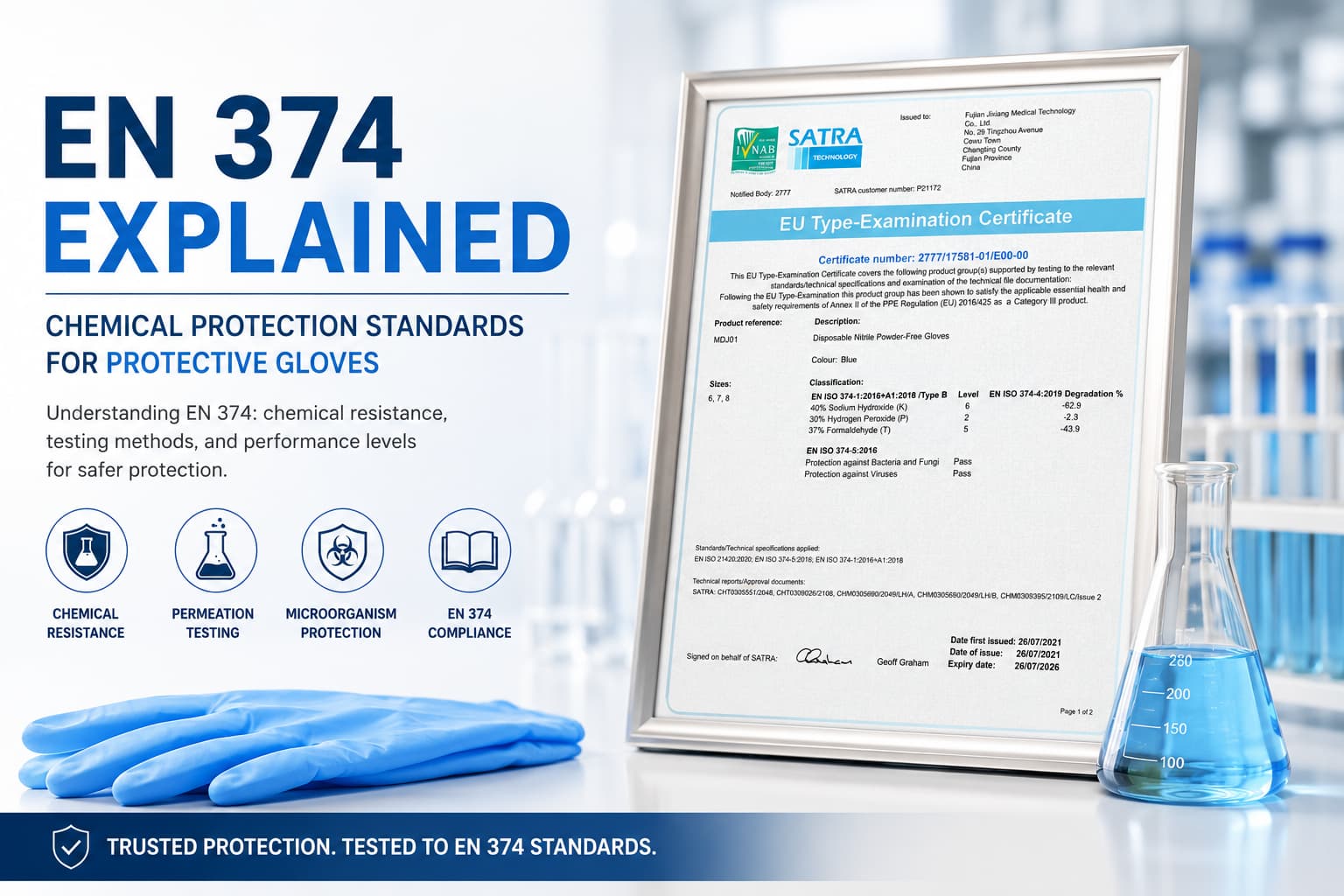
When your team handles solvents, acids, or petroleum-based chemicals, the label "EN 374" on a glove box is more than marketing — it is a verified claim that the product has been tested against specific chemicals under controlled conditions. But what exactly does each part of the standard cover, and how should buyers interpret the pictograms and type classifications?
The Structure of EN 374
Part
Scope
Key Requirement
EN 374-1
Terminology & general requirements
Defines glove categories, permeation terms, minimum thresholds
EN 374-2
Determination of resistance to penetration
Air-leak & water-leak tests for physical integrity
EN 374-3
Determination of resistance to permeation by chemicals
Measures breakthrough time for 18 listed chemicals
EN 374-4
Determination of resistance to degradation by chemicals
Visual/physical deterioration after 30-min exposure
EN 374-5
Micro-organism protection requirements
Bacteria, fungi, virus penetration resistance
Chemical Resistance Classification: Type A, B, C
The 18 Test Chemicals
Code
Chemical
CAS Number
A
Methanol
67-56-1
B
Acetone
67-64-1
C
Acetonitrile
75-05-8
D
Dichloromethane
75-09-2
E
Carbon disulfide
75-15-0
F
Chloroform
67-66-3
G
Diethylamine
109-89-7
H
Diethyl ether
60-29-7
I
Ethyl acetate
141-78-6
J
Heptane
142-82-5
K
NaOH 40%
1310-73-2
L
H2SO4 96%
7664-93-9
M
HNO3 65%
7697-37-2
N
Acetic acid 99%
64-19-7
O
NH4OH 25%
1336-21-6
P
H2O2 30%
7722-84-1
Q
HF 40%
7664-39-3
R
Formaldehyde 37%
50-00-0
Reading the Pictogram
A glove certified to EN 374 bears an Erlenmeyer flask icon with chemical letter codes underneath. The letters indicate which test chemicals the glove resists for >=30 minutes. A separate biohazard symbol appears when the glove also meets EN 374-5. Always cross-check letter codes against your workplace chemical inventory before purchasing.
Q: Does EN 374 certification guarantee total chemical barrier?
A: No. EN 374 measures permeation breakthrough time, not absolute impermeability. The 30-minute threshold is a minimum performance floor, not unlimited protection.
Q: Are nitrile gloves automatically EN 374 compliant?
A: No. Thin exam-grade nitrile gloves may meet EN 455 but fail EN 374-3 permeation tests. Always verify the specific type and chemical codes.
Q: Difference between penetration and permeation?
A: Penetration: macro-scale holes allowing liquid through. Permeation: molecular-level diffusion through intact material.
Q: How often should chemical-resistant gloves be replaced?
A: Replace at no more than 50% of stated breakthrough time. For unknown mixtures, replace immediately after any visible exposure.
Q: Does JIXIANG offer EN 374-certified gloves for Gulf markets?
A: Yes. JIXIANG nitrile gloves are certified EN 374 Type C and Type A, with CE MDR documentation and GSO-compliant labeling.
{
"@context": "https://schema.org",
"@type": "FAQPage",
"mainEntity": [
{
"@type": "Question",
"name": "Does EN 374 guarantee total chemical barrier?",
"acceptedAnswer": {
"@type": "Answer",
"text": "No. EN 374 measures breakthrough time, not absolute impermeability."
}
},
{
"@type": "Question",
"name": "Are nitrile gloves automatically EN 374 compliant?",
"acceptedAnswer": {
"@type": "Answer",
"text": "No. Exam-grade nitrile may meet EN 455 but fail EN 374-3."
}
},
{
"@type": "Question",
"name": "Penetration vs permeation?",
"acceptedAnswer": {
"@type": "Answer",
"text": "Penetration = macro holes; permeation = molecular diffusion."
}
},
{
"@type": "Question",
"name": "Replacement frequency?",
"acceptedAnswer": {
"@type": "Answer",
"text": "Replace at 50% of breakthrough time; unknown mixtures = immediate."
}
},
{
"@type": "Question",
"name": "JIXIANG EN 374 for Gulf markets?",
"acceptedAnswer": {
"@type": "Answer",
"text": "Yes. Type C and Type A certified, CE MDR docs, GSO labeling."
}
}
]
}



 Network Supported