EN ISO 21420 (EN 420) Explained: General Requirements for Protective Gloves (2026 Procurement Guide)
Jul 16, 2026
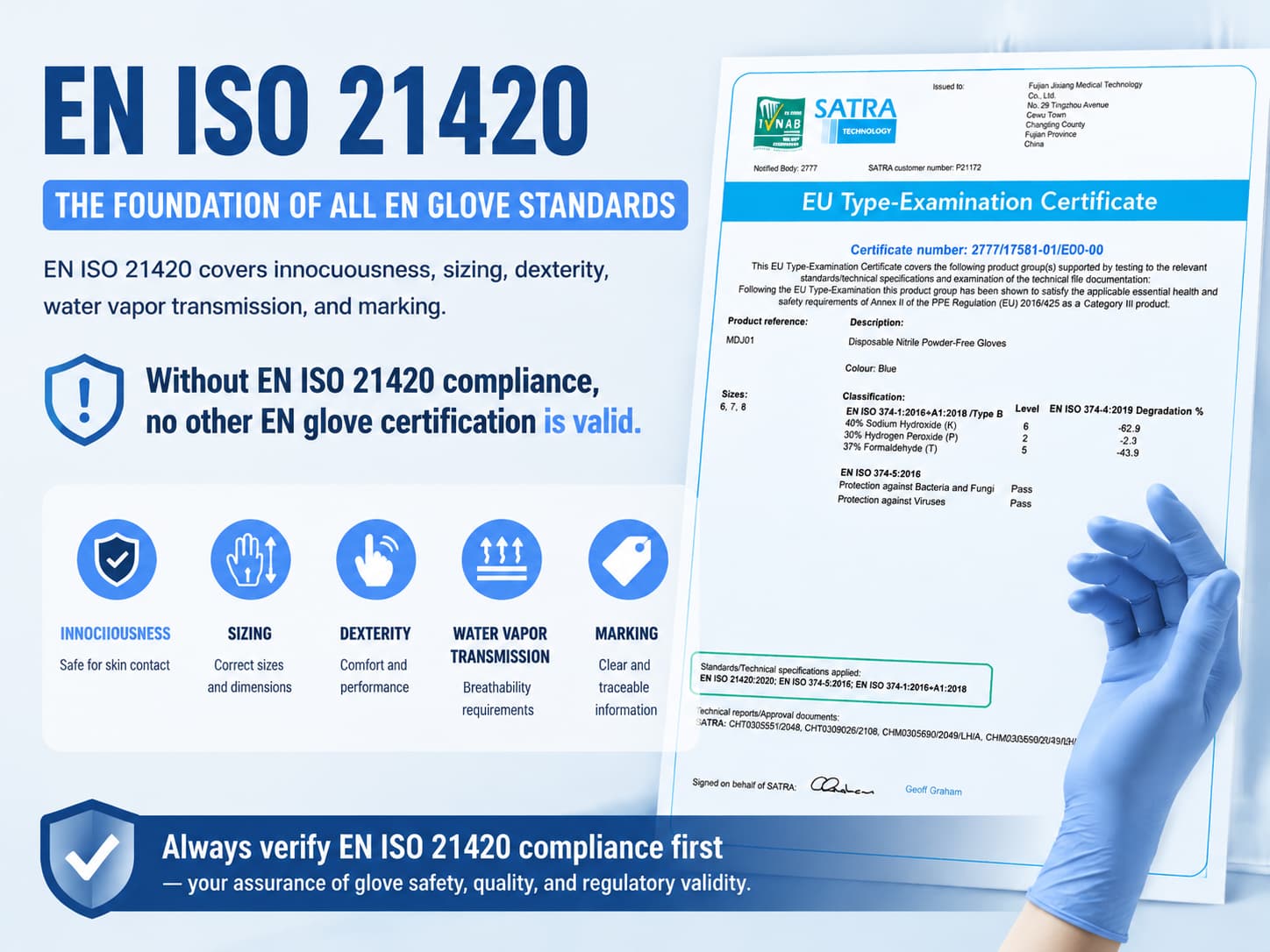
EN 420 (now superseded by EN ISO 21420) is the European base general standard for all protective gloves - including disposable nitrile, latex, PVC, and reusable work gloves. It defines the fundamental requirements for glove design and manufacturing, including innocuousness (e.g., pH value), comfort, dexterity, sizing specifications, and labeling. The standard is not used alone; it is combined with other protective standards (e.g., EN 388 for cut resistance, EN 511 for cold protection) to ensure the glove itself is harmless to the wearer and practical in use. EN ISO 21420 covers innocuousness, sizing, dexterity, water vapor transmission, and marking. Without EN ISO 21420 compliance, no other EN glove certification is valid. This guide explains the EN ISO 21420 requirements, what each metric means, and how procurement teams should verify compliance claims in 2026. For the latest globally applicable test methods and update details, refer to SATRA's guidance on EN ISO 21420.
What EN ISO 21420 Covers (and What It Does Not)
EN ISO 21420 is intentionally a "horizontal" standard. It applies to all protective gloves, regardless of material or end use. Its scope is limited to the attributes common to every glove category:
Innocuousness: Glove materials must not cause harm to the wearer. Seams, edges, and surfaces must not damage the skin. For leather products, the pH value must be between 3.5 and 9.5, and the chromium VI (hexavalent chromium) content must not exceed 3 mg/kg. This innocuousness requirement is the most overlooked and most often violated EN ISO 21420 clause in disposable glove specifications.
Sizing and ergonomics: Based on European standard hand dimensions, glove length and size must conform to standardized requirements to ensure proper fit and easy donning/doffing. EN ISO 21420 defines size codes (5, 6, 7, 8, 9, 10, 11) corresponding to hand circumference and length. Disposable nitrile and latex gloves typically cover sizes 6-10. A glove that claims EN ISO 21420 sizing compliance but ships only one or two physical sizes is in violation.
Dexterity: Based on the diameter of the smallest pin that can be picked up during testing, EN ISO 21420 grades glove dexterity on a 1 to 5 scale (level 5 = highest dexterity). Disposable examination gloves typically achieve level 3-5 depending on thickness; heavy industrial gloves are often level 1-2.
Water vapor transmission (breathability): For gloves intended for use longer than a few minutes, water vapor permeability must meet minimum values. This is one reason disposable nitrile gloves can be uncomfortable during extended wear - they score poorly on this requirement, which is acceptable for short-duration use but problematic for full-shift industrial wear.
Marking and information: Gloves and outer packaging must clearly display manufacturer information, the CE mark, size, and applicable protection level pictograms. Each glove must carry specific pictograms, the manufacturer's name and address, the EN ISO 21420 size code, and a reference to any specific EN standard the glove is certified against. The information must be supplied in the official language of the destination country.
EN ISO 21420 vs. EN 455 vs. EN 374: What's the Difference?
Procurement teams often confuse EN ISO 21420 with EN 455 or EN 374. The three standards serve distinct purposes and are independent of each other:
Standard
Scope
Applies To
Compliance
EN ISO 21420:2020(supersedes EN 420)
General requirements: innocuousness (pH, Cr VI), sizing, dexterity, marking
All protective gloves (disposable + reusable)
Mandatory baseline
EN 455-1/2/3/4:2024
Medical glove safety: pinholes, sizing, biocompatibility, shelf life
Disposable medical examination and surgical gloves
Mandatory for medical use
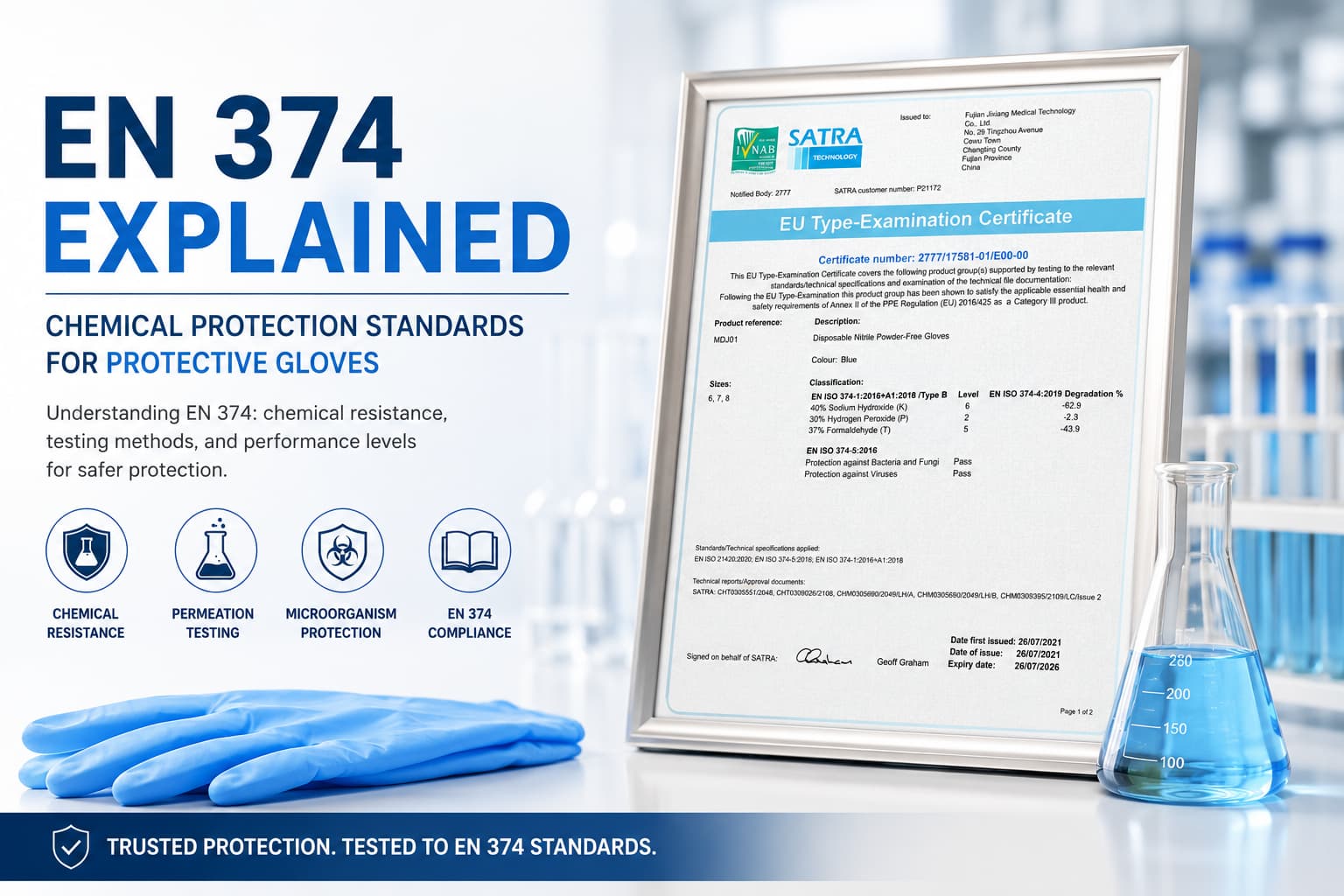
EN 374-1/2/3/4/5/6
Chemical permeation and penetration resistance
Chemical-protective gloves
Required if chemical protection is claimed
EN 388:2016+A1:2018
Mechanical hazards: abrasion, cut, tear, puncture
Mechanical protective gloves
Required for mechanical use
EN 407:2020
Thermal hazards: contact heat, convective heat, radiant heat, etc.
Heat-protective gloves
Required for thermal use
A glove that is EN 374-certified but not EN ISO 21420-certified cannot legally be sold in the EU as a protective glove. EN ISO 21420 is the prerequisite.
From EN 420 to EN ISO 21420: Key Changes
EN 420 has been superseded by EN ISO 21420:2020, which is now the current harmonized standard under the EU PPE Regulation. The transition introduced several changes that matter to 2026 procurement:
1. Tighter innocuousness requirements: EN ISO 21420 clarified that substances listed in the SVHC (Substances of Very High Concern) candidate list under REACH must be declared if present above 0.1% by weight. For nitrile rubber gloves, this typically affects accelerators (MBT, ZMBT, thiurams) used in vulcanization. The standard also specifies that leather products must have a pH value between 3.5 and 9.5, and chromium VI content must not exceed 3 mg/kg.
2. Improved sizing table: The size code is now tied directly to hand circumference and length measurements in millimeters, not to a generic "small/medium/large" mapping. This means a glove labeled "size 8" under EN ISO 21420:2020 must fit a hand of specific dimensions defined in the standard.
3. Updated pictogram requirements: Pictograms now use ISO-aligned graphics that are easier to read at a glance. The EN ISO 21420 size pictogram must be present on or attached to each glove pair or packaging unit.
4. Information supplied with the glove: The 2020 revision requires that information be provided in a more structured format, including a clear indication of which specific EN standards the glove is certified against.
Common EN ISO 21420 Compliance Failures in Disposable Gloves
From Notified Body audit reports and EU market surveillance findings, the most common EN ISO 21420 violations for disposable nitrile and latex gloves include:
1. Missing or incomplete information sheets: The EU Declaration of Conformity must accompany each shipment. Information sheets must be in the official language of the destination country. Many imported shipments fail this requirement when only English documents are provided to a French, German, or Spanish buyer.
2. SVHC declaration omissions: Accelerators such as MBT, ZMBT, and thiurams are SVHC-listed in some applications. If present above 0.1% by weight, they must be declared under EN ISO 21420 requirements.
3. Sizing non-conformance: Gloves labeled "size M" that fit hands of "size L" dimensions are non-conforming. The sizing table in EN ISO 21420:2020 makes this easier to verify objectively.
4. Marking deficiencies: The CE mark, manufacturer identification, EN ISO 21420 size pictogram, and reference to any specific EN standard must all be present. Missing any one element is a non-conformity.
5. Innocuousness failures: Some disposable gloves have failed innocuousness testing due to extractable chemicals causing skin irritation. This is rare but serious when it occurs.
How to Verify EN ISO 21420 Compliance in 2026
A robust procurement verification process includes the following five steps:
1. Request the EU Declaration of Conformity (DoC): The DoC must reference EN ISO 21420:2020 explicitly and list the specific glove SKU and manufacturer. Note that EN 420 has been superseded; any DoC still referencing only EN 420 should be questioned.
2. Verify the Notified Body number: For Category III PPE gloves (which include most chemical-protective nitrile gloves), a Notified Body must be involved. The body's four-digit identification number must appear on the product or packaging.
3. Check the EU market surveillance databases: RAPEX (now Safety Gate) lists products recalled for non-compliance. A supplier with repeated Safety Gate entries is a red flag.
4. Cross-check the SVHC declaration: If the glove is described as accelerator-free or low-allergen, verify the SVHC declaration supports the claim.
5. Validate the information sheet language: Confirm that the information sheet is available in the official language(s) of the destination country. This is a frequent point of non-compliance for shipments to non-English-speaking EU markets.
EN ISO 21420, EU MDR, and PPE Regulation: How They Intersect
Disposable medical gloves fall under the EU Medical Device Regulation (MDR 2017/745). Disposable PPE gloves fall under EU PPE Regulation (EU) 2016/425. The two regulations require different conformity assessment routes, but both reference EN ISO 21420 as a baseline. A glove sold as a medical device that does not meet EN ISO 21420 requirements is non-compliant under MDR. A glove sold as PPE without EN ISO 21420 compliance is non-compliant under the PPE Regulation. (Source: Regulation (EU) 2016/425 Annex II; Regulation (EU) 2017/745 Annex I)
2026 Market Context
EN ISO 21420 compliance has become more visible in 2026 because of tightened EU market surveillance. As of Q2 2026, Safety Gate entries for disposable gloves have increased by 18% year-over-year, with EN ISO 21420 sizing and information sheet issues accounting for approximately 30% of non-compliance findings. (Source: EU Safety Gate / RAPEX, Q1-Q2 2026) This trend makes EN ISO 21420 verification a more practical necessity for EU-bound procurement.
Key Takeaways
EN ISO 21420 is the horizontal baseline standard for all protective gloves sold in the EU, including disposable nitrile, latex, and PVC gloves. Without EN ISO 21420 compliance, no other EN glove certification is legally valid.
EN ISO 21420 covers innocuousness, sizing, dexterity, water vapor transmission, and marking. It is independent of EN 455 (medical), EN 374 (chemical), and EN 388 (mechanical), and is a prerequisite for all of them.
The 2020/2024 revision tightened innocuousness, sizing, and SVHC declaration requirements. Procurement teams should verify the DoC references the most recent version.
Common failures in 2026 include missing local-language information sheets, SVHC declaration omissions, and sizing non-conformance. Each is verifiable in the procurement process.
For EU-bound procurement in 2026, EN ISO 21420 compliance is a practical filter that separates compliant manufacturers from non-compliant traders. A supplier that cannot produce a current EN ISO 21420:2020 DoC should be treated as high-risk. For the latest test methods and update details, refer to SATRA's guidance on EN ISO 21420.
- Author: JIXIANG | www.jxgloves.com -
FAQ
Q: Is EN ISO 21420 mandatory for all protective gloves sold in the EU?
A: Yes. EN ISO 21420 (formerly EN 420) is the horizontal baseline standard for all protective gloves - including disposable nitrile, latex, PVC, and reusable work gloves. Without EN ISO 21420 compliance, no other EN glove certification (EN 455, EN 374, EN 388) is legally valid in the EU market. It is a prerequisite, not an option.
Q: What is the current version of EN 420 / EN ISO 21420?
A: EN 420 has been superseded by EN ISO 21420:2020, which is now the current harmonized standard. EN ISO 21420 introduced tighter innocuousness requirements (including pH 3.5-9.5 for leather and chromium VI <= 3 mg/kg), improved sizing tables, and updated pictogram requirements. For the latest test methods and update details, refer to SATRA's guidance on EN ISO 21420.
Q: Does EN ISO 21420 apply to medical gloves?
A: Yes. EN ISO 21420 applies to all protective gloves sold in the EU, including disposable medical examination and surgical gloves. Medical gloves must additionally comply with EN 455-1, 2, 3, 4 for medical-specific requirements. EN ISO 21420 is the baseline; EN 455 is the medical-specialized layer.
Q: What is the most common EN ISO 21420 violation in disposable gloves?
A: From Notified Body audit reports and EU Safety Gate (RAPEX) data, the most common EN ISO 21420 violation for disposable nitrile and latex gloves is missing or incomplete local-language information sheets. Gloves shipped to French, German, or Spanish markets with English-only documentation are a frequent cause of detention and re-export.
Q: Can a glove be EN 374-certified without EN ISO 21420?
A: No. EN ISO 21420 is a prerequisite for all other EN glove standards. A glove cannot be legally sold in the EU as a chemical-protective glove (EN 374) without first meeting EN ISO 21420 general requirements. The DoC must reference EN ISO 21420 as a baseline before any chemical-specific standard can be claimed.



 Network Supported