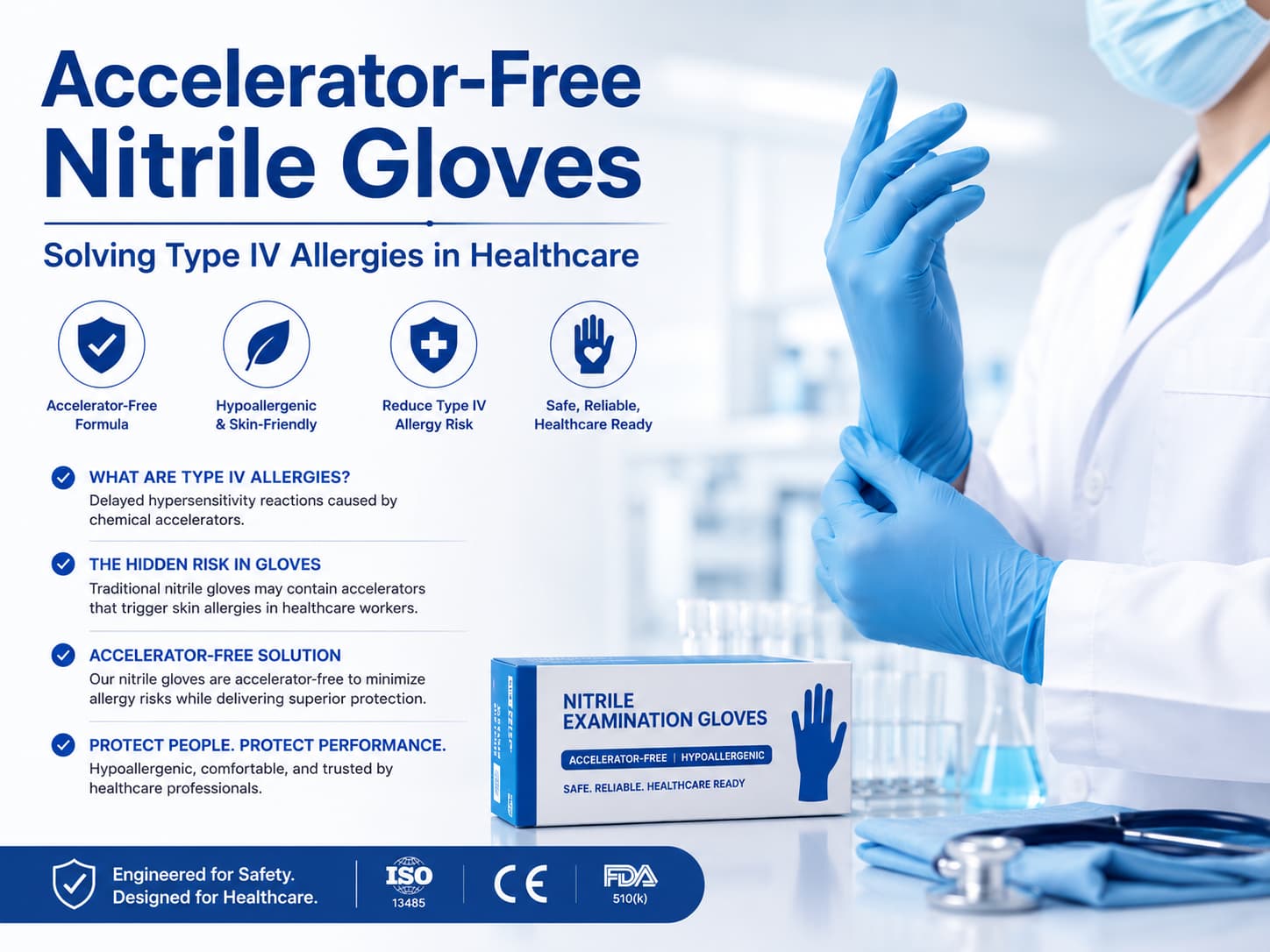
Accelerator-Free Nitrile Gloves — Solving Type IV Allergies in Healthcare
Jun 29, 2026
Healthcare professionals depend on disposable gloves as their first line of defense against pathogens, chemicals, and bodily fluids. Yet for a growing number of workers, the very gloves meant to protect them are causing an invisible injury: Type IV allergic contact dermatitis. The culprit is not the nitrile polymer itself, but the chemical accelerators added during vulcanization. This article explores the science behind accelerator-free nitrile gloves, their clinical advantages, and why procurement teams should consider them as a standard option.
The Hidden Cost of Accelerators
Vulcanization accelerators — including thiurams, carbamates, mercaptobenzothiazoles (MBTs), and diphenylguanidines (DPGs) — are essential in conventional nitrile glove manufacturing. They speed up the cross-linking of acrylonitrile and butadiene polymers in Nitrile rubber, reducing production time and improving elasticity. However, these chemicals can remain as residual traces on the glove surface, triggering delayed hypersensitivity reactions (Type IV) in sensitized individuals.
Symptoms range from mild redness and itching to severe eczematous eruptions that may force healthcare workers to change glove brands, take sick leave, or even abandon clinical work. Studies in Contact Dermatitis and the British Journal of Dermatology indicate that thiuram mix remains the most frequent sensitizer among healthcare workers, with prevalence rates between 5-17% depending on region and exposure duration.
How Accelerator-Free Technology Works
Accelerator-free nitrile gloves eliminate thiurams, carbamates, and MBTs from the formulation entirely. Instead, manufacturers use alternative cross-linking systems — typically sulfur-based curing with proprietary organic peroxides or metal oxide activators — that achieve comparable physical properties without the allergenic residues.
Key performance indicators:
· Tensile strength: >=14 MPa (comparable to standard nitrile)
· Elongation at break: >=500% (maintaining flexibility)
· AQL pinhole rate: <=1.5 (EN 455 compliance)
· Accelerator residue: <1 ppm thiuram/carbamate (verified by GC-MS)
Clinical and Occupational Benefits
For healthcare institutions, the shift to accelerator-free gloves addresses a tangible occupational health issue. Workers previously sensitized to thiurams or carbamates can resume normal duties without resorting to double-gloving or alternative materials that may compromise barrier performance. In long-term care settings and oncology units, where glove usage exceeds 30 pairs per shift, the cumulative exposure reduction translates into fewer dermatitis claims and lower staff turnover.
Accelerator-free gloves also simplify compliance with emerging occupational health regulations. The EU Medical Device Regulation (MDR 2017/745) now requires biocompatibility assessments that explicitly evaluate sensitization potential (ISO 10993-10), making accelerator-free products a proactive compliance choice.
Market Outlook and Procurement Guidance
Global demand for accelerator-free nitrile gloves has grown by approximately 22% year-on-year since 2023, driven by heightened allergy awareness in Europe and mandatory dermatitis prevention programs in several GCC healthcare frameworks. JIXIANG offers a certified accelerator-free range tested to EN 455, EN 374 Type C, and ISO 10993-10, with CE MDR documentation available for institutional buyers.
When evaluating accelerator-free options, procurement teams should:
1. Request full biocompatibility test reports (ISO 10993-10 sensitization panel)
2. Verify accelerator residue claims with chromatographic analysis certificates
3. Confirm AQL testing data (EN 455-2) from accredited third-party labs
4. Trial the product with previously sensitized staff for at least 14 working days
Conclusion
Accelerator-free nitrile gloves represent a meaningful advancement in occupational safety — not a luxury upgrade, but a necessary evolution for institutions committed to worker health. As allergy prevalence rises and regulatory scrutiny intensifies, choosing gloves that eliminate the root cause of Type IV dermatitis is both a clinical and strategic decision.
JIXIANG accelerator-free nitrile gloves — engineered for protection, designed for people.



 Network Supported