REACH Compliance for Disposable Gloves: 2026 EU Buyer's Guide
Jun 25, 2026
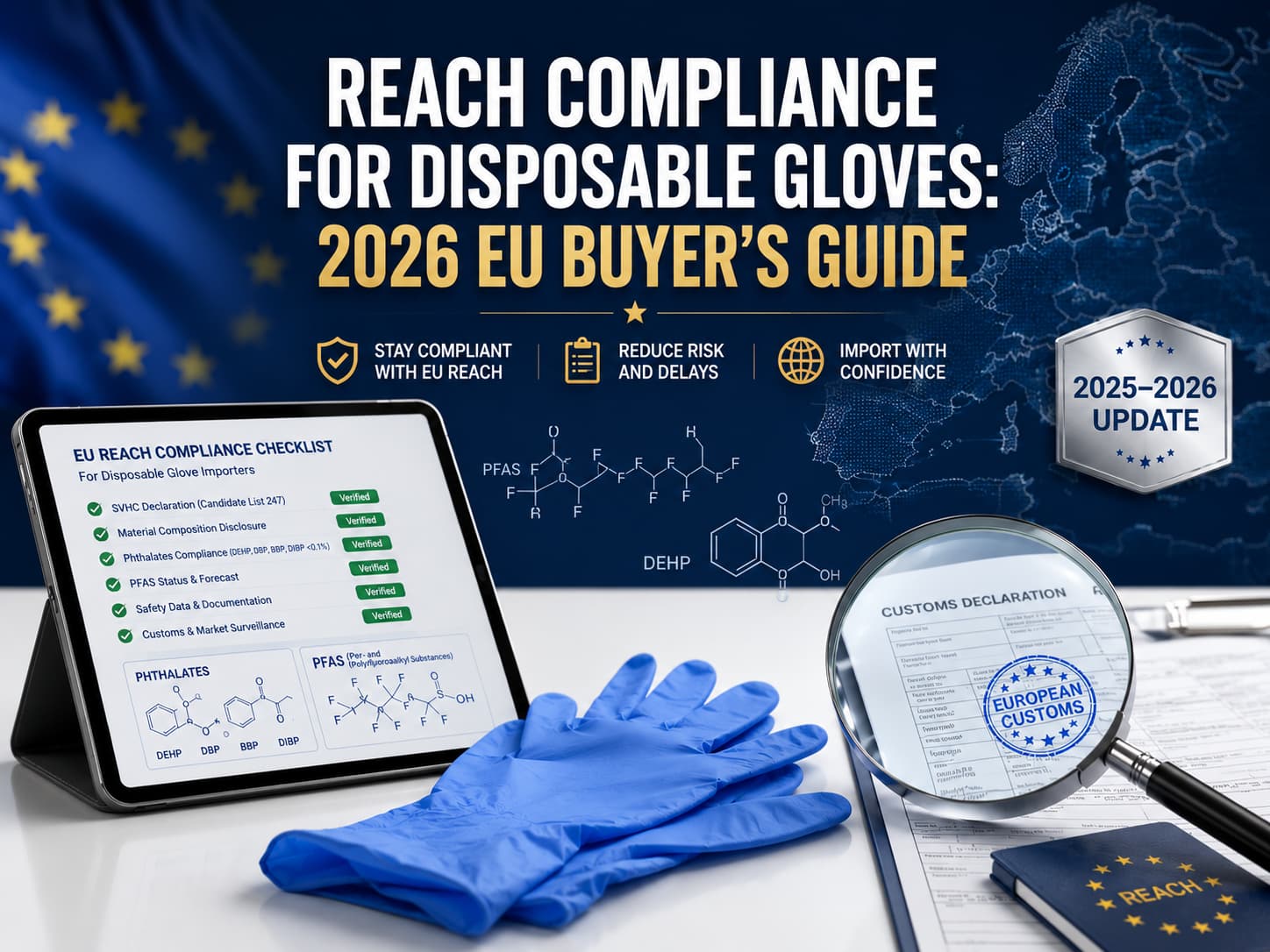
REACH regulations directly affect every disposable glove imported into the EU. This guide explains which substances are restricted, how to verify compliance, and what changed in 2025–2026 that buyers need to know.
REACH (Registration, Evaluation, Authorisation and Restriction of Chemicals) is the EU's comprehensive chemical regulation framework. If you are importing disposable gloves into the European Union, REACH compliance is not optional — it is a legal requirement. Yet many buyers outside Europe are unaware that REACH restricts specific chemical substances commonly found in glove manufacturing additives, and that non-compliant gloves can be detained at customs or removed from the market.
1. What REACH Means for Disposable Gloves
REACH applies to all chemical substances used in the manufacture of products sold in the EU — including the additives, plasticizers, accelerators, and processing aids used in disposable glove production. The regulation has two mechanisms that directly affect gloves:
• Restriction (Annex XVII): Specific substances are banned or restricted above defined concentration limits in articles (including gloves).
• SVHC (Substances of Very High Concern): Substances on the Candidate List must be declared if present above 0.1% (w/w) in the article.
2. Key REACH-Restricted Substances in Gloves
The most significant REACH restrictions for disposable gloves concern plasticizers (phthalates) used to soften PVC and some nitrile formulations. The "DEHP, DBP, BBP, DIBP" group is restricted under REACH Annex XVII Entry 51 for articles accessible to consumers, and Entry 52 for all articles placed on the market.
Restricted phthalates (as of 2026):
• DEHP (Bis(2-ethylhexyl) phthalate) — limit 0.1% (w/w)
• DBP (Dibutyl phthalate) — limit 0.1% (w/w)
• BBP (Benzyl butyl phthalate) — limit 0.1% (w/w)
• DIBP (Diisobutyl phthalate) — limit 0.1% (w/w)
Note: These restrictions apply to the glove material itself. Nitrile gloves (which use carboxylated acrylonitrile-butadiene copolymers) do not require phthalate plasticizers in their base formulation — but some low-cost nitrile blends and PVC gloves commonly use DINP or DEHP as plasticizers. Buyers must verify.
3. SVHC Candidate List: What You Must Declare
If a disposable glove contains any SVHC above 0.1% (w/w), the supplier must provide a communication down the supply chain. As of the 2026 Candidate List (11 updates since 2008; 247 entries as of January 2026), several substance groups are relevant to glove manufacturing:
SVHC Substance Group
Relevance to Gloves
Action Required if >0.1%
Phthalates (DEHP, DBP, BBP, DIBP)
Plasticizers in PVC and some nitrile blends
Declare; restrict under Annex XVII
MWCNTs (Multi-walled carbon nanotubes)
Potential in conductive glove coatings
Declare; SCIP database notification
Bisphenol A (BPA)
Possible in some glove packaging inks
Declare if >0.1%
Lead and lead compounds
Possible in colored pigment formulations
Declare; restrict under RoHS/REACH
Certain azo colorants
Possible in colored glove formulations
Declare; restrict under specific applications
4. How to Verify REACH Compliance from Your Supplier
Requesting a REACH compliance declaration is not enough. Here is the due diligence process buyers should follow:
Step 1: Request a REACH compliance declaration (specific to your SKU, not a generic company letter).
Step 2: Request test reports from an EU-notified laboratory (SGS, Intertek, TÜV) confirming phthalate content below 0.1%.
Step 3: Verify the SVHC declaration covers the current Candidate List (updated January 2026 — 247 entries).
Step 4: Confirm the declaration is signed by an authorized representative with date and signature.
Step 5: For high-volume imports, arrange independent testing of production samples annually.
5. REACH vs EU MDR: What Is the Difference?
REACH and EU MDR (Medical Device Regulation 2017/745) are separate frameworks that apply to the same product if the glove is a medical device. Here is how they interact:
• REACH: Regulates chemical substances in the product. Applies to ALL gloves (medical and non-medical) sold in the EU.
• EU MDR: Regulates medical devices. Applies only to gloves intended for medical purposes (examination, surgical).
• A medical glove sold in the EU must comply with BOTH: REACH (chemical safety) and EU MDR (medical device safety).
Practical implication: A glove with CE marking under EU MDR can still be non-compliant if it contains restricted phthalates above 0.1%. Buyers must check both.
6. Testing and Documentation Requirements
To document REACH compliance, maintain these records:
Document
Purpose
Retention Period
REACH Compliance Declaration
Confirms article compliance with Annex XVII
10 years (EU requirement)
SVHC Declaration / SCIP notification
Declares >0.1% SVHC substances
As long as product is on market
Phthalate test report (SGS/TÜV/Intertek)
Laboratory proof of compliance
5 years (recommended)
Material Safety Data Sheet (MSDS/SDS)
Full substance disclosure
10 years
Supply chain communication record
Evidence of due diligence
5 years
7. Recent and Upcoming Changes (2025–2026)
January 2026 Candidate List update: Four new SVHC entries were added, bringing the total to 247. None directly target glove base polymers, but buyers should review if any coatings or packaging inks are affected.
Proposed restriction on PFAS ("forever chemicals"): The EU is advancing a broad restriction on PFAS substances. Some fluorocarbon-based gloves (used in semiconductor handling) may be affected. The restriction is expected to enter force in 2027–2028. Buyers in high-tech sectors should monitor this development.
Enforcement trend: EU customs and market surveillance authorities have increased REACH inspection frequency by ~35% in 2025 compared to 2023 (source: European Chemicals Agency, ECHA, 2026). Gloves are a priority article category because of high import volumes from outside the EU.
Practical Checklist for EU Glove Buyers
□ Request REACH declaration specific to your glove SKU
□ Verify phthalate test report (DEHP, DBP, BBP, DIBP <0.1%)
□ Confirm SVHC declaration covers January 2026 Candidate List (247 entries)
□ Check that CE technical file (if medical glove) includes REACH compliance evidence
□ Arrange independent testing for new suppliers or new formulations
□ Document supply chain communication for audit trail
REACH compliance is not a one-time exercise. The Candidate List is updated twice per year. Buyers who establish a systematic verification process will avoid costly customs detentions and market removals.
FAQ
Q1: Are nitrile gloves automatically REACH-compliant?
A: Not automatically. While nitrile base polymer does not require phthalate plasticizers, some low-cost nitrile blends and all PVC gloves may contain restricted phthalates. Buyers must verify with test reports.
Q2: What is the difference between REACH and RoHS?
A: REACH regulates chemical substances in general products; RoHS (Restriction of Hazardous Substances) specifically restricts substances in electrical and electronic equipment. They overlap on lead and phthalates but apply to different product categories.
Q3: How often should I re-test gloves for REACH compliance?
A: For stable formulations from qualified suppliers, annual testing is sufficient. For new suppliers or changed formulations, test before first shipment and then annually.
Q4: Can I sell gloves in the EU without REACH compliance?
A: No. REACH compliance is mandatory for all articles placed on the EU market. Non-compliant gloves can be detained at customs and removed from the market by enforcement authorities.
Q5: Where can I check the current SVHC Candidate List?
A: The ECHA website (echa.europa.eu) publishes the official Candidate List. As of January 2026, it contains 247 entries. Buyers should check the list twice per year.
JIXIANG provides full REACH compliance documentation for all glove SKUs exported to the European Union. Test reports from EU-notified laboratories and current SVHC declarations are available on request.
Visit www.jxgloves.com for the compliance package.



 Network Supported