
welcome to Jixiang E-commerce!
welcome to Jixiang E-commerce!
Disposable glove manufacturing costs are driven primarily by four petrochemical feedstocks: butadiene (for nitrile rubber), acrylonitrile (for nitrile rubber), ethylene-derived PVC resin (for vinyl gloves), and natural rubber latex (for latex gloves). All four are influenced by crude oil prices and shipping route stability. In August 2026, Strait of Hormuz tensions, OPEC+ production decisions, and supply-side plant maintenance have created a complex cost picture. This alert summarizes verified market prices as of early August 2026 and explains the pass-through implications for glove buyers.
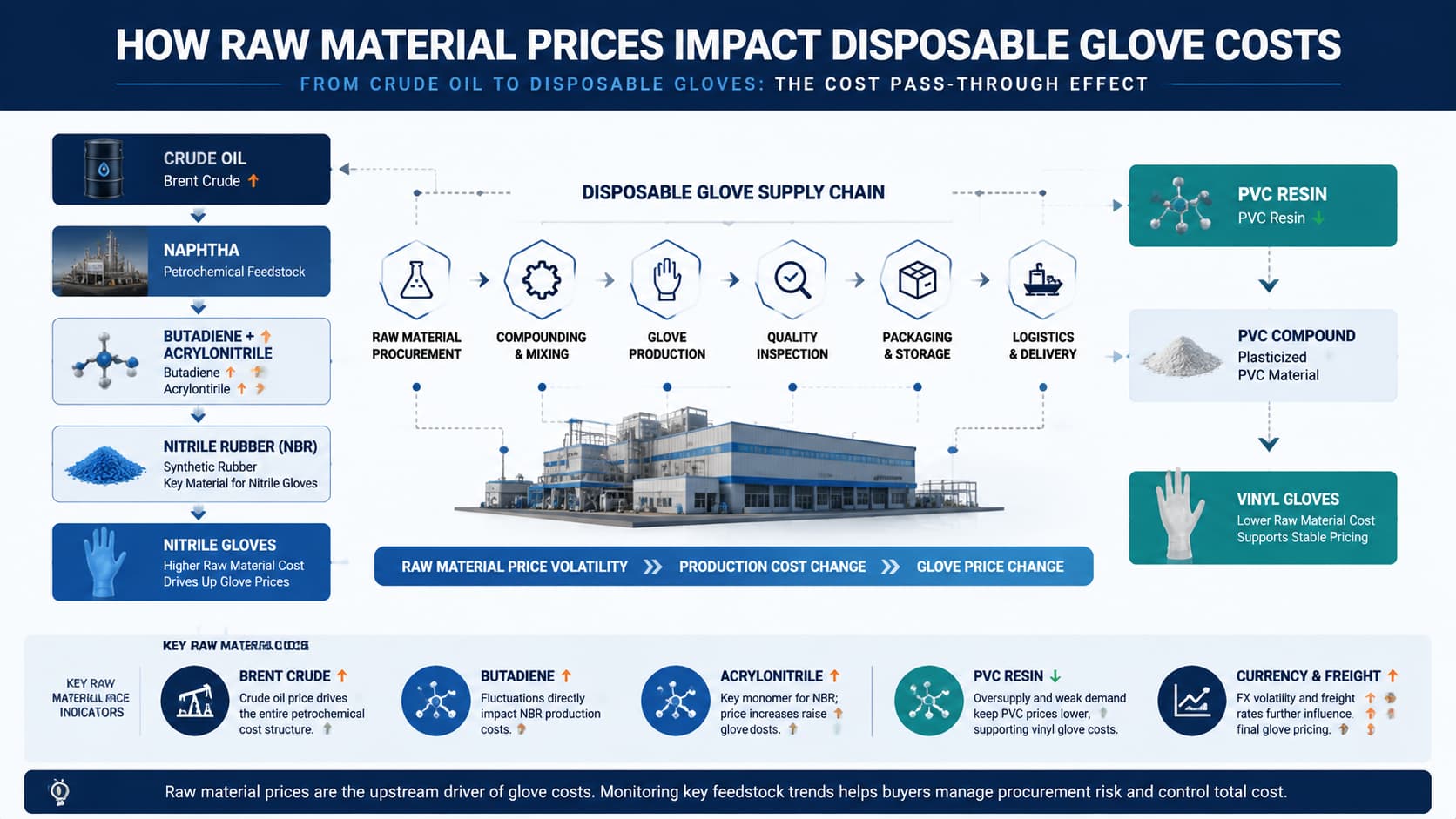
Brent crude oil is the benchmark that sets the cost of naphtha, the primary feedstock for steam cracking that produces butadiene and ethylene (the building block of PVC). When Brent rises, the entire petrochemical value chain faces cost pressure.
As of August 2-3, 2026, Brent crude was trading in a volatile range. On August 2, Brent closed at approximately $91.04/barrel, with WTI at $84.67. The Brent-WTI spread widened due to Middle East supply risk, as Hormuz disruptions affect Brent-priced barrels more directly. On August 3, prices dropped sharply (Brent down as much as 7.3% intraday to approximately $81.55/barrel) after news that US-Iran negotiations would resume. However, Iran stated that the Hormuz situation "will not return to pre-conflict conditions," suggesting ongoing risk premium.
OPEC+ announced on August 2 that seven major producers would increase output by 188,000 barrels/day in September, the sixth consecutive monthly increase. However, analysts noted that with Hormuz shipping still constrained, the supply increase has limited short-term market impact.
| Indicator | Value (as of Aug 2-3, 2026) | Trend | Source |
|---|---|---|---|
| Brent crude (spot) | ~$81.55-91.04/barrel | Volatile; dropped Aug 3 on Iran talks news | PriceOfOil.com, Sina Finance |
| WTI crude (spot) | ~$78.78-84.67/barrel | Declined; US inventory surplus | OilPriceNews.org |
| Brent-WTI spread | ~$6-8/barrel | Widened (Hormuz risk premium) | PriceOfOil.com |
| OPEC+ September output | +188,000 bpd increase | Sixth consecutive monthly increase | Xinhua / Sina Finance |
Butadiene is copolymerized with acrylonitrile to produce nitrile rubber (NBR), the core material for nitrile gloves. Butadiene is produced as a byproduct of ethylene steam cracking, so its supply and price are tied to both crude oil (naphtha feedstock) and cracker operating rates.
As of late July 2026, butadiene CFR China was approximately $1,330/ton, up $30/ton from the prior assessment. Northeast Asia CFR was approximately $1,300/ton. Domestic East China prices ranged from 10,450 to 10,650 RMB/ton (Jiangyin and Jiangsu regions, July 24-27). South Korea FOB was $1,280/ton. The market showed firm supplier pricing sentiment, though downstream demand was lukewarm.
Key factors: some plants (Northern Huajin) were in maintenance, supporting prices. However, with Fujian United and Zhejiang Petrochemical restarts, supply was expected to loosen. Downstream synthetic rubber demand was weak, capping upside. For nitrile glove buyers, butadiene at these levels means continued cost pressure but not a crisis-level spike.
| Butadiene Price | Value (late July 2026) | Change | Source |
|---|---|---|---|
| CFR China | ~$1,330/ton | Up $30/ton | ECHEMI |
| Northeast Asia CFR | ~$1,300/ton | Up $25/ton | ECHEMI |
| South Korea FOB | ~$1,280/ton | Up $30/ton | ECHEMI |
| East China domestic (Jiangyin) | ~10,450 RMB/ton | Stable | ECHEMI |
| Jiangsu domestic | ~10,625 RMB/ton | Up 25 RMB/ton | ECHEMI |
Acrylonitrile is the other monomer in nitrile rubber. Unlike butadiene, acrylonitrile prices in late July 2026 rose sharply due to supply-side factors rather than feedstock costs alone.
East China port prices reached approximately 10,600-10,750 RMB/ton by July 27, 2026, up roughly 8.7% year-on-year. The rally was driven by Zhenhai Refining and Chemical reducing operating rates (from ~72% to a planned 50-60% in August) due to maintenance of a related methionine unit. Liaoning Jinfa also planned a 20-25 day shutdown of one 130,000-ton line in mid-August. The domestic capacity utilization rate was expected to drop to 68-69% in the first half of August, tightening overall supply.
Industry inventories were at low levels, providing a foundation for the price increase. Sinopec East China planned to reduce contract supply for August, prompting active procurement. However, mid-to-late August restarts (Siérbang, Jilin Petrochemical, Tianchen Qixiang) were expected to add supply and partially restrain further increases.
For nitrile glove manufacturers, acrylonitrile at these elevated levels adds direct cost pressure. Unlike butadiene, which is weakly supported by demand, acrylonitrile supply tightness means the cost increase is more likely to stick through Q3 2026.
| Acrylonitrile Price | Value (late July 2026) | Trend | Source |
|---|---|---|---|
| East China port | ~10,600-10,750 RMB/ton | Up ~8.7% YoY | CCFGroup, ChemPriceHub |
| Shandong spot | ~10,650 RMB/ton | Rising | CCFGroup |
| Industry utilization rate | ~71.8% (dropping to 68-69%) | Declining on maintenance | ChemPriceHub |
| Key driver | Zhenhai rate cut + Jinfa shutdown | Supply-side tightness | ChemPriceHub |
PVC resin is the primary material for vinyl (PVC) gloves. Unlike nitrile rubber feedstocks, PVC resin prices have been declining in 2026, providing cost relief for PVC glove manufacturers.
As of July 30-31, 2026, PVC SG-5 spot prices were approximately 4,200 RMB/ton in Shandong, 4,100 RMB/ton in Shanxi, and 4,350 RMB/ton in Inner Mongolia. This is down significantly from May-June 2026 highs above 5,000 RMB/ton. The July average was approximately 4,405 RMB/ton.
The decline is driven by weak downstream demand from the construction and real estate sectors. Social inventory in East China has been drawn down, and export orders increased slightly in late July, but overall demand fundamentals remain weak. For PVC glove buyers, this means vinyl glove costs should be stable to declining in Q3 2026, though oversupply risks persist.
| PVC Resin SG-5 Price | Value (July 30-31, 2026) | Trend | Source |
|---|---|---|---|
| Shandong spot | ~4,200 RMB/ton | Declining | 100ppi.com (SunSirs) |
| Shanxi spot | ~4,100 RMB/ton | Declining | 100ppi.com (SunSirs) |
| Inner Mongolia spot | ~4,350 RMB/ton | Declining | 100ppi.com (SunSirs) |
| Xinjiang Yihua (ex-factory) | ~4,350-4,600 RMB/ton | Stable | ChemicalBook |
| July average | ~4,405 RMB/ton | Down from May/June highs | ChemicalBook price index |
Natural rubber latex is the primary material for latex gloves. TSR20 futures on the Shanghai Futures Exchange (SHFE) showed benchmark prices of approximately 12,830 RMB/ton for the August 2026 contract (nr2608) as of August 3, 2026. SICOM (Singapore Exchange) TSR20 futures for August 2026 were approximately 227.8 US cents/kg (~$2,278/ton).
Natural rubber prices are supported by supply concerns (adverse weather in Thailand, falling production in Malaysia down 16.7% year-on-year in May 2026) and rising crude oil prices that increase synthetic rubber costs, shifting demand toward natural rubber. However, weak demand from China and the tire industry has capped upside. For latex glove buyers, costs are stable but carry upside risk if weather-driven supply disruptions intensify in Q4 2026.
| Natural Rubber Price | Value (Aug 3, 2026) | Trend | Source |
|---|---|---|---|
| SHFE nr2608 (Aug contract) | ~12,830 RMB/ton | Stable | SHFE (Shanghai Futures Exchange) |
| SHFE nr2609 (Sep contract) | ~12,685 RMB/ton | Slightly lower | SHFE |
| SICOM TSR20 (Aug) | ~227.8 US cents/kg | Stable | SGX / Biggo Finance |
| Malaysia production (May 2026) | 20,198 tons | Down 16.7% YoY | DOSM Malaysia |
| Material | Feedstock Trend | Glove Cost Impact | Buyer Action |
|---|---|---|---|
| Nitrile rubber | Butadiene firm / ACN rising | Moderate cost pressure through Q3 2026 | Negotiate price-adjustment clause; monitor ICIS butadiene |
| PVC (vinyl) | Resin declining | Cost relief; stable to declining | Lock in favorable pricing; do not over-order |
| Natural latex | Stable with upside risk | Low immediate pressure; watch Q4 weather | Maintain buffer stock; monitor Thailand weather |
| All categories | Brent volatile (Hormuz risk) | Shipping and feedstock cost uncertainty | Include force majeure and shipping risk clauses |
Data collection date: Prices verified via WebSearch on August 3, 2026. Sources: PriceOfOil.com, OilPriceNews.org, Sina Finance, ECHEMI, CCFGroup, ChemPriceHub, SunSirs (100ppi.com), ChemicalBook, SHFE, SGX. Please verify with the latest market quotes before making procurement decisions.
Q: How does the Strait of Hormuz situation affect disposable glove costs?
A: The Strait of Hormuz is a critical shipping route for Middle East crude oil and petrochemical feedstocks. Tensions in 2026 have kept Brent crude elevated (around $81-91/barrel in early August), which raises the cost of naphtha cracking and downstream monomer production (butadiene, acrylonitrile, ethylene for PVC). Higher feedstock costs eventually pass through to nitrile rubber and PVC glove manufacturing costs.
Q: What is the current price of butadiene and how does it affect nitrile gloves?
A: As of late July 2026, butadiene CFR China was approximately $1,330/ton (up $30/ton), with domestic East China prices around 10,450-10,650 RMB/ton. Butadiene is a primary feedstock for nitrile rubber (acrylonitrile butadiene rubber). Price increases directly raise nitrile glove production costs, though the impact is partially offset by downstream demand weakness.
Q: Why is acrylonitrile prices rising in 2026?
A: Acrylonitrile prices rose sharply in late July 2026 (East China port approximately 10,600-10,750 RMB/ton, up roughly 8.7% year-on-year) due to supply tightness. Zhenhai Refining and Chemical reduced operating rates for maintenance, and Liaoning Jinfa planned a shutdown. This supply squeeze, combined with low industry inventory levels, drove the price rally despite weak downstream demand.
Q: Is PVC resin getting cheaper or more expensive in 2026?
A: PVC resin SG-5 prices have been declining. As of July 30-31, 2026, spot prices in Shandong were around 4,200 RMB/ton and Inner Mongolia around 4,350 RMB/ton, down from May-June highs above 5,000 RMB/ton. Weak downstream demand (construction, real estate) is the primary driver. This benefits PVC glove manufacturers, but oversupply risks persist.
Q: How can glove buyers protect against raw material price volatility?
A: Buyers should negotiate price adjustment clauses tied to published feedstock indices (ICIS, Platts, SunSirs), maintain 4-8 week buffer stock to avoid spot purchases during price spikes, diversify suppliers across regions, and monitor Brent crude and butadiene trends as leading indicators. Contracts should define clear escalation thresholds and caps.
Please read on, stay posted, subscribe, and we welcome you to tell us what you think.


Copyright 2026@ Fujian Jixiang E-commerce Co., Ltd All Rights Reserved.
Sitemap |
Blog
|
Xml |
Privacy Policy
 Network Supported