
welcome to Jixiang E-commerce!
welcome to Jixiang E-commerce!
EN 374 vs EN 455: The Core Difference (Direct Answer)
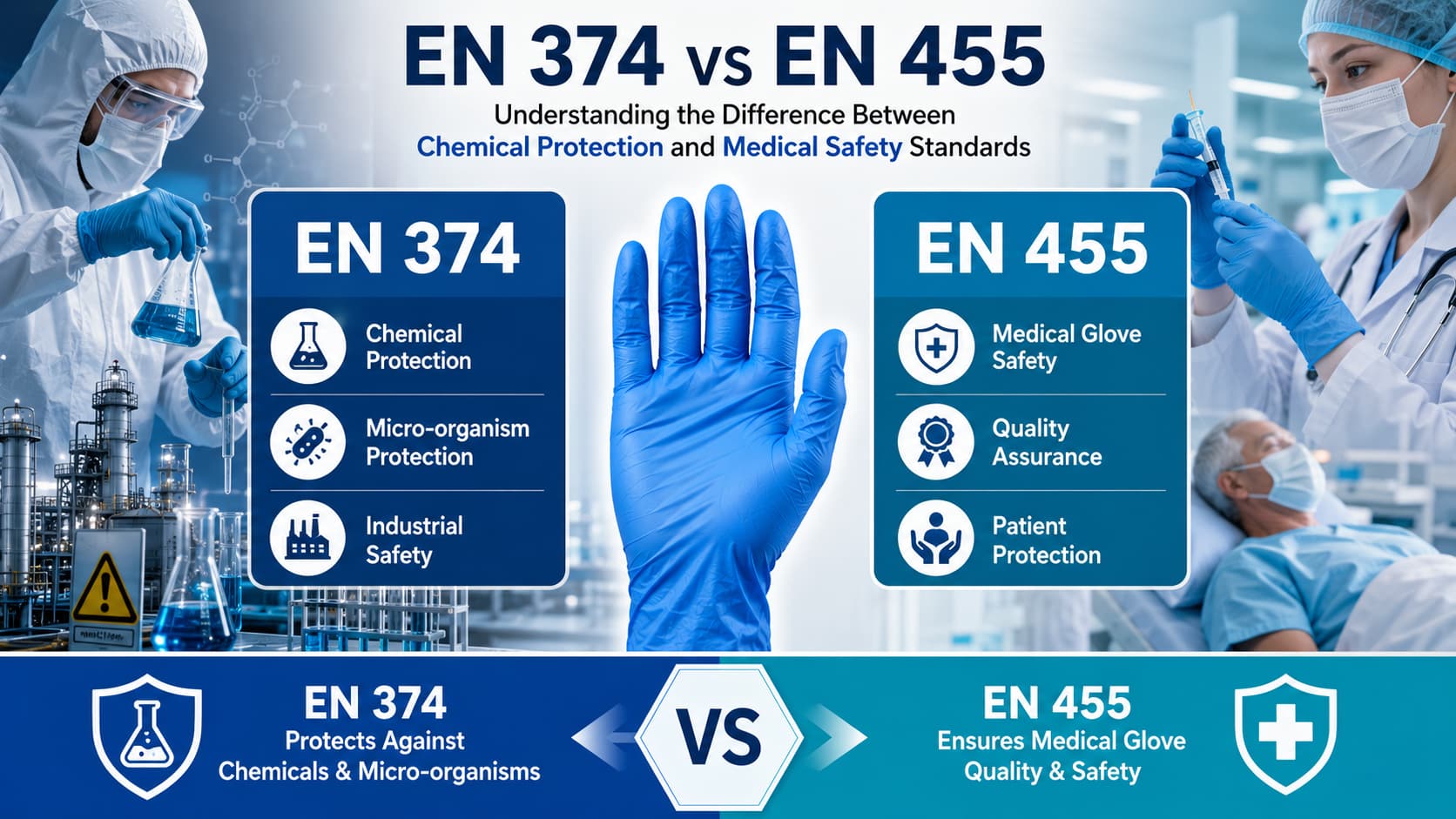
EN 374 governs chemical and micro-organism protection for protective gloves, while EN 455 governs the quality and safety of medical gloves for single use. In short: if your priority is chemical resistance → look for EN 374. If your priority is patient/healthcare safety → look for EN 455. Many industrial buyers need both, but they serve fundamentally different purposes.
• EN 374 = "Can this glove protect me from chemicals and micro-organisms?"
• EN 455 = "Is this glove safe and reliable for medical examination/surgery?"
Quick Comparison Table
|
Dimension |
EN 374 |
EN 455 |
|
Full Title |
Protective gloves against dangerous chemicals and micro-organisms |
Medical gloves for single use |
|
Scope |
Industrial, laboratory, chemical handling |
Healthcare, medical examination, surgery |
|
Key Tests |
Chemical permeation, degradation, penetration |
Freedom from holes (AQL), physical properties, biological safety |
|
Parts |
EN 374-1 to EN 374-5 |
EN 455-1 to EN 455-4 |
|
AQL Requirement |
AQL 2.5 (typically) |
AQL 1.5 (examination) / AQL 0.65 (surgical) |
|
PPE Category |
Category III (complex design) |
Medical Device (MDR 2017/745) |
|
CE Marking |
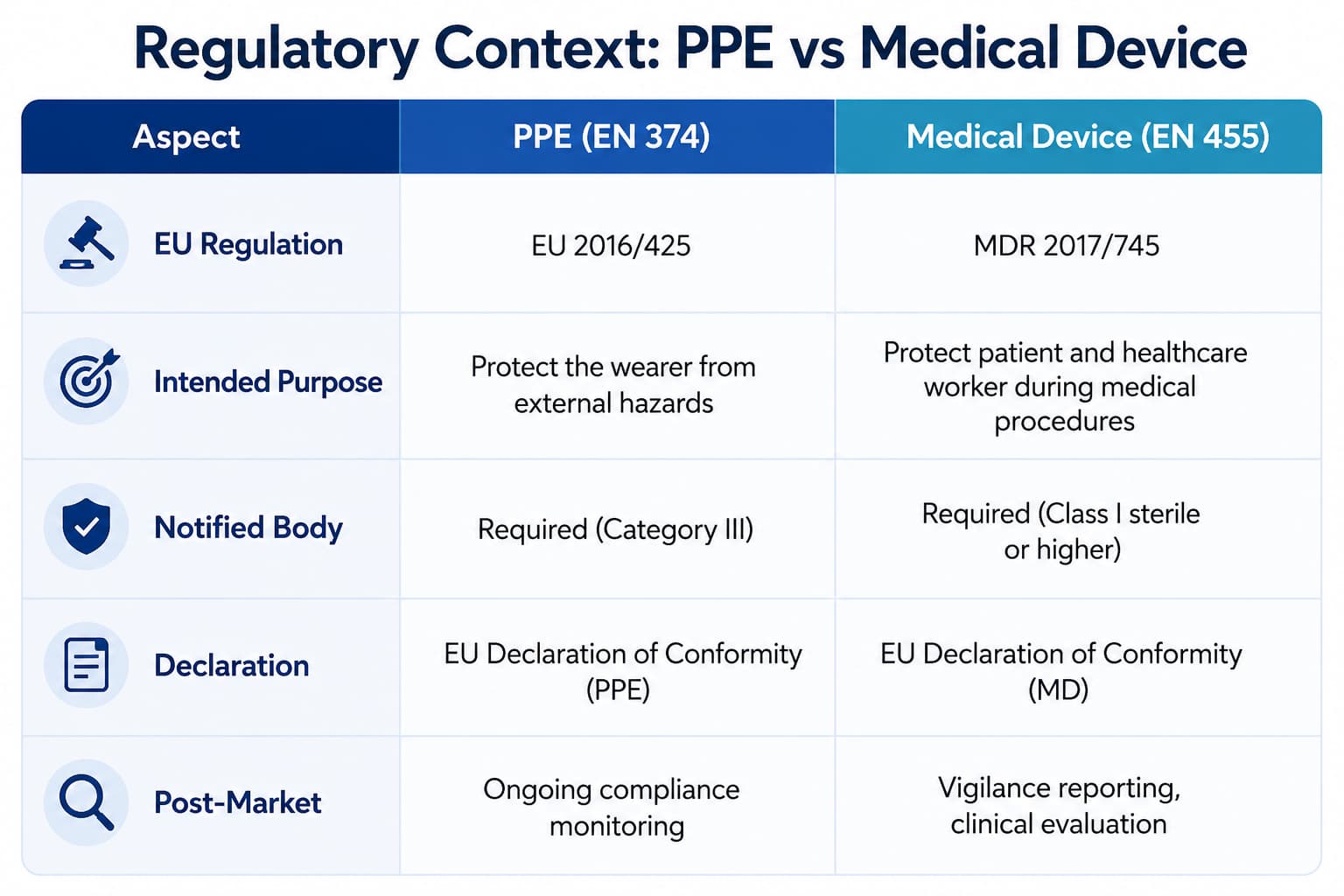
Yes (EU 2016/425) |
Yes (MDR 2017/745) |
|
Typical Users |
Chemical workers, lab technicians, mechanics |
Doctors, nurses, dentists, surgeons |
EN 374: Deep Dive
EN 374 is a series of standards under the PPE Regulation (EU) 2016/425. It applies to protective gloves designed to shield the wearer from hazardous chemicals and micro-organisms.
Parts of EN 374
|
Part |
What It Tests |
Key Requirement |
|
EN 374-1 |
Terminology and performance requirements |
Defines Type A, B, C based on chemical resistance |
|
EN 374-2 |
Resistance to penetration by micro-organisms |
Water/air leak test (AQL 2.5 minimum) |
|
EN 374-4 |
Resistance to degradation by chemicals |
Measures change in puncture resistance after chemical exposure |
|
EN 374-5 |
Protection against micro-organisms (viruses, bacteria, fungi) |
Additional virus penetration test (ISO 16604) |
EN 374 Chemical Type Classification
|
Type |
Min Chemicals Resisted |
Breakthrough Time |
Marking |
|
Type A |
6 chemicals (from list of 18) |
>= 30 min each |
EN 374:2016/Type A + chemical codes |
|
Type B |
3 chemicals |
>= 30 min each |
EN 374:2016/Type B + chemical codes |
|
Type C |
1 chemical |
>= 10 min |
EN 374:2016/Type C + chemical code |
EN 455: Deep Dive
EN 455 is a series of standards under the Medical Device Regulation (MDR) 2017/745. It applies to gloves intended for medical use — examination, diagnosis, and therapeutic procedures.
Parts of EN 455
|
Part |
What It Tests |
Key Requirement |
|
EN 455-1 |
Freedom from holes (pinhole defects) |
AQL 1.5 (examination) / AQL 0.65 (surgical) |
|
EN 455-2 |
Physical properties |
Tensile strength >= 14 MPa (nitrile); elongation >= 500% (nitrile) |
|
EN 455-3 |
Biological evaluation |
Latex protein limits, endotoxin limits, powder residue limits |
|
EN 455-4 |
Shelf-life determination |
Accelerated aging test; must maintain properties for stated shelf life |
When Do You Need Both Standards?
Some products must comply with both EN 374 and EN 455 simultaneously. This is common for:
• Chemotherapy gloves — Must meet EN 455 for medical use AND EN 374 for cytotoxic drug permeation
• Laboratory medical gloves — Used in clinical labs where both patient contact and chemical exposure occur
• Emergency response gloves — Where healthcare workers may encounter unknown substances
How to identify dual-certified gloves: Look for both markings on the packaging: "EN 455" + "EN 374" with chemical codes and CE mark.
Which Standard Should You Look For?
1. Are you using gloves for medical examination or surgery? → EN 455 is mandatory
2. Are you handling chemicals in an industrial or lab setting? → EN 374 is required
3. Are you a dental professional? → EN 455 (medical) + optionally EN 374 if handling chemical disinfectants
4. Are you in food processing? → Neither is mandatory; look for EU 10/2011 or FDA 21 CFR 177 for food contact compliance
5. Are you importing to the GCC? → GSO 4872 aligns with both EN 455 and EN 374 principles
FAQ
Q: Can a glove be both EN 374 and EN 455 certified?
A: Yes. Many high-quality nitrile gloves carry both certifications. These are typically used in clinical laboratory settings or for chemotherapy drug handling. The glove must pass the AQL 1.5 pinhole test (EN 455-1) AND the chemical permeation test (EN 374-1) to carry both marks.
Q: Is EN 455 mandatory for all gloves sold in Europe?
A: No. EN 455 is mandatory only for gloves marketed as "medical gloves." Industrial, food-handling, and general-purpose gloves do not require EN 455. However, they may need EN 374 if they claim chemical protection.
Q: What's the difference between EN 374-2 and EN 455-1 water leak tests?
A: Both tests check for pinholes, but the acceptance criteria differ. EN 455-1 requires AQL 1.5 (medical grade), while EN 374-2 typically requires AQL 2.5 (industrial grade). The test method is similar — filling the glove with water and checking for leaks.
Q: Do I need EN 374 for gloves used with cleaning products?
A: If the cleaning products contain hazardous chemicals (as defined by CLP Regulation), then yes — the employer must provide EN 374-certified gloves as PPE. For domestic cleaning with mild detergents, non-certified gloves may be sufficient, but certified gloves are always safer.
About JIXIANG: JIXIANG nitrile gloves are certified to EN 455-1/2/3/4 (medical grade, AQL 1.5) and EN 374 (chemical protection, Type B). Our ISO 13485-certified production ensures consistent quality for healthcare, laboratory, and industrial applications.
Visit www.jxgloves.com/contact for certifications and samples.
Please read on, stay posted, subscribe, and we welcome you to tell us what you think.


Copyright 2026@ Fujian Jixiang E-commerce Co., Ltd All Rights Reserved.
Sitemap |
Blog
|
Xml |
Privacy Policy
 Network Supported