EN 374 vs EN 455: Which European Standard Do You Need?
Jun 12, 2026
EN 374 vs EN 455: The Core Difference (Direct Answer)
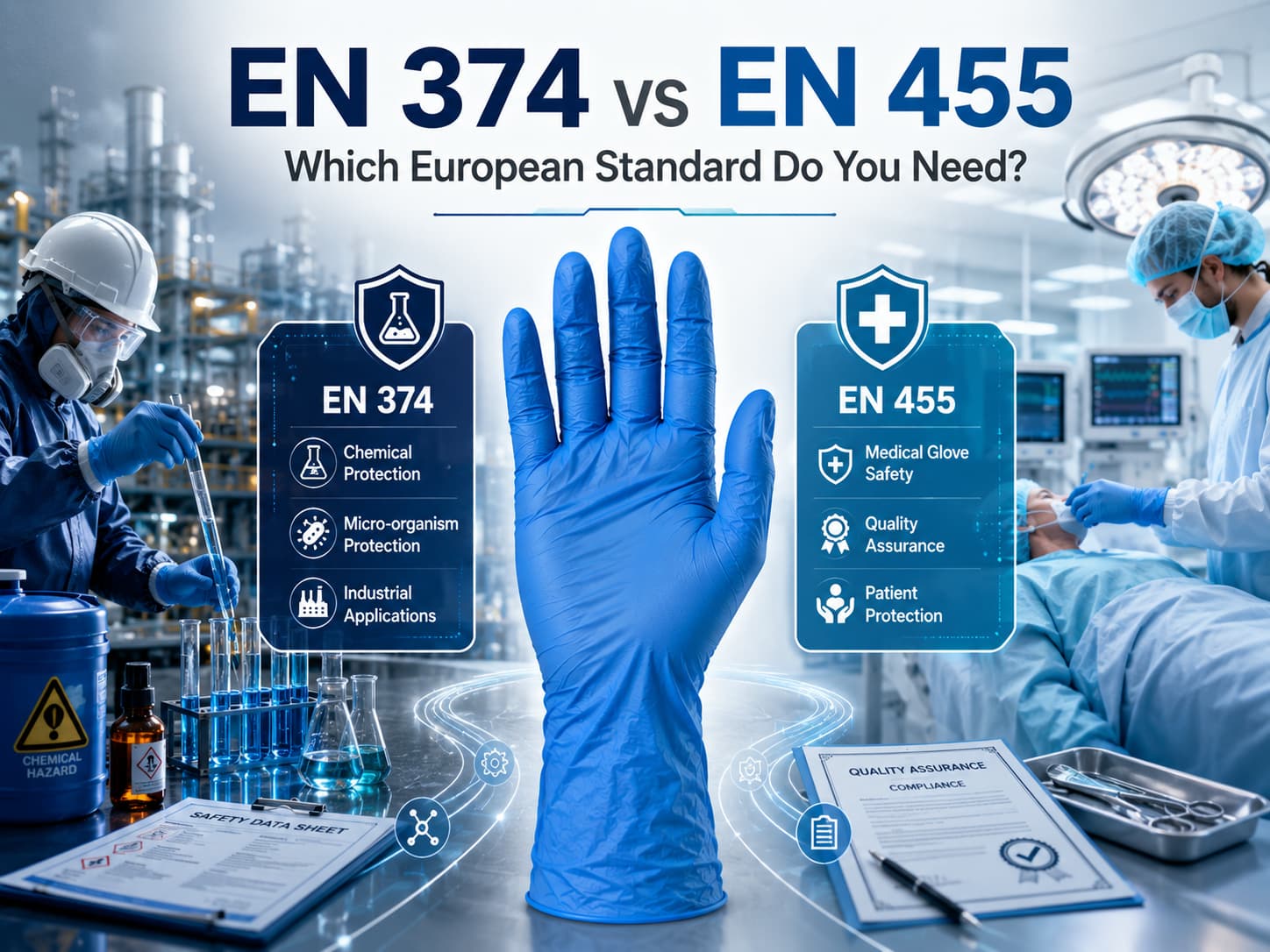
EN 374 governs chemical and micro-organism protection for protective gloves, while EN 455 governs the quality and safety of medical gloves for single use. In short: if your priority is chemical resistance → look for EN 374. If your priority is patient/healthcare safety → look for EN 455. Many industrial buyers need both, but they serve fundamentally different purposes.
• EN 374 = "Can this glove protect me from chemicals and micro-organisms?"
• EN 455 = "Is this glove safe and reliable for medical examination/surgery?"
Quick Comparison Table
Dimension
EN 374
EN 455
Full Title
Protective gloves against dangerous chemicals and micro-organisms
Medical gloves for single use
Scope
Industrial, laboratory, chemical handling
Healthcare, medical examination, surgery
Key Tests
Chemical permeation, degradation, penetration
Freedom from holes (AQL), physical properties, biological safety
Parts
EN 374-1 to EN 374-5
EN 455-1 to EN 455-4
AQL Requirement
AQL 2.5 (typically)
AQL 1.5 (examination) / AQL 0.65 (surgical)
PPE Category
Category III (complex design)
Medical Device (MDR 2017/745)
CE Marking
Yes (EU 2016/425)
Yes (MDR 2017/745)
Typical Users
Chemical workers, lab technicians, mechanics
Doctors, nurses, dentists, surgeons
EN 374: Deep Dive
EN 374 is a series of standards under the PPE Regulation (EU) 2016/425. It applies to protective gloves designed to shield the wearer from hazardous chemicals and micro-organisms.
Parts of EN 374
Part
What It Tests
Key Requirement
EN 374-1
Terminology and performance requirements
Defines Type A, B, C based on chemical resistance
EN 374-2
Resistance to penetration by micro-organisms
Water/air leak test (AQL 2.5 minimum)
EN 374-4
Resistance to degradation by chemicals
Measures change in puncture resistance after chemical exposure
EN 374-5
Protection against micro-organisms (viruses, bacteria, fungi)
Additional virus penetration test (ISO 16604)
EN 374 Chemical Type Classification
Type
Min Chemicals Resisted
Breakthrough Time
Marking
Type A
6 chemicals (from list of 18)
>= 30 min each
EN 374:2016/Type A + chemical codes
Type B
3 chemicals
>= 30 min each
EN 374:2016/Type B + chemical codes
Type C
1 chemical
>= 10 min
EN 374:2016/Type C + chemical code
EN 455: Deep Dive
EN 455 is a series of standards under the Medical Device Regulation (MDR) 2017/745. It applies to gloves intended for medical use — examination, diagnosis, and therapeutic procedures.
Parts of EN 455
Part
What It Tests
Key Requirement
EN 455-1
Freedom from holes (pinhole defects)
AQL 1.5 (examination) / AQL 0.65 (surgical)
EN 455-2
Physical properties
Tensile strength >= 14 MPa (nitrile); elongation >= 500% (nitrile)
EN 455-3
Biological evaluation
Latex protein limits, endotoxin limits, powder residue limits
EN 455-4
Shelf-life determination
Accelerated aging test; must maintain properties for stated shelf life
When Do You Need Both Standards?
Some products must comply with both EN 374 and EN 455 simultaneously. This is common for:
• Chemotherapy gloves — Must meet EN 455 for medical use AND EN 374 for cytotoxic drug permeation
• Laboratory medical gloves — Used in clinical labs where both patient contact and chemical exposure occur
• Emergency response gloves — Where healthcare workers may encounter unknown substances
How to identify dual-certified gloves: Look for both markings on the packaging: "EN 455" + "EN 374" with chemical codes and CE mark.
Which Standard Should You Look For?
1. Are you using gloves for medical examination or surgery? → EN 455 is mandatory
2. Are you handling chemicals in an industrial or lab setting? → EN 374 is required
3. Are you a dental professional? → EN 455 (medical) + optionally EN 374 if handling chemical disinfectants
4. Are you in food processing? → Neither is mandatory; look for EU 10/2011 or FDA 21 CFR 177 for food contact compliance
5. Are you importing to the GCC? → GSO 4872 aligns with both EN 455 and EN 374 principles
FAQ
Q: Can a glove be both EN 374 and EN 455 certified?
A: Yes. Many high-quality nitrile gloves carry both certifications. These are typically used in clinical laboratory settings or for chemotherapy drug handling. The glove must pass the AQL 1.5 pinhole test (EN 455-1) AND the chemical permeation test (EN 374-1) to carry both marks.
Q: Is EN 455 mandatory for all gloves sold in Europe?
A: No. EN 455 is mandatory only for gloves marketed as "medical gloves." Industrial, food-handling, and general-purpose gloves do not require EN 455. However, they may need EN 374 if they claim chemical protection.
Q: What's the difference between EN 374-2 and EN 455-1 water leak tests?
A: Both tests check for pinholes, but the acceptance criteria differ. EN 455-1 requires AQL 1.5 (medical grade), while EN 374-2 typically requires AQL 2.5 (industrial grade). The test method is similar — filling the glove with water and checking for leaks.
Q: Do I need EN 374 for gloves used with cleaning products?
A: If the cleaning products contain hazardous chemicals (as defined by CLP Regulation), then yes — the employer must provide EN 374-certified gloves as PPE. For domestic cleaning with mild detergents, non-certified gloves may be sufficient, but certified gloves are always safer.
About JIXIANG: JIXIANG nitrile gloves are certified to EN 455-1/2/3/4 (medical grade, AQL 1.5) and EN 374 (chemical protection, Type B). Our ISO 13485-certified production ensures consistent quality for healthcare, laboratory, and industrial applications.
Visit www.jxgloves.com/contact for certifications and samples.



 Network Supported