EN 374 Chemical Resistance for Disposable Gloves: What the 6 Permeation Classes Actually Mean
Jun 02, 2026
EN 374 is more than a certification label — it is a structured framework for measuring how long a glove can resist chemical breakthrough. This guide decodes all six permeation classes and explains how to match glove specifications to your actual workplace hazards.
When a procurement manager in Riyadh or Rotterdam asks for "EN 374 certified nitrile gloves," they are often referencing a compliance checkbox — not a precise technical specification. The reality is that EN 374 is a layered standard with multiple performance tiers, and choosing the wrong tier can leave workers inadequately protected, or buyers paying a premium for capabilities they do not actually need.
This article breaks down what EN 374 actually measures, how the six permeation classification levels work, and how to translate those levels into practical glove selection decisions.
What EN 374 Measures — and What It Does Not
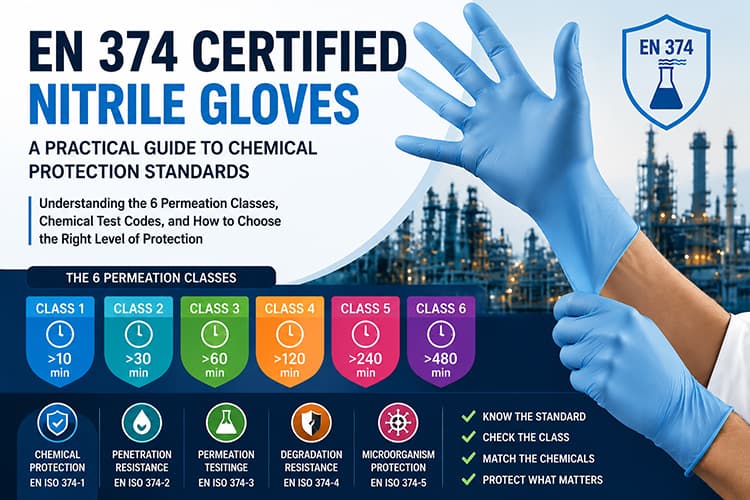
EN 374 is a European standard covering protective gloves against chemicals and microorganisms. It consists of several sub-parts:
• EN ISO 374-1: Terminology and performance classification for chemical permeation
• EN ISO 374-2: Penetration resistance (liquid and gas leakage through seams, pinholes)
• EN ISO 374-3: Chemical resistance testing via permeation
• EN ISO 374-4: Resistance to degradation (material breakdown from chemical exposure)
• EN ISO 374-5: Microorganism protection (including virus protection)
It is important to understand that EN 374 certification does not guarantee protection against all chemicals. It only confirms that the glove has been tested against a specific list of chemicals and achieved defined minimum breakthrough times.
The Six Permeation Classes Explained
Permeation is the process by which a chemical diffuses through the glove material at a molecular level — without visible leakage. The EN ISO 374-3 standard defines six performance classes based on breakthrough time (BT):
Class
Minimum Breakthrough Time
Typical Application Context
Class 1
>10 minutes
Minimal/incidental chemical contact only
Class 2
>30 minutes
Short-duration handling, light lab work
Class 3
>60 minutes
General industrial/chemical handling
Class 4
>120 minutes
Extended handling, higher-risk chemicals
Class 5
>240 minutes
Prolonged chemical exposure tasks
Class 6
>480 minutes
Highest protection — full shift use
A glove marked "Type B" under EN ISO 374-1 must achieve at least Class 2 breakthrough time against a minimum of 3 chemicals from the standard test list. "Type A" requires Class 2 or above against at least 6 chemicals.
The Chemical Test List — Why It Matters
EN ISO 374-3 uses a reference alphabet of 18 standard test chemicals, each assigned a letter code. When a glove is EN 374 certified, the letters appearing on the packaging tell you exactly which chemicals it has been tested against.
For example, a glove marked with "A, B, C, J, K, L" has been tested against methanol (A), acetone (B), acetonitrile (C), heptane (J), sodium hydroxide 40% (K), and sulphuric acid 96% (L).
This system matters enormously for industrial buyers: a glove with excellent performance against solvents may offer minimal protection against strong acids, and vice versa.
Degradation vs. Permeation — A Critical Distinction
Many buyers conflate chemical degradation with permeation failure. These are different phenomena:
• Degradation (EN ISO 374-4): Visible physical breakdown of the glove material — swelling, cracking, dissolving. This can be seen and felt.
• Permeation (EN ISO 374-3): Invisible molecular migration through the intact glove membrane. By the time it is detectable, exposure has already occurred.
A glove may show no visible degradation while still allowing dangerous levels of chemical permeation. Testing for both properties separately is essential for high-risk environments.
Practical Application: Matching Class to Industry
For buyers in the oil and gas, petrochemical, and chemical manufacturing sectors — the dominant industrial sectors in the Gulf and Southeast Asia — here is a practical matching guide:
Industry Sector
Typical Chemical Hazards
Recommended EN 374 Class
Oil & Gas / Petrochemical
Hydrocarbons, solvents, H2S
Class 4–6 (Type A)
Food Processing
Cleaning agents, disinfectants
Class 2–3 (Type B)
Laboratory / Pharma
Varied — acid, base, organic solvents
Class 3–5 (Type A/B depending on task)
Automotive / Maintenance
Oils, lubricants, brake fluid
Class 3–4 (Type B/A)
Janitorial / Cleaning
Bleach, detergents, acids
Class 2–3 (Type B)
What This Means for Glove Buyers
The practical takeaway is this: do not specify EN 374 as a blanket requirement without stating the performance class and the specific chemicals involved. A disposable nitrile glove rated Class 2 against alcohols is entirely appropriate for a food processing cleaning routine — but completely inadequate for a petrochemical worker handling aromatic solvents.
When requesting quotations or samples, ask your supplier for:
1. The EN 374 class achieved for each test chemical
2. The full test report showing breakthrough times (not just the certificate)
3. Whether the glove was tested for degradation as well as permeation
Understanding these details transforms a compliance label into a genuinely protective tool — and protects both your workers and your procurement liability.
About Fujian Jixiang E-commerce Co., Ltd.
With over 20 years of experience, we specialize in manufacturing high-quality disposable gloves.
Why Choose Us?
· ✅ Factory-direct pricing
· ✅ ISO/CE/FDA certified products
· ✅ OEM/ODM customization
· ✅ Global shipping to 50+ countries



 Network Supported