
welcome to Jixiang E-commerce!
welcome to Jixiang E-commerce!
A real-time snapshot of the raw materials that drive disposable glove costs in September 2026. Brent crude, butadiene, acrylonitrile, PVC resin, and natural rubber latex prices are tracked with current market data and pass-through implications for glove buyers.
The disposable glove industry is a downstream consumer of petrochemicals and agricultural commodities. Nitrile rubber gloves depend on acrylonitrile and butadiene; PVC gloves depend on PVC resin and plasticizers; latex gloves depend on natural rubber latex. In late August 2026, the market is sending mixed signals: crude oil is rising on renewed Middle East tensions, nitrile feedstocks are firming, PVC resin is soft, and natural rubber is weak. This snapshot summarizes verified prices as of late August 2026 and explains what glove buyers should watch in September.
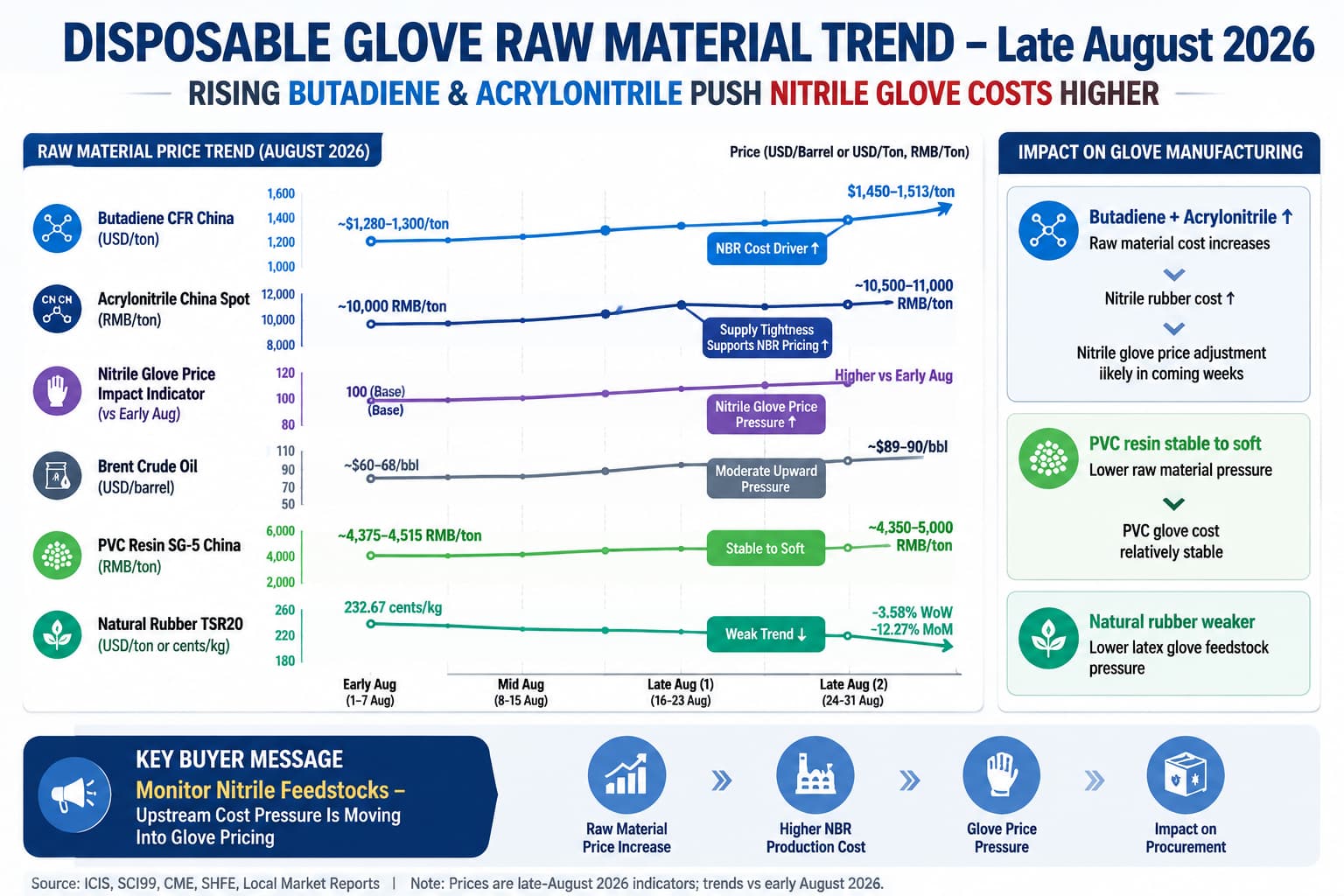
| Material | Late-August 2026 indicator | Trend vs earlier August | Glove cost impact |
|---|---|---|---|
| Brent crude oil | ~$89.47-90.00 / barrel | Rising; up ~2% on 31 Aug after Middle East tensions | Upward pressure on shipping and petrochemical feedstocks |
| Butadiene CFR China | $1,450-1,513 / ton | Rising; up from ~$1,280-1,300 in early August | Higher nitrile rubber cost; pass-through to nitrile gloves |
| Acrylonitrile China spot | ~10,500-11,000 RMB / ton | Firm; supply tightness in East China | Supports nitrile rubber pricing |
| PVC resin SG-5 China | ~4,350-5,000 RMB / ton | Stable to soft; East China ~4,375-4,515 | Cost relief for PVC glove buyers |
| Natural rubber TSR20 | SICOM ~$2,289 / ton; SHFE ~232.67 cents/kg | Weak; -3.58% WoW, -12.27% MoM | Lower latex glove feedstock pressure |
Brent crude oil traded around $89.47-90.00 per barrel on 31 August 2026, up roughly 2% intraday, after reports of military action near the Strait of Hormuz. The Aug 30 close was $89.79 per barrel according to WorldOilMonitor. The Strait of Hormuz remains the chokepoint for roughly one-fifth of global oil shipments; any disruption raises both crude prices and shipping risk premiums for Middle East routes.
For glove buyers, higher Brent means two things: first, the naphtha cracking feedstock used to produce butadiene and acrylonitrile becomes more expensive; second, ocean freight fuel surcharges and container risk premiums can rise on Middle East-GCC and Asia-Europe routes.
Butadiene is one of the two monomers in nitrile rubber (the other is acrylonitrile). As of late August 2026, butadiene CFR China was quoted at $1,505-1,513 per ton on 25 August (SunSirs), up from about $1,280-1,300 per ton in early August (ECHEMI). The increase reflects tighter C4 extraction supply and recovering synthetic rubber demand.
A rising butadiene price directly raises the cost of nitrile rubber latex emulsion used in glove dipping lines. The pass-through is not one-to-one - factories absorb some volatility through inventory and contract terms - but sustained butadiene above $1,400/ton will push nitrile glove quotes higher, especially for spot orders.
Acrylonitrile (ACN) spot prices in China were reported in the 10,500-11,000 RMB/ton range during 26-28 August 2026 (100ppi), with mainstream offers around 10,900-11,200 RMB/ton. Supply tightness in East China, partly linked to refinery maintenance and derivative demand, has kept ACN firm even as some downstream sectors remain cautious.
Because ACN determines the nitrile content of nitrile rubber - and therefore chemical resistance and tensile strength - higher ACN costs support premium nitrile glove pricing. Buyers should monitor East China port prices weekly as a leading indicator.
PVC resin SG-5 spot prices in China were reported between 4,350 and 5,000 RMB/ton in late August 2026, with East China mainstream quotes around 4,375-4,515 RMB/ton (Guidechem, 100ppi, ChemicalBook). The market is relatively stable to soft compared with the volatility seen earlier in 2026.
This creates a cost advantage for PVC (vinyl) glove buyers in the short term. However, regulatory headwinds remain: EU REACH restrictions on phthalates and the 2027-2028 EU PFAS restriction could increase formulation costs for PVC gloves sold into Europe, partially offsetting raw material savings.
Natural rubber TSR20 futures on SICOM (Singapore Exchange) settled around $2,289 per ton on 27 August 2026, while SHFE TSR20 prices were around 232.67 cents/kg on 21 August 2026. China's Ministry of Commerce price tracker shows TSR20 down 3.58% week-on-week and 12.27% month-on-month as of late August.
The weakness reflects soft demand from the tire and glove sectors, despite supply concerns in Thailand and Malaysia. For latex glove buyers, this means lower immediate feedstock pressure, though weather-related supply disruptions in Southeast Asia remain a Q4 upside risk.
| Glove type | Key feedstocks | Cost direction | Buyer action |
|---|---|---|---|
| Nitrile exam / industrial | Butadiene + acrylonitrile | Rising pressure | Negotiate price-adjustment clauses; lock spot orders before further increases |
| PVC / vinyl | PVC resin + plasticizer | Stable to lower | Good window to negotiate favourable terms; verify phthalate/PFAS compliance |
| Latex | Natural rubber latex | Stable to lower | Maintain buffer stock; monitor Thailand/Malaysia weather |
Data sources and collection date: Brent crude from WorldOilMonitor and Sina Finance (30-31 Aug 2026); butadiene CFR China from SunSirs and Mysteel (18-25 Aug 2026); acrylonitrile China spot from 100ppi (21-28 Aug 2026); PVC resin SG-5 from Guidechem, 100ppi and ChemicalBook (26-30 Aug 2026); natural rubber TSR20 from SICOM, SHFE and China's Ministry of Commerce price tracker (21-27 Aug 2026). Prices are spot market indications; verify with your supplier's reference source before procurement decisions.
Q: Why do butadiene prices affect nitrile gloves so much?
A: Butadiene is one of the two monomers that make nitrile rubber (the other is acrylonitrile). It typically represents a large share of the polymer mass. When butadiene prices rise, the cost of nitrile rubber emulsion used in glove dipping increases, and factories pass at least part of that increase through to glove prices.
Q: How does PVC resin price affect vinyl glove costs?
A: PVC resin is the main polymer in vinyl gloves, usually representing 40-60% of material cost. When PVC resin prices fall, vinyl glove manufacturing costs decline, giving buyers room to negotiate lower prices. Plasticizer costs and regulatory compliance (phthalates, PFAS) also affect final pricing.
Q: What is the Strait of Hormuz risk for glove buyers?
A: The Strait of Hormuz carries roughly one-fifth of global oil shipments. Tensions in the region raise Brent crude prices and shipping insurance premiums. Higher crude increases the cost of naphtha feedstocks for butadiene and acrylonitrile, while higher freight costs affect container rates on Asia-Middle East-Europe routes.
Q: Should buyers lock in glove prices now?
A: For nitrile gloves, locking spot orders soon may protect against further butadiene/acrylonitrile increases. For PVC and latex gloves, the near-term feedstock outlook is softer, so buyers can negotiate from a stronger position but should still include raw-material escalation clauses in long contracts.
Q: How much do raw materials affect the final glove price?
A: Raw materials typically account for 50-70% of disposable glove manufacturing cost. Nitrile rubber dominates nitrile glove cost; PVC resin and plasticizers dominate vinyl glove cost; natural rubber latex dominates latex glove cost. Logistics, energy, labor, and packaging make up the remainder.
Please read on, stay posted, subscribe, and we welcome you to tell us what you think.


Copyright 2026@ Fujian Jixiang E-commerce Co., Ltd All Rights Reserved.
Sitemap |
Blog
|
Xml |
Privacy Policy
 Network Supported