Nitrile vs Latex vs PVC Gloves - Material Properties and Task Fit (2026 Comparison)
Sep 03, 2026
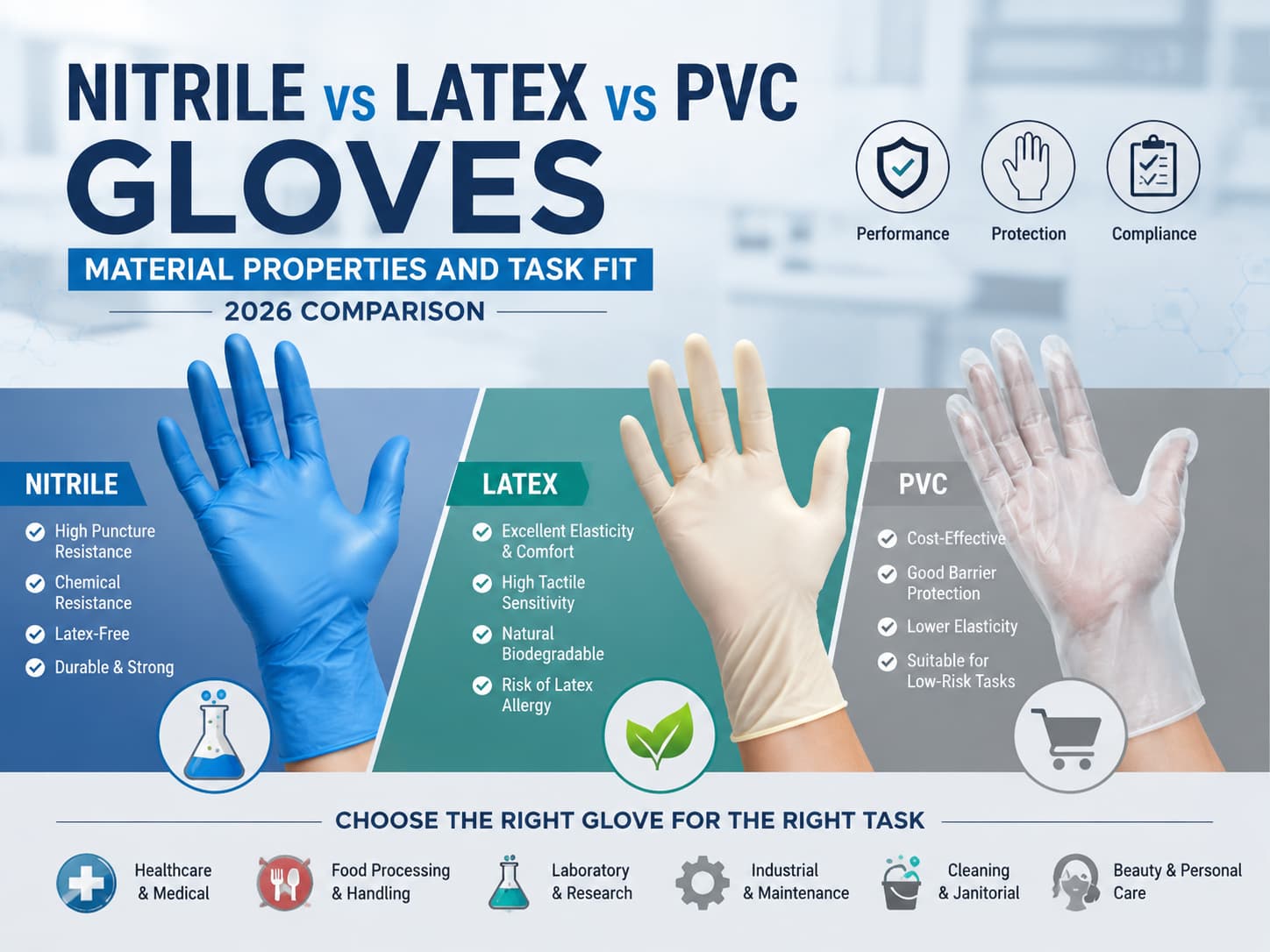
Nitrile, latex, and PVC gloves each have different strengths. This comparison explains the chemistry, barrier performance, allergy risks, and best-use tasks for each material so buyers can match the glove to the job.
The three most common disposable glove materials - nitrile rubber, natural rubber latex, and polyvinyl chloride (PVC) - are not interchangeable. Each has a different polymer structure, barrier profile, elasticity, allergy risk, and cost base. The right choice depends on the task, the regulatory environment, and the user population. This guide compares the materials side by side and provides a task-based selection framework.
1. The Chemistry in One Sentence
Nitrile rubber is acrylonitrile butadiene rubber (ACN + butadiene), a synthetic polymer with no latex proteins
Natural rubber latex is a plant-derived polymer harvested from Hevea brasiliensis trees; it contains proteins that can trigger Type I allergy
PVC is a thermoplastic polymer made from vinyl chloride monomer, softened with plasticizers such as phthalates or DINCH for glove use
2. Side-by-Side Material Comparison
Property
Nitrile rubber
Natural rubber latex
PVC / vinyl
Source
Synthetic (ACN + butadiene)
Natural (Hevea tree latex)
Synthetic (vinyl chloride)
Latex proteins
None
Present
None
Tensile strength
High (>= 14 MPa per ASTM D6319)
Very high (18-24 MPa typical)
Moderate (8-13 MPa typical)
Elongation at break
400-600%
650-750%
250-350%
Puncture resistance
Excellent
Good
Lower
Chemical resistance
Best (oils, solvents, many chemicals)
Moderate
Limited (better with acids/bases)
Tactile sensitivity
Very good, especially thin grades
Excellent
Fair
Allergy risk
Type I: none; Type IV: possible (accelerator chemicals)
Type I: yes; Type IV: possible
Type I: none; plasticizer/Type IV: possible
Cost position (2026)
Mid-to-premium
Moderate
Lowest
Common thickness
3-8 mil (0.08-0.20 mm)
3-7 mil (0.08-0.18 mm)
3-5 mil (0.08-0.13 mm)
3. Barrier Performance Against Pathogens and Chemicals
For medical and food safety, the most important question is whether the glove blocks pathogens and the chemicals it will contact. Nitrile rubber generally outperforms latex and PVC for oils, solvents, and many hospital chemicals. Latex has excellent barrier properties for biological fluids but is degraded by oils. PVC is acceptable for low-risk tasks and short-duration contact but has lower puncture resistance and can soften or leak under stress.
4. Allergy Considerations
Type I latex allergy is the headline risk for natural rubber latex gloves. It can cause hives, respiratory symptoms, and anaphylaxis. Nitrile and PVC gloves eliminate this risk. However, nitrile gloves can still trigger Type IV contact dermatitis in some users because of accelerator chemicals such as thiurams, carbamates, and mercaptobenzothiazole (MBT). Accelerator-free nitrile gloves are available for sensitive users.
5. Cost and Supply Factors in 2026
Raw material costs influence glove pricing. Nitrile rubber depends on acrylonitrile and butadiene, both petrochemical derivatives; prices can rise with crude oil and cracker economics. Natural rubber latex depends on plantation supply, weather, and the TSR20 price. PVC is tied to PVC resin and plasticizer costs, which are generally the lowest of the three. As of late August 2026, Brent crude has risen above $89/barrel on Middle East tensions, putting upward pressure on nitrile feedstock costs, while PVC resin remains relatively soft.
6. Task-Based Selection Guide
Task / Industry
Recommended material
Why
Medical examination
Nitrile rubber
Latex-free, strong barrier, puncture-resistant, meets ASTM D6319 / EN 455
Surgery
Natural rubber latex or synthetic polyisoprene
Best tactile sensitivity and elasticity; low-protein powder-free grades required
Chemotherapy handling
Thick nitrile (ASTM D6978 tested)
Resists permeation by oncology drugs
Food handling
Nitrile or PVC
Cost-effective, complies with FDA 21 CFR 177.2600 / EU 1935/2004
Industrial / automotive
Nitrile
Oil and solvent resistance
Cleanroom / electronics
Powder-free nitrile or latex
Low particle shedding; chemical compatibility
Short low-risk cleaning
PVC
Lowest cost; adequate for brief contact
Tattoo / beauty
Nitrile
Barrier to inks and blood; latex-free for client safety
7. Procurement Checklist
Assess the hazard: biological, chemical, mechanical, or combination
Screen users for latex allergy: if any risk exists, default to nitrile or PVC
Match thickness to task: 3-4 mil for dexterity; 6-8 mil for durability
Request certifications: EN 455 or ASTM D6319 for medical; FDA 21 CFR 177.2600 or EU 1935/2004 for food
Consider accelerator-free nitrile: for users with Type IV dermatitis
Check raw material trends: lock in pricing when butadiene/ACN costs are rising
Data sources: ASTM D6319; EN 455 series; EN ISO 21420:2020 (formerly EN 420); FDA 21 CFR 177.2600; EU 1935/2004; ASTM D6978; material property data from major glove manufacturers. Information current as of August 2026.
FAQ
Q: Which glove material is best for chemical resistance?
A: Nitrile rubber generally offers the best chemical resistance among the three common disposable glove materials, especially against oils, greases, solvents, and many hospital chemicals. Latex performs well against biological fluids but is degraded by oils and hydrocarbons. PVC has limited chemical resistance and is best for short-duration, low-risk contact.
Q: Are nitrile gloves completely allergy-free?
A: Nitrile gloves eliminate Type I latex allergy because they contain no latex proteins. However, some users may develop Type IV contact dermatitis from accelerator chemicals used in the vulcanization process, such as thiurams, carbamates, and mercaptobenzothiazole (MBT). Accelerator-free nitrile gloves are available for these users.
Q: Why are PVC gloves cheaper than nitrile and latex?
A: PVC gloves are cheaper because PVC resin and plasticizer raw materials are generally lower-cost than nitrile rubber monomers (acrylonitrile and butadiene) or natural rubber latex. They are also simpler to manufacture. The trade-off is lower puncture resistance, lower elasticity, and more limited chemical resistance.
Q: Can latex gloves be used for food handling?
A: Yes, powder-free latex gloves can be used for food handling where permitted, but many food businesses avoid them because of Type I latex allergy risk among workers and customers. Nitrile and PVC are more common choices in food service because they are latex-free.
Q: Which material has the best tactile sensitivity?
A: Natural rubber latex has the best tactile sensitivity and elasticity, which is why it remains preferred for surgical applications. Modern thin nitrile gloves (3-4 mil) can approach latex-like sensitivity for most examination tasks, while PVC is generally less tactile.



 Network Supported