welcome to Jixiang E-commerce!

Search

Home

AQL

  • Sterile vs Non-Sterile Medical Gloves: A 2026 Regulatory & Procurement Guide
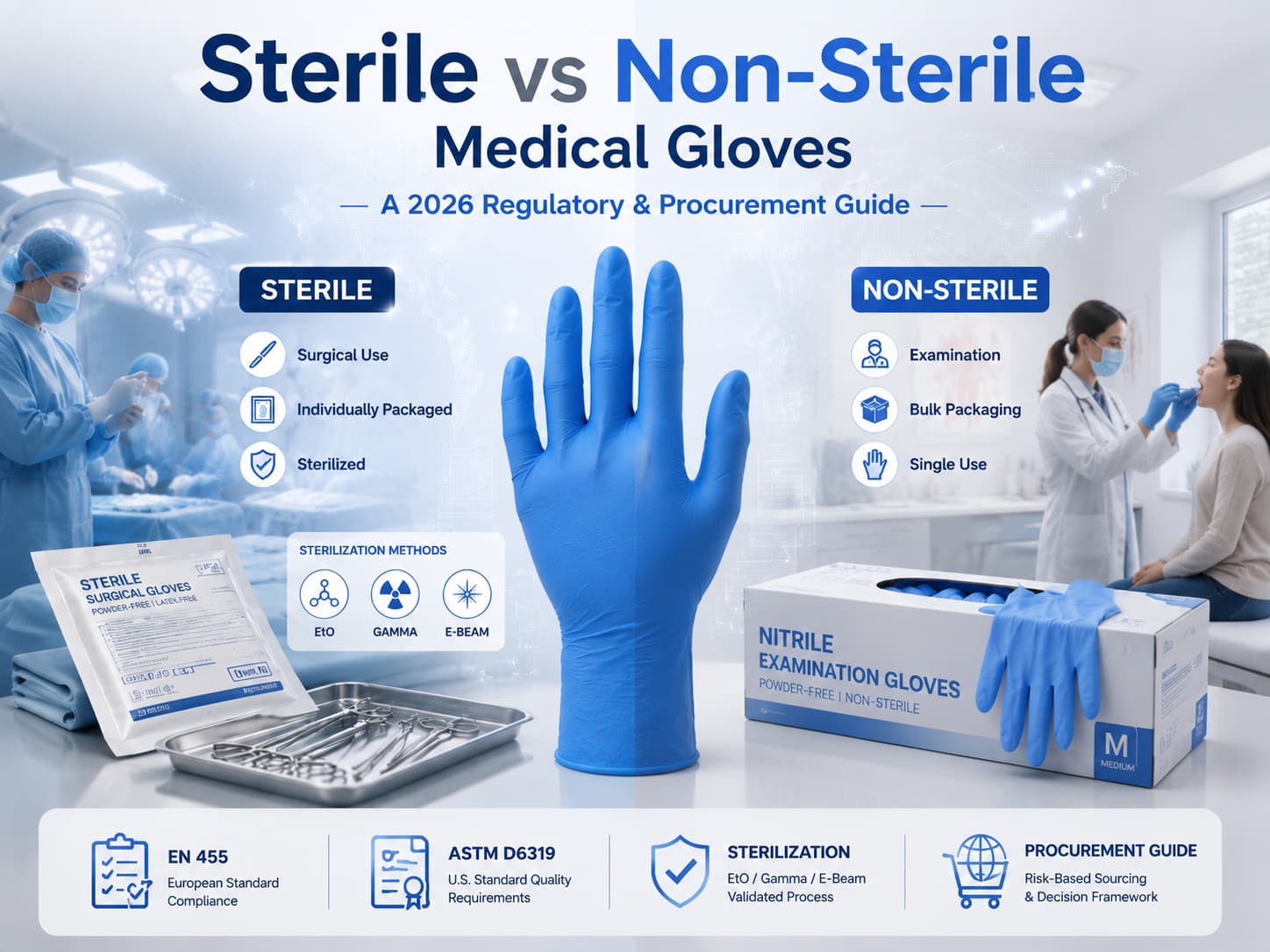
    Sterile vs Non-Sterile Medical Gloves: A 2026 Regulatory & Procurement Guide
    Jul 14, 2026
    What is the difference between sterile and non-sterile medical gloves? This 2026 guide covers EN 455, ASTM D6319, sterilization methods (EtO, gamma, e-beam), AQL requirements, packaging, shelf life, and a procurement decision framework for healthcare buyers.   Sterile medical gloves are manufactured, sterilized, and individually packaged to maintain a Sterile Assurance Level (SAL) of 10^-6 or better, meaning no more than 1 in 1,000,000 units may carry a viable microorganism. Non-sterile medical gloves are produced under controlled cleanliness standards but do not undergo a terminal sterilization process; they carry an AQL of 1.5 or 2.5 for pinholes, meaning up to 1.5% or 2.5% of gloves may have microscopic holes. The distinction is not merely labeling - it determines the legal use case, the regulatory pathway, the packaging format, the shelf life, and the unit cost. In 2026, with raw material costs elevated by sustained crude oil volatility and supply chains still adjusting post-Hormuz disruption, understanding this distinction is essential for cost-effective, compliant procurement. What Are Sterile and Non-Sterile Medical Gloves? Sterile gloves are intended for surgical and invasive procedures where any microbial contamination could enter sterile tissue or the vascular system. They are individually wrapped in sterile pouches, often paired in peel-open packs, and carry expiration dates tied to sterilization stability. Typical materials include natural rubber latex, nitrile rubber, and polychloroprene. Non-sterile gloves are intended for routine patient examination, wound care, dental procedures, and general healthcare tasks where contact with sterile tissue is not anticipated. They are typically bulk-packaged in boxes of 100 or 200, do not carry a sterile barrier claim, and are less expensive per unit. The key technical difference is not the glove material itself - the same nitrile rubber formulation can be used for both sterile and non-sterile gloves. The difference lies in the manufacturing controls, the terminal sterilization step, the packaging, and the AQL (Acceptable Quality Limit) for pinholes. Regulatory Standards Governing Sterility Multiple regulatory frameworks govern whether a glove may be labeled and sold as "sterile" or "non-sterile" in different markets: Standard / Regulation Scope Sterile Requirement Non-Sterile Requirement EN 455-1 (EU) Medical gloves for single use - freedom from holes AQL 1.0 (max 1% pinholes) AQL 1.5 (max 1.5% pinholes) EN 455-4 (EU) Shelf life determination Mandatory real-time and accelerated aging data Same requirement, but typically longer shelf life due to no sterilization degradation ASTM D6319 (US) Nitrile rubber examination gloves Sterile version must meet SAL 10^-6 Non-sterile version must meet AQL 2.5 ASTM D3578 (US) Rubber latex examination gloves Sterile: AQL 1.0 Non-sterile: AQL 2.5 FDA 21 CFR 880.6250 (US) Class I (non-sterile) / Class II (sterile) medical device 510(k) clearance required; SAL 10^-6 Exempt from 510(k); registration only EUDAMED (EU MDR) Medical Device Regulation 2017/745 Class IIa sterile; full QMS audit Class I; self-declaration of conformity GSO ISO 11193-1 (GCC) Single-use medical examination gloves Sterile: AQL 1.0 per GSO requirements Non-sterile: AQL 1.5 or 2.5 per GSO requirements Source: EN 455:2020 series (CEN), ASTM D6319-19 (ASTM International), FDA 21 CFR 880.6250 (FDA.gov), EU MDR 2017/745 (European Commission), GSO ISO 11193-1:2020 (GSO Standard Store). Accessed July 2026. Sterilization Methods: EtO, Gamma, and E-Beam Sterile medical gloves undergo a terminal sterilization process after packaging. Three methods dominate the industry in 2026: Method Mechanism Typical Dose / Parameters Material Compatibility Residuals / Concerns Ethylene Oxide (EtO) Alkylation of microbial DNA/RNA 400-1,200 mg/L at 30-60C for 2-6 hours All glove materials (latex, nitrile, PVC) EtO residuals must be below ISO 10993-7 limits; requires aeration period of 7-14 days Gamma Irradiation Ionizing radiation breaks DNA bonds 25-35 kGy (Cobalt-60 source) Nitrile and latex; PVC can yellow Can cause cross-linking or chain scission in some polymers; may reduce tensile strength by 5-15% E-Beam (Electron Beam) Accelerated electrons damage microbial DNA 25-35 kGy (electron accelerator) Most glove materials; faster than gamma Lower penetration depth than gamma; requires thinner product packaging configuration Ethylene Oxide (EtO) remains the most widely used sterilization method for medical gloves globally, particularly for latex and nitrile surgical gloves, because it does not alter the polymer's mechanical properties. However, EtO is classified as a carcinogen (Group 1 by IARC), and regulatory agencies including the EPA and ECHA are tightening emission limits in 2025-2026. Gamma irradiation is faster but can degrade nitrile rubber tensile strength over time. E-beam is gaining adoption for its speed and lower environmental impact but requires specialized facilities. Procurement note: Always request the sterilization validation report (ISO 11135 for EtO, ISO 11137 for radiation) from the supplier. A certificate stating "sterile" without the underlying validation data is insufficient for regulatory audits. AQL Requirements: Surgical vs Examination Gloves The Acceptable Quality Limit (AQL) is the maximum percentage of gloves with pinholes that a lot may contain and still pass inspection. Lower AQL = higher quality = higher cost. The AQL is determined by the glove's intended use: Glove Type Sterility AQL (Pinholes) Typical Use Case EN 455 Reference Surgical gloves Sterile (SAL 10^-6) AQL 1.0 (max 1%) Surgery, invasive procedures, sterile field EN 455-1, surgical category Examination gloves (sterile) Sterile (SAL 10^-6) AQL 1.0 (max 1%) Sterile examinations, central line dressing EN 455-1, sterile exam category Examination gloves (non-sterile) Non-sterile AQL 1.5 (max 1.5%) Routine patient exam, wound care EN 455-1, non-sterile exam category Examination gloves (economy) Non-sterile AQL 2.5 (max 2.5%) Non-medical use, general handling, food service Below EN 455 threshold; industrial grade A common procurement mistake is buying AQL 2.5 gloves for medical examination use. EN 455 requires AQL 1.5 or better for medical examination gloves. An AQL 2.5 glove labeled as "examination grade" without EN 455 certification is non-compliant for medical use in the EU and most GCC markets. Packaging, Labeling & Shelf Life Sterile and non-sterile gloves have fundamentally different packaging requirements: Sterile gloves: Individually wrapped in peel-open sterile pouches, typically paired (one left, one right) in a single sterile pack. Each pack must carry the sterilization method, batch number, sterilization date, and expiration date. The packaging itself must maintain sterility for the claimed shelf life, validated per ISO 11607. Typical shelf life: 3-5 years for EtO-sterilized nitrile; 3 years for gamma-sterilized nitrile. Non-sterile gloves: Bulk-packaged in dispenser boxes of 100 or 200 units. No sterile barrier claim required. Labeling must include the AQL, manufacturer name, batch number, and material composition. Typical shelf life: 3-5 years for nitrile; up to 5 years for latex with proper antioxidant formulation. Labeling requirements by market: EU (MDR 2017/745): CE mark, Notified Body number (for sterile Class IIa), UDI-DI, instructions in official language of destination country US (FDA): 510(k) number (for sterile), establishment registration, product code (LZA for examination gloves, KGO for surgical gloves) GCC (GSO): GSO conformity mark, Arabic and English labeling, GSO registration number The 2026 Raw Material Cost Context The cost differential between sterile and non-sterile gloves has widened in 2026 due to raw material and energy cost pressures. Nitrile rubber is derived from acrylonitrile and butadiene - both petrochemical derivatives. Brent crude has averaged above $95/barrel through Q2 2026, driven by sustained Hormuz Strait shipping risk and OPEC+ production discipline. This has pushed butadiene to $1,450-1,520/ton and acrylonitrile to $1,380-1,440/ton (CFR China, July 2026). The sterilization step adds 15-30% to the unit cost of a sterile glove compared to its non-sterile equivalent, primarily due to: (1) the sterilization process itself (EtO gas costs, gamma facility fees), (2) the aeration/quarantine period that ties up inventory for 7-14 days, (3) individual packaging instead of bulk packaging, and (4) the tighter AQL requirement (1.0 vs 1.5) that results in higher rejection rates during QC. Source: ICIS Butadiene Report (July 2026), Platts Acrylonitrile Assessment (July 2026), Brent Crude futures data (ICE, July 2026). Procurement Decision Framework Use this decision framework to determine whether sterile or non-sterile gloves are appropriate for your application: Use Case Required Type AQL Regulatory Pathway Cost Index Surgical procedures (operating room) Sterile surgical AQL 1.0 EU: Class IIa + NB audit; US: 510(k); GCC: GSO sterile registration 1.0 (baseline) Sterile field dressing (central lines, catheters) Sterile examination AQL 1.0 EU: Class IIa; US: 510(k); GCC: GSO sterile registration 0.8x surgical Routine patient examination Non-sterile examination AQL 1.5 EU: Class I self-declaration; US: registration only; GCC: GSO standard 0.4x surgical Dental procedures (non-surgical) Non-sterile examination AQL 1.5 Same as routine exam 0.4x surgical Laboratory handling (non-biological) Non-sterile examination or industrial AQL 1.5 or 2.5 Industrial grade if AQL 2.5; no medical device classification 0.3x surgical Food service / food processing Non-sterile, food-grade AQL 2.5 acceptable FDA 21 CFR 177 (food contact); no medical device classification 0.25x surgical The cost index above uses sterile surgical gloves as the baseline (1.0). Non-sterile examination gloves typically cost 55-65% less per unit than sterile surgical gloves. For a hospital purchasing 500,000 gloves per month, switching from sterile to non-sterile for routine examinations (where sterile is unnecessary) can save 55-60% on glove expenditure without compromising patient safety - provided the AQL 1.5 requirement is met and the gloves carry valid EN 455 certification. Key Takeaways   1. Sterile gloves require SAL 10^-6 and AQL 1.0; non-sterile examination gloves require AQL 1.5 per EN 455. The AQL determines regulatory classification and legal use case. 2. The sterilization method matters: EtO is the most common but faces tightening environmental regulation. Gamma and e-beam are alternatives but may affect polymer properties. Always request ISO 11135 or ISO 11137 validation reports. 3. Packaging drives cost: Individual sterile pouches cost significantly more than bulk dispenser boxes. The 15-30% cost premium for sterile gloves reflects packaging, sterilization, QC rejection rates, and regulatory compliance costs. 4. 2026 raw material costs remain elevated: Butadiene at $1,450-1,520/ton and acrylonitrile at $1,380-1,440/ton (CFR China, July 2026) continue to pressure all nitrile glove pricing. Lock in supply contracts early and diversify sourcing regions. 5. Verify before you buy: A "sterile" label without an ISO 11135/11137 validation report, a valid CE certificate with Notified Body number, or an FDA 510(k) clearance is insufficient. Request full regulatory documentation before placing any sterile glove order.   FAQ / Frequently Asked Questions   Q: Can non-sterile examination gloves be used in the operating room? A: No. Non-sterile examination gloves cannot be used in surgical or invasive procedures. The sterility assurance level (SAL) of non-sterile gloves is undefined - they are not sterilized at all. SFDA, MoHAP, EU MDR, and FDA all require sterile gloves (typically SAL 10^-6) for any procedure that breaches intact skin or enters sterile body cavities. Using non-sterile gloves in the OR can result in audit findings, fines, and product recalls. Q: What is the difference between gamma irradiation and EtO sterilization for gloves? A: Gamma irradiation uses cobalt-60 gamma rays to break down microbial DNA. It is fast (a few hours), leaves no chemical residue, and is the most common method for disposable sterile gloves. EtO (ethylene oxide) is a chemical sterilant that requires longer exposure (8-12 hours) plus aeration to remove residual EtO. EtO sterilization has faced regulatory pressure due to EtO being a known carcinogen. Most modern sterile nitrile gloves use gamma irradiation. The choice affects labeling: gamma-irradiated gloves typically have lower extractables and shorter post-sterilization aging requirements. Q: What does AQL 1.5 mean for medical gloves? A: AQL (Acceptable Quality Limit) 1.5 is the statistical quality threshold defined in ISO 2859-1 for medical examination gloves. It means that in a random sampling batch, no more than 1.5% of gloves can have pinhole defects. For surgical gloves, the standard is stricter: AQL 0.65. The lower the AQL, the more rigorous the manufacturing and inspection. AQL 1.5 is the minimum required by EN 455-1, ASTM D6319, and GSO 4872 for medical examination gloves. Industrial-grade gloves typically use AQL 2.5 or 4.0. Q: How long is the shelf life of sterile medical gloves? A: The shelf life of sterile medical gloves is typically 3-5 years from the date of manufacture, depending on the material and packaging. Nitrile sterile gloves generally have a 5-year shelf life; latex sterile gloves 3-5 years; PVC sterile gloves 3 years. Shelf life is validated by accelerated aging tests per ASTM F1980 and ISO 11607. After the expiration date, the manufacturer no longer guarantees sterility, package integrity, or material performance. Stockpile managers should rotate stock using FIFO (first-in, first-out) and monitor expiration dates closely. Q: Are sterile surgical gloves and sterile exam gloves interchangeable? A: No. Sterile surgical gloves and sterile exam gloves are not interchangeable. Surgical gloves have a lower AQL (0.65 vs 1.5), are tested for use on wet hands, and meet additional dimensional and strength requirements in EN 455-2 and ASTM D3577. Sterile exam gloves are designed for minor invasive procedures (catheterization, wound irrigation) but not for open surgery. Substituting exam gloves for surgical gloves will fail an SFDA, MoHAP, or EU MDR audit. The packaging should clearly state "surgical" or "examination" use.

  • EN ISO 21420 (EN 420) Explained: General Requirements for Protective Gloves (2026 Procurement Guide)
    EN ISO 21420 (EN 420) Explained: General Requirements for Protective Gloves (2026 Procurement Guide)
    Jul 16, 2026
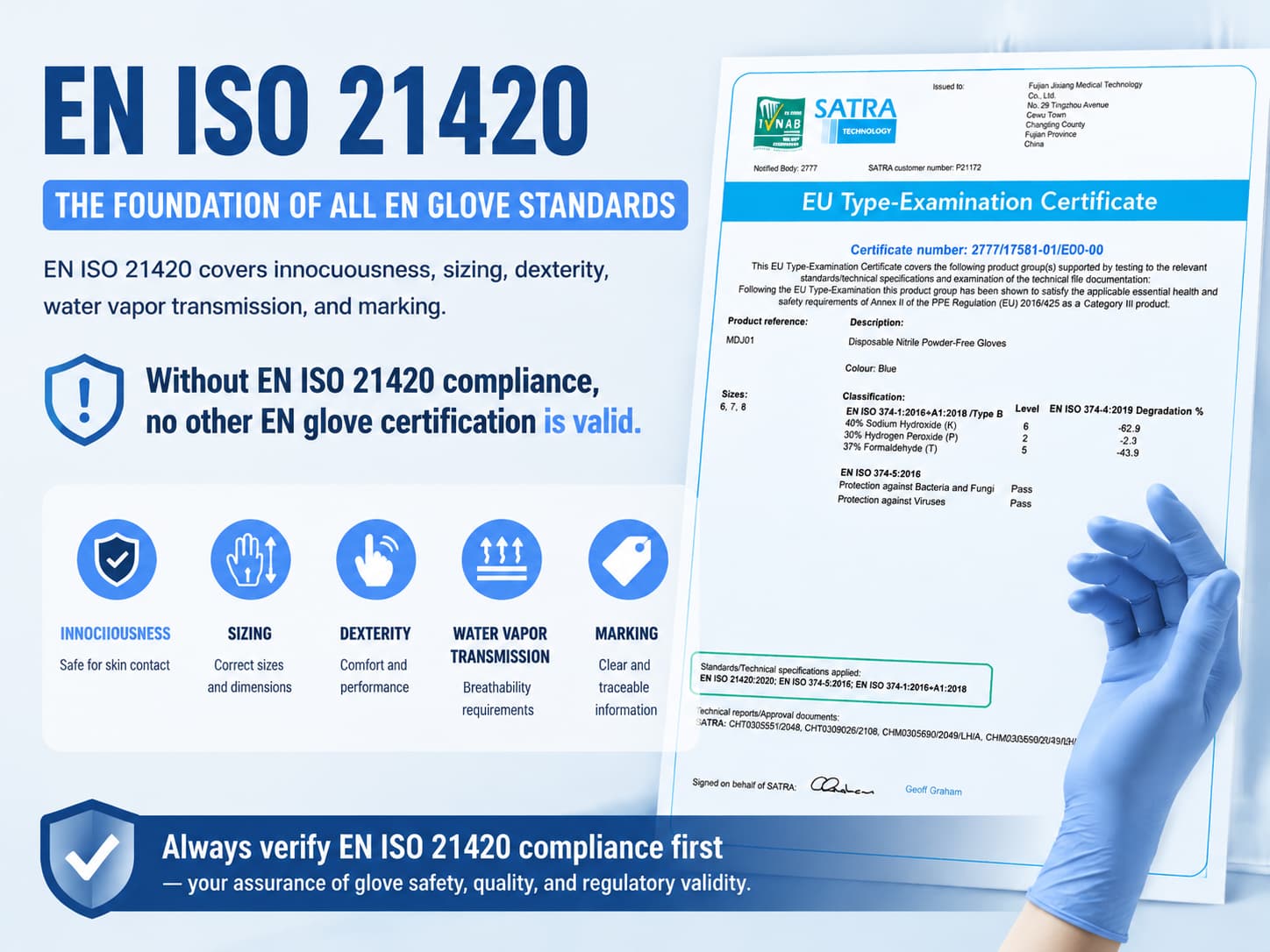
    EN 420 (now superseded by EN ISO 21420) is the European base general standard for all protective gloves - including disposable nitrile, latex, PVC, and reusable work gloves. It defines the fundamental requirements for glove design and manufacturing, including innocuousness (e.g., pH value), comfort, dexterity, sizing specifications, and labeling. The standard is not used alone; it is combined with other protective standards (e.g., EN 388 for cut resistance, EN 511 for cold protection) to ensure the glove itself is harmless to the wearer and practical in use. EN ISO 21420 covers innocuousness, sizing, dexterity, water vapor transmission, and marking. Without EN ISO 21420 compliance, no other EN glove certification is valid. This guide explains the EN ISO 21420 requirements, what each metric means, and how procurement teams should verify compliance claims in 2026. For the latest globally applicable test methods and update details, refer to SATRA's guidance on EN ISO 21420. What EN ISO 21420 Covers (and What It Does Not) EN ISO 21420 is intentionally a "horizontal" standard. It applies to all protective gloves, regardless of material or end use. Its scope is limited to the attributes common to every glove category: Innocuousness: Glove materials must not cause harm to the wearer. Seams, edges, and surfaces must not damage the skin. For leather products, the pH value must be between 3.5 and 9.5, and the chromium VI (hexavalent chromium) content must not exceed 3 mg/kg. This innocuousness requirement is the most overlooked and most often violated EN ISO 21420 clause in disposable glove specifications. Sizing and ergonomics: Based on European standard hand dimensions, glove length and size must conform to standardized requirements to ensure proper fit and easy donning/doffing. EN ISO 21420 defines size codes (5, 6, 7, 8, 9, 10, 11) corresponding to hand circumference and length. Disposable nitrile and latex gloves typically cover sizes 6-10. A glove that claims EN ISO 21420 sizing compliance but ships only one or two physical sizes is in violation. Dexterity: Based on the diameter of the smallest pin that can be picked up during testing, EN ISO 21420 grades glove dexterity on a 1 to 5 scale (level 5 = highest dexterity). Disposable examination gloves typically achieve level 3-5 depending on thickness; heavy industrial gloves are often level 1-2. Water vapor transmission (breathability): For gloves intended for use longer than a few minutes, water vapor permeability must meet minimum values. This is one reason disposable nitrile gloves can be uncomfortable during extended wear - they score poorly on this requirement, which is acceptable for short-duration use but problematic for full-shift industrial wear. Marking and information: Gloves and outer packaging must clearly display manufacturer information, the CE mark, size, and applicable protection level pictograms. Each glove must carry specific pictograms, the manufacturer's name and address, the EN ISO 21420 size code, and a reference to any specific EN standard the glove is certified against. The information must be supplied in the official language of the destination country. EN ISO 21420 vs. EN 455 vs. EN 374: What's the Difference? Procurement teams often confuse EN ISO 21420 with EN 455 or EN 374. The three standards serve distinct purposes and are independent of each other: Standard Scope Applies To Compliance EN ISO 21420:2020(supersedes EN 420) General requirements: innocuousness (pH, Cr VI), sizing, dexterity, marking All protective gloves (disposable + reusable) Mandatory baseline EN 455-1/2/3/4:2024 Medical glove safety: pinholes, sizing, biocompatibility, shelf life Disposable medical examination and surgical gloves Mandatory for medical use EN 374-1/2/3/4/5/6 Chemical permeation and penetration resistance Chemical-protective gloves Required if chemical protection is claimed EN 388:2016+A1:2018 Mechanical hazards: abrasion, cut, tear, puncture Mechanical protective gloves Required for mechanical use EN 407:2020 Thermal hazards: contact heat, convective heat, radiant heat, etc. Heat-protective gloves Required for thermal use A glove that is EN 374-certified but not EN ISO 21420-certified cannot legally be sold in the EU as a protective glove. EN ISO 21420 is the prerequisite. From EN 420 to EN ISO 21420: Key Changes EN 420 has been superseded by EN ISO 21420:2020, which is now the current harmonized standard under the EU PPE Regulation. The transition introduced several changes that matter to 2026 procurement: 1. Tighter innocuousness requirements: EN ISO 21420 clarified that substances listed in the SVHC (Substances of Very High Concern) candidate list under REACH must be declared if present above 0.1% by weight. For nitrile rubber gloves, this typically affects accelerators (MBT, ZMBT, thiurams) used in vulcanization. The standard also specifies that leather products must have a pH value between 3.5 and 9.5, and chromium VI content must not exceed 3 mg/kg. 2. Improved sizing table: The size code is now tied directly to hand circumference and length measurements in millimeters, not to a generic "small/medium/large" mapping. This means a glove labeled "size 8" under EN ISO 21420:2020 must fit a hand of specific dimensions defined in the standard. 3. Updated pictogram requirements: Pictograms now use ISO-aligned graphics that are easier to read at a glance. The EN ISO 21420 size pictogram must be present on or attached to each glove pair or packaging unit. 4. Information supplied with the glove: The 2020 revision requires that information be provided in a more structured format, including a clear indication of which specific EN standards the glove is certified against. Common EN ISO 21420 Compliance Failures in Disposable Gloves From Notified Body audit reports and EU market surveillance findings, the most common EN ISO 21420 violations for disposable nitrile and latex gloves include: 1. Missing or incomplete information sheets: The EU Declaration of Conformity must accompany each shipment. Information sheets must be in the official language of the destination country. Many imported shipments fail this requirement when only English documents are provided to a French, German, or Spanish buyer. 2. SVHC declaration omissions: Accelerators such as MBT, ZMBT, and thiurams are SVHC-listed in some applications. If present above 0.1% by weight, they must be declared under EN ISO 21420 requirements. 3. Sizing non-conformance: Gloves labeled "size M" that fit hands of "size L" dimensions are non-conforming. The sizing table in EN ISO 21420:2020 makes this easier to verify objectively. 4. Marking deficiencies: The CE mark, manufacturer identification, EN ISO 21420 size pictogram, and reference to any specific EN standard must all be present. Missing any one element is a non-conformity. 5. Innocuousness failures: Some disposable gloves have failed innocuousness testing due to extractable chemicals causing skin irritation. This is rare but serious when it occurs. How to Verify EN ISO 21420 Compliance in 2026 A robust procurement verification process includes the following five steps: 1. Request the EU Declaration of Conformity (DoC): The DoC must reference EN ISO 21420:2020 explicitly and list the specific glove SKU and manufacturer. Note that EN 420 has been superseded; any DoC still referencing only EN 420 should be questioned. 2. Verify the Notified Body number: For Category III PPE gloves (which include most chemical-protective nitrile gloves), a Notified Body must be involved. The body's four-digit identification number must appear on the product or packaging. 3. Check the EU market surveillance databases: RAPEX (now Safety Gate) lists products recalled for non-compliance. A supplier with repeated Safety Gate entries is a red flag. 4. Cross-check the SVHC declaration: If the glove is described as accelerator-free or low-allergen, verify the SVHC declaration supports the claim. 5. Validate the information sheet language: Confirm that the information sheet is available in the official language(s) of the destination country. This is a frequent point of non-compliance for shipments to non-English-speaking EU markets. EN ISO 21420, EU MDR, and PPE Regulation: How They Intersect Disposable medical gloves fall under the EU Medical Device Regulation (MDR 2017/745). Disposable PPE gloves fall under EU PPE Regulation (EU) 2016/425. The two regulations require different conformity assessment routes, but both reference EN ISO 21420 as a baseline. A glove sold as a medical device that does not meet EN ISO 21420 requirements is non-compliant under MDR. A glove sold as PPE without EN ISO 21420 compliance is non-compliant under the PPE Regulation. (Source: Regulation (EU) 2016/425 Annex II; Regulation (EU) 2017/745 Annex I) 2026 Market Context EN ISO 21420 compliance has become more visible in 2026 because of tightened EU market surveillance. As of Q2 2026, Safety Gate entries for disposable gloves have increased by 18% year-over-year, with EN ISO 21420 sizing and information sheet issues accounting for approximately 30% of non-compliance findings. (Source: EU Safety Gate / RAPEX, Q1-Q2 2026) This trend makes EN ISO 21420 verification a more practical necessity for EU-bound procurement. Key Takeaways EN ISO 21420 is the horizontal baseline standard for all protective gloves sold in the EU, including disposable nitrile, latex, and PVC gloves. Without EN ISO 21420 compliance, no other EN glove certification is legally valid. EN ISO 21420 covers innocuousness, sizing, dexterity, water vapor transmission, and marking. It is independent of EN 455 (medical), EN 374 (chemical), and EN 388 (mechanical), and is a prerequisite for all of them. The 2020/2024 revision tightened innocuousness, sizing, and SVHC declaration requirements. Procurement teams should verify the DoC references the most recent version. Common failures in 2026 include missing local-language information sheets, SVHC declaration omissions, and sizing non-conformance. Each is verifiable in the procurement process. For EU-bound procurement in 2026, EN ISO 21420 compliance is a practical filter that separates compliant manufacturers from non-compliant traders. A supplier that cannot produce a current EN ISO 21420:2020 DoC should be treated as high-risk. For the latest test methods and update details, refer to SATRA's guidance on EN ISO 21420. - Author: JIXIANG | www.jxgloves.com - FAQ  Q: Is EN ISO 21420 mandatory for all protective gloves sold in the EU? A: Yes. EN ISO 21420 (formerly EN 420) is the horizontal baseline standard for all protective gloves - including disposable nitrile, latex, PVC, and reusable work gloves. Without EN ISO 21420 compliance, no other EN glove certification (EN 455, EN 374, EN 388) is legally valid in the EU market. It is a prerequisite, not an option. Q: What is the current version of EN 420 / EN ISO 21420? A: EN 420 has been superseded by EN ISO 21420:2020, which is now the current harmonized standard. EN ISO 21420 introduced tighter innocuousness requirements (including pH 3.5-9.5 for leather and chromium VI <= 3 mg/kg), improved sizing tables, and updated pictogram requirements. For the latest test methods and update details, refer to SATRA's guidance on EN ISO 21420. Q: Does EN ISO 21420 apply to medical gloves? A: Yes. EN ISO 21420 applies to all protective gloves sold in the EU, including disposable medical examination and surgical gloves. Medical gloves must additionally comply with EN 455-1, 2, 3, 4 for medical-specific requirements. EN ISO 21420 is the baseline; EN 455 is the medical-specialized layer. Q: What is the most common EN ISO 21420 violation in disposable gloves? A: From Notified Body audit reports and EU Safety Gate (RAPEX) data, the most common EN ISO 21420 violation for disposable nitrile and latex gloves is missing or incomplete local-language information sheets. Gloves shipped to French, German, or Spanish markets with English-only documentation are a frequent cause of detention and re-export. Q: Can a glove be EN 374-certified without EN ISO 21420? A: No. EN ISO 21420 is a prerequisite for all other EN glove standards. A glove cannot be legally sold in the EU as a chemical-protective glove (EN 374) without first meeting EN ISO 21420 general requirements. The DoC must reference EN ISO 21420 as a baseline before any chemical-specific standard can be claimed.
  • Biodegradable Nitrile Gloves vs Traditional Nitrile Gloves: An ESG-Focused Procurement Comparison (2026)
    Biodegradable Nitrile Gloves vs Traditional Nitrile Gloves: An ESG-Focused Procurement Comparison (2026)
    Jul 17, 2026
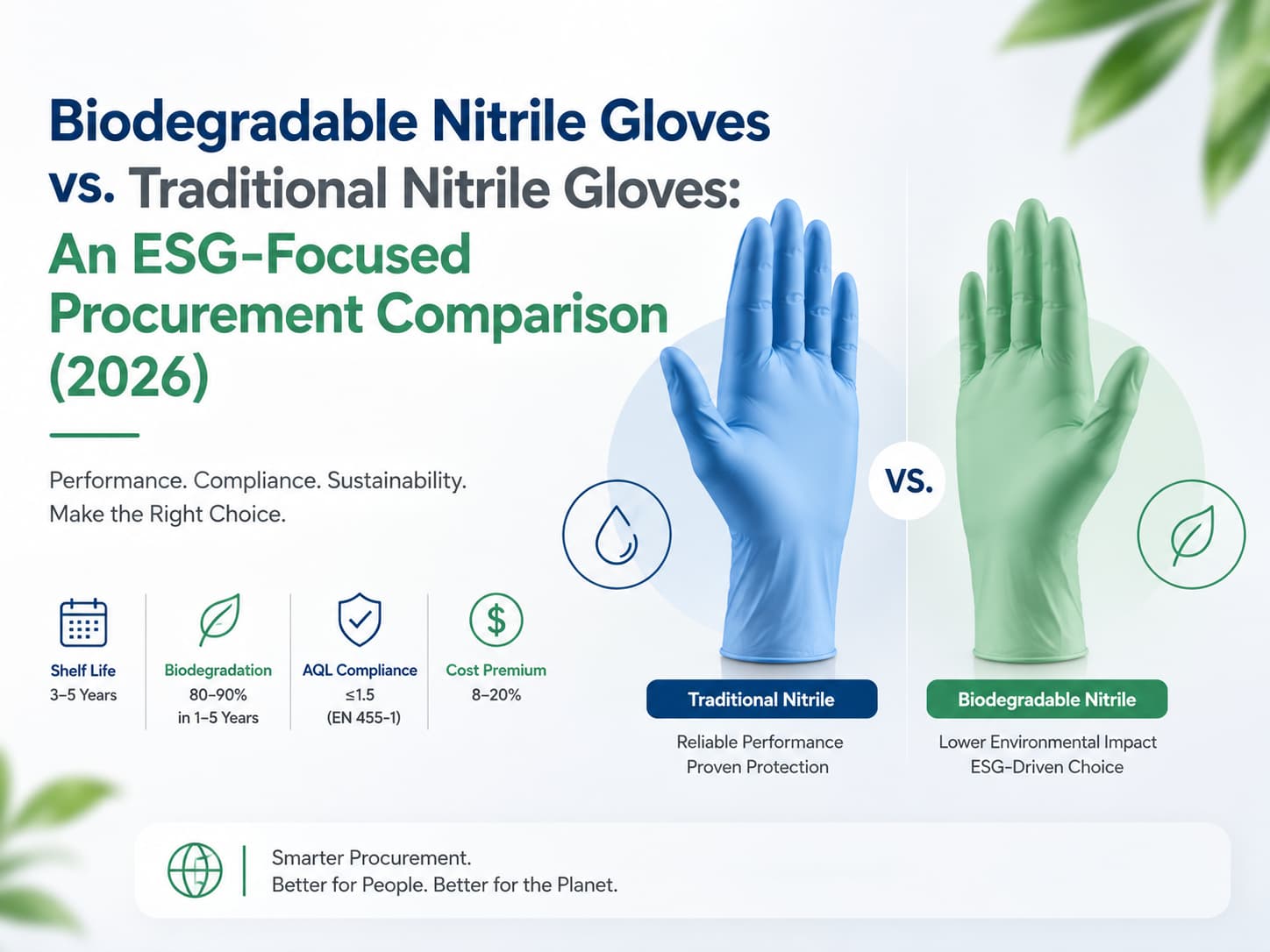
    Biodegradable nitrile gloves are designed to break down in landfill or industrial composting conditions significantly faster than traditional nitrile rubber gloves. They use organic or bio-based additive packages that accelerate microbial degradation. The performance trade-offs vs traditional nitrile gloves include higher unit cost (typically 8-20%), shorter shelf life (12-18 months vs 3-5 years), and a more limited chemical permeation database. This comparison guide helps 2026 procurement teams understand when biodegradable nitrile makes sense for ESG reporting, when traditional nitrile remains the better choice, and how to verify biodegradation claims responsibly. What "Biodegradable Nitrile" Actually Means in 2026 Biodegradable nitrile gloves are not a new polymer. They are conventional nitrile rubber (acrylonitrile butadiene rubber) with an additive package that accelerates microbial breakdown under specific conditions. The two most common additive technologies in 2026 are: 1. Organic nutrient additives: These provide a food source for microorganisms in landfill or compost environments. The additive itself is consumed, and the polymer matrix is broken down into smaller fragments. Typical claim: 80-90% biodegradation within 1-5 years under ASTM D5511 conditions (anaerobic landfill simulation). 2. Bio-based or partially bio-based nitrile: Some manufacturers use a portion of bio-based feedstock (e.g., butadiene from sugarcane or corn-derived ethanol) to reduce the carbon footprint of the base polymer. These are not necessarily biodegradable but have a lower cradle-to-gate carbon footprint. Important clarification: Biodegradable nitrile does NOT mean the glove will decompose in a normal waste pile in a few weeks. Industrial composting or specific landfill conditions are required. The ASTM D5511 and D5526 standard test methods simulate accelerated landfill conditions, not ambient disposal. Side-by-Side Comparison: Biodegradable vs Traditional Nitrile When Biodegradable Nitrile Makes Sense Based on 2026 ESG procurement trends and supplier feedback, biodegradable nitrile is a reasonable choice in the following scenarios: 1. ESG reporting requirements: Companies with published Scope 3 emissions targets or zero-waste-to-landfill commitments can include biodegradable nitrile in their reporting. The 80-90% biodegradation claim within 1-5 years is meaningful for waste-stream reporting. 2. High-volume low-hazard applications: Food service, hospitality, dental, and general-purpose use cases where shelf life (12-18 months) is acceptable and chemical permeation data is not the primary selection criterion. 3. Customer or end-user pressure: When end consumers or downstream customers (e.g., hospital systems, restaurant chains) are explicitly requesting biodegradable or compostable glove options. 4. Government and public sector tenders: Some EU and UK public sector tenders now include biodegradation or recycled content scoring criteria. Biodegradable nitrile can earn additional tender points. When Traditional Nitrile Remains the Better Choice Biodegradable nitrile is not a universal upgrade. The following scenarios strongly favor traditional nitrile: 1. Long shelf-life inventory requirements: Healthcare systems, government stockpiles, and disaster response agencies typically need 3-5 year shelf life. Biodegradable nitrile's 12-18 month shelf life is disqualifying. 2. Chemical or cytotoxic drug handling: ASTM D6978 chemotherapy drug handling and EN 374 chemical permeation applications require extensive test data. Biodegradable nitrile has a more limited chemical permeation database. Verify each chemical of interest is tested before switching. 3. High-temperature storage: Biodegradable nitrile is more sensitive to heat. Storage above 30 degrees C can accelerate degradation of the additive package and shorten functional shelf life. 4. Cost-sensitive high-volume applications: For applications where every fractional cent per glove matters (e.g., 1M+ gloves per month), the 8-20% premium is a significant cost driver without proportional functional benefit. How to Verify Biodegradation Claims Not all "biodegradable" claims are equal. Procurement teams should require the following documentation: 1. ASTM D5511 or D5526 test report: These are the standard test methods for high-solids anaerobic biodegradation. Request the actual test report, not just a summary. The report should specify the test duration, conditions, and percentage of biodegradation achieved. 2. Independent third-party validation: Test reports should be from accredited third-party labs (ISO 17025). In-house manufacturer claims are not sufficient. 3. Specific test conditions: The 80-90% biodegradation claim is achieved under specific conditions. Request the temperature, humidity, and microbial environment used in testing. A claim of "biodegradable" without test condition disclosure is marketing language. 4. Time-to-biodegradation: A 5-year claim is significantly different from a 1-year claim. Request the time to 80% biodegradation. 5. Shelf life vs biodegradation trade-off: Confirm that the biodegradation does not begin during storage. Additive packages should be designed to remain dormant during normal storage and activate only in landfill or compost conditions. 2026 Cost and Market Context Biodegradable nitrile currently trades at an 8-20% premium to traditional nitrile, depending on volume and supplier. The premium is driven primarily by the additive package cost (typically $0.003-0.008/pc) and the dedicated production runs required to avoid cross-contamination with non-biodegradable lines. As of July 2026, with Brent crude at $95-98/bbl and butadiene at $1,450-1,520/MT, the absolute price difference for a 4-mil examination glove is approximately $0.004-0.008/pc. For an organization consuming 1M gloves per month, this is $4,000-8,000/month in additional cost. (Source: ICIS Petrochemical Index, July 2026) Production capacity for biodegradable nitrile has expanded significantly in 2024-2026, with major Malaysian and Thai manufacturers adding dedicated lines. Expect the premium to narrow to 5-15% by 2027 as scale increases. Common Procurement Mistakes "Biodegradable means it disappears in my trash." No. Biodegradable nitrile requires specific landfill or industrial composting conditions. It will not degrade quickly in a typical waste pile or recycling stream. "I can substitute it for traditional nitrile in any application." No. Shelf life and chemical permeation data are the two main constraints. Verify each application before switching. "All biodegradable nitrile is the same." No. Additive technology, test method used, and time-to-biodegradation vary significantly. Always require the test report. "Bio-based means biodegradable." Not necessarily. Bio-based refers to feedstock origin; biodegradable refers to end-of-life behavior. They are different attributes. Key Takeaways Biodegradable nitrile is conventional NBR with an additive package that accelerates microbial breakdown under specific landfill or composting conditions. It is not a new polymer. The typical biodegradation claim is 80-90% within 1-5 years under ASTM D5511 conditions, which simulate accelerated landfill. Real-world ambient disposal will be slower. Biodegradable nitrile carries an 8-20% cost premium and a 12-18 month shelf life, both of which limit its applicability in long-inventory and chemical-handling scenarios. Biodegradation claims should be verified with ASTM D5511 or D5526 test reports from accredited third-party labs, with specific test conditions and time-to-biodegradation disclosed. For ESG reporting, government tenders, and customer-driven applications, biodegradable nitrile is a viable 2026 procurement option. For high-hazard, long-shelf-life, or cost-sensitive applications, traditional nitrile remains the better choice.   FAQ  Q: Are biodegradable nitrile gloves a different polymer? A: No. Biodegradable nitrile gloves are conventional nitrile rubber (acrylonitrile butadiene rubber, NBR) with an organic additive package that accelerates microbial breakdown. The base polymer is the same as traditional nitrile. The additive provides a food source for microorganisms in landfill or composting environments. Q: Do biodegradable nitrile gloves decompose in normal trash? A: No. Biodegradable nitrile requires specific landfill or industrial composting conditions to biodegrade. The 80-90% biodegradation claim is achieved under ASTM D5511 or D5526 test conditions, which simulate accelerated high-solids anaerobic landfill. Normal ambient disposal will be significantly slower. Q: What is the cost premium for biodegradable nitrile in 2026? A: As of mid-2026, biodegradable nitrile trades at an 8-20% premium to traditional nitrile, depending on volume and supplier. For a 4-mil examination glove at $0.045/pc base, the additional cost is approximately $0.004-0.008/pc, or $4,000-8,000 per month for an organization consuming 1 million gloves monthly. The premium is expected to narrow to 5-15% by 2027 as production capacity scales. Q: What is the shelf life of biodegradable nitrile gloves? A: Biodegradable nitrile gloves typically have a 12-18 month shelf life, compared to 3-5 years for traditional nitrile. This is because the additive package is designed to remain dormant during normal storage but becomes active in landfill conditions. For applications requiring long shelf life (healthcare stockpiles, disaster response), traditional nitrile is the better choice. Q: Is bio-based the same as biodegradable? A: No. Bio-based refers to feedstock origin (e.g., butadiene from sugarcane or corn-derived ethanol). Biodegradable refers to end-of-life behavior (breakdown in landfill or compost). They are independent attributes. A glove can be bio-based but not biodegradable, or biodegradable but not bio-based. Verify each claim with its specific test report.
Contact Us
Unit 1301-1, No. 3, Xixishan Wei Road, Software Park phase III, Torch High-tech Zone,Xiamen City, Fujian Province, China
+86-592-6511055
+86 -15750719843
Subscribe

Copyright 2026@ Fujian Jixiang E-commerce Co., Ltd All Rights Reserved. Sitemap | Blog | Xml | Privacy Policy Network Supported

leave a message

Leave A Message
If you are interested in our products and want to know more details,please leave a message here,we will reply you as soon as we can.
Submit

Home

Products

whatsApp

contact