
welcome to Jixiang E-commerce!
welcome to Jixiang E-commerce!
Tattoo, piercing, and beauty studios are high-exposure environments. Artists work with blood, needles, inks, pigments, acetone, acrylate monomers, and a long list of chemicals - while touching clients directly. Choosing the right disposable gloves is not a style choice; it is an infection control and occupational safety decision. This guide explains the risks by service type, compares glove materials for beauty applications, and gives a practical procurement checklist for studios.
Unlike general office environments, tattoo and beauty services create three distinct exposure routes:
Gloves in these settings must provide a certified barrier, chemical resistance where needed, and enough tactile sensitivity for precision work. Nitrile rubber (acrylonitrile butadiene rubber, ACN + butadiene) meets all three requirements, which is why it dominates the professional studio market.
The glove requirement differs by service. The table below maps the main hazards and the recommended glove for each service.
| Service | Main Hazards | Recommended Glove |
|---|---|---|
| Tattoo | Bloodborne pathogens, ink pigments, needle sticks, disinfectants | Nitrile rubber, 4-6 mil (0.10-0.15 mm), black or blue |
| Body piercing | Bloodborne pathogens, metal contact, needle sticks | Nitrile rubber, 4-6 mil (0.10-0.15 mm) |
| Permanent makeup / microblading | Blood + pigment, fine needle control | Nitrile rubber, 4 mil (0.10 mm), maximum tactility |
| Nail services (acrylic, gel) | Acetone, acrylate monomers, UV gel | Nitrile rubber, 4-6 mil (0.10-0.15 mm) |
| Hair coloring | PPD, ammonia, bleach, oxidation dyes | Nitrile rubber, 3-4 mil (0.08-0.10 mm) |
| Facials and skincare | Low infection risk, product actives | Nitrile rubber or vinyl, 3 mil (0.08 mm) |
| Salon cleaning | Disinfectants, bleach, detergents | Nitrile rubber, 4-6 mil (0.10-0.15 mm) |
Three materials appear in studio glove boxes: nitrile rubber, latex, and vinyl (PVC). Their differences determine when each is acceptable.
| Property | Nitrile rubber | Latex | Vinyl (PVC) |
|---|---|---|---|
| Barrier vs bloodborne pathogens | Excellent (EN 455 / ASTM D6319 certified models) | Excellent (EN 455 certified models) | Lower - higher permeability, weaker tensile strength |
| Resistance to acetone / monomers | Good | Poor - degrades with solvents | Poor |
| Resistance to PPD / hair dyes | Good | Moderate | Poor |
| Latex protein allergy risk | None | Type I allergy risk (8-17% sensitization reported in exposed workers) | None |
| Tactile sensitivity | High (4 mil models) | Very high | Low to moderate |
| Durability during long sessions | Good | Good | Poor - tears easily |
| Phthalate concerns (EU REACH) | None | None | Yes - phthalate plasticizers under scrutiny |
| Typical use in studios | Professional standard for all services | Legacy - being phased out | Low-risk short tasks only |
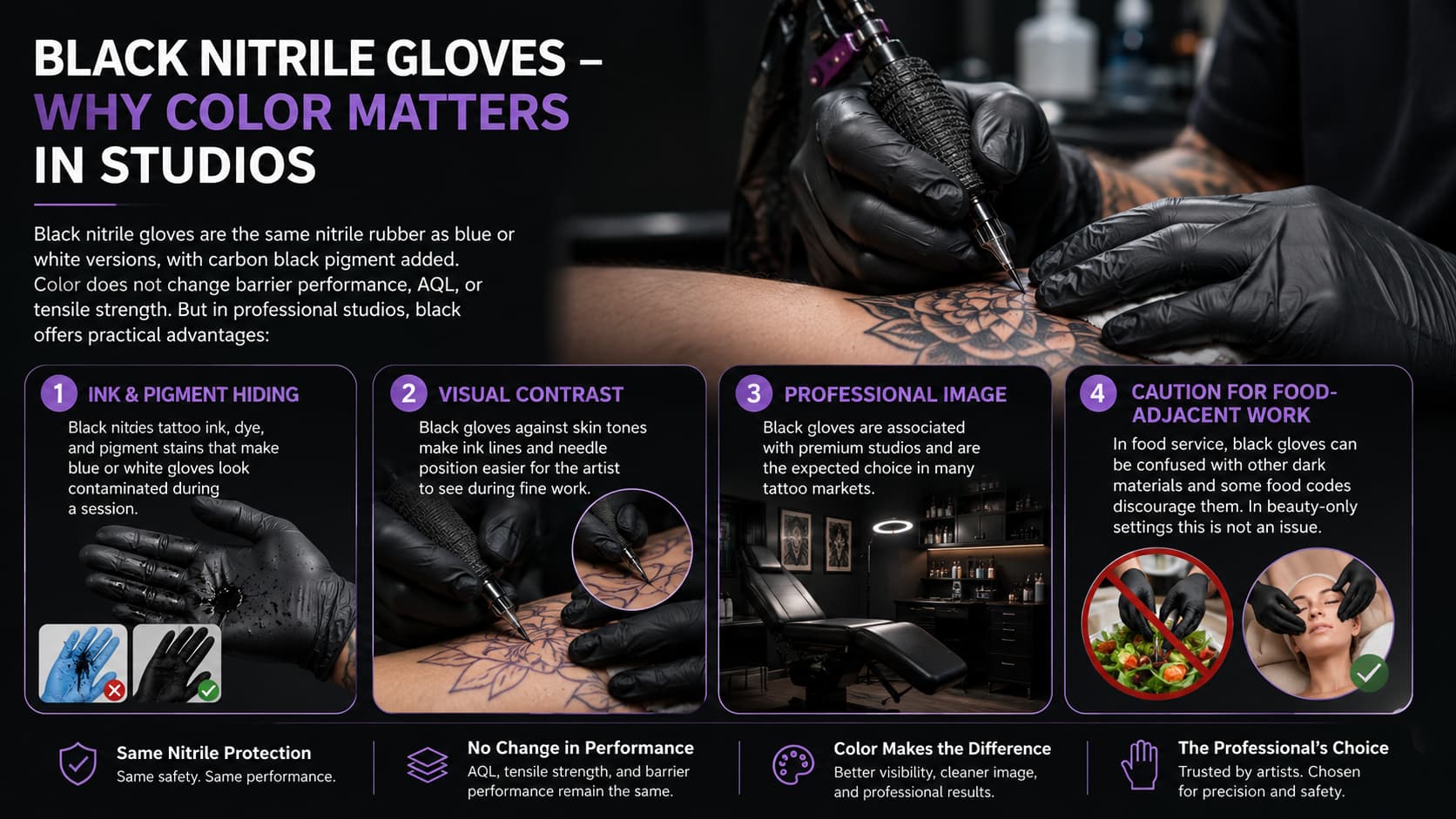
Black nitrile gloves are the same nitrile rubber as blue or white versions, with carbon black pigment added. Color does not change barrier performance, AQL, or tensile strength. But in professional studios, black offers practical advantages:
When ordering black nitrile gloves, verify they carry the same certification as other colors from the same manufacturer (EN 455, ASTM D6319, AQL 1.5 where applicable).
Tattoo sessions can last hours. Glove comfort directly affects artist performance. Key specification points:
Studio gloves should meet at least one recognized standard. In the EU, medical-grade disposable gloves follow EN 455 (examination gloves) or EN ISO 374 (chemical protection). In the US, nitrile examination gloves follow ASTM D6319 with FDA 510(k) clearance. For beauty chemicals, EN ISO 374 chemical permeation testing adds confidence against acetone and monomers. Gloves are not cosmetics, but they contact skin and clients, so choose certified products and keep the batch test reports (AQL water leak, tensile, elongation) on file. Waste disposal of used gloves should follow local medical or biohazard waste rules where blood contact is possible.
Data sources: WHO Guidelines on Infection Prevention and Control; CDC Guidelines for Environmental Infection Control; occupational health literature on latex protein sensitization (reported 8-17% in exposed healthcare and beauty workers); EU REACH regulation on phthalates; EN 455 / ASTM D6319 / EN ISO 374 standards. Information current as of August 2026; verify regulatory status before procurement decisions.
Q: Why are nitrile gloves the standard choice in tattoo studios instead of latex?
A: Latex gloves were once standard in tattoo studios but carry two problems: Type I latex protein allergy (occupational health studies report latex protein sensitization in roughly 8-17% of healthcare and beauty workers regularly exposed to powdered latex gloves) and weaker resistance to ink solvents and disinfectants. Nitrile rubber gloves provide a comparable or better barrier against bloodborne pathogens, resist inks, acetone, and common disinfectants better, and eliminate the latex protein allergy risk. Most professional tattoo artists switched to nitrile rubber in the 2010s, and black nitrile became the visual standard.
Q: Do black nitrile gloves provide the same protection as blue or white ones?
A: Yes. Black nitrile gloves are made from the same nitrile rubber (acrylonitrile butadiene rubber, ACN + butadiene) with carbon black pigment added. The pigment does not change barrier properties, tensile strength, or the AQL water-leak rating. Black is preferred in tattoo and beauty work because it hides ink and pigment stains, provides visual contrast against skin tones, and gives a professional studio look. Always verify that black gloves carry the same certification (EN 455, ASTM D6319, AQL 1.5) as other colors from the same manufacturer.
Q: What thickness of nitrile gloves should a tattoo artist use?
A: Most tattoo artists work with 4-6 mil (0.10-0.15 mm) nitrile gloves for a balance of tactile sensitivity and durability. Thinner gloves (3 mil) give maximum fingertip feel for line work but tear more easily during long sessions; thicker gloves (6-8 mil) last longer but reduce sensitivity. In the beauty industry, 3-4 mil is common for short tasks (hair coloring, facials), while 4-6 mil is recommended for nail services involving acetone and acrylate monomers. Thickness is always expressed in mil or mm.
Q: Are vinyl gloves acceptable for beauty work?
A: Vinyl (PVC) gloves can be used for low-risk, short-duration beauty tasks such as shampooing, makeup application, or light cleaning where no blood, chemicals, or sharps are involved. Vinyl has weaker tensile strength and higher permeability than nitrile rubber, so it is NOT recommended for tattoo, piercing, permanent makeup, nail monomer handling, or any task with blood contact or strong chemicals. Vinyl also contains phthalate plasticizers, which face increasing EU REACH scrutiny. For professional studios, nitrile rubber is the safer default.
Q: How often should gloves be changed during a tattoo or beauty session?
A: Change gloves between every client, and change mid-procedure whenever gloves are contaminated, torn, or after touching non-sterile surfaces such as phones, door handles, or equipment. In tattoo work, artists typically change gloves after setting up the station, before handling the tattoo machine, and after any interruption. For a single client, use a fresh pair for setup and a fresh pair for the procedure if the setup pair touched surfaces - never reuse a pair. Single use means single use.
Please read on, stay posted, subscribe, and we welcome you to tell us what you think.


Copyright 2026@ Fujian Jixiang E-commerce Co., Ltd All Rights Reserved.
Sitemap |
Blog
|
Xml |
Privacy Policy
 Network Supported