welcome to Jixiang E-commerce!

Search

Home

glove procurement

  • The Ultimate B2B Sourcing Guide for Disposable Gloves
    The Ultimate B2B Sourcing Guide for Disposable Gloves
    Mar 18, 2026
      What Procurement Managers Need to Know Introduction In today's global marketplace, procurement managers face increasing pressure to source high-quality disposable gloves at competitive prices while maintaining supply chain reliability. Whether you're purchasing for healthcare facilities, food processing plants, automotive workshops, or industrial applications, understanding the nuances of B2B glove sourcing can save your organization thousands of dollars annually while ensuring worker safety and regulatory compliance. This comprehensive guide will walk you through everything you need to know about bulk disposable glove procurement, from evaluating suppliers to optimizing costs and avoiding common pitfalls. B2B vs. B2C Purchasing Understanding the Key Differences Volume and Pricing Structure B2B purchases typically involve orders of 100,000+ units Tiered pricing based on volume commitments Negotiable terms for long-term contracts Customization options (branding, packaging, specifications) Quality Assurance Requirements Batch-level testing and certification Factory audit access Consistency across production runs Documentation for regulatory compliance Supply Chain Considerations Reliable lead times and delivery schedules Inventory management support Emergency supply capabilities Multi-location distribution options 10 Critical Factors When Sourcing 1. Material Selection Choose the right material for your application: Nitrile: Chemical resistance, latex-free, versatile Latex: Superior elasticity, tactile sensitivity PVC: Cost-effective, food-safe options available 2. Certification and Compliance Ensure products meet relevant standards: FDA 510(k) for medical applications CE marking for European markets ISO 13485 quality management ASTM standards (D6319, D3578, D5250) 3. Manufacturing Capacity Evaluate supplier production capabilities: Daily/monthly output capacity Multi-line production flexibility Quality control infrastructure Expansion capabilities 4. Lead Time and Reliability Understand delivery expectations: Standard production lead times (15-45 days) Express/emergency order capabilities Historical on-time delivery performance Communication responsiveness 5. Pricing Transparency Analyze total cost of ownership: Unit pricing at different volumes Shipping and logistics costs Payment terms and options Currency and tariff considerations 6. Quality Control Processes Verify quality assurance measures: Incoming raw material inspection In-process quality checks Final product testing protocols Third-party laboratory verification 7. Customization Options Explore value-added services: Private labeling and branding Custom packaging solutions Special formulations (color, thickness, texture) Bundle configurations 8. Geographic Considerations Factor in logistics advantages: Proximity to major ports Regional distribution capabilities Free trade zone benefits Local regulatory expertise 9. Financial Stability Assess supplier reliability: Company history and track record Financial health indicators Insurance coverage References from similar-sized buyers 10. Communication and Support Evaluate service quality: Dedicated account management Technical support availability Problem resolution processes Language capabilities How to Evaluate Suppliers Request Essential Documentation Before committing to a supplier, request: Business licenses and registration Quality certifications (ISO, CE, FDA) Factory audit reports Product test reports (recent batches) Client references (similar industries) Conduct Factory Audits Key areas to assess: Production environment cleanliness Equipment condition and maintenance Worker training and safety protocols Quality control checkpoints Raw material storage conditions Sample Testing Protocol Always request samples before large orders: Test multiple production batches Verify consistency in sizing and thickness Evaluate durability for your application Check packaging and labeling quality Cost Optimization Strategies MOQ Negotiation Start with supplier's standard MOQ Negotiate lower MOQ for trial orders Commit to volume for better pricing Consider blanket orders with scheduled releases Logistics Cost Reduction Consolidate shipments when possible Choose optimal shipping methods (sea vs. air) Utilize warehouse facilities near your operations Plan orders to avoid expedited shipping premiums Common Mistakes to Avoid 1. Focusing Solely on Price Lowest price often means compromised quality. Consider total value, including reliability, quality consistency, and service support. 2. Inadequate Sample Testing Never place large orders without thorough sample evaluation across multiple batches. 3. Ignoring Regulatory Requirements Ensure all products meet relevant standards for your industry and market before purchasing. 4. Single Supplier Dependency Maintain relationships with 2-3 qualified suppliers to mitigate supply chain risks. 5. Poor Communication Establish clear communication channels and expectations from the beginning of the relationship. 6. Neglecting Contract Details Document all specifications, terms, and conditions in writing to avoid disputes. Building Long-Term Supplier Relationships Successful B2B procurement is built on trust and mutual benefit. Be a Reliable Partner: Honor payment commitments Provide accurate demand forecasts Give adequate lead time for orders Provide feedback on product quality Expect the Same in Return: Consistent product quality Transparent communication Fair pricing practices Proactive problem resolution Conclusion Effective B2B sourcing of disposable gloves requires a strategic approach that balances cost, quality, reliability, and compliance. By following the guidelines in this comprehensive guide, procurement managers can build strong supplier relationships, optimize costs, and ensure a steady supply of high-quality gloves for their organizations. Remember: the cheapest option is rarely the best value. Focus on total cost of ownership, supplier reliability, and long-term partnership potential. Next Steps Ready to optimize your glove procurement strategy? Get detailed insights into our manufacturing capabilities, quality control processes, and certification documentation. Contact our B2B sales team today to discuss your bulk disposable glove requirements.   [Request a Factory Audit Report] About Fujian Jixiang E-commerce Co., Ltd. With over 20 years of experience, we specialize in manufacturing high-quality disposable gloves. Why Choose Us? ✅ Factory-direct pricing ✅ ISO/CE/FDA certified products ✅ OEM/ODM customization ✅ Global shipping to 50+ countries Contact Us: info@jxgloves.com
  • Tattoo and Beauty Industry Gloves - A Procurement Guide for Inking, Piercing, and Cosmetology
    Tattoo and Beauty Industry Gloves - A Procurement Guide for Inking, Piercing, and Cosmetology
    Aug 18, 2026
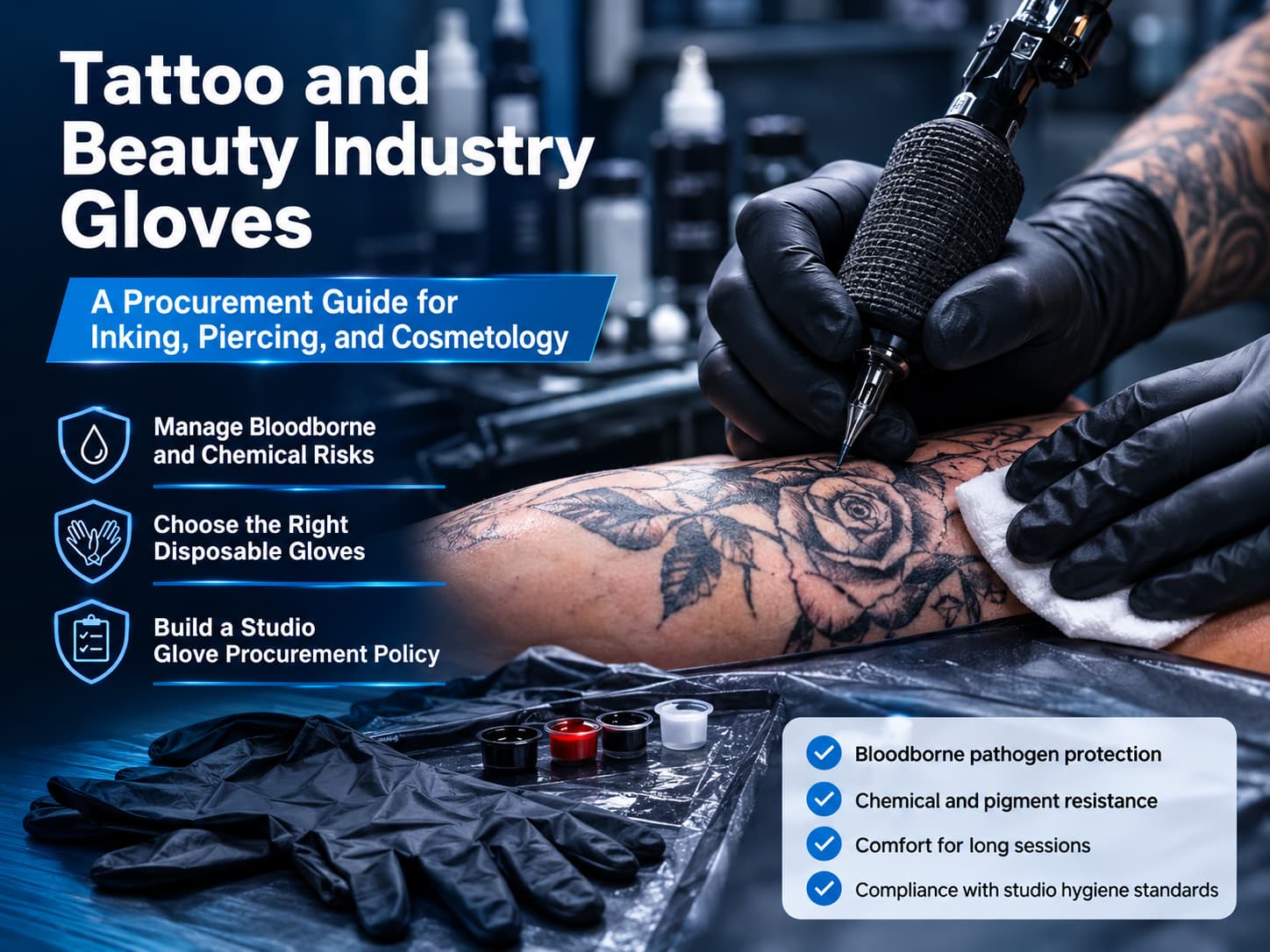
    Tattoo, piercing, and beauty studios are high-exposure environments. Artists work with blood, needles, inks, pigments, acetone, acrylate monomers, and a long list of chemicals - while touching clients directly. Choosing the right disposable gloves is not a style choice; it is an infection control and occupational safety decision. This guide explains the risks by service type, compares glove materials for beauty applications, and gives a practical procurement checklist for studios. 1. Why Tattoo and Beauty Work Requires Dedicated Gloves Unlike general office environments, tattoo and beauty services create three distinct exposure routes: Bloodborne pathogens: Tattoo, piercing, and permanent makeup involve needles that break the skin. Hepatitis B, Hepatitis C, and HIV are transmitted through blood contact. Single-use gloves are the primary barrier between the artist's hands and the client's blood. Chemical exposure: Nail services use acetone, acrylate monomers, and UV gels. Hair coloring involves para-phenylenediamine (PPD), ammonia, and bleach. These chemicals can cause contact dermatitis (Type IV allergy) and are absorbed through the skin. Ink and pigment exposure: Tattoo pigments contain heavy metals and organic colorants. Pigment staining of the hands is not just cosmetic - it indicates skin contact with materials that should stay under the skin or on the surface. Gloves in these settings must provide a certified barrier, chemical resistance where needed, and enough tactile sensitivity for precision work. Nitrile rubber (acrylonitrile butadiene rubber, ACN + butadiene) meets all three requirements, which is why it dominates the professional studio market. 2. Risk Profile by Service Type The glove requirement differs by service. The table below maps the main hazards and the recommended glove for each service. Service Main Hazards Recommended Glove Tattoo Bloodborne pathogens, ink pigments, needle sticks, disinfectants Nitrile rubber, 4-6 mil (0.10-0.15 mm), black or blue Body piercing Bloodborne pathogens, metal contact, needle sticks Nitrile rubber, 4-6 mil (0.10-0.15 mm) Permanent makeup / microblading Blood + pigment, fine needle control Nitrile rubber, 4 mil (0.10 mm), maximum tactility Nail services (acrylic, gel) Acetone, acrylate monomers, UV gel Nitrile rubber, 4-6 mil (0.10-0.15 mm) Hair coloring PPD, ammonia, bleach, oxidation dyes Nitrile rubber, 3-4 mil (0.08-0.10 mm) Facials and skincare Low infection risk, product actives Nitrile rubber or vinyl, 3 mil (0.08 mm) Salon cleaning Disinfectants, bleach, detergents Nitrile rubber, 4-6 mil (0.10-0.15 mm) 3. Glove Materials Compared for Beauty Applications Three materials appear in studio glove boxes: nitrile rubber, latex, and vinyl (PVC). Their differences determine when each is acceptable. Property Nitrile rubber Latex Vinyl (PVC) Barrier vs bloodborne pathogens Excellent (EN 455 / ASTM D6319 certified models) Excellent (EN 455 certified models) Lower - higher permeability, weaker tensile strength Resistance to acetone / monomers Good Poor - degrades with solvents Poor Resistance to PPD / hair dyes Good Moderate Poor Latex protein allergy risk None Type I allergy risk (8-17% sensitization reported in exposed workers) None Tactile sensitivity High (4 mil models) Very high Low to moderate Durability during long sessions Good Good Poor - tears easily Phthalate concerns (EU REACH) None None Yes - phthalate plasticizers under scrutiny Typical use in studios Professional standard for all services Legacy - being phased out Low-risk short tasks only 4. Black Nitrile Gloves - Why Color Matters in Studios Black nitrile gloves are the same nitrile rubber as blue or white versions, with carbon black pigment added. Color does not change barrier performance, AQL, or tensile strength. But in professional studios, black offers practical advantages: Ink and pigment hiding: Black hides tattoo ink, dye, and pigment stains that make blue or white gloves look contaminated during a session. Visual contrast: Black gloves against skin tones make ink lines and needle position easier for the artist to see during fine work. Professional image: Black gloves are associated with premium studios and are the expected choice in many tattoo markets. Caution for food-adjacent work: In food service, black gloves can be confused with other dark materials and some food codes discourage them. In beauty-only settings this is not an issue. When ordering black nitrile gloves, verify they carry the same certification as other colors from the same manufacturer (EN 455, ASTM D6319, AQL 1.5 where applicable). 5. Fit, Texture, and Comfort for Long Sessions Tattoo sessions can last hours. Glove comfort directly affects artist performance. Key specification points: Thickness: 4-6 mil (0.10-0.15 mm) balances sensitivity and durability; 3 mil (0.08 mm) for maximum fingertip feel on fine line work. Texture: Textured fingertips improve grip on tattoo machines and tools; beaded cuffs prevent roll-down and glove-to-skin contact at the wrist. Sizing: Correct fit matters more than brand. Measure hand circumference at the palm; sizes follow the EN ISO 21420 (formerly EN 420) sizing codes where applicable. Dexterity: On the standard dexterity scale of 1 to 5, studio gloves should deliver level 4-5 for fine motor tasks. Powder-free: Always choose powder-free gloves. Powder can contaminate open wounds, interfere with pigment adhesion, and trigger irritation. 6. Regulatory Considerations for Studio Gloves Studio gloves should meet at least one recognized standard. In the EU, medical-grade disposable gloves follow EN 455 (examination gloves) or EN ISO 374 (chemical protection). In the US, nitrile examination gloves follow ASTM D6319 with FDA 510(k) clearance. For beauty chemicals, EN ISO 374 chemical permeation testing adds confidence against acetone and monomers. Gloves are not cosmetics, but they contact skin and clients, so choose certified products and keep the batch test reports (AQL water leak, tensile, elongation) on file. Waste disposal of used gloves should follow local medical or biohazard waste rules where blood contact is possible. 7. Procurement Checklist for Tattoo and Beauty Studios Standardize on nitrile rubber for all services involving blood, chemicals, or precision work. Stock black nitrile for artist-facing tasks and blue/white nitrile for general studio use, with color-segregated storage. Buy a size mix - most studios order S, M, and L in a ratio matched to staff hand sizes; add XS and XL for flexibility. Request batch-level test reports (AQL 1.5 water leak, tensile strength, elongation) with every order. Verify certifications (EN 455, ASTM D6319, or EN ISO 374 as applicable) and keep certificates on file. Order in volume with buffer stock - studios use 20-60 pairs per artist per day depending on service volume. Train staff on glove change discipline: between clients, after touching surfaces, and after any contamination. Data sources: WHO Guidelines on Infection Prevention and Control; CDC Guidelines for Environmental Infection Control; occupational health literature on latex protein sensitization (reported 8-17% in exposed healthcare and beauty workers); EU REACH regulation on phthalates; EN 455 / ASTM D6319 / EN ISO 374 standards. Information current as of August 2026; verify regulatory status before procurement decisions. FAQ Q: Why are nitrile gloves the standard choice in tattoo studios instead of latex? A: Latex gloves were once standard in tattoo studios but carry two problems: Type I latex protein allergy (occupational health studies report latex protein sensitization in roughly 8-17% of healthcare and beauty workers regularly exposed to powdered latex gloves) and weaker resistance to ink solvents and disinfectants. Nitrile rubber gloves provide a comparable or better barrier against bloodborne pathogens, resist inks, acetone, and common disinfectants better, and eliminate the latex protein allergy risk. Most professional tattoo artists switched to nitrile rubber in the 2010s, and black nitrile became the visual standard. Q: Do black nitrile gloves provide the same protection as blue or white ones? A: Yes. Black nitrile gloves are made from the same nitrile rubber (acrylonitrile butadiene rubber, ACN + butadiene) with carbon black pigment added. The pigment does not change barrier properties, tensile strength, or the AQL water-leak rating. Black is preferred in tattoo and beauty work because it hides ink and pigment stains, provides visual contrast against skin tones, and gives a professional studio look. Always verify that black gloves carry the same certification (EN 455, ASTM D6319, AQL 1.5) as other colors from the same manufacturer. Q: What thickness of nitrile gloves should a tattoo artist use? A: Most tattoo artists work with 4-6 mil (0.10-0.15 mm) nitrile gloves for a balance of tactile sensitivity and durability. Thinner gloves (3 mil) give maximum fingertip feel for line work but tear more easily during long sessions; thicker gloves (6-8 mil) last longer but reduce sensitivity. In the beauty industry, 3-4 mil is common for short tasks (hair coloring, facials), while 4-6 mil is recommended for nail services involving acetone and acrylate monomers. Thickness is always expressed in mil or mm. Q: Are vinyl gloves acceptable for beauty work? A: Vinyl (PVC) gloves can be used for low-risk, short-duration beauty tasks such as shampooing, makeup application, or light cleaning where no blood, chemicals, or sharps are involved. Vinyl has weaker tensile strength and higher permeability than nitrile rubber, so it is NOT recommended for tattoo, piercing, permanent makeup, nail monomer handling, or any task with blood contact or strong chemicals. Vinyl also contains phthalate plasticizers, which face increasing EU REACH scrutiny. For professional studios, nitrile rubber is the safer default. Q: How often should gloves be changed during a tattoo or beauty session? A: Change gloves between every client, and change mid-procedure whenever gloves are contaminated, torn, or after touching non-sterile surfaces such as phones, door handles, or equipment. In tattoo work, artists typically change gloves after setting up the station, before handling the tattoo machine, and after any interruption. For a single client, use a fresh pair for setup and a fresh pair for the procedure if the setup pair touched surfaces - never reuse a pair. Single use means single use.
  • Disposable Glove Receiving Inspection: Incoming Quality Assurance Checklist (2026)
    Disposable Glove Receiving Inspection: Incoming Quality Assurance Checklist (2026)
    Aug 21, 2026
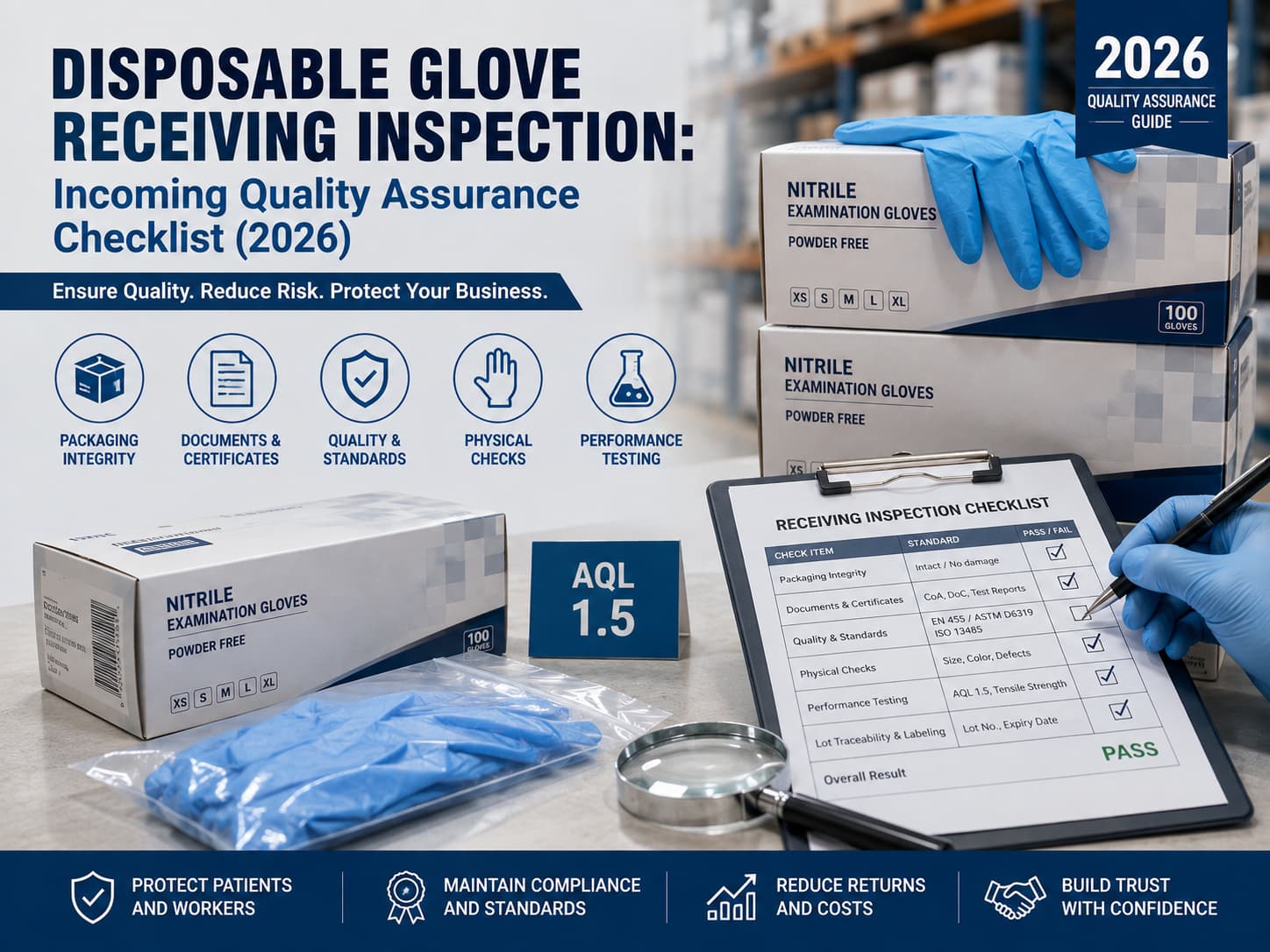
    Receiving inspection is the structured process of verifying that a delivered glove shipment matches the purchase order, the supplier's test claims, and the applicable standards - before the goods are accepted and paid for. It is the buyer's last independent checkpoint before quality problems become expensive problems. This guide covers the documents to verify, the visual checks, the statistical sampling plan, on-site tests, and the accept-hold-reject decision framework. 1. Direct Answer: What Receiving Inspection Is and Why It Matters Receiving inspection (incoming quality assurance, or AQA) is performed at the warehouse when goods arrive. Its purpose is to protect the buyer from three risks: (1) wrong or short product (incorrect size mix, count, or model), (2) non-conforming quality (failed AQL, damaged packaging, missing certifications), and (3) unverifiable claims (a supplier that says "compliant" but provides no batch evidence). In volatile markets, batch-level documentation and spot checks are the difference between catching a problem in 48 hours and discovering it after the gloves are already distributed to users. 2. Documents to Verify Before Opening Cartons Check the documents first - they determine what the shipment claims to be. Verify that lot numbers, quantities, and descriptions match the purchase order. Document What to check Why it matters Packing list Carton count, quantity, lot numbers, model/size mix Confirms shipment matches the PO Certificate of Conformity (CoC) / Analysis (CoA) Batch-level test results: AQL water leak, tensile strength, elongation, dimensions Proves the batch passed manufacturing QC Standards certificates EN 455, ASTM D6319, EN ISO 374, ISO 13485 (as applicable) Confirms the product is certified to the required standard EU Declaration of Conformity Product ID, standards cited, manufacturer signature Required for legal EU placement Labels / carton marking Size, quantity, lot number, expiry date, manufacturer ID, barcode/UDI Enables traceability and stock rotation Regulatory registration references FDA 510(k) K-number, EUDAMED UDI-DI for medical gloves Confirms legal market access 3. Visual Inspection of Cartons and Labels Carton condition: Check for crushing, water damage, or torn outer boxes. If outer cartons are damaged, inspect inner boxes before accepting. Label accuracy: Verify size, quantity, lot number, and expiry date printed on cartons match the packing list. Expired or near-expiry stock should be flagged. Lot consistency: Multiple lot numbers in one shipment are normal - but every lot must have its own CoC/CoA and test report. Single-lot shipments are easier to trace. Pallet and wrapping: Check for moisture, pests, or foreign objects. Document any anomalies with photos. 4. Statistical Sampling per ISO 2859-1 Sample size follows ISO 2859-1 (ANSI/ASQ Z1.4), using the lot size, the inspection level (typically General Level II), and the AQL from your contract (AQL 1.5 for medical exam gloves, AQL 2.5/4.0 for industrial). Examples for AQL 1.5, General Level II: Lot size (pieces) Sample size (pieces) Accept (Ac) Reject (Re) 2,801 - 8,000 125 5 6 8,001 - 22,000 200 7 8 22,001 - 110,000 315 10 11 110,001 - 500,000 500 14 15 500,001+ 800 21 22 Sample randomly from multiple cartons and multiple layers of the pallet - not from the first box you open. Record which cartons were sampled for traceability. Never reduce the sample size below the standard; the acceptance numbers lose their statistical meaning. 5. On-Site Physical Tests Several checks can be performed at the warehouse without laboratory equipment: Water leak (AQL) test: Fill a sampled glove with about 1,000 mL of water, hold 1-2 minutes, and check for droplets or wet spots. Any leak = barrier failure. Perform on a statistically valid sample. Visual defect check: Inspect sampled gloves for holes, tears, discoloration, embedded particles, or powder anomalies. Thickness spot check: If you have a micrometer, measure palm and finger thickness and compare to the TDS/specification (in mil or mm). Elasticity check: Gently stretch a sampled glove - it should return to shape without tearing or whitening (stress whitening indicates degraded polymer). Powder check (powder-free products): Shake a glove over dark fabric; visible powder residue indicates non-conformance. Laboratory tensile and elongation testing (ASTM D412 / EN 455-2) requires a tensile testing machine - for full verification, send samples to an ISO 17025 accredited laboratory. 6. Accept - Hold - Reject Decision Framework Decision Trigger Action ACCEPT All document, visual, and sampling checks pass Document results, release to stock, file the inspection report with the CoC/CoA HOLD Minor non-conformity: label misprints, damaged outer cartons with intact inner boxes, missing copies of certificates (verifiable) Quarantine the lot, notify the supplier, set a resolution deadline (e.g., 7 days) for replacement documents or re-labeling REJECT Failed AQL, wrong product/size mix, missing or non-matching certificates, expired or near-expiry stock Quarantine the lot, issue a written rejection with photos and test evidence, negotiate return/credit per contract, keep retain samples 7. Records and Traceability Every inspection produces a record. Keep at least: inspection date, PO number, supplier, lot numbers, sample size and acceptance/rejection result, on-site test results, photos of anomalies, and the disposition (accept/hold/reject). Retain samples from each inspected lot for 6-12 months for medical products. A complete inspection file is the evidence base for claims, audits, and regulatory inquiries - and it feeds directly into supplier scorecards for the next sourcing decision. Data sources: ISO 2859-1 (sampling procedures for inspection by attributes); EN 455 series; ASTM D6319 / D412; ISO 17025 (laboratory accreditation); EU MDR 2017/745 (UDI requirements). Sampling table values are from ISO 2859-1 General Inspection Level II, AQL 1.5. Information current as of August 2026. FAQ Q: What is a receiving inspection for disposable gloves and why is it important? A: Receiving inspection (incoming quality assurance) is the process of verifying that a delivered glove shipment matches the purchase order, the supplier's test claims, and the applicable standards BEFORE the goods are accepted and paid for. It matters because in volatile markets a meaningful share of shipments shows issues - wrong size mix, damaged cartons, missing batch reports, or in rare cases failed AQL. Accepting defective goods without evidence makes claims and returns much harder. A structured receiving inspection protects the buyer's quality, safety, and budget. Q: What documents must accompany a compliant glove shipment? A: A compliant shipment should include: (1) packing list with quantities, carton counts, and lot numbers; (2) Certificate of Conformity / Certificate of Analysis with batch-level test results (AQL water leak, tensile strength, elongation, dimensions); (3) applicable standards certificates (EN 455, ASTM D6319, ISO 13485, or EN ISO 374 for chemical gloves); (4) EU Declaration of Conformity if selling in the EU; (5) labels with size, lot number, expiry date, and manufacturer ID; and (6) for medical gloves, regulatory registration references such as FDA 510(k) K-number or EUDAMED UDI-DI. Verify that lot numbers on documents match lot numbers on cartons. Q: How many gloves should be sampled for an AQL inspection? A: Sampling follows ISO 2859-1 (ANSI/ASQ Z1.4). For a medical glove shipment with AQL 1.5 at General Inspection Level II, a lot of 35,001-150,000 gloves requires a sample of 315 gloves with acceptance number 10 and rejection number 11. For a smaller lot of 8,001-22,000 gloves, the sample is 200 gloves with acceptance 7 and rejection 8. Use the lot size and AQL from your contract to look up the correct sample size - never sample fewer than the standard requires, or the inspection loses statistical meaning. Q: Can we test the water leak (AQL) on-site at our warehouse? A: Yes, a basic on-site water leak test is feasible: fill a sampled glove with about 1,000 mL of water and inspect for droplets or wet spots after 1-2 minutes. Any leak means the glove fails barrier integrity. This catches gross defects such as holes and tears, but does not substitute for laboratory tensile and elongation testing, which requires a tensile testing machine. For full verification, send samples to an accredited laboratory (ISO 17025) and request the batch test report from the manufacturer. Q: What should we do if a shipment fails inspection? A: Follow a three-tier decision: (1) ACCEPT - all checks pass; document and release to stock. (2) HOLD - minor non-conformities such as label misprints or damaged outer cartons with intact inner boxes; quarantine, notify the supplier, and decide on rework or re-labeling with a time limit. (3) REJECT - failed AQL, wrong product, missing certificates, or non-conforming labeling; quarantine the lot, formally reject in writing, and negotiate return or credit per contract terms. Always photograph non-conformities, keep retain samples, and issue a written inspection report within 48 hours.  

Contact Us
Unit 1301-1, No. 3, Xixishan Wei Road, Software Park phase III, Torch High-tech Zone,Xiamen City, Fujian Province, China
+86-592-6511055
+86 -15750719843
Subscribe

Copyright 2026@ Fujian Jixiang E-commerce Co., Ltd All Rights Reserved. Sitemap | Blog | Xml | Privacy Policy Network Supported

leave a message

Leave A Message
If you are interested in our products and want to know more details,please leave a message here,we will reply you as soon as we can.
Submit

Home

Products

whatsApp

contact