
welcome to Jixiang E-commerce!
welcome to Jixiang E-commerce!
Halal certification for disposable gloves confirms that the gloves are manufactured, packaged, and handled in compliance with Islamic law — meaning they contain no haram substances, are produced on clean equipment free from cross-contamination, and meet the requirements of a recognized Halal certification body. For glove buyers serving Muslim-majority markets in the GCC, Southeast Asia, and beyond, Halal certification has become a de facto market access requirement.
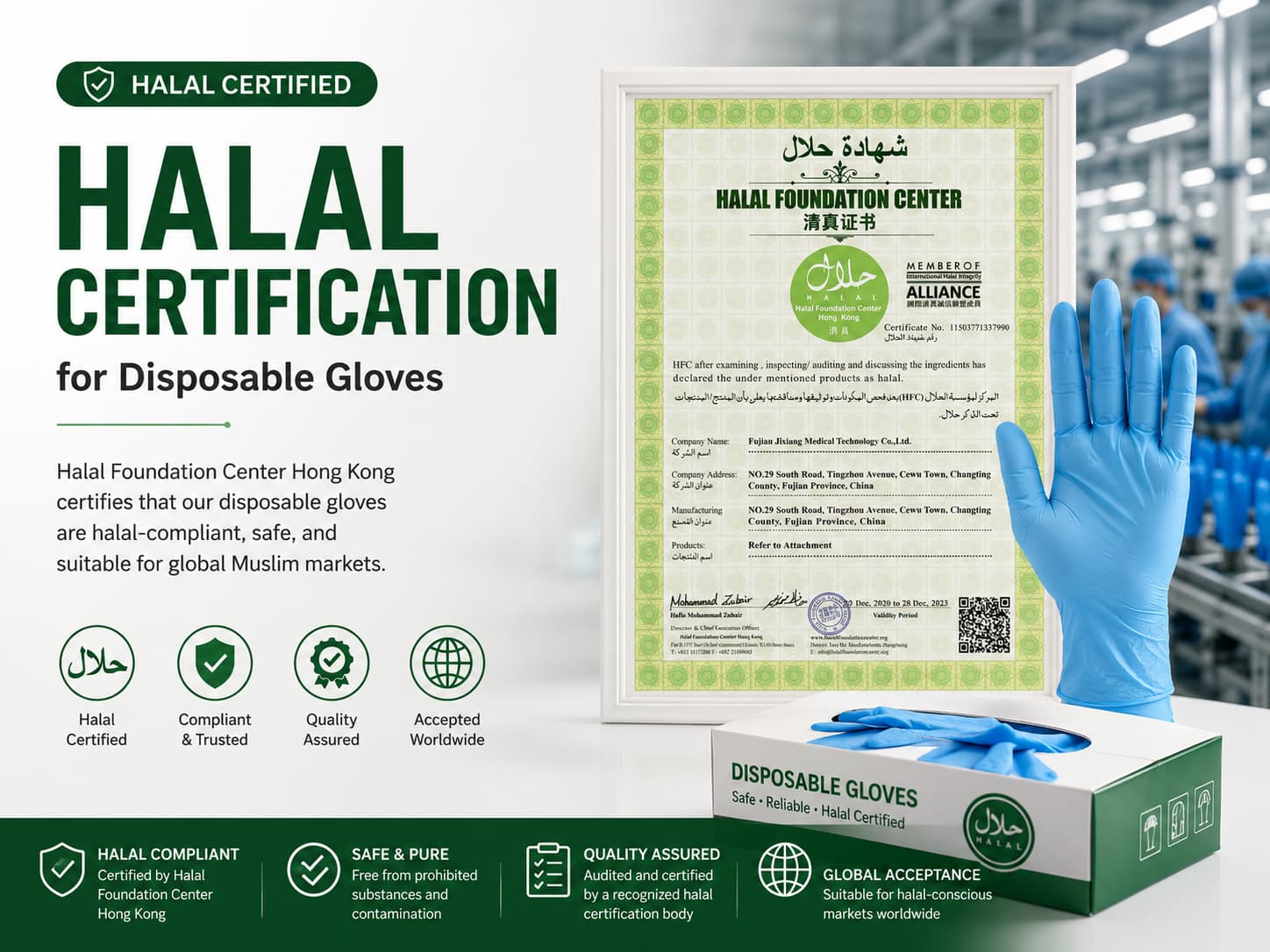
1. Why Halal Certification Matters for Gloves
Disposable gloves are not food — so why do they need Halal certification? The answer lies in material composition and manufacturing process.
Material concerns:
• Some manufacturing additives (stearic acid, processing aids) may be animal-derived.
• Nitrile base polymer is inherently Halal-compliant. The concern is with additives.
• Latex: natural rubber itself is permissible. Additives are the concern.
Manufacturing process concerns:
• Shared production lines risk cross-contamination.
• Cleaning agents and release sprays may contain non-Halal ingredients.
• Packaging and storage contact with non-Halal substances.
2. What Halal Certification Covers for Gloves
|
Area |
What Is Audited |
|
Raw materials |
Source verification of all ingredients. No porcine or non-Halal animal derivatives. |
|
Manufacturing equipment |
Cleaning validation, dedicated or properly cleaned lines. |
|
Production facility |
Overall hygiene, pest control, worker hygiene protocols. |
|
Packaging materials |
Inner and outer packaging must be Halal-compliant. |
|
Storage and logistics |
Segregation from non-Halal products. |
|
Quality management |
Documented procedures, traceability, periodic re-audit. |
3. Recognized Halal Certification Bodies
Not all Halal certificates are equal. Buyers should verify that the certifying body is recognized by the destination country.
|
Certification Body |
Country |
Recognition Scope |
Online Verification |
|
JAKIM |
Malaysia |
Widely recognized globally |
MYeHALAL portal |
|
MUI (LPPOM MUI) |
Indonesia |
Required for Indonesia; ASEAN |
CEROL-SS23000 |
|
CICOT |
Thailand |
ASEAN and GCC markets |
Yes |
|
ESMA (UAE.S 2055) |
UAE |
Required for UAE food-contact |
ESMA tracking |
|
GAC (GSO 993) |
GCC |
Pan-GCC standard |
Member state bodies |
|
HQC |
Singapore |
Singapore and ASEAN |
Yes |
|
HFA |
UK |
UK and parts of Europe |
Yes |
4. The Certification Process: Step by Step
Step 1: Application → Supplier submits application
Step 2: Documentation Review → Ingredient lists, MSDS, factory layout, SOPs
Step 3: On-Site Audit → Inspector visits factory
Step 4: Lab Testing (if required) → Porcine DNA or ethanol content
Step 5: Certification Issued → 1–3 year validity
Step 6: Annual Surveillance → Annual audit to maintain
Typical timeline: 2–4 months from application to certification.
5. How to Verify a Supplier's Halal Certification
Red flags to watch for:
• Certificate issued by unknown or unrecognized body
• No expiry date
• Does not list specific product categories
• Cannot provide certificate number for online verification
• Certificate for "company" but not specific factory/production lines
6. Halal Certification and Other Standards
|
Standard |
What It Covers |
Relationship to Halal |
|
EN 455 |
Medical glove properties |
Separate; both required for EU medical + Halal |
|
EN 374 |
Chemical protection |
Separate |
|
GSO 4872 |
GCC medical glove standard |
Increasingly references Halal requirements |
|
ISO 13485 |
Medical device QMS |
Supports Halal through traceability |
|
ISO 9001 |
General QMS |
Supports Halal through documented procedures |
|
FDA 510(k) |
US medical device clearance |
Separate; not relevant to Halal |
7. The Cost Impact of Halal Certification
|
Cost Factor |
Estimated Impact |
|
Certification fees (amortized) |
+$0.02–0.05 per 1,000 gloves |
|
Raw material premiums (Halal-grade) |
+$0.10–0.30 per 1,000 gloves |
|
Dedicated production line (if needed) |
One-time capex, amortized |
|
Annual surveillance |
+$0.01–0.03 per 1,000 gloves |
|
Total estimated premium |
$0.15–0.40 per 1,000 gloves (~1–2% of FOB) |
FAQ
Q1: Do nitrile gloves automatically qualify as Halal?
A: Not automatically. Nitrile rubber is inherently free from animal-derived materials, but manufacturing may involve animal-derived additives. Full Halal audit is still required.
Q2: Which markets require Halal certification for gloves?
A: Saudi Arabia, UAE, Malaysia, and Indonesia increasingly require it. Other GCC states strongly prefer it. Brunei requires certification; Thailand and Singapore have voluntary frameworks.
Q3: How can I check if a Halal certificate is genuine?
A: Use online verification portals: JAKIM (MYeHALAL), MUI (CEROL-SS23000), ESMA (conformity tracking). Enter certificate number to confirm.
Please read on, stay posted, subscribe, and we welcome you to tell us what you think.


Copyright 2026@ Fujian Jixiang E-commerce Co., Ltd All Rights Reserved.
Sitemap |
Blog
|
Xml |
Privacy Policy
 Network Supported