Halal Certification for Disposable Glove
Jun 18, 2026
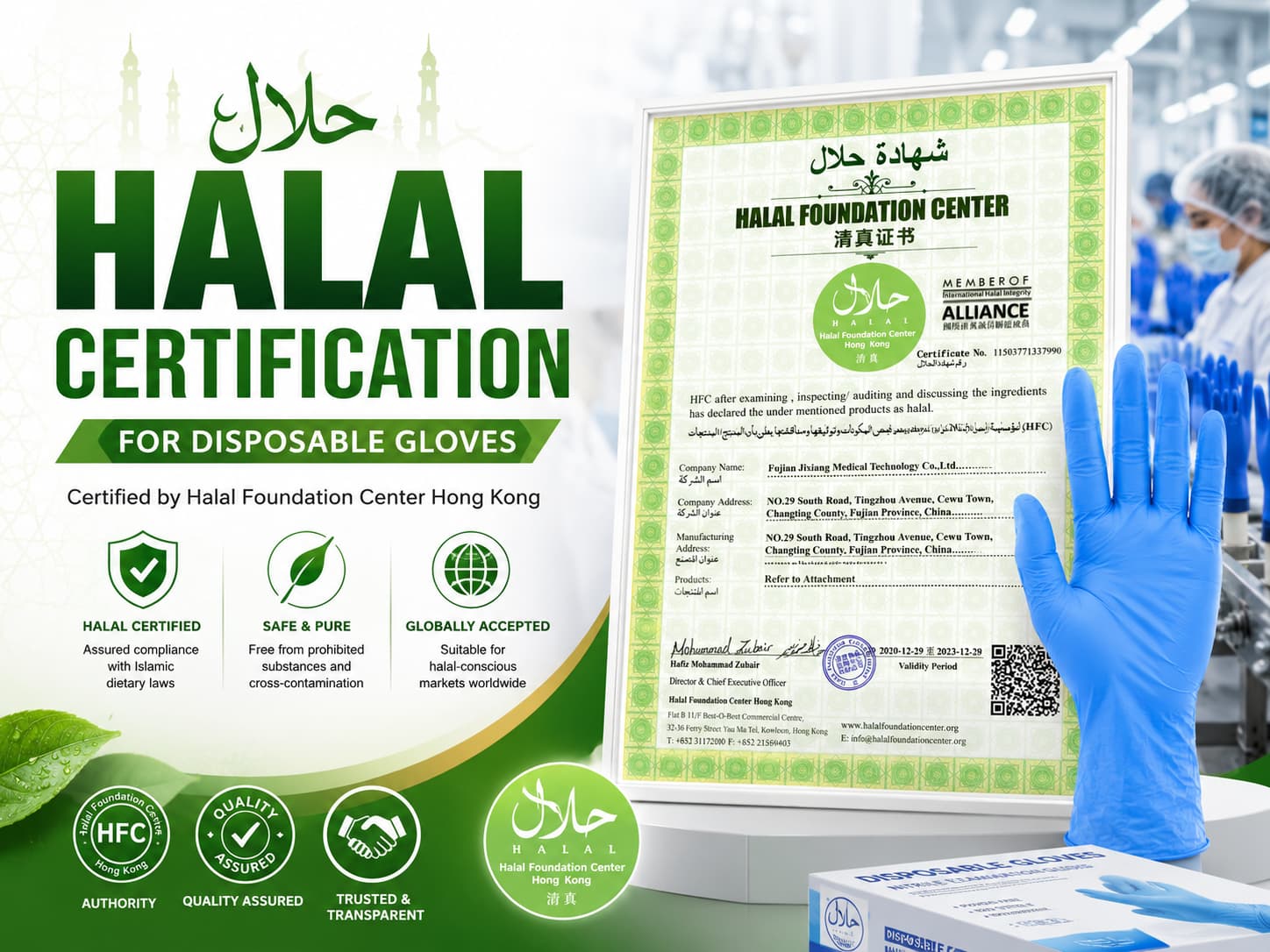
Halal certification for disposable gloves confirms that the gloves are manufactured, packaged, and handled in compliance with Islamic law — meaning they contain no haram substances, are produced on clean equipment free from cross-contamination, and meet the requirements of a recognized Halal certification body. For glove buyers serving Muslim-majority markets in the GCC, Southeast Asia, and beyond, Halal certification has become a de facto market access requirement.
1. Why Halal Certification Matters for Gloves
Disposable gloves are not food — so why do they need Halal certification? The answer lies in material composition and manufacturing process.
Material concerns:
• Some manufacturing additives (stearic acid, processing aids) may be animal-derived.
• Nitrile base polymer is inherently Halal-compliant. The concern is with additives.
• Latex: natural rubber itself is permissible. Additives are the concern.
Manufacturing process concerns:
• Shared production lines risk cross-contamination.
• Cleaning agents and release sprays may contain non-Halal ingredients.
• Packaging and storage contact with non-Halal substances.
2. What Halal Certification Covers for Gloves
Area
What Is Audited
Raw materials
Source verification of all ingredients. No porcine or non-Halal animal derivatives.
Manufacturing equipment
Cleaning validation, dedicated or properly cleaned lines.
Production facility
Overall hygiene, pest control, worker hygiene protocols.
Packaging materials
Inner and outer packaging must be Halal-compliant.
Storage and logistics
Segregation from non-Halal products.
Quality management
Documented procedures, traceability, periodic re-audit.
3. Recognized Halal Certification Bodies
Not all Halal certificates are equal. Buyers should verify that the certifying body is recognized by the destination country.
Certification Body
Country
Recognition Scope
Online Verification
JAKIM
Malaysia
Widely recognized globally
MYeHALAL portal
MUI (LPPOM MUI)
Indonesia
Required for Indonesia; ASEAN
CEROL-SS23000
CICOT
Thailand
ASEAN and GCC markets
Yes
ESMA (UAE.S 2055)
UAE
Required for UAE food-contact
ESMA tracking
GAC (GSO 993)
GCC
Pan-GCC standard
Member state bodies
HQC
Singapore
Singapore and ASEAN
Yes
HFA
UK
UK and parts of Europe
Yes
4. The Certification Process: Step by Step
Step 1: Application → Supplier submits application
Step 2: Documentation Review → Ingredient lists, MSDS, factory layout, SOPs
Step 3: On-Site Audit → Inspector visits factory
Step 4: Lab Testing (if required) → Porcine DNA or ethanol content
Step 5: Certification Issued → 1–3 year validity
Step 6: Annual Surveillance → Annual audit to maintain
Typical timeline: 2–4 months from application to certification.
5. How to Verify a Supplier's Halal Certification
Red flags to watch for:
• Certificate issued by unknown or unrecognized body
• No expiry date
• Does not list specific product categories
• Cannot provide certificate number for online verification
• Certificate for "company" but not specific factory/production lines
6. Halal Certification and Other Standards
Standard
What It Covers
Relationship to Halal
EN 455
Medical glove properties
Separate; both required for EU medical + Halal
EN 374
Chemical protection
Separate
GSO 4872
GCC medical glove standard
Increasingly references Halal requirements
ISO 13485
Medical device QMS
Supports Halal through traceability
ISO 9001
General QMS
Supports Halal through documented procedures
FDA 510(k)
US medical device clearance
Separate; not relevant to Halal
7. The Cost Impact of Halal Certification
Cost Factor
Estimated Impact
Certification fees (amortized)
+$0.02–0.05 per 1,000 gloves
Raw material premiums (Halal-grade)
+$0.10–0.30 per 1,000 gloves
Dedicated production line (if needed)
One-time capex, amortized
Annual surveillance
+$0.01–0.03 per 1,000 gloves
Total estimated premium
$0.15–0.40 per 1,000 gloves (~1–2% of FOB)
FAQ
Q1: Do nitrile gloves automatically qualify as Halal?
A: Not automatically. Nitrile rubber is inherently free from animal-derived materials, but manufacturing may involve animal-derived additives. Full Halal audit is still required.
Q2: Which markets require Halal certification for gloves?
A: Saudi Arabia, UAE, Malaysia, and Indonesia increasingly require it. Other GCC states strongly prefer it. Brunei requires certification; Thailand and Singapore have voluntary frameworks.
Q3: How can I check if a Halal certificate is genuine?
A: Use online verification portals: JAKIM (MYeHALAL), MUI (CEROL-SS23000), ESMA (conformity tracking). Enter certificate number to confirm.



 Network Supported