
welcome to Jixiang E-commerce!
welcome to Jixiang E-commerce!
Per- and polyfluoroalkyl substances (PFAS), widely known as "forever chemicals," are facing broad regulatory restrictions across the European Union under the REACH regulation. For disposable glove buyers and procurement professionals, the 2027-2028 PFAS restriction timeline creates both compliance urgency and supply chain transition challenges. This guide explains what PFAS are, how they enter glove manufacturing, what the EU restriction requires, and how to verify PFAS-free claims when sourcing nitrile rubber gloves and other disposable gloves.
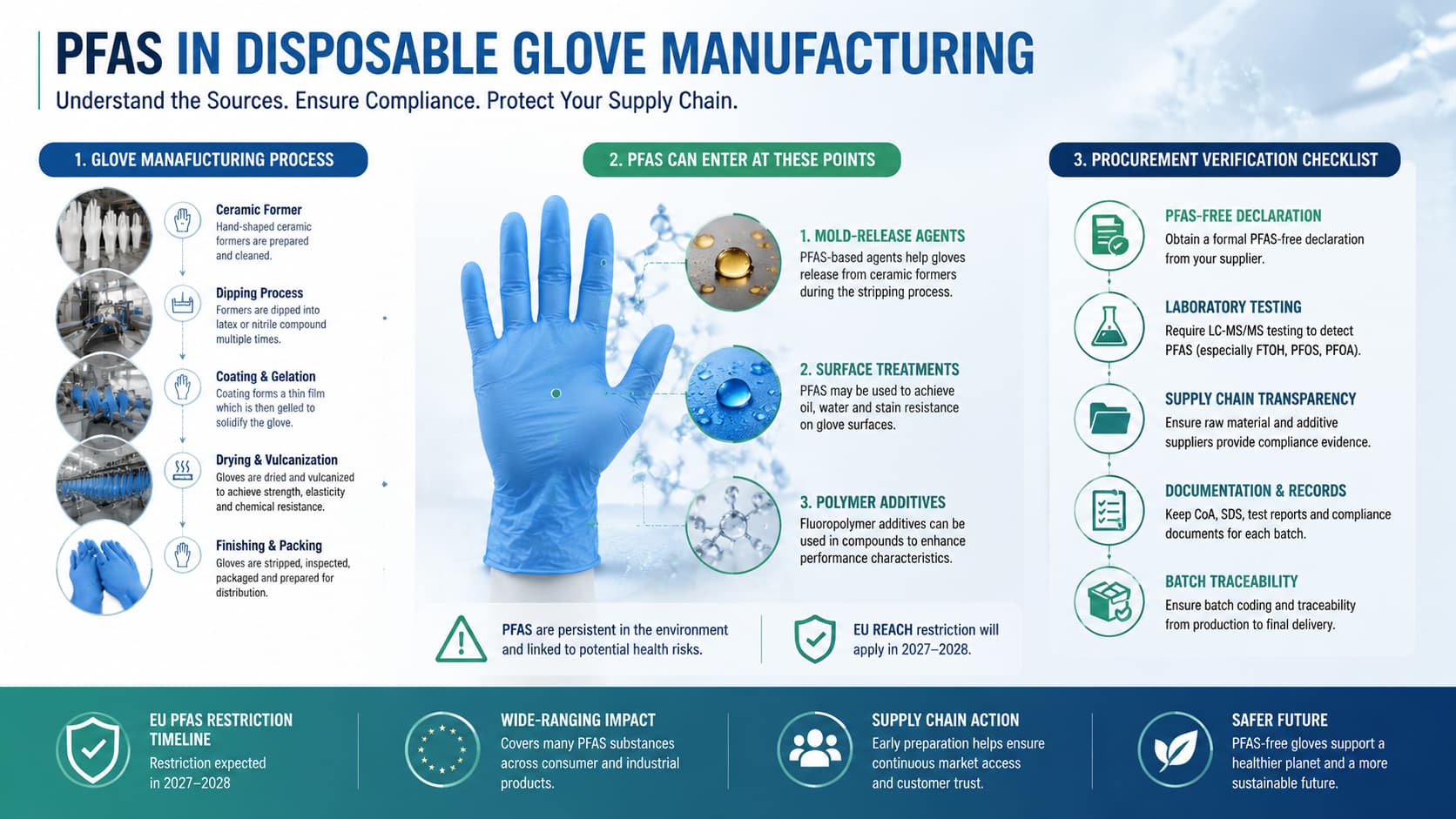
PFAS are a family of over 12,000 synthetic chemicals characterized by carbon-fluorine bonds, which are among the strongest in organic chemistry. This molecular stability makes PFAS extremely persistent in the environment, bioaccumulative in human tissue, and linked to adverse health effects including certain cancers, immune suppression, and endocrine disruption.
In disposable glove manufacturing, PFAS may be used in three primary ways: (1) mold-release agents that help gloves separate from ceramic formers during dipping, (2) surface treatments for oil and water repellency, and (3) fluoropolymer additives in polymer blends. While not all gloves contain PFAS, their presence in manufacturing chains is widespread enough that the EU has moved toward a comprehensive restriction.
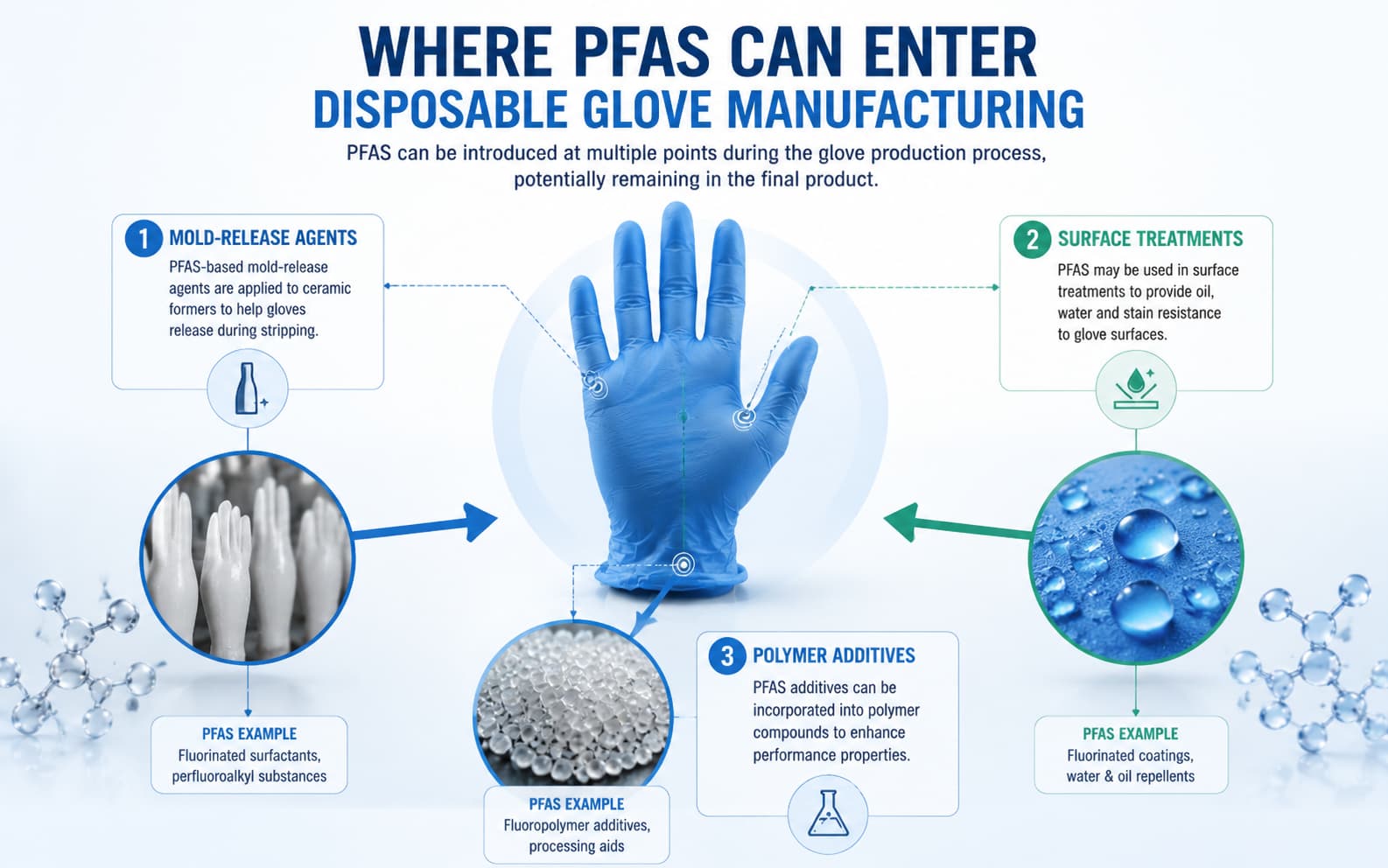
Not all disposable gloves contain PFAS. The risk varies by material type and manufacturing process. The table below summarizes PFAS risk levels by glove type.
| Glove Type | PFAS Risk Level | Common Source of PFAS |
|---|---|---|
| Nitrile rubber | Low to Moderate | Mold-release agents, surface treatments |
| Latex (natural rubber) | Low | Some mold-release agents |
| PVC (vinyl) | Moderate | Mold-release agents, plasticizer contamination |
| Polyethylene | Very Low | Minimal processing aids needed |
| Fluoropolymer-blend | High | PFAS is part of the polymer formulation |
The EU PFAS restriction is being advanced through the REACH Annex XV process, led by authorities from Germany, the Netherlands, Norway, Sweden, and Denmark. The restriction proposal was submitted in January 2023, and the European Chemicals Agency (ECHA) Committee for Risk Assessment (RAC) has been reviewing scope and derogations. Key milestones for glove buyers include:
| Phase | Timeline | What It Means for Glove Buyers |
|---|---|---|
| Proposal submission | January 2023 | Initial restriction proposal submitted to ECHA |
| RAC opinion formation | 2024-2025 | Committee opinions on scope, exemptions, transition periods |
| Adoption decision | 2025-2026 | EU Commission decision on final restriction text |
| Entry into force | 2027-2028 | Restriction becomes legally binding for all EU market access |
| Transition period | 2027-2030 (varies) | Application-specific derogations may extend deadlines |
Procurement teams should not rely on marketing claims alone. A credible PFAS-free declaration from a glove manufacturer should include the following elements:
The transition to PFAS-free manufacturing will have measurable cost and supply implications. Buyers should prepare for:
However, these costs should be weighed against the risk of non-compliance: product seizures at EU customs, market access loss, contract penalties, and reputational damage in ESG-conscious procurement markets.
Procurement teams should adopt a phased transition strategy starting immediately:
Q: What are PFAS and why are they used in disposable gloves?
A: PFAS (per- and polyfluoroalkyl substances) are a group of synthetic chemicals used in some glove manufacturing for oil and water repellency, mold-release agents during production, and surface treatments. They provide stain resistance and improve manufacturing efficiency but persist in the environment indefinitely, earning the name 'forever chemicals.'
Q: When will the EU PFAS restriction take effect for gloves?
A: The EU is advancing a broad PFAS restriction under REACH Annex XV, expected to enter force in 2027-2028. For disposable gloves, the transition period may vary by application, but manufacturers and buyers should prepare for compliance verification by mid-2027. The restriction covers intentionally added PFAS as well as PFAS present as impurities above threshold limits.
Q: How can I verify that gloves are PFAS-free?
A: Request a PFAS-free declaration from the manufacturer with supporting test data from an accredited laboratory. Common analytical methods include LC-MS/MS for targeted PFAS analysis. The declaration should reference specific PFAS compounds tested (e.g., PFOA, PFOS, GenX) and confirm levels are below detection limits or regulatory thresholds.
Q: Are nitrile rubber gloves naturally PFAS-free?
A: Nitrile rubber (acrylonitrile butadiene rubber) as a raw material does not inherently contain PFAS. However, PFAS may be introduced during manufacturing through mold-release agents, surface treatments, or contaminated additives. Buyers should still request explicit PFAS-free declarations even for nitrile rubber gloves to ensure the entire production chain is PFAS-free.
Q: Will PFAS-free gloves cost more than traditional gloves?
A: In the short term, PFAS-free gloves may carry a 3-8% cost premium due to reformulation, alternative mold-release agents, and additional testing requirements. As more manufacturers transition and scale economies improve, this premium is expected to narrow. Buyers should factor in the cost of non-compliance, which can include product recalls, market access loss, and reputational damage.
Please read on, stay posted, subscribe, and we welcome you to tell us what you think.


Copyright 2026@ Fujian Jixiang E-commerce Co., Ltd All Rights Reserved.
Sitemap |
Blog
|
Xml |
Privacy Policy
 Network Supported