Disposable Glove Receiving Inspection: Incoming Quality Assurance Checklist (2026)
Aug 21, 2026
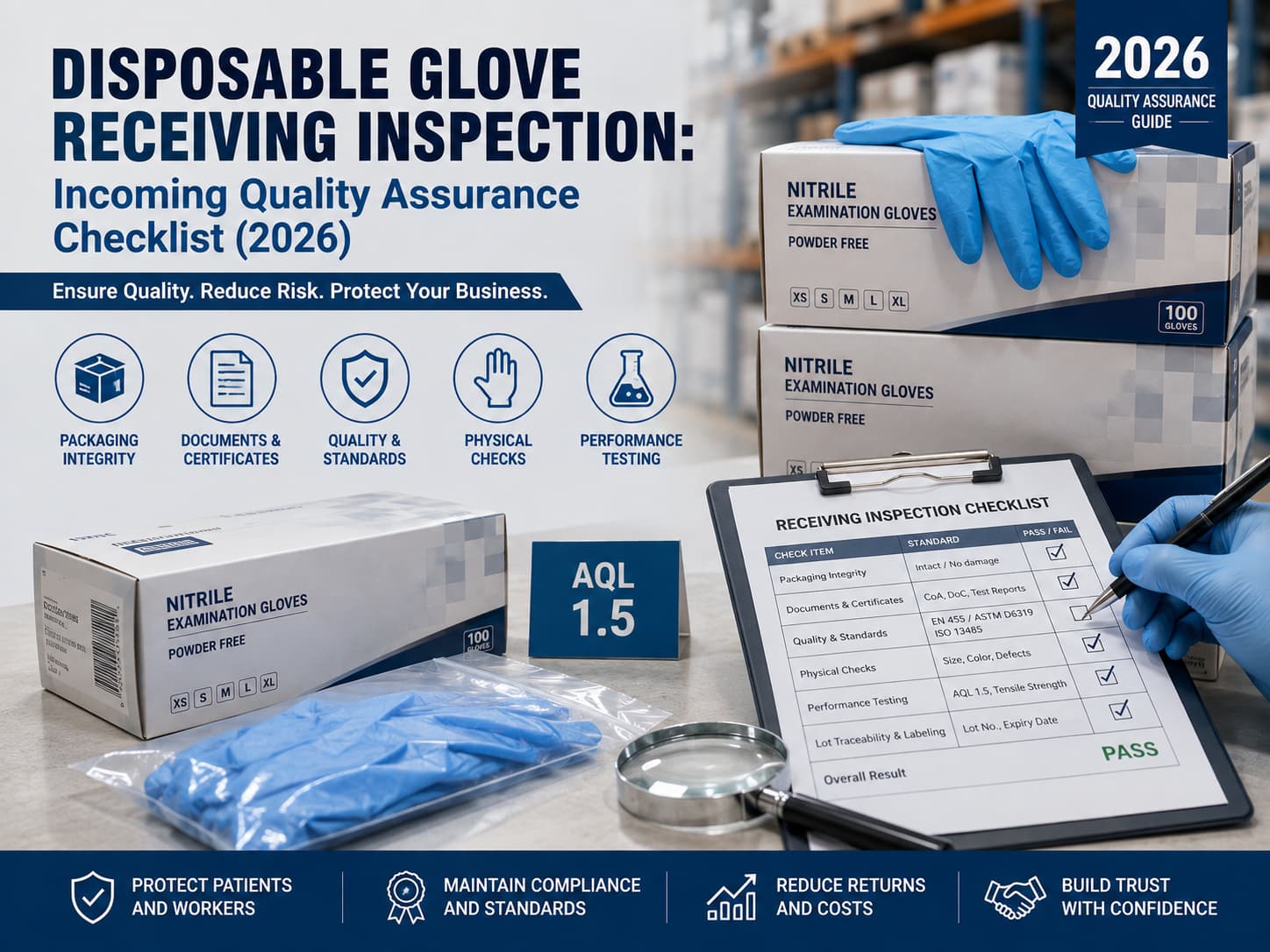
Receiving inspection is the structured process of verifying that a delivered glove shipment matches the purchase order, the supplier's test claims, and the applicable standards - before the goods are accepted and paid for. It is the buyer's last independent checkpoint before quality problems become expensive problems. This guide covers the documents to verify, the visual checks, the statistical sampling plan, on-site tests, and the accept-hold-reject decision framework.
1. Direct Answer: What Receiving Inspection Is and Why It Matters
Receiving inspection (incoming quality assurance, or AQA) is performed at the warehouse when goods arrive. Its purpose is to protect the buyer from three risks: (1) wrong or short product (incorrect size mix, count, or model), (2) non-conforming quality (failed AQL, damaged packaging, missing certifications), and (3) unverifiable claims (a supplier that says "compliant" but provides no batch evidence). In volatile markets, batch-level documentation and spot checks are the difference between catching a problem in 48 hours and discovering it after the gloves are already distributed to users.
2. Documents to Verify Before Opening Cartons
Check the documents first - they determine what the shipment claims to be. Verify that lot numbers, quantities, and descriptions match the purchase order.
Document
What to check
Why it matters
Packing list
Carton count, quantity, lot numbers, model/size mix
Confirms shipment matches the PO
Certificate of Conformity (CoC) / Analysis (CoA)
Batch-level test results: AQL water leak, tensile strength, elongation, dimensions
Proves the batch passed manufacturing QC
Standards certificates
EN 455, ASTM D6319, EN ISO 374, ISO 13485 (as applicable)
Confirms the product is certified to the required standard
EU Declaration of Conformity
Product ID, standards cited, manufacturer signature
Required for legal EU placement
Labels / carton marking
Size, quantity, lot number, expiry date, manufacturer ID, barcode/UDI
Enables traceability and stock rotation
Regulatory registration references
FDA 510(k) K-number, EUDAMED UDI-DI for medical gloves
Confirms legal market access
3. Visual Inspection of Cartons and Labels
Carton condition: Check for crushing, water damage, or torn outer boxes. If outer cartons are damaged, inspect inner boxes before accepting.
Label accuracy: Verify size, quantity, lot number, and expiry date printed on cartons match the packing list. Expired or near-expiry stock should be flagged.
Lot consistency: Multiple lot numbers in one shipment are normal - but every lot must have its own CoC/CoA and test report. Single-lot shipments are easier to trace.
Pallet and wrapping: Check for moisture, pests, or foreign objects. Document any anomalies with photos.
4. Statistical Sampling per ISO 2859-1
Sample size follows ISO 2859-1 (ANSI/ASQ Z1.4), using the lot size, the inspection level (typically General Level II), and the AQL from your contract (AQL 1.5 for medical exam gloves, AQL 2.5/4.0 for industrial). Examples for AQL 1.5, General Level II:
Lot size (pieces)
Sample size (pieces)
Accept (Ac)
Reject (Re)
2,801 - 8,000
125
5
6
8,001 - 22,000
200
7
8
22,001 - 110,000
315
10
11
110,001 - 500,000
500
14
15
500,001+
800
21
22
Sample randomly from multiple cartons and multiple layers of the pallet - not from the first box you open. Record which cartons were sampled for traceability. Never reduce the sample size below the standard; the acceptance numbers lose their statistical meaning.
5. On-Site Physical Tests
Several checks can be performed at the warehouse without laboratory equipment:
Water leak (AQL) test: Fill a sampled glove with about 1,000 mL of water, hold 1-2 minutes, and check for droplets or wet spots. Any leak = barrier failure. Perform on a statistically valid sample.
Visual defect check: Inspect sampled gloves for holes, tears, discoloration, embedded particles, or powder anomalies.
Thickness spot check: If you have a micrometer, measure palm and finger thickness and compare to the TDS/specification (in mil or mm).
Elasticity check: Gently stretch a sampled glove - it should return to shape without tearing or whitening (stress whitening indicates degraded polymer).
Powder check (powder-free products): Shake a glove over dark fabric; visible powder residue indicates non-conformance.
Laboratory tensile and elongation testing (ASTM D412 / EN 455-2) requires a tensile testing machine - for full verification, send samples to an ISO 17025 accredited laboratory.
6. Accept - Hold - Reject Decision Framework
Decision
Trigger
Action
ACCEPT
All document, visual, and sampling checks pass
Document results, release to stock, file the inspection report with the CoC/CoA
HOLD
Minor non-conformity: label misprints, damaged outer cartons with intact inner boxes, missing copies of certificates (verifiable)
Quarantine the lot, notify the supplier, set a resolution deadline (e.g., 7 days) for replacement documents or re-labeling
REJECT
Failed AQL, wrong product/size mix, missing or non-matching certificates, expired or near-expiry stock
Quarantine the lot, issue a written rejection with photos and test evidence, negotiate return/credit per contract, keep retain samples
7. Records and Traceability
Every inspection produces a record. Keep at least: inspection date, PO number, supplier, lot numbers, sample size and acceptance/rejection result, on-site test results, photos of anomalies, and the disposition (accept/hold/reject). Retain samples from each inspected lot for 6-12 months for medical products. A complete inspection file is the evidence base for claims, audits, and regulatory inquiries - and it feeds directly into supplier scorecards for the next sourcing decision.
Data sources: ISO 2859-1 (sampling procedures for inspection by attributes); EN 455 series; ASTM D6319 / D412; ISO 17025 (laboratory accreditation); EU MDR 2017/745 (UDI requirements). Sampling table values are from ISO 2859-1 General Inspection Level II, AQL 1.5. Information current as of August 2026.
FAQ
Q: What is a receiving inspection for disposable gloves and why is it important?
A: Receiving inspection (incoming quality assurance) is the process of verifying that a delivered glove shipment matches the purchase order, the supplier's test claims, and the applicable standards BEFORE the goods are accepted and paid for. It matters because in volatile markets a meaningful share of shipments shows issues - wrong size mix, damaged cartons, missing batch reports, or in rare cases failed AQL. Accepting defective goods without evidence makes claims and returns much harder. A structured receiving inspection protects the buyer's quality, safety, and budget.
Q: What documents must accompany a compliant glove shipment?
A: A compliant shipment should include: (1) packing list with quantities, carton counts, and lot numbers; (2) Certificate of Conformity / Certificate of Analysis with batch-level test results (AQL water leak, tensile strength, elongation, dimensions); (3) applicable standards certificates (EN 455, ASTM D6319, ISO 13485, or EN ISO 374 for chemical gloves); (4) EU Declaration of Conformity if selling in the EU; (5) labels with size, lot number, expiry date, and manufacturer ID; and (6) for medical gloves, regulatory registration references such as FDA 510(k) K-number or EUDAMED UDI-DI. Verify that lot numbers on documents match lot numbers on cartons.
Q: How many gloves should be sampled for an AQL inspection?
A: Sampling follows ISO 2859-1 (ANSI/ASQ Z1.4). For a medical glove shipment with AQL 1.5 at General Inspection Level II, a lot of 35,001-150,000 gloves requires a sample of 315 gloves with acceptance number 10 and rejection number 11. For a smaller lot of 8,001-22,000 gloves, the sample is 200 gloves with acceptance 7 and rejection 8. Use the lot size and AQL from your contract to look up the correct sample size - never sample fewer than the standard requires, or the inspection loses statistical meaning.
Q: Can we test the water leak (AQL) on-site at our warehouse?
A: Yes, a basic on-site water leak test is feasible: fill a sampled glove with about 1,000 mL of water and inspect for droplets or wet spots after 1-2 minutes. Any leak means the glove fails barrier integrity. This catches gross defects such as holes and tears, but does not substitute for laboratory tensile and elongation testing, which requires a tensile testing machine. For full verification, send samples to an accredited laboratory (ISO 17025) and request the batch test report from the manufacturer.
Q: What should we do if a shipment fails inspection?
A: Follow a three-tier decision: (1) ACCEPT - all checks pass; document and release to stock. (2) HOLD - minor non-conformities such as label misprints or damaged outer cartons with intact inner boxes; quarantine, notify the supplier, and decide on rework or re-labeling with a time limit. (3) REJECT - failed AQL, wrong product, missing certificates, or non-conforming labeling; quarantine the lot, formally reject in writing, and negotiate return or credit per contract terms. Always photograph non-conformities, keep retain samples, and issue a written inspection report within 48 hours.



 Network Supported