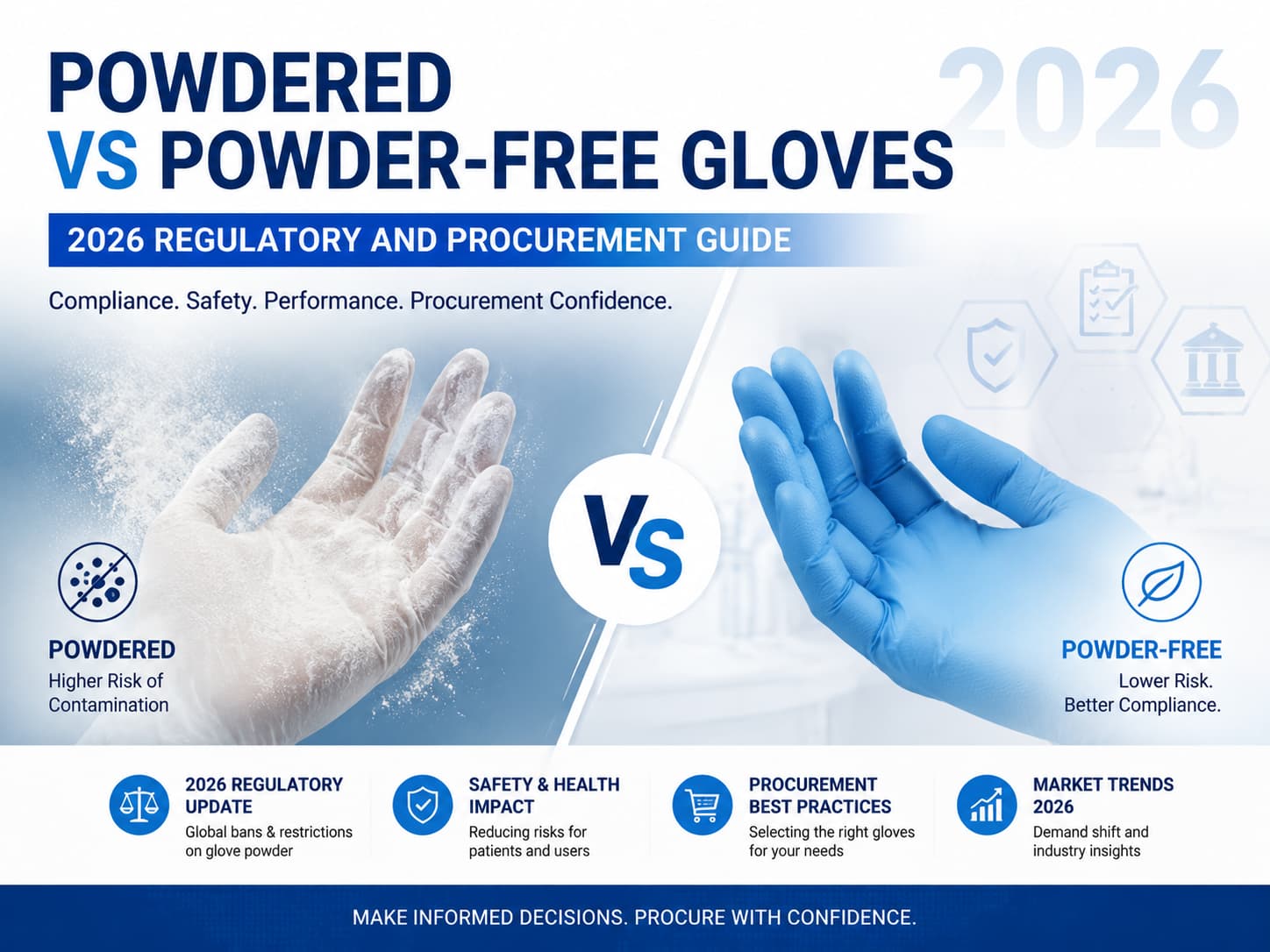
Powdered vs Powder-Free Gloves - 2026 Regulatory and Procurement Guide
Jul 28, 2026
The FDA banned powdered medical gloves in 2017. Learn why powder-free is now the global standard, how chlorination and polymer coatings replaced powder, and what buyers must verify in 2026.
The FDA banned powdered surgeon's gloves and powdered patient examination gloves effective January 18, 2017, under 21 CFR 895. Nearly a decade later, powder-free gloves have become the global standard for medical use. Yet some buyers still encounter powdered gloves in non-medical markets or legacy inventory. This guide explains the regulatory landscape, the health risks that drove the ban, the manufacturing alternatives that replaced powder, and what procurement teams need to verify in 2026.
1. What Are Powdered Gloves?
Powdered gloves are disposable gloves that have an internal coating of powder to serve as a donning aid. The powder reduces friction between the hand and the glove interior, making the glove easier to put on. It also helps manufacturers strip the glove from the porcelain former during production. The most recent powder standard was USP absorbable dusting powder (modified cornstarch). Earlier versions used talc and lycopodium spores, which were phased out due to severe complication rates.
2. The 2017 FDA Ban: Why It Happened
On December 19, 2016, the FDA published a final rule banning powdered surgeon's gloves, powdered patient examination gloves, and absorbable powder for surgeon's gloves. The ban was effective January 18, 2017, under 21 CFR 895.101 (powdered patient examination gloves) and 895.102 (powdered surgeon's glove). This was only the second medical device ban in FDA history.
The FDA identified three primary risks. First, powder causes severe airway inflammation and wound inflammation in surgical patients. Second, powder particles entering body tissue trigger immune responses leading to granuloma formation and post-surgical adhesions. Third, powder on natural rubber latex gloves adsorbs latex proteins and aerosolizes them, significantly increasing the risk of Type I (IgE-mediated) allergic reactions in both patients and healthcare workers.
3. EU and Global Regulatory Response
The EU did not impose an outright statutory ban but effectively transitioned to powder-free through MDR (EU 2017/745) requirements. EN 455-3 biological evaluation requirements, combined with EN ISO 21420 (formerly EN 420) innocuousness clauses, make powdered medical gloves effectively non-marketable in the EU. Japan, Canada, Australia, and most GCC countries have followed the same trend through their respective medical device regulations and procurement policies.
Region
Regulatory Status
Key Reference
United States
Banned (medical)
21 CFR 895.101 / 895.102, effective Jan 2017
European Union
De facto banned (MDR)
MDR 2017/745 + EN 455-3 biological evaluation
Japan
Effectively prohibited
PMDA + JSDI standards
Canada
Transitioned to powder-free
Health Canada medical device regulations
GCC / Middle East
Powder-free preferred
SFDA / GSO procurement policies
4. Powder-Free Manufacturing Alternatives
Two primary technologies replaced powder for donning assistance:
Chlorination: The glove interior is treated with chlorine gas or hypochlorite solution, which oxidizes the polymer surface and creates a slick, low-friction layer. This is the most common and cost-effective method for latex and nitrile rubber gloves. The trade-off is a slight reduction in tensile strength and elongation, which modern manufacturing controls have largely mitigated.
Polymer coating: A silicone or polyurethane-based coating is applied to the interior surface during manufacturing. This method preserves the polymer's tensile properties better than chlorination and is increasingly preferred for premium nitrile rubber gloves. The cost is approximately 5-8% higher than chlorination.
Factor
Powdered (legacy)
Powder-Free (Chlorinated)
Powder-Free (Polymer Coated)
FDA status (medical)
Banned
Allowed
Allowed
Donning ease
High (powder lubricant)
High (chlorinated surface)
High (polymer layer)
Tensile strength impact
Minimal
Slight reduction
Minimal
Protein aerosolization risk
High (latex)
Low
Low
Cost impact
Baseline
+3-5%
+5-8%
Latex allergy risk
Elevated
Reduced
Reduced
5. Procurement Checklist for 2026
US market: Verify that no powdered medical gloves remain in the supply chain. 21 CFR 895 prohibits their sale.
EU market: Confirm EN 455-3 compliance and powder-free labeling on packaging.
Industrial/non-medical: Powdered versions may still exist in some markets. Verify if powder-free is required by end-user policy.
CoC verification: The Certificate of Conformity should explicitly state "powder-free" or "PF" designation.
Material preference: Nitrile rubber gloves are inherently latex-free and powder-free. They are the recommended default for most medical and industrial applications.
FAQ
Q: Are powdered gloves still legal in any market?
A: Powdered medical gloves are banned in the US under 21 CFR 895. In the EU, they are effectively non-marketable under MDR (EU 2017/745) requirements. Some non-medical (industrial) powdered gloves may still exist, but they are increasingly rare and not recommended for healthcare use.
Q: What type of powder was used in medical gloves?
A: The most recent standard was USP absorbable dusting powder (modified cornstarch). Earlier versions used talc and lycopodium spores, which were phased out in the 1990s due to even higher complication rates including granulomas and tissue adhesions.
Q: Does the chlorination process weaken gloves?
A: Chlorination can slightly reduce tensile strength and elongation, but modern manufacturing controls minimize this effect. Polymer coating is an alternative that better preserves mechanical properties while still providing a powder-free donning surface.
Q: Are powder-free gloves more expensive than powdered ones?
A: Chlorination adds approximately 3-5% to production cost, and polymer coating adds 5-8%. However, since powder-free is now the global market standard, the price gap has largely disappeared and powder-free gloves are competitively priced.
Q: Can powdered gloves cause latex allergy?
A: Yes. Powder on natural rubber latex gloves can adsorb latex proteins and aerosolize them, increasing the risk of Type I (IgE-mediated) allergic reactions in both patients and healthcare workers. The FDA ban specifically cited this risk.



 Network Supported