Nitrile Glove Manufacturing Quality Control - 8 Critical Checkpoints from Raw Material to Final Pack
Aug 14, 2026
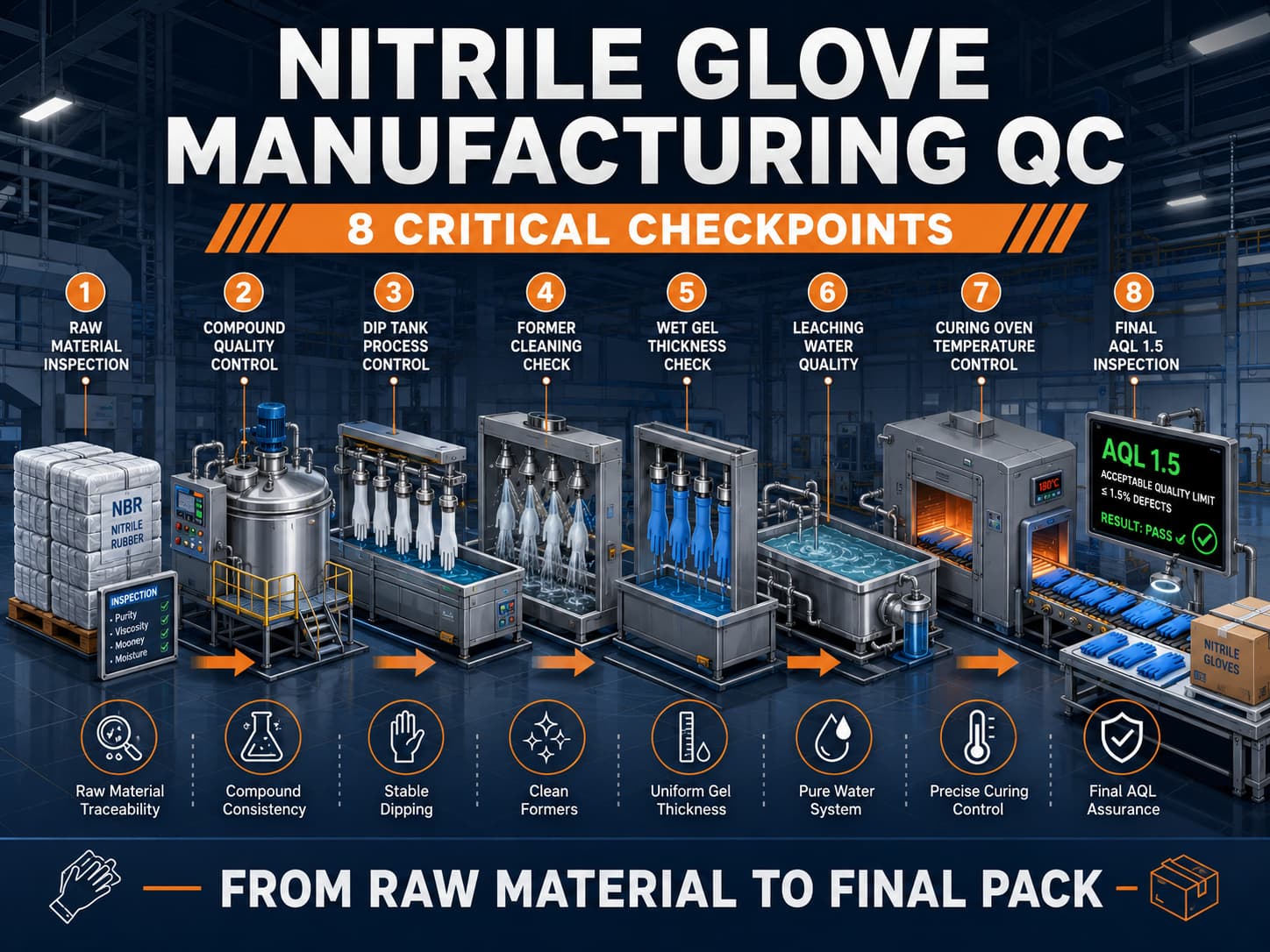
Nitrile rubber glove manufacturing is a continuous chemical process with multiple stages, each requiring specific quality controls. A single missed checkpoint can lead to AQL failure, pinhole defects, or shelf life issues that compromise end-user safety. This guide walks through the 8 critical QC checkpoints from incoming raw material to final packaging, with specific control limits, test frequencies, and corrective actions. Essential reading for quality engineers, procurement auditors, and sourcing professionals evaluating disposable glove suppliers.
1. The 8 Checkpoints at a Glance
#
Checkpoint
Control Parameter
Test Frequency
1
Raw nitrile rubber incoming
Mooney viscosity, ACN content, volatile matter
Per incoming lot
2
Compound preparation
Crosslinker/accelerator/stabilizer dispersion, pH
Every batch (800-1,200 kg)
3
Dipping tank conditions
Temperature, coagulant concentration, viscosity
Continuous / every 30 min
4
Former cleanliness
Surface contamination, residual polymer, temperature
Per cycle (every 60-90 sec)
5
Wet gel film thickness
Coagulant dip time, residence time, draft speed
Every hour
6
Leaching tank water quality
pH, temperature, water hardness, surfactant level
Continuous monitoring
7
Curing oven profile
Temperature uniformity, dwell time, hot spots
Per oven load
8
Final AQL and shelf life
Water leak (AQL 1.5), tensile, elongation, powder
Per batch (ISO 2859-1)
2. Checkpoint 1: Raw Nitrile Rubber Incoming Inspection
Raw nitrile rubber (NBR) is the core material. Incoming inspection verifies that each shipment meets specifications before release to production. Key parameters:
Mooney viscosity: Typically 70-100 ML(1+4) at 100 degrees C. High viscosity indicates harder-to-process material. Low viscosity may indicate degradation or off-spec production. Control: reject lots outside the specification window.
Acrylonitrile (ACN) content: Typically 28-33% for glove-grade NBR. Higher ACN gives better oil resistance but lower flexibility. Control: verify by Kjeldahl nitrogen analysis or FTIR.
Volatile matter: Should be below 0.5% by weight. High volatile content can cause porosity and pinholes during dipping. Control: oven-dry a sample for 2 hours at 105 degrees C.
Contamination check: Visual inspection of bales for foreign particles, dirt, or discoloration. Control: reject contaminated bales.
3. Checkpoint 2: Compound Preparation
The raw nitrile rubber is compounded with crosslinkers (typically zinc oxide and sulfur or peroxide), accelerators (carbamates, thiurams, mercaptobenzothiazoles), stabilizers, pigments (for colored gloves), and processing aids. Critical QC parameters during compounding include:
Mixing time and temperature: Insufficient mixing causes uneven dispersion; excessive mixing causes scorch (premature crosslinking). Control: mill or internal mixer temperature below 100 degrees C; mixing time per recipe.
Dispersion quality: Visual inspection of compound sheets for streaks, lumps, or undispersed material. Control: pass through a straining mesh before transfer to dipping tank.
pH control: The dipping compound should be maintained within a defined pH range (typically 9-11) for stable viscosity and proper coagulation. Control: continuous pH monitoring with auto-dosing.
Viscosity: The compound viscosity affects film thickness and consistency. Control: Brookfield viscosity measurement at 25 degrees C, recorded every batch.
4. Checkpoint 3: Dipping Tank Conditions
The dipping tank holds the compounded nitrile rubber latex. Key parameters:
Parameter
Typical Range
Control Method
Frequency
Compound temperature
22-28 degrees C
Heat exchanger with PID control
Continuous
Compound viscosity
20-60 cP
Brookfield viscometer, automatic
Every 30 min
Total solids content
35-45%
Refractometer or gravimetric oven drying
Every hour
pH
9-11
Continuous pH probe with auto-dosing
Continuous
Mechanical agitation
Continuous, controlled speed
Variable-speed impeller
Continuous
Coagulant dip concentration
Calcium nitrate 5-15% + calcium carbonate
Auto-dosing pump
Continuous
5. Checkpoint 4: Former Cleanliness and Surface
The former (ceramic or metal mold) defines the glove shape. Contamination causes pinholes and defects. Critical controls:
Surface cleanliness: Formers are washed with acid/caustic solutions and brushed between cycles. Control: visual inspection for residual polymer; sample swab testing weekly for residual contaminants.
Surface temperature: Affects film formation. Control: 50-70 degrees C depending on formulation; PID-controlled heater.
Coagulant coating uniformity: The coagulant dip (often calcium nitrate in alcohol) must form a uniform thin film on the former surface before latex dipping. Control: visual inspection and dip weight measurement.
6. Checkpoint 5: Wet Gel Film Thickness
Wet gel thickness determines the final glove thickness. Controls:
Dipping time: Longer dip = thicker film. Control: programmable dip timer, deviation less than +/- 0.5 second.
Withdrawal speed: Affects film uniformity. Control: programmable hoist, deviation less than +/- 5% of set speed.
Drying tunnel temperature and humidity: Affects film formation. Control: 80-120 degrees C with controlled humidity.
Wet film thickness measurement: Sampled using a wet film gauge or by calculation from glove weight and surface area. Control: every hour, track trend.
7. Checkpoint 6: Leaching Tank Water Quality
After dipping, the wet gel is washed in a leaching tank to remove excess surfactants, calcium salts, and unbound additives. Critical parameters:
Parameter
Target
Why It Matters
Frequency
Water pH
6.5-8.0
Affects surfactant removal
Continuous
Water temperature
40-60 degrees C
Drives leaching kinetics
Continuous
Water conductivity
< 50 microS/cm (ion exchange)
Prevents re-deposition of ions on glove surface
Continuous
Surfactant level
0.1-0.5% non-ionic
Maintains wetting for next dipping stage
Daily
Residence time
10-30 min
Sufficient time for leaching
Per cycle
Water turnover
Continuous bleed + makeup
Prevents buildup of impurities
Continuous
8. Checkpoint 7: Curing Oven Profile
The curing (vulcanization) oven crosslinks the nitrile rubber to give final mechanical properties. Critical controls:
Temperature uniformity: Multi-zone oven with independent PID control per zone. Monitor with a multipoint thermocouple probe weekly to verify no hot or cold spots.
Dwell time: Typically 15-30 minutes at 120-140 degrees C. Control: conveyor speed and oven length.
Airflow: Proper airflow prevents cool spots and removes volatiles. Control: weekly airflow verification at multiple positions.
9. Checkpoint 8: Final AQL and Shelf Life Verification
Final QC ensures only conforming gloves leave the factory. Tests per batch:
Test
Method
Acceptance Criterion
Sampling
Water leak (AQL 1.5)
Fill glove with 1,000 mL water, inspect for leaks after 2 min
No droplets
ISO 2859-1, General Level I, AQL 1.5
Tensile strength
ASTM D412 (dumbbell from cuff)
>= 14 MPa (ASTM D6319)
3 samples per batch
Elongation at break
ASTM D412
>= 500% (ASTM D6319)
3 samples per batch
Powder residue
ASTM D6319 section 9 (if powder-free)
<= 2 mg per glove
2 samples per batch
Dimensions (width, length, thickness)
ASTM D6319 section 6
Within specified tolerance
5 samples per batch
Accelerated aging
ASTM D7160 (70 degrees C, 7 days)
Pass tensile + AQL after aging
1 sample set per week
Visual defects
Inspection booth
No holes, tears, discoloration, foreign matter
100% or AQL sampling
If any test fails, the batch is reworked or rejected. Batch-level test reports are generated and must accompany each shipment for procurement verification.
10. Buyer Audit Checklist
When auditing a potential supplier, verify the 8 checkpoints are actively controlled. Request:
Recent (within 6 months) raw material test records
Compound batch records with mixing time, temperature, viscosity
Dipping tank monitoring logs (24-hour continuous)
Former cleaning CIP (clean-in-place) records and swab test results
Wet film thickness trend charts
Leaching tank water analysis records (pH, conductivity, surfactant)
Oven temperature profiling reports from each oven
Final AQL test reports per batch with K-values per ISO 2859-1
Accelerated aging reports (ASTM D7160 or EN 455-4)
Customer complaint and CAPA (Corrective Action/Preventive Action) log
FAQ
Q: What are the most critical QC checkpoints in nitrile glove manufacturing?
A: The 8 most critical QC checkpoints are: (1) raw nitrile rubber incoming inspection (Mooney viscosity, ACN content), (2) compound preparation (crosslinker, accelerator, stabilizer dispersion), (3) dipping tank temperature and coagulant concentration, (4) former (mold) cleanliness and surface temperature, (5) wet gel film thickness control, (6) leaching tank pH and water quality, (7) curing oven temperature uniformity and dwell time, and (8) final post-cure inspection (AQL water leak, tensile strength, elongation, powder residue). Each checkpoint has specific control limits and frequency.
Q: How often should QC testing be performed during production?
A: Frequency varies by checkpoint. Raw material testing is per-lot (each incoming shipment). Compound preparation testing is every batch (typically 800-1,200 kg). Dipping and former checks are continuous or every 30 minutes. Wet gel thickness is typically checked every hour. Leaching tank pH is monitored continuously. Curing oven profiling is done per oven load. Final AQL is per batch per ISO 2859-1 sampling plans. The key is that QC data is traced to specific lot/batch numbers for traceability.
Q: What is the difference between AQL 1.5 and AQL 2.5 for nitrile gloves?
A: AQL (Acceptable Quality Level) is the maximum acceptable percentage of defective items in a sample. AQL 1.5 means the sample can have at most 1.5% defective units; AQL 2.5 allows up to 2.5%. AQL 1.5 is required for medical examination gloves (EN 455-1, ASTM D6319). AQL 2.5 is typical for industrial gloves. A lower AQL means tighter quality but more rejected units during production. Most manufacturers achieve actual defect rates well below the AQL limit.
Q: What causes pinholes in nitrile rubber gloves and how are they detected?
A: Pinholes are tiny defects that compromise the glove's barrier function. Common causes include: contaminated former surface (residual polymer, dirt), improper coagulant dipping (uneven film formation), foreign particles in the compound, air bubbles trapped in latex, and mechanical damage during stripping. Pinholes are detected by the water leak test (AQL 1.5 sampling): the glove is filled with water and visually inspected for droplets or wet spots. Failed gloves are rejected.
Q: How is shelf life determined for nitrile medical examination gloves?
A: Shelf life is determined through accelerated aging tests per ASTM D7160 or EN 455-4 protocols. Samples are aged at elevated temperature (typically 70 degrees C) for a defined period, then tested for tensile strength, elongation, and AQL water leak. The aging time is extrapolated to estimate real-time shelf life at 25 degrees C storage. Typical nitrile rubber gloves have a 3-5 year shelf life when stored properly (10-30 degrees C, below 65% relative humidity, away from direct sunlight).



 Network Supported