
welcome to Jixiang E-commerce!
welcome to Jixiang E-commerce!
Choosing the wrong disposable glove supplier can cost you compliance, reputation, and money. Here are the 7 essential checks every buyer should run — from certifications to factory audits — before signing a contract. Updated for 2026.
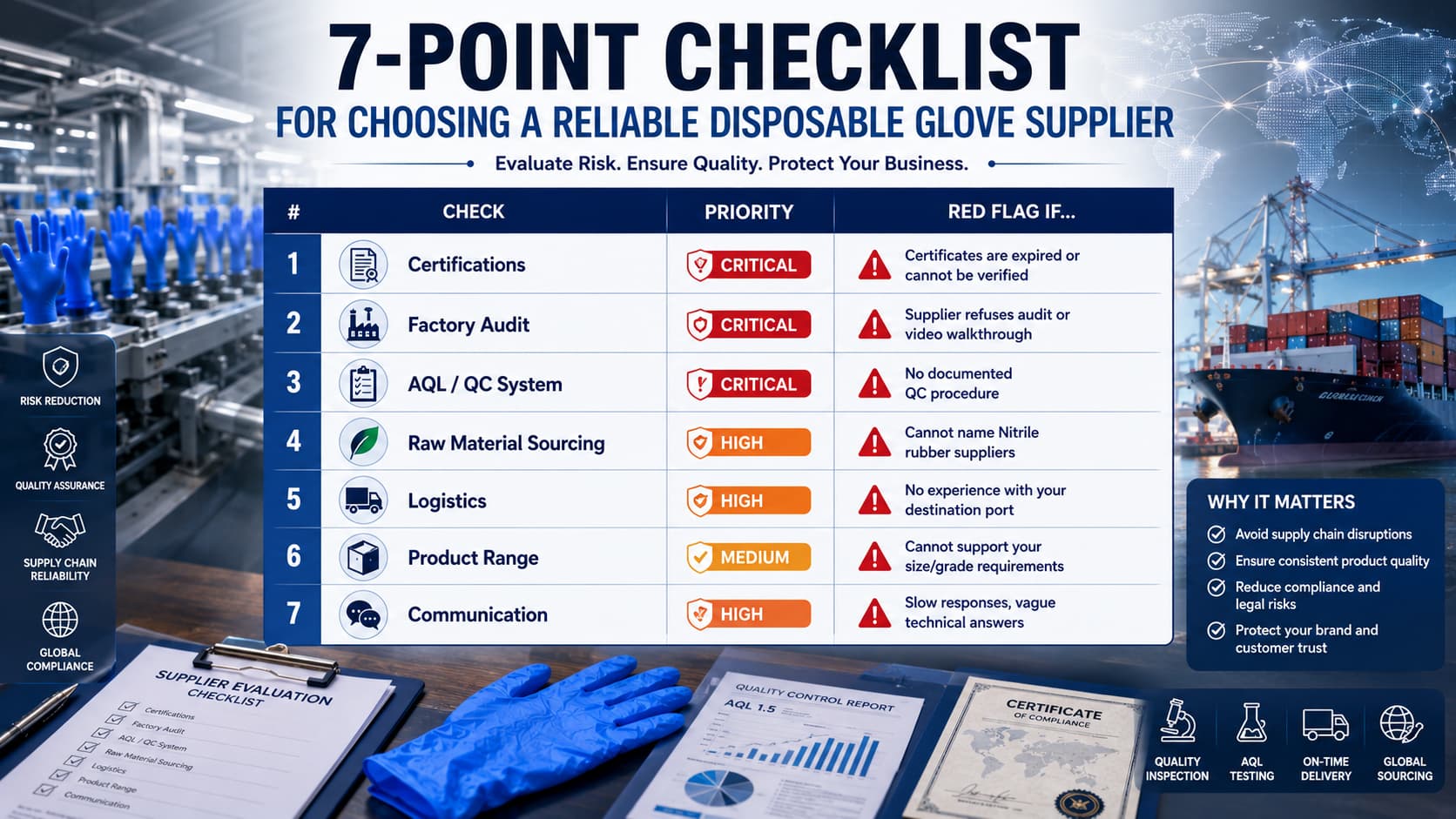
Choosing a disposable glove supplier is not just about finding the lowest price per carton. It is about verifying that the supplier can consistently deliver gloves that meet your target market's regulatory requirements, perform as expected in your application, and arrive on time — every time. A supplier evaluation should cover certifications, factory capability, quality control systems, raw material traceability, logistics reliability, and after-sales support. This article walks through seven essential checks you should perform before committing to a supplier.
1. Verify Certifications Relevant to Your Market
Certifications are the first filter. Different markets require different standards, and a supplier without the right certifications is a non-starter.
|
Market |
Required Certifications |
Key Standard |
|
Europe (Medical) |
CE Mark + EN 455 |
EN 455-1/2/3/4 |
|
Europe (PPE) |
CE Mark + EN 374 |
EN 374-1/2/3/4 |
|
GCC / Saudi Arabia |
GSO 4872 + SABER |
GSO 4872 |
|
Middle East / SE Asia |
Halal Certification |
— |
|
Global (Quality System) |
ISO 13485 / ISO 9001 |
ISO 13485 |
|
Global (Cleanroom) |
GMP / ISO 14644 |
ISO Class 8+ |
Pro tip: Ask the supplier to send you copies of the actual certificates — not just a list on their website. Verify the issuing body and expiration date. A genuine ISO 13485 certificate can be checked against the issuing notified body's online database.
2. Audit the Factory — Physically or Virtually
A certification on paper means little if the factory floor doesn't match. The best approach is an on-site audit, but if travel is not feasible, request a live video walkthrough.
During the audit, pay attention to:
• Cleanroom classification: Medical-grade gloves require at least ISO Class 8 (Class 100,000). Look at air filtration systems, gowning protocols, and particle count logs.
• Production line automation: Fully automated lines reduce human contact and contamination risk.
• Raw material storage: Nitrile rubber (nitrile butadiene rubber emulsion, not natural rubber latex) and PVC resin should be stored in temperature-controlled environments.
• Water treatment: The factory should have an on-site water treatment system.
A supplier that hesitates to share audit results is a red flag.
3. Understand Quality Control (QC) and AQL Levels
Quality control in glove manufacturing revolves around AQL sampling, defined in ISO 2859-1. The industry standard for medical examination gloves is AQL 1.5 for pinhole testing.
|
Application |
Recommended AQL |
Standard |
|
Medical Examination |
AQL 1.5 |
EN 455-1 |
|
Food Handling |
AQL 2.5 |
— |
|
Industrial Use |
AQL 4.0 |
— |
|
Cleanroom / Lab |
AQL 1.0 or lower |
ISO 14644 |
4. Check Raw Material Sourcing and Price Stability
In 2025–2026, the disposable glove industry has been heavily impacted by raw material cost volatility. Nitrile rubber and PVC resin are both petrochemical derivatives, meaning their prices are closely tied to crude oil markets.
Key facts (Source: ICIS, May 2026):
• Strait of Hormuz tensions have added a risk premium of approximately $5–8/barrel to crude oil since late 2025.
• Nitrile rubber prices rose approximately 18–22% year-over-year in Q1 2026.
• PVC resin costs in Asia increased roughly 12–15% over the same period.
A reliable supplier should be transparent about their raw material sourcing.
5. Evaluate Logistics and Delivery Reliability
A perfect product that arrives three months late is useless.
|
Factor |
What to Check |
|
Production Lead Time |
Standard: 25–40 days from order confirmation |
|
Shipping Port |
Proximity to major container ports (e.g., Xiamen, Shanghai, Ningbo) |
|
Freight Options |
FOB vs CIF; ability to handle LCL and FCL |
|
Documentation |
Bill of Lading, Certificate of Origin, packing list accuracy |
|
Customs Clearance |
Experience with your destination country's import procedures |
6. Assess Product Range and Customization Capability
A good supplier should offer a range that matches your needs — and be able to adapt as those needs change.
Product range checklist:
☐ Nitrile gloves (industrial, medical, food-grade)
☐ Vinyl/PVC gloves
☐ Latex gloves
☐ Multiple sizes (XS to XXL)
☐ Multiple colors (blue, black, white, orange, etc.)
☐ Powder-free only (powdered gloves are increasingly banned)
☐ Custom packaging and private labeling
7. Test Communication and After-Sales Support
This is the most overlooked factor — and often the most important.
Red flags in communication:
• Takes more than 24 hours to reply to a standard inquiry
• Cannot provide clear answers to technical questions about their own product
• Refuses to share documentation (test reports, certificates, MSDS)
• Pushes for payment before providing samples
FAQ
Q1: What is the most important certification for medical gloves sold in Europe?
A: CE marking under EU MDR 2017/745, supported by EN 455 compliance (all four parts).
Q2: How much does a factory audit typically cost?
A: Between $2,000 and $5,000 depending on scope, location, and audit body. Many suppliers share recent audit reports at no cost.
Q3: What does AQL 1.5 actually mean?
A: A batch passes if defective units in the sample do not exceed the acceptance number for that sample size. For a typical lot of 500,000 gloves, ~315 are tested and the batch passes if ≤10 fail.
Q4: Should I choose nitrile or vinyl gloves for food handling?
A: Nitrile is generally preferred — better puncture resistance, chemical resistance against fats/oils, and more secure fit. Both must be certified food-grade.
Q5: What should I do if I receive a batch with quality issues?
A: Document with photos, retain samples, and send a formal complaint within your contract timeframe (typically 7–30 days). Request replacement, credit, or discount.
Q6: How do I verify a supplier's Halal certification?
A: Request the certificate, note the issuing body (JAKIM, MUI, CICOT, ESMA), and verify the certificate number on the body's online portal.
At JIXIANG, we provide complete documentation across all seven check areas.
Visit https://www.jxgloves.com/contact for our supplier evaluation package.
Please read on, stay posted, subscribe, and we welcome you to tell us what you think.


Copyright 2026@ Fujian Jixiang E-commerce Co., Ltd All Rights Reserved.
Sitemap |
Blog
|
Xml |
Privacy Policy
 Network Supported