ASTM D6978 Explained - Chemotherapy Drug Permeation Testing for Medical Gloves
Jul 29, 2026
ASTM D6978 is the FDA-referenced standard for testing chemotherapy drug permeation through medical gloves. Learn the 9 test drugs, methodology, pass criteria, and which materials qualify.
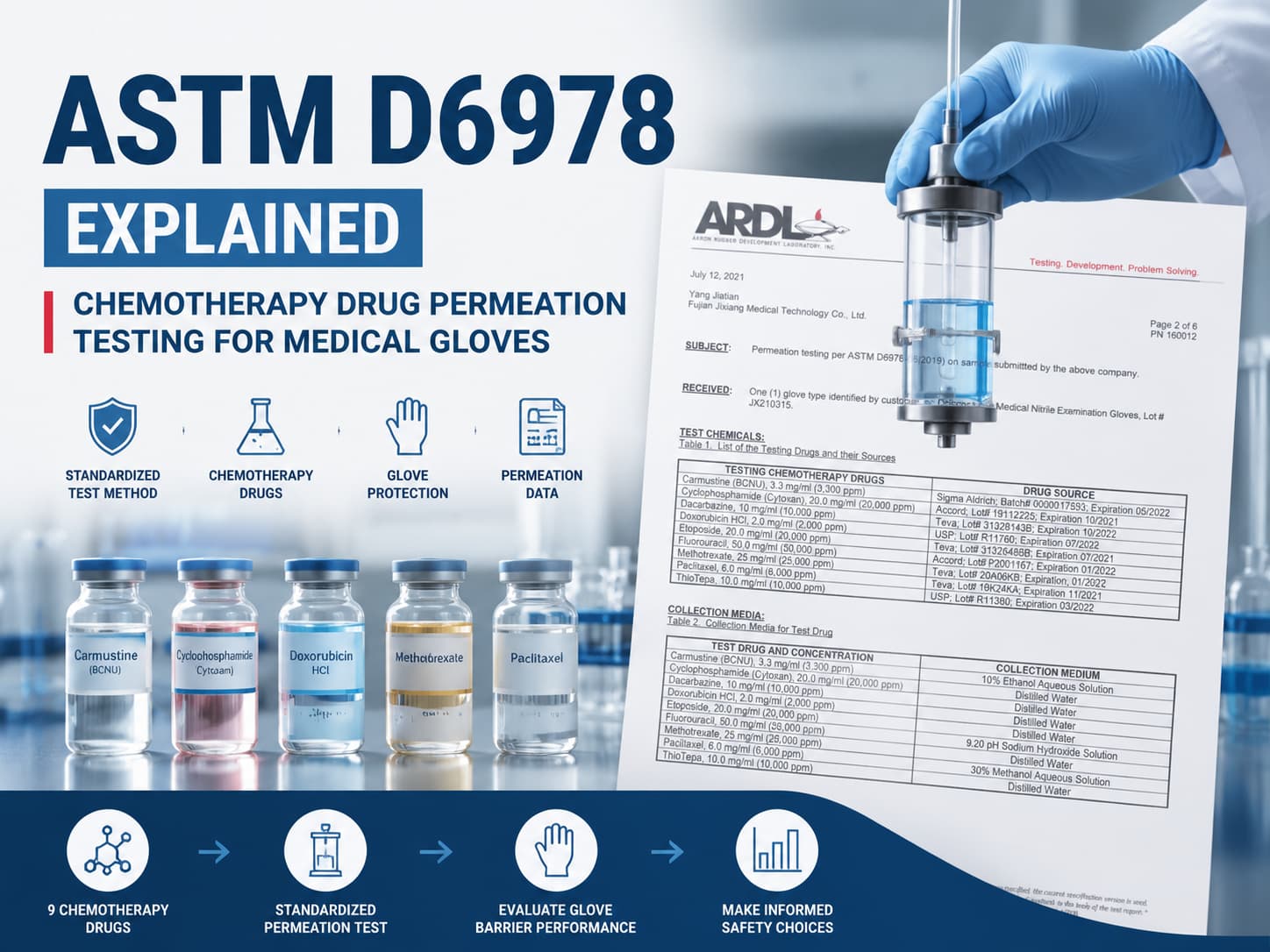
ASTM D6978 is the standard test method for assessing the resistance of medical gloves to permeation by chemotherapy drugs. It is the primary standard referenced by the FDA for evaluating whether a glove can be labeled as "chemotherapy tested" in the United States. For procurement teams supplying oncology, hematology, and pharmacy compounding departments, understanding this standard is essential for patient and worker safety.
1. What Is ASTM D6978?
ASTM D6978 (Standard Practice for Assessment of Resistance of Medical Gloves to Permeation by Chemotherapy Drugs) specifies a standardized method for measuring how long a medical glove can resist the permeation of specific oncology drugs. The standard was developed because general chemical permeation standards such as EN 374 do not adequately represent the unique molecular properties and concentrations of chemotherapy agents used in clinical practice.
In the US, the FDA references ASTM D6978 in its 510(k) review process for gloves that carry chemotherapy-related claims. Gloves that pass the standard may be labeled as tested for chemotherapy drug permeation, but the specific drugs tested and breakthrough times must be documented in the Technical Data Sheet (TDS).
2. The Nine Chemotherapy Test Drugs
ASTM D6978 requires testing against 9 chemotherapy drugs that represent a range of molecular sizes, solubilities, and clinical usage patterns. These drugs were selected because they are among the most commonly handled hazardous drugs in oncology practice.
#
Drug Name
Class
Clinical Use
1
Carmustine (BCNU)
Alkylating agent
Brain tumors, lymphoma
2
Cisplatin
Platinum compound
Solid tumors, testicular, ovarian
3
Cyclophosphamide
Alkylating agent
Leukemia, lymphoma, breast
4
Dacarbazine
Alkylating agent
Melanoma, Hodgkin lymphoma
5
Doxorubicin HCl
Anthracycline
Breast, leukemia, sarcoma
6
Etoposide
Topoisomerase inhibitor
Lung, testicular, lymphoma
7
5-Fluorouracil (5-FU)
Antimetabolite
Colorectal, breast, gastric
8
Ifosfamide
Alkylating agent
Sarcoma, testicular, lymphoma
9
Paclitaxel
Taxane
Breast, ovarian, lung
3. Test Methodology
The test uses a two-chamber permeation cell. The chemotherapy drug solution is placed in one chamber, and the glove material is clamped between the two chambers as a barrier. The collecting medium in the second chamber is then analyzed at timed intervals to detect whether the drug has permeated through the glove material.
The key performance metric is the permeation rate, measured in micrograms per square centimeter per minute (ug/cm2/min). A glove passes the standard if the permeation rate does not exceed 0.01 ug/cm2/min for each of the 9 drugs over the test period, which typically runs for 240 minutes (4 hours).
4. ASTM D6978 vs EN 374: Key Differences
Factor
ASTM D6978
EN 374
Scope
Chemotherapy drug permeation
Industrial chemical permeation
Number of test chemicals
9 oncology drugs
18 industrial chemicals
Test duration
240 minutes
Typically 480 minutes
Pass criterion
Permeation rate <= 0.01 ug/cm2/min
Breakthrough time classification (Type A/B/C)
Primary market
United States (FDA)
European Union (MDR)
Typical use
Oncology/chemotherapy gloves
Chemical/industrial PPE gloves
5. Which Glove Materials Pass?
Material performance varies significantly under ASTM D6978 testing:
Nitrile rubber gloves: Typically pass all 9 drugs with breakthrough times exceeding 240 minutes. Nitrile rubber is the recommended material for chemotherapy drug handling.
Natural rubber latex gloves: Generally perform well, passing most or all 9 drugs. However, latex allergy risk must be considered.
PVC (vinyl) gloves: Often fail one or more of the 9 drugs. PVC is not recommended for chemotherapy drug handling.
Thickness factor: Thicker gloves (e.g., 6-8 mil) generally provide longer breakthrough times than thinner gloves (3-4 mil). However, thickness alone does not guarantee ASTM D6978 compliance.
6. Procurement Implications
Verify that the Technical Data Sheet (TDS) explicitly references ASTM D6978 and lists the 9 drugs tested.
Be cautious of vague claims such as "chemo-safe" or "chemotherapy compatible" without an ASTM D6978 reference.
Confirm the Certificate of Conformity (CoC) includes chemotherapy permeation test results.
For EU markets, check for both ASTM D6978 (US) and EN 374 Type A (EU) dual certification where applicable.
Ensure that procurement specifies nitrile rubber gloves with minimum 5 mil thickness for oncology use.
FAQ
Q: What is the difference between ASTM D6978 and EN 374?
A: ASTM D6978 specifically tests chemotherapy drug permeation through medical gloves using 9 oncology drugs. EN 374 tests chemical permeation using a broader list of 18 industrial chemicals. They serve different purposes and a glove may meet both standards.
Q: Which chemotherapy drugs are tested under ASTM D6978?
A: The standard requires testing with 9 drugs: carmustine (BCNU), cisplatin, cyclophosphamide, dacarbazine, doxorubicin hydrochloride, etoposide, 5-fluorouracil (5-FU), ifosfamide, and paclitaxel.
Q: Can PVC (vinyl) gloves be used for chemotherapy handling?
A: PVC gloves generally do not pass ASTM D6978 testing for all 9 chemotherapy drugs. Nitrile rubber and natural rubber latex gloves typically perform better. PVC gloves are not recommended for chemotherapy drug handling.
Q: How long must a glove resist permeation under ASTM D6978?
A: The test typically runs for 240 minutes. A glove must demonstrate a permeation rate that does not exceed 0.01 micrograms per square centimeter per minute for each drug tested.
Q: How can I verify that a glove is chemotherapy-tested?
A: Check the Technical Data Sheet (TDS) and Certificate of Conformity (CoC) for explicit reference to ASTM D6978. Be cautious of vague claims like 'chemo-safe' without a specific standard reference.



 Network Supported