welcome to Jixiang E-commerce!

Blog

Home

Blog

  • Middle East PPE Market 2026: Which Industries Are Driving Glove Demand and What Buyers Need to Know
    Middle East PPE Market 2026: Which Industries Are Driving Glove Demand and What Buyers Need to Know
    May 29, 2026
       The Middle East PPE market is expanding rapidly across healthcare, food processing, and oil & gas sectors. Here is a data-driven industry analysis for glove buyers and distributors in the Gulf region.     For glove manufacturers and distributors watching global demand patterns in 2026, the Middle East — and particularly the Gulf Cooperation Council (GCC) states — stands out as one of the most structurally compelling growth markets in the world. This is not a story about a single spike in demand. It is about a confluence of regulatory tightening, economic diversification, healthcare infrastructure expansion, and a growing food safety culture that is systematically increasing the need for certified disposable gloves across multiple sectors. Below, we break down the key industries driving demand and what buyers in the region need to know when sourcing.   1. Healthcare and Medical: The Foundation of Demand The GCC healthcare sector is undergoing its most ambitious expansion in a generation. Saudi Arabia is investing over USD 65 billion in healthcare infrastructure under Vision 2030, targeting 96 hospital beds per 100,000 population by 2030 (up from around 22 in recent years). The UAE has similarly expanded its network of hospitals, day-surgery centers, and specialist clinics, particularly in Dubai and Abu Dhabi. For glove procurement, this means:     • Rapid growth in demand for EN 455-compliant medical examination gloves     • Increasing preference for nitrile over latex (due to latex allergy protocols in modern hospitals)     • GSO certification is now a procurement baseline, not a differentiator, across Saudi Arabia, UAE, Qatar, Kuwait, Bahrain, and Oman     • Bulk tender procurement cycles (annual or biannual) are the norm — locking in certified suppliers early is critical Key insight: Distributors serving the healthcare sector in the Gulf must prioritize CE + GSO dual certification and maintain consistent documentation (Declaration of Conformity, CE test reports, batch certificates) to survive tender processes.   2. Food Processing and the Rise of Food Safety Culture The GCC food processing sector is being transformed by two parallel forces: Vision 2030 agricultural and food security investments in Saudi Arabia, and increasingly stringent food safety enforcement across the region. Saudi Arabia's National Agriculture Development Company (NADEC) and similar state-backed food producers are scaling up local production — requiring food-grade PPE at scale. Meanwhile, the UAE's Dubai Food Safety Authority and similar bodies have significantly tightened inspection protocols for food handlers. What this means for glove buyers:     • Food-grade nitrile (blue, white, or black) with EN 374 certification is now a minimum requirement for many large food operators in the region     • Color-coded glove programs (HACCP-compliant) are being mandated by hotel chains, hospital kitchens, and food processing plants     • Halal-compliant manufacturing documentation is increasingly requested by distributors serving Saudi and Kuwaiti food clients     • Demand for powder-free, accelerator-free variants is growing as awareness of occupational allergy increases   3. Oil, Gas, and Petrochemicals: High-Value Industrial PPE The Middle East remains the world's most significant hydrocarbon production region, and the oil and gas sector generates some of the most technically demanding glove procurement requirements in any industry. Workers in refineries, LNG facilities, offshore platforms, and petrochemical plants face daily exposure to hydrocarbons, solvents, and aggressive cleaning chemicals. Standard examination-grade nitrile (3.5–4.5 mil) is insufficient for these environments. The industry standard is:     • Heavy-duty nitrile (8mil and above) for chemical resistance in refinery environments     • EN 374-3 chemical permeation resistance testing is a procurement requirement for major operators (Saudi Aramco, ADNOC, QatarEnergy supply chains)     • ESD (electrostatic discharge) or specific color requirements may apply in certain facility zones Procurement note: GCC energy sector procurement often requires compliance documentation for the entire supply chain. Suppliers who can provide IFU (Instructions for Use) in Arabic, along with complete technical data sheets, gain significant advantages in tender submissions.   4. Construction and Infrastructure The GCC is in the midst of a generational infrastructure boom. Saudi Arabia's NEOM, Qatar's post-World Cup construction sector, and the UAE's ongoing urban development projects are employing hundreds of thousands of workers who require PPE. Construction-grade glove requirements:     • Medium to heavy-duty nitrile (5–8 mil) for general construction, concrete handling, and painting tasks     • EN 388 cut and abrasion resistance standards apply for tasks involving sharp materials     • High volume, cost-sensitive procurement — buyers prioritize price per unit alongside basic compliance   5. Hospitality and Retail: A Growing but Underestimated Segment The Gulf region's massive hospitality sector — from five-star hotels in Dubai to Mecca's Hajj season accommodation infrastructure — is an often-overlooked glove buyer. Housekeeping, laundry, food preparation, and cleaning operations across the region's hotels, hospitals, and malls create consistent baseline demand for food-grade and general-purpose nitrile gloves year-round. The Hajj and Umrah seasons (which in 2026 will again see millions of pilgrims) create predictable procurement spikes for medical and food-handling gloves across Mecca and Medina.   What This Means for Sourcing Strategy For distributors and procurement managers in the Gulf, the key takeaways are:     • Dual certification (CE + GSO) is the minimum entry point for the healthcare and food sectors     • Technical documentation in Arabic strengthens your position in government and energy sector tenders     • Plan procurement cycles around Hajj season (April–June) when regional demand peaks sharply     • The raw material cost trajectory in 2026 — driven by oil price volatility and rising petrochemical feedstock costs — means locking in annual contracts now is strategically sound. Nitrile's key raw materials (butadiene and acrylonitrile) are directly correlated with crude oil prices, which have been under upward pressure.     • Supplier reliability — including consistent documentation, lead times, and certification maintenance — matters more in this market than the cheapest unit price   At Jixiang (LYEEANG brand), we have been supplying the GCC market with CE and GSO-certified nitrile, PVC, and latex gloves for years. Our export team provides full documentation support — in English and Arabic where needed — for distributors navigating the Gulf's procurement landscape. Learn more at www.jxgloves.com or contact us for a market-specific product recommendation. About Fujian Jixiang E-commerce Co., Ltd. With over 20 years of experience, we specialize in manufacturing high-quality disposable gloves. Why Choose Us? ·        ✅ Factory-direct pricing ·        ✅ ISO/CE/FDA certified products ·        ✅ OEM/ODM customization ·        ✅ Global shipping to 50+ countries    
  • How to Store Disposable Gloves Correctly: Shelf Life, Degradation & Best Practices for Distributors
    How to Store Disposable Gloves Correctly: Shelf Life, Degradation & Best Practices for Distributors
    May 26, 2026
    Did you know improper storage can cut a nitrile glove's effective lifespan by half? Learn the science behind glove degradation and the warehouse best practices every distributor should follow. When distributors and procurement managers think about glove quality, they focus on certifications, thickness, and chemical resistance. Rarely does anyone ask the question that determines whether all that quality actually reaches the end user: How are these gloves being stored? The reality is that a premium nitrile glove stored incorrectly can degrade faster than a lower-grade product stored properly. Shelf life management is one of the most overlooked aspects of PPE supply chain management — and one that directly impacts your customers' safety and your returns/complaints rate.   What Causes Disposable Gloves to Degrade? Disposable nitrile, PVC, and latex gloves are polymer-based products. Their physical properties — elasticity, tensile strength, puncture resistance — are sensitive to environmental conditions. The main degradation factors are: 1. UV Light and Ozone Nitrile rubber is particularly vulnerable to ozone exposure. Ozone breaks the polymer chains in nitrile, causing the glove to become brittle, develop micro-cracks, and ultimately lose its barrier integrity. Even indirect sunlight through warehouse windows can cause cumulative damage over weeks. 2. Heat High temperatures accelerate chemical aging in all polymer gloves. EN 455-4 (which governs medical glove shelf life testing) specifies that gloves should be stored below 30°C. In Middle Eastern warehouse environments — where ambient temperatures can exceed 45°C in summer — without proper climate control, glove integrity can deteriorate significantly within a single storage season. 3. Humidity and Moisture While moderate humidity (40–70% RH) is acceptable, excessive moisture can cause gloves to stick together (blocking), degrade the inner coating, and in extreme cases, promote mold growth on the packaging. Conversely, extremely dry air causes latex and some nitrile formulations to crack. 4. Chemical Contamination Gloves stored near solvents, acids, oils, or cleaning chemicals can absorb these substances through packaging. This is especially problematic for medical-grade gloves where chemical contamination would disqualify them for use. 5. Compression and Physical Stress Stacking too many cartons high — or storing gloves under heavy items — compresses glove packages and can cause permanent deformation, leading to gloves that no longer unfold correctly or that develop stress points prone to tearing.   Standard Shelf Life: What the Regulations Say Different glove types have different standard shelf lives under proper storage conditions:   Important: These shelf lives assume compliance with recommended storage conditions. Improper storage can invalidate these timelines and void any quality guarantees.   Best Practice Storage Guidelines for Distributors Temperature: Store between 10°C and 25°C. Never exceed 30°C. For Gulf region warehouses, air-conditioned storage is not optional — it is essential for maintaining glove integrity. Humidity: Maintain relative humidity between 40% and 70%. Use dehumidifiers or silica gel packs in high-humidity regions (Southeast Asia wet season). Light: Store gloves away from direct sunlight and UV sources. Use opaque or UV-blocking packaging and ensure warehouse windows are screened or tinted. Ozone: Keep gloves away from ozone-generating equipment such as electric motors, fluorescent lights, and UV sterilizers. Maintain ozone levels below 0.1 ppm in storage areas. Stacking: Follow carton stacking limits printed on packaging (typically maximum 10 cartons high for standard boxes). Do not place heavy items on top of glove inventory. FIFO Rotation: Always apply First In, First Out (FIFO) stock rotation. This is especially critical for medical-grade inventory approaching 3-year limits. Separate storage: Do not store gloves in the same area as solvents, cleaning agents, lubricants, or any volatile chemicals.   How to Inspect Gloves Before Use (End-User Checklist) Even correctly stored gloves should be inspected before distribution to end users:   A Note on Labelling and Traceability All Jixiang (LYEEANG brand) glove cartons include manufacture date, lot number, and recommended storage conditions in compliance with EN 455 and GSO requirements. For distributors managing large inventories across multiple warehouses, we strongly recommend implementing a barcode or RFID-based lot tracking system tied to manufacture date. If you need customized labelling that includes storage instructions in Arabic, French, or other languages for your specific market — our OEM team can accommodate this.   Summary Glove quality is not just about what comes out of the factory — it is equally about what happens in the supply chain between factory and end user. Proper storage is the invisible quality guarantee that protects your investment and your customers. Questions about shelf life, storage requirements, or lot traceability for your next order?Contact our technical team at www.jxgloves.com. About Fujian Jixiang E-commerce Co., Ltd. With over 20 years of experience, we specialize in manufacturing high-quality disposable gloves. Why Choose Us? ·        ✅ Factory-direct pricing ·        ✅ ISO/CE/FDA certified products ·        ✅ OEM/ODM customization ·        ✅ Global shipping to 50+ countries  
  • The Strait of Hormuz, Oil Prices & Your Glove Supply Chain in H2 2026
    The Strait of Hormuz, Oil Prices & Your Glove Supply Chain in H2 2026
    May 21, 2026
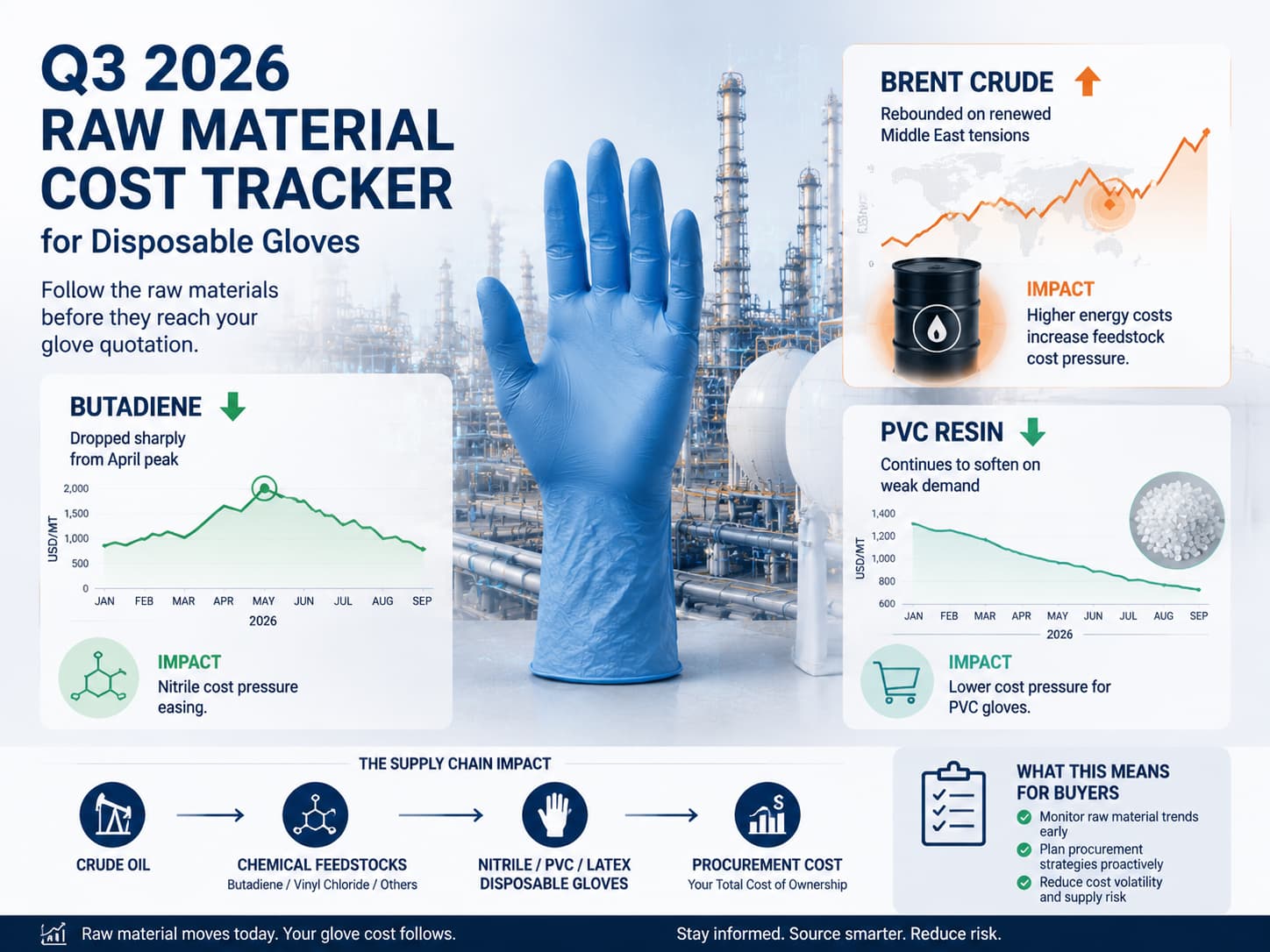
      In the first week of May 2026, geopolitical escalation in the Gulf region pushed the Strait of Hormuz back into global headlines. For most buyers of industrial and medical supplies, this feels like a distant macro event. But for anyone sourcing disposable gloves — particularly nitrile and PVC — it is an immediate and direct supply chain issue. Here is the mechanism, the current status, and what it means for your procurement decisions in the second half of 2026. Why the Strait of Hormuz Matters to Glove Buyers The Strait of Hormuz is the world's most critical oil chokepoint. Approximately 20–21% of global crude oil shipments pass through this 34-kilometer-wide passage between Oman and Iran. Any event that disrupts — or threatens to disrupt — transit through the strait sends crude oil prices higher within hours. Nitrile gloves are made from NBR (Nitrile Butadiene Rubber), which is derived from two petroleum-based feedstocks: butadiene and acrylonitrile. PVC gloves are made from polyvinyl chloride, which uses ethylene as its primary feedstock. Both butadiene and ethylene are directly linked to crude oil pricing through the petrochemical supply chain. When crude oil prices rise, the cost of producing NBR and PVC rises within the same quarter — sometimes within weeks. There is no buffer, no lag of quarters. Glove manufacturers pay more for raw material, and that cost flows into the price of finished goods. What We Are Seeing in Q2 2026 Based on publicly available petrochemical pricing data and industry reporting, butadiene prices in Asian markets have risen approximately 12–18% in Q1–Q2 2026 compared to the same period in 2025. Ethylene prices show a similar trajectory. For disposable glove buyers, this translates into quoted prices that are higher than Q4 2025 levels — and it is not a temporary fluctuation. The structural driver is not just current crude oil supply. Markets are now pricing in a persistent risk premium for Gulf transit disruption. That premium does not disappear when a headline fades. It becomes a floor under petrochemical prices for as long as the risk perception remains. For buyers in the Middle East, this is a direct cost pressure: your supplier's raw material costs are rising, and the finished glove price will follow.   What Savvy Buyers Are Doing Right Now The buyers who have the strongest supplier relationships in the current market are not necessarily those with the lowest prices — they are those who locked their 12-month supply agreements in Q4 2025, before the current geopolitical situation escalated. They are protected through the first half of 2026, and in some cases into early 2027. For buyers who did not lock in a long-term agreement, the picture is different. Spot prices are higher. The window to lock in pricing for the rest of 2026 is narrowing. Here is what leading procurement managers are prioritizing: 1. Moving from spot purchasing to forward contracts: Even a 6-month agreement at current prices provides protection against further escalation. The cost of waiting is asymmetric — the downside of waiting outweighs the upside of a modest price decrease. 2. Reviewing supplier inventory and lead times: Manufacturers who have pre-purchased raw material stocks are in a better position to honor current pricing. Buyers should ask about a supplier's raw material sourcing strategy — not just their current price. 3. Considering alternative specifications: In some cases, reviewing glove thickness requirements may open access to a lower price tier without compromising core protection requirements. This is a specification optimization conversation, not a quality compromise. 4. Building contingency into budgets: For buyers in regulated industries (healthcare, food processing), the cost of inadequate glove supply during a period of price volatility can far exceed the cost of the gloves themselves. Budget contingency planning is part of PPE risk management. A Note on What This Article Is Not This is not a market forecast from a financial analyst, and it is not a sales pitch. The data points referenced are publicly available — from OPEC reporting, petrochemical trade publications, and standard industry sources. The purpose is to help procurement professionals understand the structural dynamics that are currently affecting glove pricing, so they can make more informed decisions. Whether or not you purchase from a Chinese manufacturer, from a regional distributor, or from any specific supplier — a buyer who understands their supply chain is always in a stronger negotiating position. The Takeaway for H2 2026 The link between Gulf geopolitics and glove prices is not an abstract concept — it is an immediate operational reality. For buyers in the Middle East, Southeast Asia, and Europe who rely on nitrile and PVC gloves for their operations, the second half of 2026 is a period that rewards proactive procurement planning, not reactive purchasing. Understanding the market is the first step. The second step is having a supply chain partner who can translate that understanding into contract structures that protect your business. For procurement teams who want to discuss specification options, volume commitments, or forward contract structures for H2 2026, conversations are available on request — no commitment required. 👉 Contact us via the channels below and mention “H2 2026 glove procurement inquiry” About Fujian Jixiang E-commerce Co., Ltd. With over 20 years of experience, we specialize in manufacturing high-quality disposable gloves. Why Choose Us? ·        ✅ Factory-direct pricing ·        ✅ ISO/CE/FDA certified products ·        ✅ OEM/ODM customization ·        ✅ Global shipping to 50+ countries     Contact Us: info@jxgloves.com  
  • 7 Glove Mistakes That Are Costing You More Than You Think
    7 Glove Mistakes That Are Costing You More Than You Think
    May 19, 2026
      The conversation about glove quality usually starts and ends with certifications, thickness, and price per carton. But in our 8+ years of working with procurement teams across the Middle East, Southeast Asia, and Europe, we've seen a pattern that certification tests never capture: most glove waste is behavioral, not material. These are the mistakes that silently erode your PPE budget — and how to address them at an operational level, not just a purchasing one. Mistake 1: Doubling Up Gloves "Just to Be Safe" This one is surprisingly common in healthcare and food processing, and it is genuinely counterproductive. The practice of wearing two gloves simultaneously — typically a nitrile over a latex, or two layers of the same type — creates a false sense of security while actually reducing tactile sensitivity. When dexterity drops, workers compensate by forcing movements, gripping harder, and removing the outer glove more frequently. A single, quality-certified glove at the correct thickness is almost always more protective in practice than two mismatched layers. What to do instead: Invest in the right single glove for the task. If chemical splash protection is a concern, specify EN 374 certified gloves — not double gloves. Mistake 2: Wearing Gloves Beyond the Recommended Duration Nitrile gloves are not designed for indefinite wear. EN 455 specifies maximum continuous wear recommendations based on the task environment. In high-heat conditions common in GCC food kitchens and industrial facilities, glove material degrades faster — sweat accelerates the breakdown of the polymer structure. The result: Micro-perforations that are invisible to the naked eye, occurring as early as 15–30 minutes into wear in extreme conditions. A glove that passes AQL testing at the factory may no longer be intact after extended use in a hot environment. What to do instead: Establish task-based change intervals. In high-heat or high-exposure environments, shorter change cycles cost less than the liability of a contamination incident. Mistake 3: Improper Storage That Nullifies Certifications Certification standards like EN 455 and EN 374 are validated under specific storage conditions — typically temperatures between 15°C and 30°C, relative humidity below 80%, away from direct sunlight and ozone sources. Many warehouses and workplace storage areas in the Gulf and Southeast Asia do not meet these conditions year-round. When gloves are stored in temperatures above 40°C — common in unventilated warehouses during GCC summers — the polymer structure of nitrile and latex gloves degrades before the expiry date printed on the box. The gloves still look fine. They are not. What to do instead: Store gloves in climate-controlled or ventilated storage. Check expiry dates and rotate stock using FIFO (First In, First Out). If storage conditions are uncertain, request temperature cycling test data from your supplier. Mistake 4: Ignoring Color-Code Compliance In food processing and catering, glove color coding is not cosmetic — it is a food safety tool mandated by hazard analysis protocols in most regulated markets. Blue nitrile gloves in food contact environments exist primarily so that any torn fragment is detectable in the product. The mistake: Using white or mixed-color gloves in a facility where blue is required by HACCP or local food safety regulations. In the EU, Regulation (EC) 1935/2004 and EN 1186 requirements extend to visual detectability standards. What to do instead: Specify glove color as part of your food safety protocol, not as an afterthought. Blue is the global standard for food-contact gloves in most jurisdictions. Mistake 5: Choosing Gloves by Price Alone — Ignoring the Real Cost A carton of budget gloves at USD 3 cheaper per carton sounds like a saving. But if those gloves have an AQL of 4.0 instead of 1.5, the economics shift quickly: at a 2% higher defect rate across a facility using 50 cartons per month, you are looking at one additional defective glove per carton entering a sensitive environment. In medical and food processing settings, even a single undetected defective glove can trigger a contamination investigation, product recall, or regulatory audit. The cost of one recall dwarfs the savings from a dozen budget orders. What to do instead: Evaluate gloves on total cost of use — defect rate, wear life, change frequency — not just the price per carton. Mistake 6: Not Verifying the Actual Certificate, Only the Claim It is not uncommon for buyers to receive a PDF of a certificate from a supplier and accept it at face value. But certificate fraud and outdated certifications are genuine risks in the global PPE market. We have seen expired CE certificates, certificates issued by non-existent notified bodies, and test reports that do not correspond to the actual batch shipped. What to do instead: Always cross-reference the certificate number against the issuing notified body's public database. In the EU, CE certificates can be verified through the NANDO database. Ask for a sample batch test report — not just a marketing brochure. Mistake 7: Not Training End-Users on Correct Donning and Doffing This is the most overlooked operational mistake. The correct sequence for putting on and removing disposable gloves — particularly in healthcare and food environments — directly affects cross-contamination risk. Improper doffing transfers pathogens or contaminants from the glove surface to the hands, defeating the entire purpose of wearing gloves. What to do instead: Conduct brief quarterly refresher training on donning and doffing sequences. The WHO's "5 Moments for Hand Hygiene" protocol provides a useful framework for healthcare settings. The Bottom Line Glove costs are not just a procurement line item — they are an operational system. Improving glove performance in your facility often requires better habits, storage infrastructure, and specification discipline, not necessarily a more expensive product. Buyers who understand this are better positioned to negotiate from a position of knowledge — whether they are working with a Chinese manufacturer, a regional distributor, or a domestic supplier. If you want to review glove performance in your specific facility, please contact us. About Fujian Jixiang E-commerce Co., Ltd. With over 20 years of experience, we specialize in manufacturing high-quality disposable gloves. Why Choose Us? ·        ✅ Factory-direct pricing ·        ✅ ISO/CE/FDA certified products ·        ✅ OEM/ODM customization ·        ✅ Global shipping to 50+ countries   Contact Us: info@jxgloves.com
  • Rising Raw Material Costs in 2026: Why Glove Buyers Should Lock In Contracts Now, Not Later
    Rising Raw Material Costs in 2026: Why Glove Buyers Should Lock In Contracts Now, Not Later
    May 13, 2026
    If you've been waiting for "the right moment" to finalize your 2026 glove procurement contract — that moment is now. And here's why. Across global disposable glove markets, a cost pressure wave is building quietly but powerfully. The cause? A confluence of geopolitical instability in the Middle East, rising crude oil prices, and direct knock-on effects on the petrochemical raw materials that make nitrile and PVC gloves possible. At Jixiang, we work directly with raw material markets on a daily basis. This article is our honest analysis of what's happening in the supply chain — and what smart buyers should be doing right now.   The Root Cause: Oil Prices and the Hormuz Factor Approximately 20% of the world's oil passes through the Strait of Hormuz. Ongoing instability in the Middle East region has raised the risk premium on crude oil shipments through this critical chokepoint, contributing to upward pressure on global oil prices throughout 2025 and into 2026. Why does this matter for glove buyers? Because the two primary raw materials for nitrile (NBR) gloves — butadiene and acrylonitrile — are both downstream petrochemical derivatives. When crude oil prices rise, the cost of these inputs rises with them. It's a direct, structural link — not speculation. Similarly, PVC gloves rely on ethylene, another petrochemical derived from oil and gas. Across all three major glove types — nitrile, PVC, and latex — the current macroeconomic environment is pushing input costs higher.   What the Data is Telling Us Butadiene (C4H6): A byproduct of steam cracking, butadiene prices are highly sensitive to crude oil feedstock costs. Asian butadiene prices have tracked upward alongside regional oil price volatility in Q1 2026. Acrylonitrile (ACN): Used alongside butadiene in NBR production, acrylonitrile is also a propylene derivative — tightly linked to refinery output economics. Supply-side tightness from refinery production adjustments has added further pressure. PVC resin: Ethylene feedstock costs have risen, squeezing PVC resin margins and pushing finished PVC glove pricing upward. The result: production costs at Chinese nitrile and PVC glove factories are under sustained upward pressure. Factories that were able to hold pricing flat through 2024 are increasingly finding that cost absorption has limits.   What This Means for Buyers If you are a distributor, wholesaler, or procurement manager buying disposable gloves for resale or institutional use — the window for locking in favorable contract pricing is closing. Here is what we are observing in the market:     • Spot pricing for nitrile gloves has begun trending upward from Q1 2026 lows     • Factories are increasingly reluctant to commit to fixed pricing beyond 90 days without escalation clauses     • Lead times for large orders (3+ containers) are extending as factories prioritize confirmed orders over spot buyers Buyers who commit to annual or semi-annual contracts now are locking in pricing that reflects today's cost environment — not the higher costs that are expected as raw material pressures accumulate.   The Case for Acting Now: 3 Procurement Arguments 1. Price Risk Mitigation A committed supply contract is a hedge. If raw material costs rise 10–20% over the next two quarters (a realistic scenario given current oil market dynamics), buyers with locked contracts benefit directly while spot buyers absorb the full increase. 2. Supply Security in Uncertain Markets Geopolitical events don't follow procurement calendars. Buyers with confirmed orders get prioritized when supply tightens. Waiting means competing for available inventory at higher prices — a double disadvantage. 3. Budget Certainty for Your Business Whether you're a hospital procurement manager, a PPE distributor, or a food industry buyer, budget certainty is operationally valuable. Fixed-price annual contracts let you price your own products and services with confidence.   What Jixiang Offers: Stability You Can Plan Around We understand that in an uncertain market, your supplier's stability matters as much as their price. That's why we offer:     • Annual and semi-annual supply contracts with transparent pricing reviews     • Early commitment discounts for buyers who confirm Q3/Q4 2026 volumes before June 30     • Dedicated account management and proactive communication on any market developments that may affect your orders     • Full certification documentation (CE/EU MDR, EN 455, EN 374, GSO) maintained and current Jixiang is not just a supplier. We are a supply chain partner that helps you navigate market volatility — not be blindsided by it.   The Bottom Line The disposable glove market does not exist in isolation from the broader energy and petrochemical markets. What happens at the Strait of Hormuz, in crude oil futures, and in Asian butadiene spot markets directly affects what you'll pay for gloves in Q3 and Q4 2026. The buyers who act today will be better positioned than those who wait. Contact Jixiang today to discuss your procurement needs and lock in competitive 2026 pricing. Visit www.jxgloves.com or reach out directly to our export team.   About Fujian Jixiang E-commerce Co., Ltd. With over 20 years of experience, we specialize in manufacturing high-quality disposable gloves. Why Choose Us? ·        ✅ Factory-direct pricing ·        ✅ ISO/CE/FDA certified products ·        ✅ OEM/ODM customization ·        ✅ Global shipping to 50+ countries     Contact Us: info@jxgloves.com    
  • Gulf Market Glove Compliance Guide 2026: GSO Standards, Specifications & Supplier Checklist for UAE & Saudi Arabia
    Gulf Market Glove Compliance Guide 2026: GSO Standards, Specifications & Supplier Checklist for UAE & Saudi Arabia
    May 07, 2026
      The Gulf Cooperation Council (GCC) region — encompassing Saudi Arabia, UAE, Qatar, Kuwait, Bahrain, and Oman — is one of the world's fastest-growing markets for disposable protective gloves. With a healthcare infrastructure expanding at pace with Vision 2030 initiatives and a growing food processing and hospitality sector, demand for certified, compliant gloves has never been higher. Yet for many international buyers and regional distributors, navigating Gulf compliance requirements remains a source of confusion. What does GSO mean? Which specifications does your product need to meet? What documentation does customs require? This guide answers those questions — clearly and practically.   Understanding GSO: The Gulf's Unified Standards Body The Gulf Standards Organization (GSO) was established to harmonize technical standards and regulations across GCC member states. For disposable gloves, GSO standards function similarly to CE marking in Europe: they confirm that a product meets defined safety and performance thresholds for import and sale across the bloc. Key GSO standards for disposable gloves:     • GSO 1651 — Disposable gloves for food contact use     • GSO EN 455 series — Medical gloves (Parts 1–4): dimensional requirements, freedom from holes, biological evaluation, and shelf life     • GSO EN 374 series — Protective gloves for chemical and microorganism risk Products sold as medical or food-contact gloves in the GCC must comply with the applicable GSO standard and be registered or cleared through the relevant national authority (e.g., Saudi FDA / SFDA in Saudi Arabia, ESMA in UAE).   Specification Requirements: What Gulf Buyers Need to Verify Beyond certification numbers, Gulf procurement managers should confirm the following before approving a supplier: Specification Parameter Requirement / Typical Standard Glove length Min. 240mm (medical exam); 280mm+ (surgical) Thickness (palm / finger) Min. 0.05mm / 0.08mm (nitrile exam grade) AQL (Acceptable Quality Level) AQL 1.5 for critical defects (holes); AQL 2.5 general Tensile strength (before aging) Min. 6.0 N (nitrile); 9.0 N (surgical) Elongation at break Min. 500% (before aging) Powder content Powder-free: <2 mg per glove Protein content (latex only) <50 ug/g (ASTM D6499) Shelf life declaration Required: typically 3–5 years from manufacture     Country-by-Country Market Entry Notes Saudi Arabia (SFDA) Medical gloves require SFDA registration. Importers must submit a product registration dossier including technical file, CE or equivalent certification, and local agent authorization. Non-compliant products face seizure at port of entry. The SFDA has been increasingly active in enforcement since 2023. United Arab Emirates (ESMA) The Emirates Authority for Standardization and Metrology (ESMA) oversees conformity assessment. Medical gloves must comply with GSO EN 455 and may require Emirates Conformity Assessment Scheme (ECAS) certification depending on classification. UAE is also implementing UAE.S GSO 1651 for food-contact gloves in food manufacturing facilities. Qatar, Kuwait, Oman, Bahrain These markets generally follow Saudi Arabia and UAE compliance frameworks under GSO. Local distributors often facilitate market clearance; SFDA-registered or CE-marked products typically receive faster approvals.   What Documentation Should Your Supplier Provide? When importing gloves from China to the Gulf market, request the following from your supplier:     ✅ CE Declaration of Conformity (EU MDR or PPE Regulation)     ✅ EN 455 test reports (Parts 1–4) from accredited lab     ✅ GSO-equivalent test reports or GSO certificate (if available)     ✅ ISO 13485 certificate (for medical grade)     ✅ Certificate of Analysis (COA) for each production batch     ✅ Product technical file / data sheet     ✅ Country-of-origin certificate (COO)     ✅ Shelf life declaration   How Jixiang Supports Gulf Market Entry At Jixiang (jxgloves.com), we have direct experience supplying certified disposable gloves to distributors in UAE, Saudi Arabia, Qatar, and Oman. Our standard documentation package for Gulf clients includes:     • CE Declaration of Conformity (EU MDR)     • EN 455 (Parts 1–4) test reports from TÜV/SGS-accredited laboratories     • GSO-compliant product specifications     • ISO certificate (available on request)     • Batch COA for every shipment     • Full packing list and COO documentation We also offer OEM private label services for Gulf distributors who wish to sell under their own brand, with Arabic packaging options available.   Ready to Source for the Gulf Market? Visit www.jxgloves.com or contact our export team directly. We'll prepare a compliance documentation package tailored to your target GCC country within 48 hours. About Fujian Jixiang E-commerce Co., Ltd. With over 20 years of experience, we specialize in manufacturing high-quality disposable gloves. Why Choose Us? ·        ✅ Factory-direct pricing ·        ✅ ISO/CE/FDA certified products ·        ✅ OEM/ODM customization ·        ✅ Global shipping to 50+ countries     Contact Us: info@jxgloves.com    
  • CE, FDA, and GSO Certification for Disposable Gloves: A Complete Guide for Importers in Europe, the US, and the Gulf
    CE, FDA, and GSO Certification for Disposable Gloves: A Complete Guide for Importers in Europe, the US, and the Gulf
    Apr 30, 2026
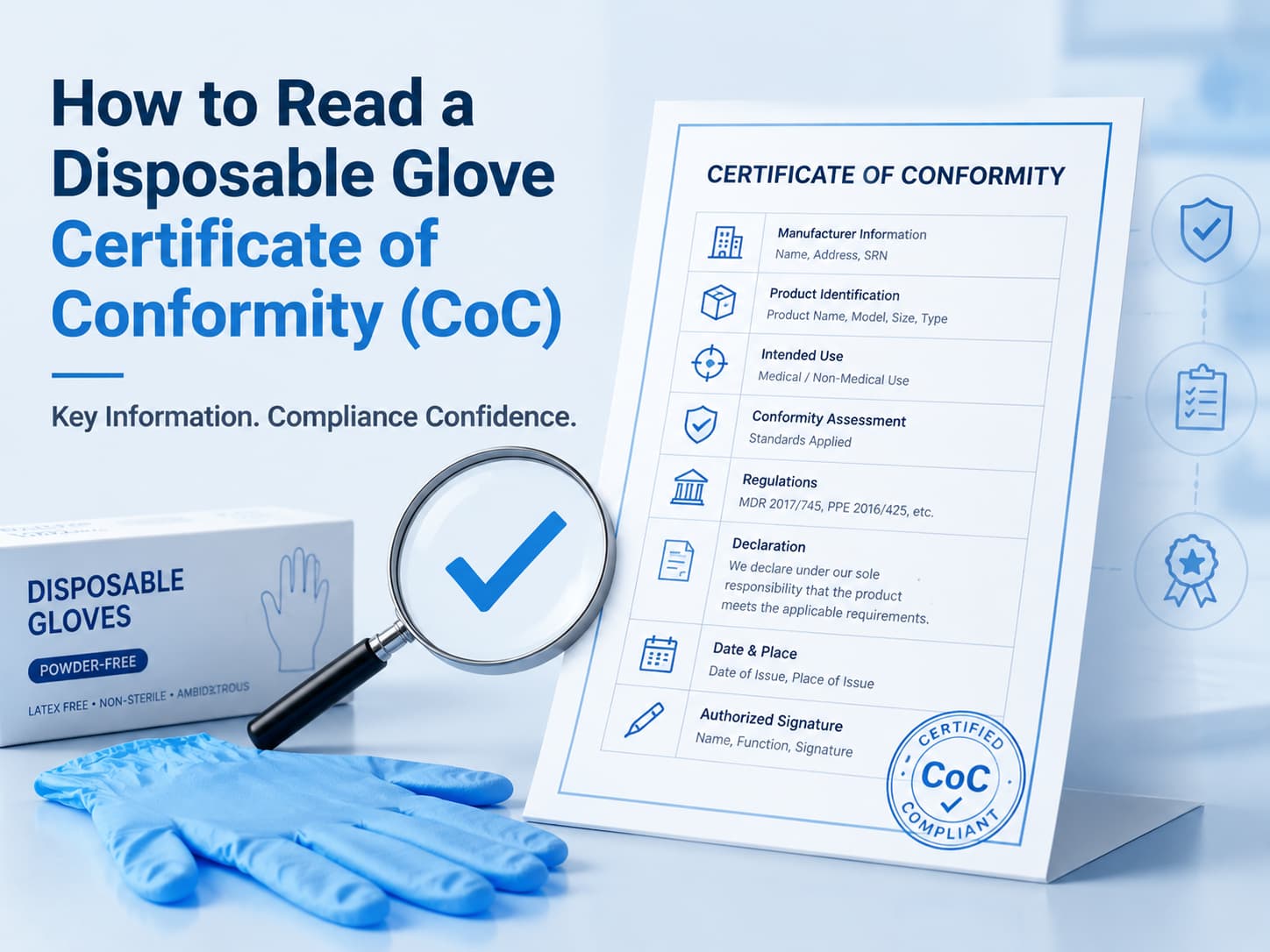
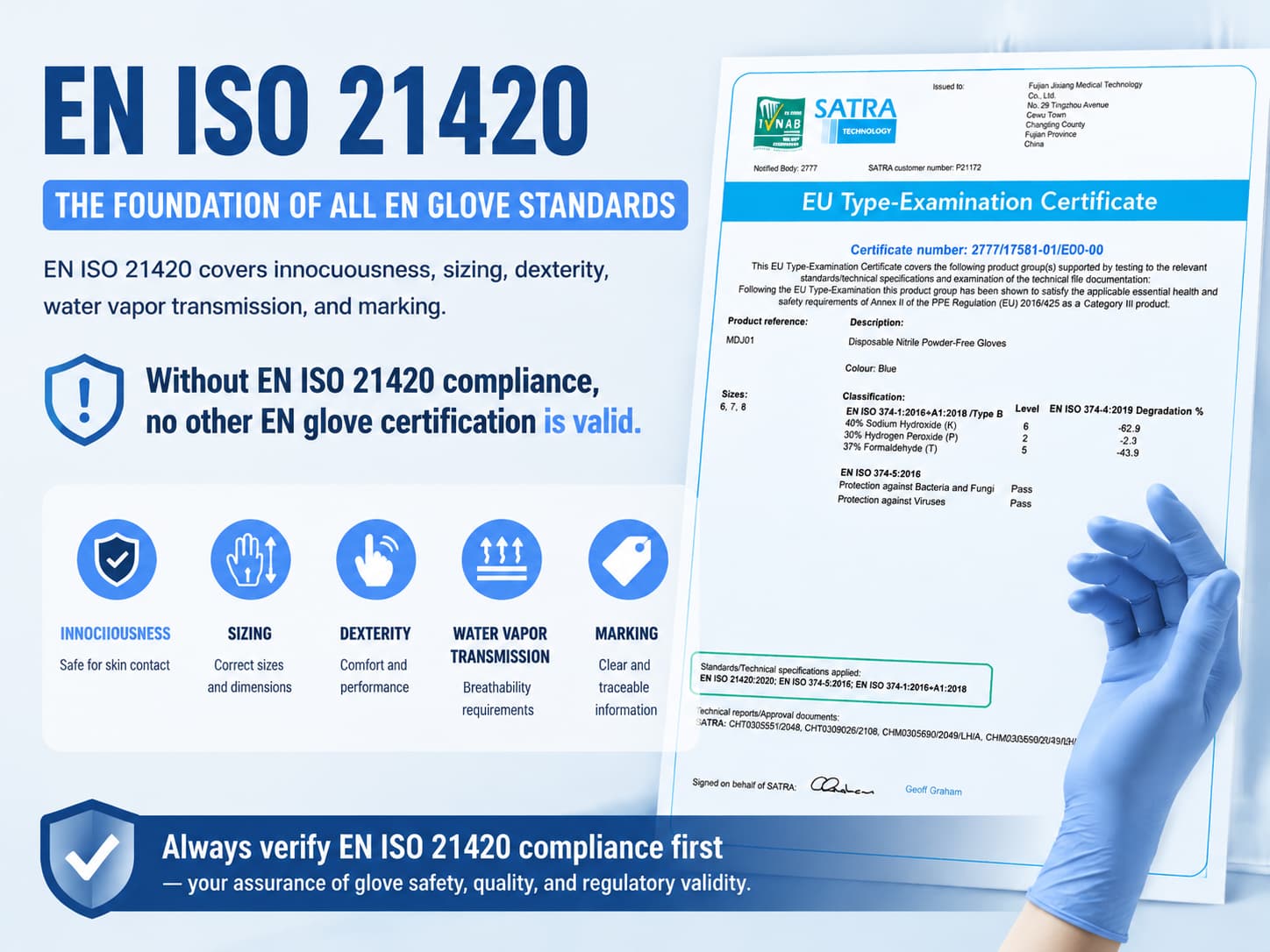
    If you are importing disposable gloves — whether nitrile, PVC, or latex — the certification landscape can feel like an alphabet soup: CE, MDR, FDA, 510(k), GSO, EN 455, EN 374. And the stakes are high. Importing non-compliant PPE can result in customs rejection, product recalls, regulatory fines, or serious reputational damage. This guide cuts through the complexity. We will explain each major certification, who requires it, what it actually verifies, and how to confirm your supplier genuinely holds it.   Part 1: CE Certification (European Union) What it means: CE marking indicates that a product meets EU health, safety, and environmental protection standards. For disposable gloves, CE is mandatory for both:     • Medical examination gloves (classified as Medical Devices under EU MDR 2017/745)     • Protective gloves (classified as Personal Protective Equipment under EU PPE Regulation 2016/425) Key standards for gloves:     • EN 455-1/2/3/4: For medical examination gloves — covers freedom from holes, physical properties, biological evaluation, and shelf life     • EN 374-1/2/3: For chemical and micro-organism protective gloves — penetration, permeation, and degradation resistance     • EN ISO 21420: General requirements for all protective gloves What to verify:     • Ask for the Declaration of Conformity (DoC) — this is a self-declaration signed by the manufacturer     • For medical gloves (EU MDR Class I): request the technical file reference     • For Class IIa medical devices: a Notified Body (NB) must be involved — check the NB number on the CE certificate     • Verify the CE certificate has not expired Red flag: A supplier who cannot provide a valid DoC with their NB number for medical-grade gloves is not truly CE compliant.   Part 2: FDA Compliance (United States) What it means: In the US, disposable medical gloves are regulated by the FDA as Class II medical devices. To legally import and sell medical examination gloves in the US, you need:     • 510(k) clearance (substantial equivalence to a predicate device), OR     • FDA establishment registration and product listing Key regulation: 21 CFR Part 880.6250 (medical examination gloves) and 21 CFR Part 880.6260 (patient examination gloves) For industrial/food-contact nitrile gloves: FDA 21 CFR 177.2600 governs rubber articles intended for repeated use in food contact applications. What to verify:     • Ask for the 510(k) clearance number (format: K######)     • Verify the number on the FDA's 510(k) database at www.accessdata.fda.gov     • For food-contact gloves, ask for the food contact compliance letter Note: As of 2026, most Chinese glove manufacturers do NOT hold 510(k) clearance. If you are selling to the US market, your importing entity will typically need to hold the FDA registration.   Part 3: GSO Certification (Gulf Cooperation Council) What it means: The Gulf Standards Organization (GSO) sets harmonized standards for the six GCC member states: Saudi Arabia, UAE, Qatar, Kuwait, Bahrain, and Oman. For disposable gloves, the relevant standard is:     • GSO EN 455: Aligns with the European EN 455 standard for medical examination gloves     • GSO 1651: Covers general-use protective gloves in the Gulf region Importation requirements vary by country: Country Import Requirement Saudi Arabia (SASO) Product Registration Certificate (PRC) required via SABER system UAE (ESMA) Product Registration via Emirates Conformity Assessment Scheme (ECAS) Qatar (QS) QSTP or customs clearance with conformity certificate Kuwait, Bahrain, Oman Generally accept GSO-aligned CE documentation with Arabic labeling     How Jixiang Supports Your Certification Journey At Jixiang, we understand that certifications are not just paper — they are your license to sell. Here is what we provide to all clients:     • CE Declaration of Conformity — current, signed, and with full EN 455 and EN 374 test reports attached     • EN 455 Test Reports — from accredited third-party labs (SGS, Intertek, or equivalent)     • GSO-Aligned Documentation — test reports and factory audit summaries suitable for GCC product registration     • FDA Food Contact Letter — for food-grade nitrile gloves under 21 CFR 177.2600     • Certificate of Origin — issued by Xiamen Chamber of Commerce     • OEM Certification Support — for private label clients, we assist with documentation preparation for your brand's CE or GSO registration   The 5-Step Certification Verification Checklist Before signing any glove supply contract, verify:     ☐ 1. Ask for the certificate — not just a statement that the product is certified     ☐ 2. Check the certificate covers the exact product (glove type, size range, reference number)     ☐ 3. Verify validity dates — certificates typically need annual renewal for medical gloves     ☐ 4. Cross-check the issuing body — CE certificates should reference an EU-recognised Notified Body     ☐ 5. Request a product sample with the batch number — QC test reports should be traceable to the batch   Final Thought Certification is not a burden — it is a competitive advantage. When you can hand your customer a file of valid CE, GSO, and food contact certificates, you close deals faster and at better prices than competitors who cannot. At Jixiang, our compliance documents are always ready. Contact us at www.jxgloves.com to request a complete certification dossier for any of our products. About Fujian Jixiang E-commerce Co., Ltd. With over 20 years of experience, we specialize in manufacturing high-quality disposable gloves. Why Choose Us? ·        ✅ Factory-direct pricing ·        ✅ ISO/CE/FDA certified products ·        ✅ OEM/ODM customization ·        ✅ Global shipping to 50+ countries       Contact Us: info@jxgloves.com  
  • OEM & ODM Disposable Gloves: Build Your Private Label Brand with a Trusted China Manufacturer
    OEM & ODM Disposable Gloves: Build Your Private Label Brand with a Trusted China Manufacturer
    Apr 27, 2026
      Building your own private label disposable gloves brand has never been more accessible — or more strategically valuable. Whether you are a distributor, a regional wholesaler, a healthcare operator, or an emerging PPE brand, white-label gloves allow you to differentiate from the commodity crowd, build customer loyalty, and capture higher margins. At Jixiang (jxgloves.com), we have been supporting OEM and ODM clients across the Middle East, Southeast Asia, and Europe for over eight years. In this guide, we will walk you through exactly how private labeling works, what choices you have, and how to get started.   OEM vs. ODM — What Is the Difference? These terms are often used interchangeably, but they represent distinct service levels: OEM (Original Equipment Manufacturer): You provide the specifications — product formula, glove thickness, color, packaging design, and branding. Jixiang manufactures to your exact requirements and ships under your brand. ODM (Original Design Manufacturer): You leverage our existing product designs and formulations. We customize elements such as logo, label language, box artwork, and carton markings. This is a faster, lower-investment route to private label. Most of our first-time private label clients start with ODM and graduate to full OEM as their brand scales.   What Can Be Customized? Customization Element OEM ODM Product formula / compound Full custom Use existing formula Glove color Any color Select from standard range Thickness & AQL spec Fully defined by client Standard options available Brand name & logo on box Yes Yes Label language Yes (any language) Yes (any language) Box count & inner pack Custom Custom Carton markings / shipper Custom Custom Certification (CE, GSO, etc.) Client applies or Jixiang assists Jixiang certificates available   Minimum Order Quantity (MOQ) and Lead Times One of the most common questions from new clients is: How much do I need to order?     • ODM private label: 1 x 20ft FCL (full container load) — approximately 1,000–1,200 cartons depending on product     • OEM custom formula: Typically 2–3 x FCL for initial production run (to support tooling and QC sampling)     • Lead time: 30–45 days from artwork approval and deposit receipt We also support LCL (less than container load) orders for sample orders and initial market testing.   Certification and Compliance for Private Label This is where many first-time private label buyers get caught out. When your brand name is on the box, the compliance responsibility sits with your entity — not the manufacturer. Here is what you need to know:     • EU/UK Market: CE marking under EU MDR (Regulation 2017/745) requires your entity to be the legal manufacturer or authorized representative. We can assist with technical documentation and connect you with EU notified bodies.     • Gulf/Middle East: GSO certification is applied per product and brand. Jixiang can supply the test reports and factory audit documentation required for GSO application.     • Southeast Asia: Requirements vary by country. We regularly support clients with documentation for SIRIM (Malaysia), SNI (Indonesia), and BPOM (Indonesia).     • FDA Registration (if exporting to US): Requires your facility to be registered as a medical device establishment. We can advise, but this is your entity's responsibility. Pro tip: Start with markets where your existing entity can hold the compliance documentation. Build a track record, then expand.   The Jixiang Private Label Process — Step by Step Step Action Timeline 1 Initial inquiry — share your target market, product specs, brand concept Day 1 2 Sample review — we send standard samples for your evaluation Day 3–7 3 Artwork & label design — share your logo and packaging requirements Day 7–14 4 Proofing & approval — we produce a print proof for your sign-off Day 14–21 5 Production — mass production begins after deposit and proof approval Day 21–45 6 QC inspection — AQL 1.5 inspection before loading Day 43–45 7 Shipment & documentation — full export docs prepared by Jixiang team Day 45–50   Why Private Label Gloves Make Business Sense in 2026 With global PPE demand growing and commodity competition intensifying, private labeling gives you:     • Price control — you set the retail/distribution price, not the commodity market     • Brand equity — customers recognize your brand, not the factory behind it     • Customer retention — buyers who reorder your brand are stickier than spot market buyers     • Differentiation — stand out in tenders, hospital supply chains, and distributor networks The 2026 market shift — with US tariff pressure redirecting supply — means that Chinese factories like Jixiang have more capacity and more flexibility to take on new private label partners. This is the right time to act.   Ready to Build Your Brand? Contact Jixiang today for a private label consultation. We will assess your target market, recommend the right product specifications, and provide a detailed quotation within 48 hours. Visit  www.jxgloves.com  or reach out directly. We're ready when you are. About Fujian Jixiang E-commerce Co., Ltd. With over 20 years of experience, we specialize in manufacturing high-quality disposable gloves. Why Choose Us? ·        ✅ Factory-direct pricing ·        ✅ ISO/CE/FDA certified products ·        ✅ OEM/ODM customization ·        ✅ Global shipping to 50+ countries     Contact Us: info@jxgloves.com    
  • How to Choose the Right Glove Thickness for Your Industry
    How to Choose the Right Glove Thickness for Your Industry
    Apr 23, 2026
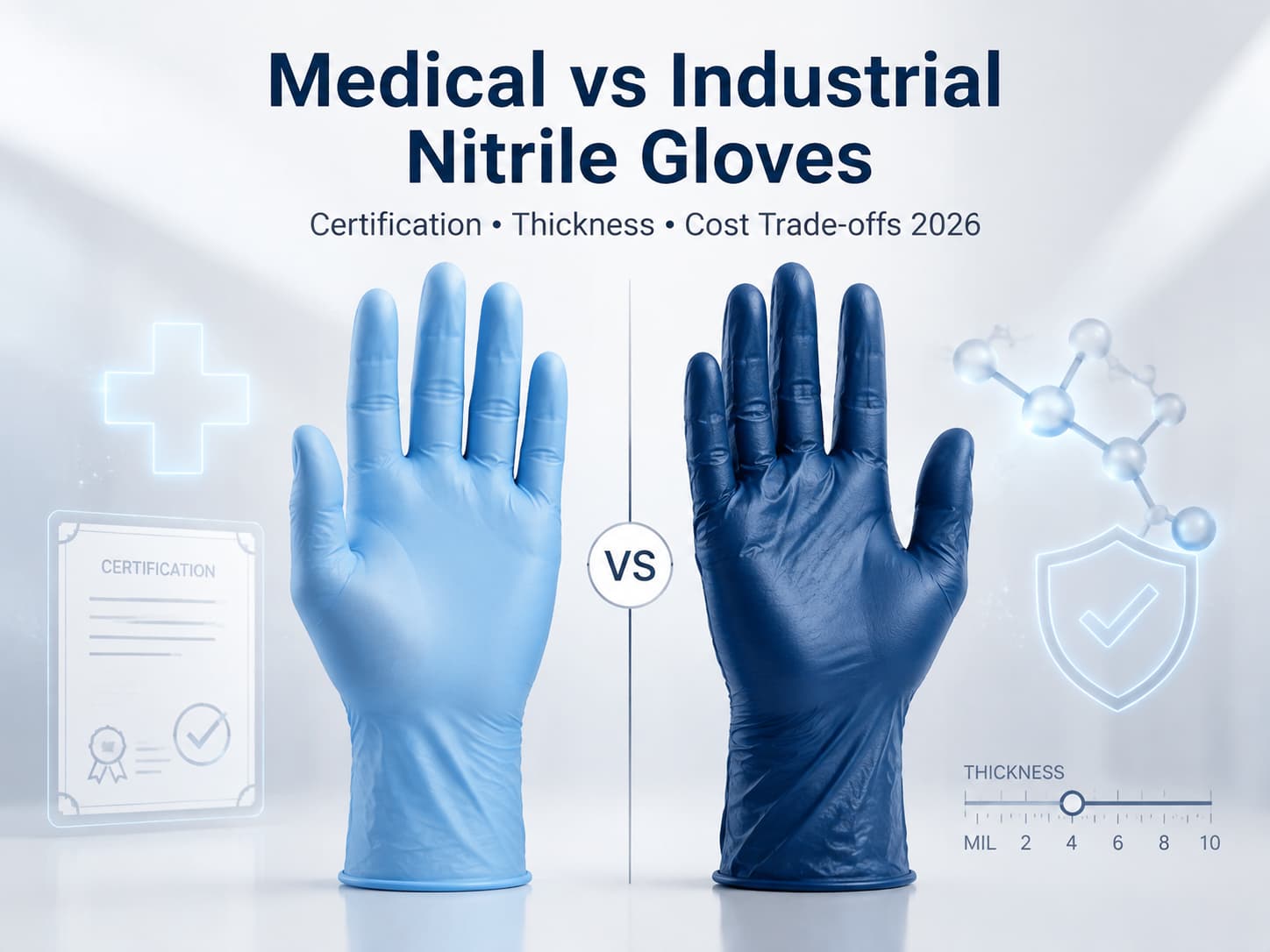
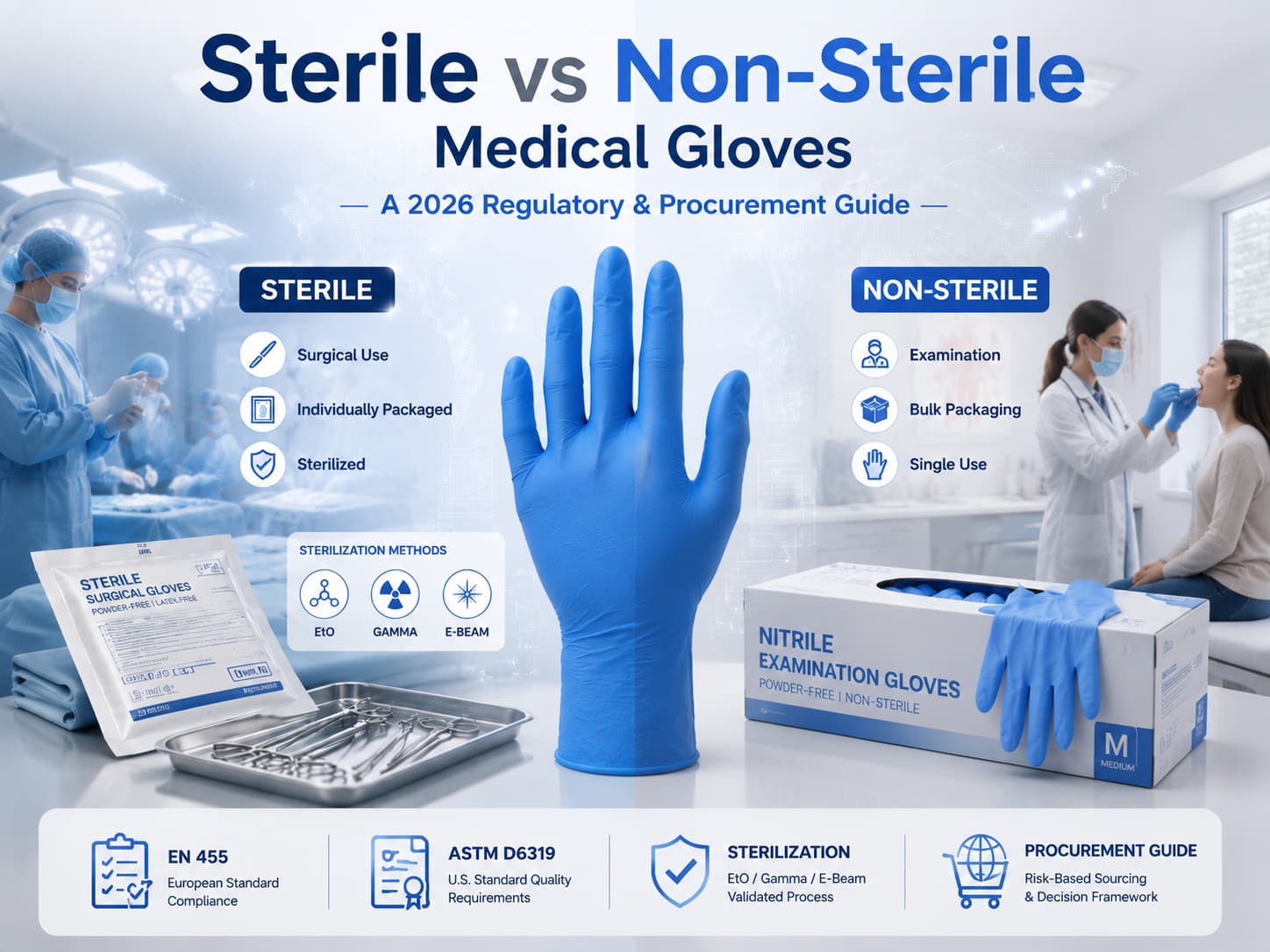
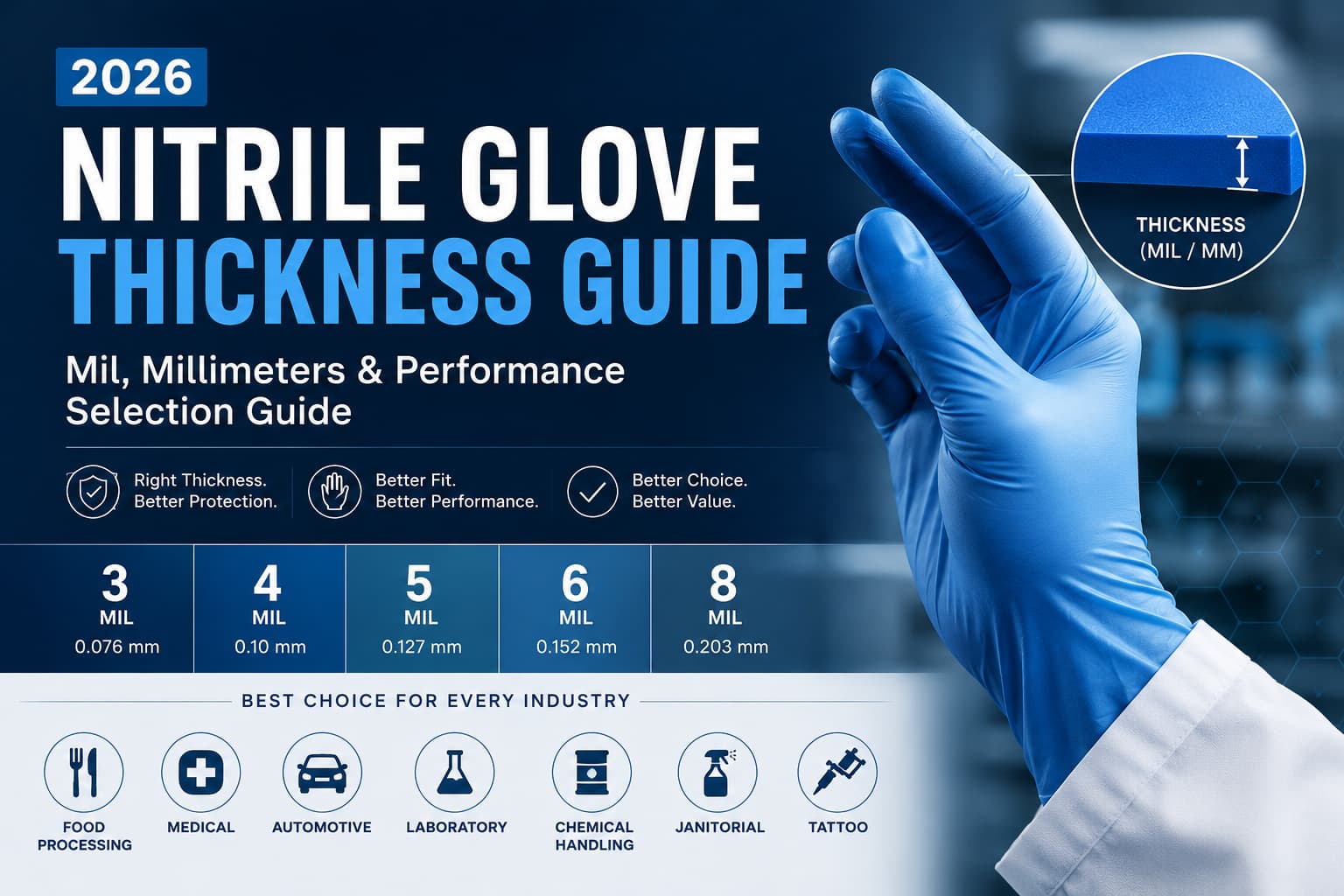
    "Mil" is a word that appears on every glove specification sheet, yet it's one of the most misunderstood terms in PPE procurement. Get the thickness wrong and you're either paying too much for over-spec'd gloves or exposing workers to risk with under-spec'd ones. This guide helps you get it right the first time. 1. What Is "Mil" and Why Does It Matter? One mil equals one-thousandth of an inch (0.0254 mm). For disposable gloves, thickness is typically measured at the palm, finger, and cuff areas. The most important measurement is the fingertip thickness, as this is where gloves experience the highest stress. Common nitrile glove thickness ranges: Thickness Category Typical Weight Common Description 2.5–3 mil Ultra-light / Economy 2.5–3.5 g/pcs Thin, food service, high-touch tasks 3.5–4 mil Standard / Medical 4–5 g/pcs Exam grade, general purpose 4.5–5 mil Medium / Industrial 5–6 g/pcs Enhanced durability, light chemical 6–7 mil Heavy Duty 7–9 g/pcs Industrial use, moderate chemical 8+ mil Extra Heavy 10+ g/pcs Extended chemical exposure, manufacturing   2. Industry-by-Industry Thickness Guide Healthcare & Medical Examination Recommended thickness: 3–4 mil (powder-free, medical-grade) In medical examination settings, dexterity and tactile sensitivity are the primary requirements. A 3–4 mil glove provides adequate barrier protection for standard examination procedures while maintaining the fingertip sensitivity that clinicians rely on. Gloves must conform to EN 455 (Europe) or ASTM D6319 (Americas) standards. Key spec: AQL 1.5 (acceptable quality level), confirming that no more than 1.5% of gloves in a batch have detectable defects. Food Processing & Catering Recommended thickness: 3–4 mil (food-safe, powder-free) Food industry buyers often underestimate the importance of color coding. Regulatory bodies in the EU and GCC require food handlers to use detectable gloves — typically blue — so that any glove fragment can be visually identified in food products. A 3.5–4 mil nitrile glove balances cost, dexterity, and compliance for high-volume food environments. Key spec: EC Regulation 1935/2004 (Europe) or FDA 21 CFR 170–180 (Americas) food contact compliance. Industrial & Manufacturing Recommended thickness: 5–7 mil Workers in automotive, electronics, and general manufacturing facilities need gloves that resist abrasion, tears, and light chemical exposure — while still allowing enough dexterity to handle parts and tools. A 5–6 mil nitrile glove is the sweet spot for most light-to-medium industrial applications. For heavier applications such as metal stamping, maintenance, or working with solvents, step up to 7–8 mil. Petrochemical & Chemical Processing Recommended thickness: 6–8 mil (or purpose-specific chemical gloves) This is where thickness alone is not enough — chemical permeation data is critical. Always request EN 374-3 (Europe) or ASTM F739 permeation test data for the specific chemicals in your environment. A 6 mil nitrile glove provides good resistance to common petroleum products, oils, and mild solvents, but thick does not always mean better against aggressive chemicals. Dental & Surgical Recommended thickness: 2.5–3 mil (surgical: sterile, surgical-grade only) Dental and surgical procedures require maximum tactile sensitivity. Surgical gloves are manufactured and tested to tighter tolerances than exam gloves (EN 455-2/-3 for sterile surgical use). Never substitute standard exam gloves for surgical procedures. Automotive & Maintenance Recommended thickness: 7–8 mil (black nitrile preferred) Black nitrile gloves in 7–8 mil are the standard for automotive workshops and maintenance environments. The dark color helps hide grease and oils (reducing the urge to remove gloves during tasks), and the heavier gauge provides better puncture resistance against sharp metal components. 3. Thickness vs. Touch Sensitivity Trade-Off A common question from buyers: "If thicker means better protection, why not always buy the heaviest glove?" The answer is ergonomics. Thicker gloves increase hand fatigue over time, reduce tactile sensitivity, and can lead workers to remove gloves during tasks — which defeats the purpose of PPE. In clinical or food environments where workers change gloves dozens of times per day, a lighter-weight glove that workers will actually keep on is safer than a heavy one they'll remove. The right specification balances protection level with user compliance. 4. Questions to Ask Your Supplier Before placing any glove order, ask your supplier for: ① Thickness test report (EN 455-1 or ASTM D3578) — measured at palm, finger, and cuff ② AQL certification (1.5 for medical, 2.5–4 for industrial) ③ Chemical permeation data (if applicable, EN 374-3 or ASTM F739) ④ Physical property testing: tensile strength, elongation at break ⑤ Weight per pair (a useful cross-check for consistent quality across batches) Conclusion Choosing the right glove thickness is about matching protection to task, not defaulting to the thickest (most expensive) option. For most medical and food applications, 3.5–4 mil delivers the optimal balance. For industrial use, 5–6 mil is the sweet spot. When in doubt, request samples in 2–3 thickness variants and test them in your actual work environment. Jixiang (LYEEANG brand) manufactures nitrile gloves from 2.5 mil to 8 mil. Contact us at www.jxgloves.com to request thickness-specific samples with full test documentation.   [Request a Factory Audit Report] About Fujian Jixiang E-commerce Co., Ltd. With over 20 years of experience, we specialize in manufacturing high-quality disposable gloves. Why Choose Us? ·        ✅ Factory-direct pricing ·        ✅ ISO/CE/FDA certified products ·        ✅ OEM/ODM customization ·        ✅ Global shipping to 50+ countries   Contact Us: info@jxgloves.com  
  • Nitrile vs PVC vs Latex Gloves: The 2026 Buyer's Decision Guide
    Nitrile vs PVC vs Latex Gloves: The 2026 Buyer's Decision Guide
    Apr 21, 2026
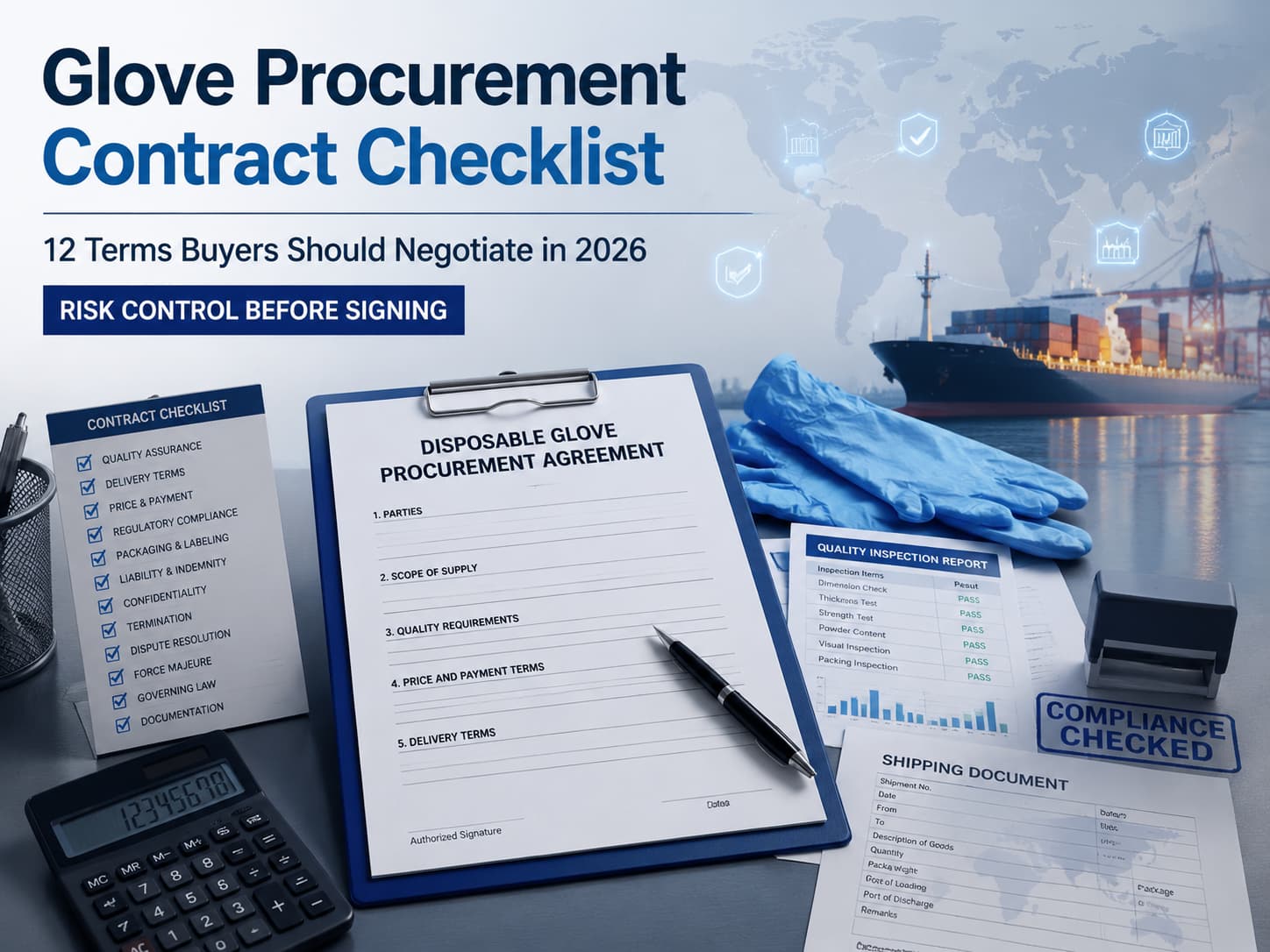
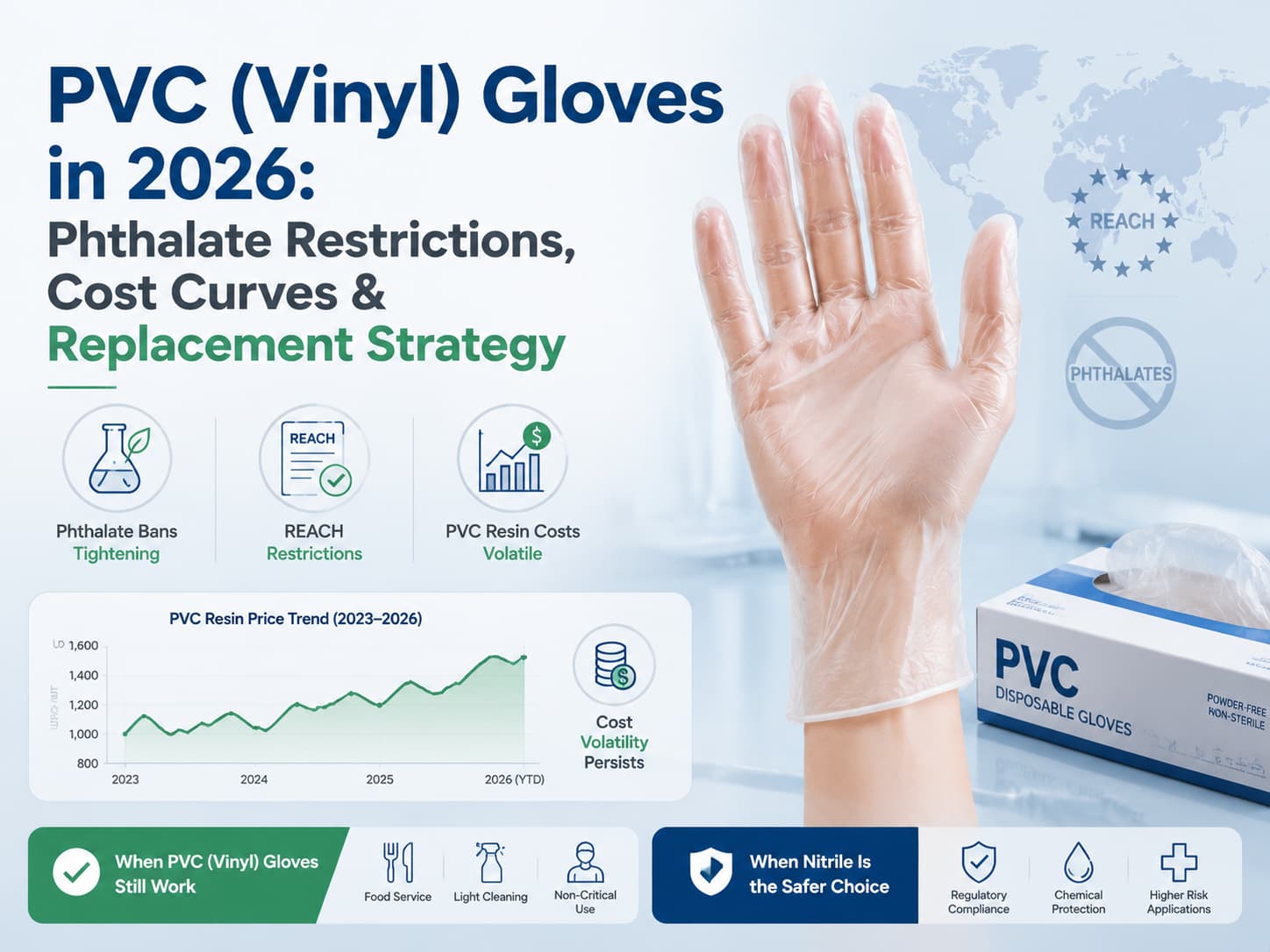
      Choosing the right disposable glove is not just a procurement decision — it's a safety, compliance, and cost-efficiency decision. With global supply chains stabilizing and demand across healthcare, food processing, and industrial sectors surging in 2026, buyers from the Middle East, Southeast Asia, and Europe are revisiting their glove specifications. This guide cuts through the confusion. 1. Material Overview at a Glance Feature Nitrile PVC (Vinyl) Latex (Natural Rubber) Raw Material Synthetic rubber (acrylonitrile-butadiene) Polyvinyl chloride (PVC) Natural rubber latex Elasticity ★★★★★ Excellent ★★★ Moderate ★★★★★ Excellent Chemical Resistance ★★★★★ High ★★★ Low-Moderate ★★★ Moderate Allergen Risk None None (plasticizer note) Latex protein allergy risk Puncture Resistance ★★★★ High ★★ Low ★★★ Moderate Comfort / Fit ★★★★★ Form-fitting ★★ Loose ★★★★★ Snug Cost (per 100 pcs) USD 3.5–6 USD 2–3.5 USD 2.5–4 Best Use Medical, lab, chemical handling Food service, light assembly Dental, surgery, precision tasks   2. Nitrile Gloves — The Professional's Choice Nitrile gloves have become the dominant choice globally, accounting for over 65% of the world's disposable glove consumption in 2025 (Mordor Intelligence). Here's why: Allergy-free formulation: Unlike latex, nitrile contains no natural rubber proteins, making it safe for users and end-consumers with latex sensitivities — a critical requirement in EU healthcare procurement. Superior chemical and puncture resistance: Nitrile withstands exposure to oils, fuels, and a wide range of chemicals. For industrial buyers in the GCC region — especially in petrochemical, automotive, and food manufacturing — this is non-negotiable. Regulatory compliance: Our nitrile gloves carry CE (EU MDR) certification under EN 455 (medical) and EN 374 (chemical protection), and comply with GSO standards for the Gulf Cooperation Council region. Available in multiple thicknesses (3 mil to 8 mil) and colors (blue, black, purple), nitrile gloves are versatile enough to serve as standard PPE across healthcare, food service, and light industrial applications. 3. PVC Gloves — The Economy Workhorse PVC (vinyl) gloves are the go-to for buyers who need high-volume, low-cost protection for non-hazardous tasks. Their looser fit and lower elasticity mean they are not ideal for precise work, but in settings like food preparation, hotel housekeeping, or retail checkout — where gloves are changed frequently — PVC delivers exceptional cost-per-use value. Key considerations for your market: • Middle East food service sector: PVC gloves dominate hotel and restaurant kitchens due to low cost and high turnover rate. • Regulatory note: Some EU markets are tightening regulations on DEHP plasticizers in PVC gloves. Buyers sourcing for European distribution should request REACH compliance documentation from suppliers. Jixiang's PVC gloves are manufactured DEHP-free, with REACH compliance documentation available upon request. 4. Latex Gloves — High Performance, Specific Use Cases Natural rubber latex gloves remain the preferred choice for surgical and dental applications where tactile sensitivity and dexterity are paramount. However, latex allergy affects approximately 1–6% of the general population and up to 17% of healthcare workers (WHO data), which has driven many hospitals — particularly in Europe — to shift toward nitrile as the standard. Where latex still makes sense: • Surgical and dental procedures requiring maximum tactile feedback • Cost-sensitive markets where natural rubber is locally sourced (e.g., Southeast Asia) • Buyers who have confirmed allergen-safe supply chains and end-user screening protocols Important: If you are sourcing latex gloves for the EU or GCC healthcare markets, ensure EN 455 certification and AQL 1.5 testing documentation are provided. 5. Which Glove Is Right for Your Business? Your Sector Recommended Type Key Spec to Request Healthcare / Hospital Nitrile (medical grade) EN 455, CE, AQL 1.5, powder-free Food Processing / Catering Nitrile or PVC FDA/EC 1935:2004 food contact compliance Industrial / Petrochemical Nitrile (heavy duty 6–8 mil) EN 374, chemical permeation data Dental / Surgery Latex or Nitrile (surgical grade) EN 455-3, sterile option available Retail / Housekeeping PVC (economy) EN 420, REACH compliance Laboratory / Pharma Nitrile (low-protein) ISO 11193, low extractables   6. Sourcing Tips for 2026 1. Lock in pricing now: Nitrile raw material (NBR) prices have stabilized after post-pandemic volatility. Q2–Q3 2026 is an excellent window to negotiate 6–12 month supply agreements. 2. Request sample packs: Always test gloves in your specific work environment before placing bulk orders. Request 2–3 mil and 4–6 mil variants for comparison. 3. Verify certifications independently: A reputable supplier will provide original CE certificates with notified body numbers. Cross-check certificate validity at the issuing body's database. 4. Ask about MOQ flexibility: For new market entry or product transitions, look for suppliers offering 1–5 carton trial orders without compromising on certification standards. Jixiang (LYEEANG brand) offers flexible trial orders starting from 1 carton, with full CE, EN 374, and GSO documentation included. Conclusion The right glove depends on your industry, regulatory environment, and budget. Nitrile leads on performance and compliance; PVC wins on cost for light-duty use; latex remains irreplaceable for certain surgical applications. The key is matching the specification to the application — and choosing a supplier who can grow with your volume requirements. Ready to compare samples? Contact Jixiang today at www.jxgloves.com to request your free sample pack.     [Request a Factory Audit Report] About Fujian Jixiang E-commerce Co., Ltd. With over 20 years of experience, we specialize in manufacturing high-quality disposable gloves. Why Choose Us? ·        ✅ Factory-direct pricing ·        ✅ ISO/CE/FDA certified products ·        ✅ OEM/ODM customization ·        ✅ Global shipping to 50+ countries Contact Us: info@jxgloves.com  
  • Food-Grade Nitrile Gloves in 2026: What Every Food Industry Buyer Needs to Know About Compliance, Safety & Sourcing
    Food-Grade Nitrile Gloves in 2026: What Every Food Industry Buyer Needs to Know About Compliance, Safety & Sourcing
    Apr 16, 2026
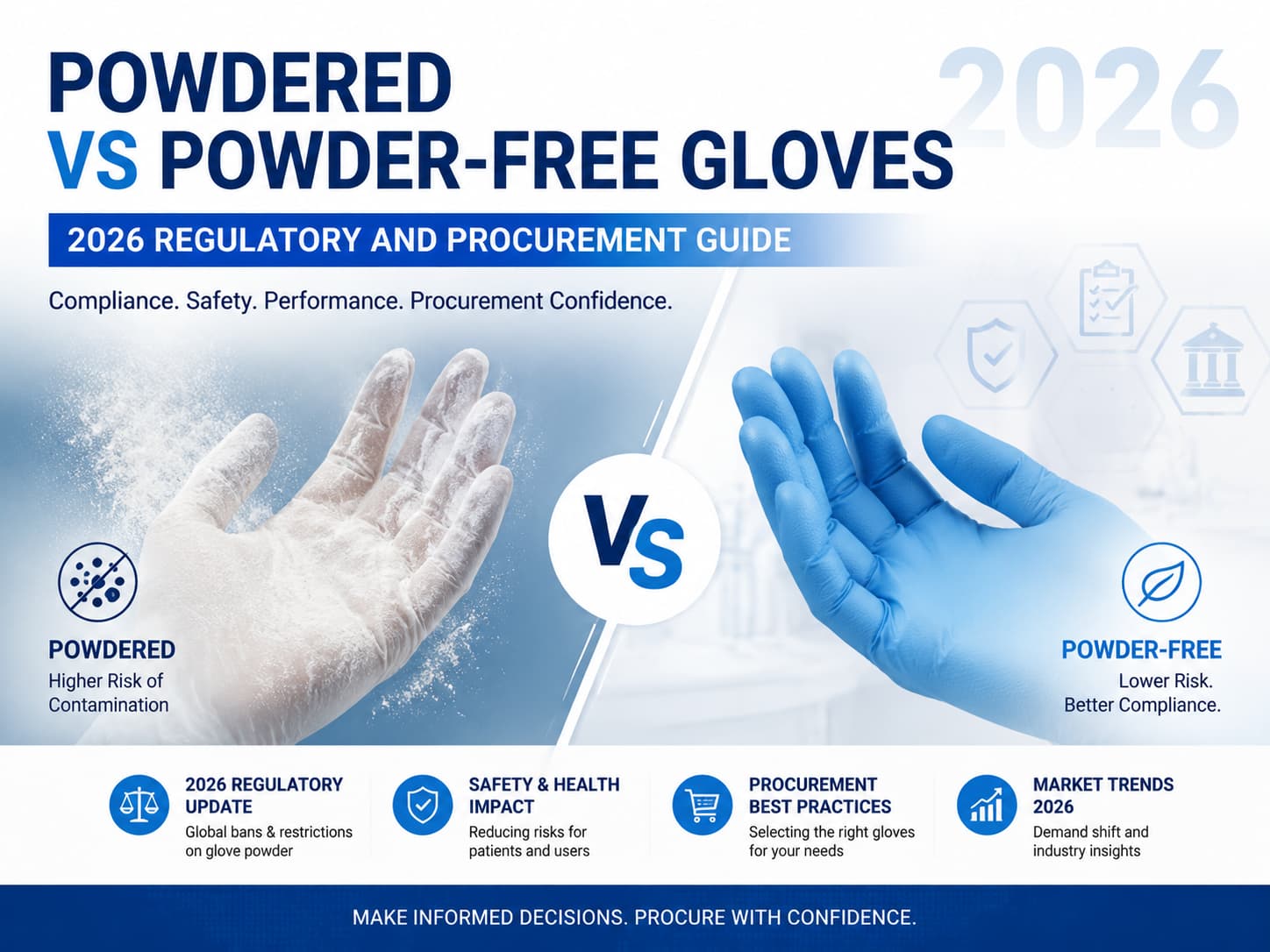
      Are your nitrile gloves truly food-safe? From FDA 21 CFR to EU Regulation 10/2011 and HACCP requirements — here's Jixiang's complete compliance guide for food industry buyers.   In the food processing, catering, and retail sectors, "disposable gloves" is not a generic commodity — it's a safety-critical product with strict compliance requirements that vary significantly by region. If you're purchasing gloves for food industry use in Europe, the Middle East, or Southeast Asia, this guide is for you. At Jixiang, we supply food-grade nitrile gloves to distributors and food industry operators across three continents. Here's everything you need to know before placing your next order.   What Makes a Nitrile Glove "Food-Grade"? Not all nitrile gloves are created equal. A standard nitrile glove designed for medical examination may not be approved for direct food contact. True food-grade classification requires: 1. Low Migration of Chemical Components Food-grade gloves must pass migration testing — ensuring that no harmful chemicals leach from the glove into food products. In the EU, this is governed by Regulation (EC) No. 1935/2004 (materials in contact with food) and EU Regulation 10/2011 (plastics). 2. No Powdering or Problematic Additives All Jixiang food-grade nitrile gloves are 100% powder-free. Powdered gloves present a contamination risk and are banned in many food production environments. Accelerator-free variants are also available for environments with latex allergy concerns. 3. Color-Coded for HACCP Compliance Many food safety management systems (HACCP, BRC, IFS) require color-coded gloves to prevent cross-contamination between allergen zones. Jixiang offers:     • Blue — most common for general food handling; visually detectable if torn     • White — widely used in bakery, dairy, and beverage sectors     • Black — premium catering and butchery applications 4. Regional Certifications Region Standard Required European Union EN 374, EU Regulation 1935/2004, LFGB (Germany) Middle East / Gulf GSO 1651, Halal certification (sector-specific) Southeast Asia SIRIM (Malaysia), SNI (Indonesia), TCPS (Thailand) Global Baseline FDA 21 CFR 177.2600 (food contact)     Temperature & Application Considerations One misconception among buyers is that "food-grade" means suitable for all food applications. There are important nuances:     • Cold chain handling (meat, seafood): Use 5mil+ thickness for durability; extended grip texture preferred     • Hot food handling (bakery, kitchen prep): Nitrile tolerates short-term heat up to 100°C but is NOT suitable for oven use     • Chemical/cleaning environments (food factories): Heavy-duty 8mil nitrile provides better chemical resistance against cleaning agents We always recommend sharing your specific application with our technical team so we can match the right specification.   2026 Market Outlook: Why Food-Grade Demand is Surging Regulatory tightening across the globe is driving demand:     • EU: Updated food safety enforcement in 2025-2026 has increased inspection frequency for food operators, driving demand for certified PPE     • Middle East: Saudi Arabia's Vision 2030 agri-food sector expansion is creating large-scale demand for compliant food-handling PPE     • Southeast Asia: Growth of food export industries (Vietnam, Indonesia, Thailand) is pulling demand for certified export-grade food contact gloves   Why Source Food-Grade Gloves from Jixiang? Certifications on file — We maintain up-to-date EU, FDA, and regional certification documentation, ready to share with your procurement team upon request. Consistent quality — Our production follows ISO 22000-aligned QC protocols. Every batch is tested for AQL 1.5 (critical defects) before shipment. Flexible sizing & packaging — Available in XS–XL, with custom box counts (50pcs/100pcs/200pcs) and OEM private label options. Fast documentation support — CE declaration of conformity, food contact certificates, country-of-origin certificates, and packing lists — all prepared by our dedicated export team.   Checklist: Before You Order Food-Grade Gloves     ☐ Have you confirmed which certifications your local authority requires?     ☐ Is the application direct food contact or indirect (e.g., cleaning equipment)?     ☐ What thickness (mil) does your operation require?     ☐ Do you require color-coding per your HACCP plan?     ☐ Is allergen declaration (latex-free, accelerator-free) needed? Send us your checklist — or just describe your operation — and we'll send you the right recommendation within 24 hours.   [Request a Factory Audit Report] About Fujian Jixiang E-commerce Co., Ltd. With over 20 years of experience, we specialize in manufacturing high-quality disposable gloves. Why Choose Us? ·        ✅ Factory-direct pricing ·        ✅ ISO/CE/FDA certified products ·        ✅ OEM/ODM customization ·        ✅ Global shipping to 50+ countries Contact Us: info@jxgloves.com      
  • Why Smart Buyers Are Turning to China's Nitrile Glove Suppliers Amid 2026 Tariff Turbulence — A Guide for Middle East & European Importers
    Why Smart Buyers Are Turning to China's Nitrile Glove Suppliers Amid 2026 Tariff Turbulence — A Guide for Middle East & European Importers
    Apr 13, 2026
    The global disposable gloves market is undergoing one of its most dramatic reshuffles in years. With the United States imposing 100% tariffs on medical-grade nitrile gloves from China as of January 2026, a significant volume of high-quality Chinese production is actively pivoting toward new markets — and Middle Eastern and European importers are positioned to benefit like never before. At Jixiang (jxgloves.com), we've been navigating global supply chains for over 30 years. This article breaks down what's happening in the market, what it means for buyers in your region, and why now is actually a strategic moment to lock in long-term supplier relationships.   What's Happening in 2026's Glove Market? The global nitrile gloves market is valued at approximately USD 26.61 billion in 2026 and is projected to reach USD 50+ billion by 2034 (Precedence Research). Demand is surging across medical, food processing, and industrial sectors — driven by stricter health regulations, post-pandemic awareness, and rapid urbanization in emerging economies. However, the US tariff shock has created a sharp redirection of supply:     • Chinese glove exports to the US have dropped significantly     • European demand has become the strongest growth driver for Chinese medical nitrile gloves     • Middle East disposable nitrile glove market is projected to grow from USD 1.2 billion (2024) to USD 2.5 billion by 2034 — a 7.8% CAGR (Emergen Research) For buyers in the Gulf, Southeast Asia, and Europe — this is a buyer's market.   Why Middle East & European Buyers Are Winning Right Now 1. Competitive Pricing — Freed from US Tariff Pressure Chinese manufacturers are no longer competing for US orders at compressed margins. Instead, they're offering more competitive pricing structures to strategic markets in the Middle East and Europe. Factories that previously prioritized US clients are now actively seeking long-term buyers in Dubai, Riyadh, Frankfurt, and Warsaw. 2. Quality That Meets Your Compliance Requirements Modern Chinese nitrile glove manufacturers — including Jixiang — hold CE certification (EU MDR), ISO 13485, EN 455, and EN 374 compliance. Our gloves meet the stringent requirements of European medical device regulations, making them fully distributeable across the EU and UK markets. For Middle Eastern markets, our products comply with Gulf Standard Organization (GSO) requirements and have been successfully distributed across UAE, Saudi Arabia, Qatar, and Oman. 3. Supply Chain Reliability: What Sets Jixiang Apart With 8+ years in the glove supply chain and operations based in Xiamen — one of China's premier export hubs — Jixiang offers:     • 30-day lead times for standard orders     • OEM/ODM capability for private label buyers     • Minimum order quantities from 1 container (FCL)     • Dedicated export documentation support for EU, Gulf, and ASEAN markets     • In-house quality control with AQL 1.5/2.5 inspection standards   The Products Your Clients Are Asking For In 2026, we're seeing consistent demand spikes in three categories: Product Key Market Why It's Growing Blue/Black Powder-Free Nitrile Gloves (3.5g–6g) Europe, Gulf Medical and industrial dual-use Food-Grade White Nitrile Gloves Southeast Asia, EU HACCP compliance, food safety regulations Heavy-Duty Industrial Nitrile (8mil+) Middle East, EU Oil & gas, construction sectors   A Note to Distributors and Wholesalers If you're a distributor in Dubai, Amsterdam, Jakarta, or Kuala Lumpur — now is the time to build your inventory position. Prices remain favorable while the US tariff rebalancing is still underway, and supply from tier-1 Chinese factories is readily available. We recommend locking in Q3–Q4 2026 contracts before seasonal demand peaks in the Gulf (pre-Hajj medical procurement) and European winter healthcare season.   [Request a Factory Audit Report] About Fujian Jixiang E-commerce Co., Ltd. With over 20 years of experience, we specialize in manufacturing high-quality disposable gloves. Why Choose Us? ✅ Factory-direct pricing ✅ ISO/CE/FDA certified products ✅ OEM/ODM customization ✅ Global shipping to 50+ countries Contact Us: info@jxgloves.com  
1 2 3 4
A total of4pages
Contact Us
Unit 1301-1, No. 3, Xixishan Wei Road, Software Park phase III, Torch High-tech Zone,Xiamen City, Fujian Province, China
+86-592-6511055
+86 -15750719843
Subscribe

Copyright 2026@ Fujian Jixiang E-commerce Co., Ltd All Rights Reserved. Sitemap | Blog | Xml | Privacy Policy Network Supported

leave a message

Leave A Message
If you are interested in our products and want to know more details,please leave a message here,we will reply you as soon as we can.
Submit

Home

Products

whatsApp

contact